Viewpoint: Vitalik's comments on MPC solution, which is better between MPC and SC?

Original author: Haotian (Twitter: @tmel0211), blockchain security practitioner
VitalikButerin's comment on MPC solutions and SC wallets has caused a stir in the encryption industry, sparking intense discussions about the advantages and disadvantages of MPC and SC at the industry level. The MPC team criticized VitalikButerin for being biased and hostile towards MPC technology, while the SC team was proud to have such a flag bearer as VitalikButerin. In my opinion, MPC and SC serve different customer groups and application scenarios, and their technologies and business logic are vastly different. There is no need to confuse and argue about them.
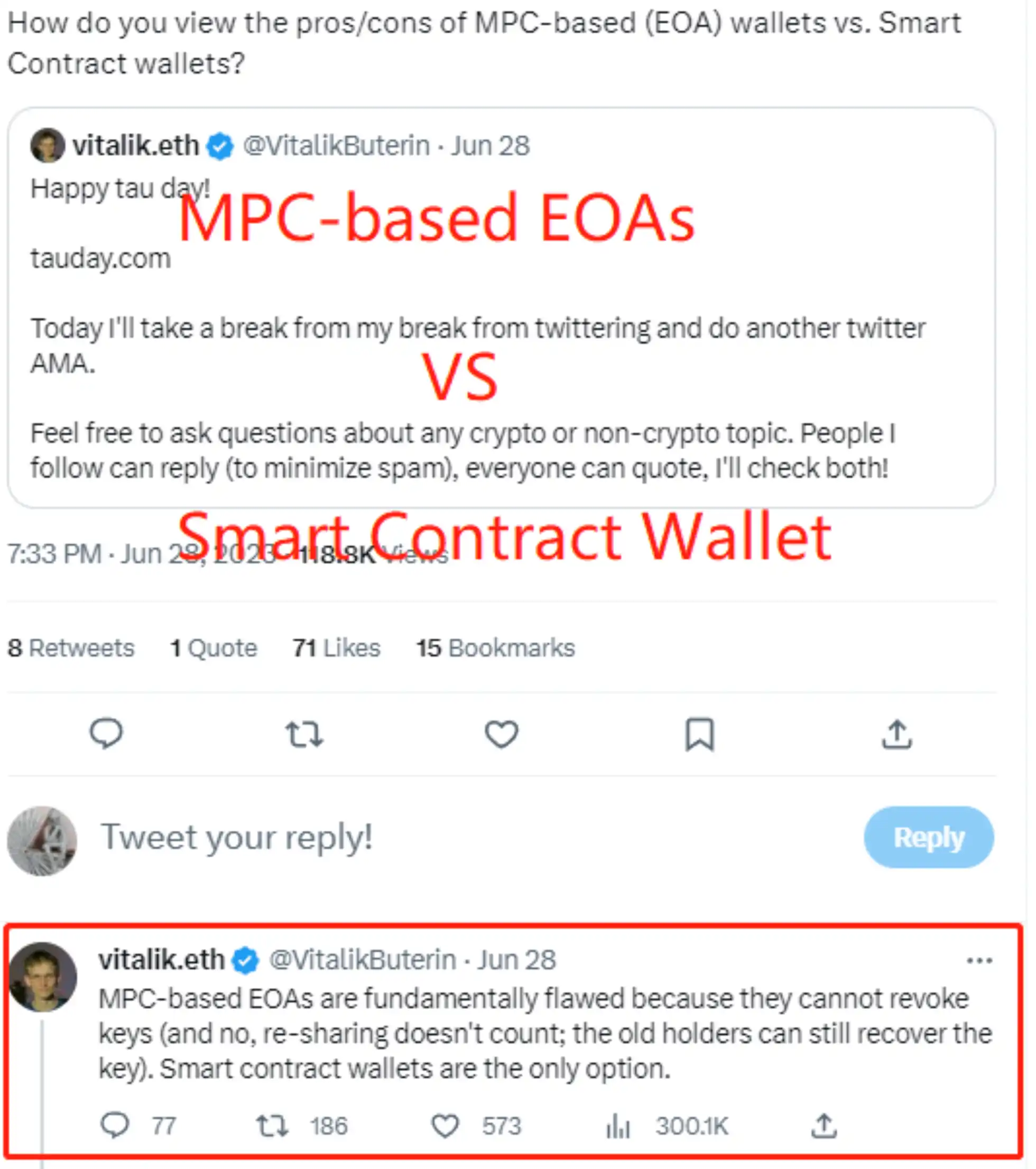
Do not explain the systematic differences between the two, only use V God's point of view as an example to glimpse the differences between the two:
First of all, V God said that the fundamental flaw of MPC EOA is that it cannot revoke private keys. The technical logic makes sense because the trusted encryption algorithm of MPC is similar to the sidechain system, and revoking private keys is a problem at the main chain EVM layer, which cannot be driven by the sidechain-level input to the main chain EVM-level output;
However, the criticism of the MPC technology flaw does not objectively discuss the business gain of MPC.
Let's first talk about the technical logic. The MPC Solution provides an EOA private key "algorithm encryption machine". A private key feed that meets the main chain rules is divided into several fragments and authorized to different parties for safekeeping through the encryption machine. The encryption machine manages the "private key" throughout its lifecycle. The parties cannot see the tangible private key. When a signature is required on the chain, the encryption machine gathers and reconstructs the fragments to perform the signature operation. Throughout the process, the "private key" is intangible.
However, "invisibility" only applies to parties. The seed that generates private key fragments in a trusted encryption machine is fixed, and the encryption algorithm is also constant. If the subsequent private key fragments are updated, the original private key feed will not change. Therefore, the original private key fragments can still be used to restore the private key for signature operations. If the feed and algorithm are forcibly changed, it is equivalent to changing the private key system, and it is meaningless to control the corresponding on-chain assets.
However, the SC wallet reshapes the EOA address into a smart contract. Under the logic of the smart contract, the private key can be used to implement subsequent update permission changes, set effective duration, and enable Social Recovery. Since the smart contract itself complies with the EVM execution specification, when the contract code changes, the corresponding private key manipulation logic is also updated. Revoking the key is of course not a problem, as it is an improvement in the same chain layer and there are no compatibility issues.
As a result, the execution of SC smart contracts on the chain is naturally limited by the performance of the same layer. For example, contract vulnerabilities can easily cause asset losses, and high gas consumption during contract execution can affect user experience, among other issues.
This means that some application scenarios with large user groups, high transaction frequency, decentralized private key management, and complex business processes, as well as institutional service providers pursuing ultimate security, are not very suitable for the SC solution.
Speaking of business logic, the essence of MPC Solution is to do off-chain amplification, specifically serving organizations with process-oriented needs for EOA management, such as asset management platforms, exchanges, and corporate groups;
These types of institutions have high data privacy requirements and there is a single point of failure issue in their internal control processes, which MPC fills the market demand for.
However, deploying MPC should reduce the probability of private key loss. Assuming that private key loss occurs, questioning its technical capabilities is illogical.
Compared to that, SC is essentially doing on-chain expansion, specifically serving users who have private key security anxiety and specialized custody needs such as social recovery, time-sharing refresh of private keys, etc., such as technical geeks, ordinary users with poor security awareness after mass adoption, etc. There is overlap with MPC's customer base, but the differences are significant and there is no need to confuse them. Obviously, V God's evaluation is based on technical logic, and business logic ultimately depends on market choice.
I believe that most of the friends who are discussing MPC and SC are excellent builders in various fields, and there is no need to confuse technical and business logic to engage in a battle.
Tribute: MPC Camp: @Safeheron, @OpenBlockWallet, @echooo_wallet, @okxweb3, @QredoNetwork, @coinbase.
SC Camp: @UniPassWallet, @argentHQ, @soulwallet_eth
Original Link
Welcome to join the official BlockBeats community:
Telegram Subscription Group: https://t.me/theblockbeats
Telegram Discussion Group: https://t.me/BlockBeats_App
Official Twitter Account: https://twitter.com/BlockBeatsAsia