A quick overview of the new LSD protocol for asset evaluation and risk assessment in OETH.
Origin Ether (OETH) Introduction
Development History
In July 2021, Origin Protocol launched Origin Dollar (OUSD), a stablecoin that generates profits without the need for collateral or asset locking. The total market value of OUSD is approximately $27 million, which is slightly lower than its peak of $30 million before UST in early 2022. Subsequently, Origin Governance Token (OGV) was applied to OUSD Token to promote decentralized and inclusive decision-making.
In May 2023, the protocol launched Origin Ether (OETH), an interest-bearing token pegged to the value of Ethereum, aimed at capitalizing on the trend of liquid staking derivatives (LSDs) and providing hassle-free returns for holders.
Team
(Note: This content contains HTML tags and English characters, which should not be translated. The Chinese characters should be translated as is.)
Here is a brief introduction of the core team members:
· Josh Fraser: Co-founder, has co-founded three other venture-backed companies: EventVue, Torbit (acquired by Walmart Labs), and Forage.
· Matthew Liu: Co-founder, formerly the third product manager at YouTube (acquired by Google), as well as Vice President of Product at Qwiki (acquired by Yahoo) and Bonobos (acquired by Walmart).
· Franck Chastagnol: Engineering Director, formerly led engineering teams at Inktomi, Paypal, YouTube, Google, and Dropbox.
· Micah Alcorn: Product Director, formerly the technical co-founder of WellAttended, a self-service ticket management platform.
· Linus Chung: Vice President of Product, previously served as Director of Product at Coinbase and led product work at companies such as Tesla, Pinterest, and LinkedIn.
· Andra Nicolau: OUSD Business Development Director. She recently served as Head of Growth at 1inch, raising over $250 million.
· Justin Charlton: Financial Director, previously worked at PwC and KPMG for seven years, designing budgets for satellite launches and providing M&A and strategic consulting to technology clients.
OETH Dapp
OETH can be minted through the Origin Dapp by providing ETH, WETH, stETH, rETH, frxETH, or sfrxETH. The Dapp integrates several contracts (Curve pool, OETH insurance pool, and OETH Zapper) to find the best route, taking into account slippage and gas fees. If OETH is below the anchor price, the router will acquire OETH already in circulation (from the Curve pool or obtained through Uniswap) instead of minting new OETH tokens from the insurance pool. OETH can be converted back to its composite or individual assets through the Dapp.
OETH Protocol Overview
Contract Architecture
The contract architecture uses a familiar proxy pattern around the OETH insurance library, where assets are held in custody and deployed to various strategy centers managed by authorized Strategists.

保险库
translates to
Insurance Vault
in English.
OETH Insurance Vault mints and burns OETH from WETH, frxETH, rETH, and stETH. Supported assets can be queried in getAllAssets. The Insurance Vault is also a core system contract that holds deposit funds and stores various strategies (see: getAllStrategies), where underlying assets are deployed to generate yield. It calculates interest earned from the strategies and executes benchmark adjustments for OETH supply.
The OETH redeemed from the insurance vault will be returned to the user at a value equal to each supported asset (WETH, frxETH, rETH, stETH). A 0.5% exit fee is charged for direct redemption from the insurance vault and returned to the OETH holder. In addition, there is a performance fee allocated to the trustee address, which receives 20% of the profits earned when calling the benchmark adjustment function. This address is set as Origin's 2-of-8 Strategist multisig. The purpose of this fee is to accumulate Flywheel Tokens with 100% usage.
Zapper
OETH Zapper is a smart contract designed to assist users in using Ether (ETH) and Frax collateralized Ether (sfrxETH) to mint OETH, as the OETH vault only directly supports WETH, frxETH, rETH, and stETH. This setup increases the security of the system and optimizes gas costs during the minting process.
Zapper's function allows for the minting of OETH and automatic routing of ETH/sfrxETH to the Vault in a single transaction, followed by sending the newly minted OETH to the depositor. Funds cannot be withdrawn from Zapper, but users can redeem their OETH by combining it with WETH, rETH, stETH, and frxETH in the OETH Vault or by selling it directly for ETH in the Curve pool.
Harvester and Dripper
OETHHarvester collects rewards according to its collection strategy and sells them in the form of WETH, then transfers the proceeds to the rewardsProceedsAddress. This address is set to the dripper contract, which aims to gradually distribute all protocol-generated profits to OETH holders within 3 days (see: dripDuration). This method can balance sudden fluctuations in profits and prevent potential attacks by eliminating the ability to predict important liquidity events within the protocol. Anyone can call the harvest function and receive a 2% incentive.
Oracle
OETH relies on the Chainlink oracle to ensure proper pricing of liquidity staking tokens (LST). The goal of OETH is to always maintain a 1:1 backup with ETH and calculate LSD prices during minting/redemption to prevent overpayment.
The contract call sets the minimum required amount for minting and redeeming. This ensures that transaction risks due to price fluctuations are mitigated, and if the output of OUSD/OETH or stablecoin/LST is insufficient, the transaction will fail.
This agreement also uses Chainlink oracles when selling reward tokens on Ethereum to obtain additional income. This helps ensure that the slippage of the sale price remains within an acceptable range, and also applies to OGV repurchases in protocol revenue.
As of April 2023, Chainlink provides pricing oracles for stETH and rETH, while the frxETH ratio is hard-coded at 1:1. The Origin team plans to implement Curve's time-weighted price oracle for frxETH.
Oracle address:
· stETH/ETH: 0x86392dc19c0b719886221c78ab11eb8cf5c52812
· rETH/ETH: 0x536218f9e9eb48863970252233c8f271f554c2d0
· CRV/ETH: 0x8a12be339b0cd1829b91adc01977caa5e9ac121e
· CVX/ETH: 0xC9CbF687f43176B302F03f5e58470b77D07c61c6
Adjusting the benchmark
OETH provides returns to token holders by readjusting the benchmark. This process adjusts the total currency supply based on the protocol's earnings. OETH dynamically modifies its currency supply to ensure its value equals 1 ETH. At the same time, the token balance in the holder's wallet will fluctuate in real-time, reflecting the protocol's accumulated earnings. The benchmark adjustment is "upward only," and if losses occur due to strategy reallocation (transaction fees and slippage), the benchmark adjustment will stop until earnings catch up to repay the debt. Other loss events (such as the protocol being hacked or LSD reduction) will cause OETH's price to drop in major liquidity venues.
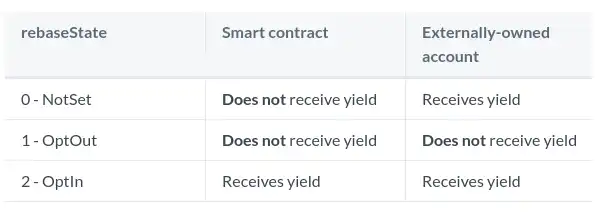
In order to generate profits, smart contracts must actively opt in to the protocol by using the rebaseOptIn() function. This allows the protocol to optimize capital utilization and enhance integration with DeFi protocols that were not originally designed to handle balance changes. Therefore, OETH operates as a regular ERC-20 Token in other DeFi protocols until a change is explicitly requested. Standard EOA wallets will automatically join the system without the need for explicit selection. OETH managed by AMO will not undergo any rebasing adjustments.
To verify whether a specific address is configured to receive rewards, you can call the public function on the OETH contract. This function returns an indicator that shows whether the address has chosen to join or exit, regardless of wallet type.
Encapsulated OETH
Origin also offers wOETH, which is a wrapped version of OETH that conforms to the ERC-4626 standard and has a fixed quantity but appreciates in value. This feature makes wOETH compatible with other contracts and may offer tax benefits in certain regions, rather than undergoing benchmark readjustments. As users already own the wrapped version, unpacking wOETH into OETH does not require approval or restrictions on minimum deadlines or lock-up periods. Although the quantity of wOETH tokens is static, the number of equivalent OETH tokens that can be unpacked from wOETH can gradually increase. The redemption function allows for specifying the quantity of wrapped tokens to be unpacked, and the extraction function of Etherscan can also be used to specify the amount of OETH to be retrieved.
wOETH is still an edge token with very few holders:

AMO
Origin uses the Automated Market Operations (AMO) design originally pioneered by Frax. The AMO is implemented through the ConvexEthMetaStrategy strategy used by the OETH Vault. The AMO operates by depositing funds into the Curve pool and allocating liquidity to both sides of the pool (ETH and OETH). Its main functions are to maintain stability, improve capital efficiency, and optimize returns for OETH holders.
LP Token is staked in Curve Gauge to maximize rewards (CRV and CVX). These rewards, when exchanged for ETH, form collateral that is added to the Vault. Conversely, the protocol can remove excess OETH from the pool to maintain price stability. Ultimately, AMO can independently implement monetary policy within a closed system, provided that it does not have a negative impact on anchoring. The protocol claims to be fully collateralized even as the money supply automatically expands and contracts based on market conditions.

AMO-generated OETH Tokens are unique because they are not backed by collateral provided by Vault. This system can be seen as Vault pre-selling some OETH for Curve and when these Tokens enter circulation, they become 100% backed. These Tokens are self-supporting and only circulate after being collateralized. User actions of adding or removing OETH from the Curve pool can be achieved through policy burning or minting new Tokens, making this behavior similar to the minting or redemption process. OETH Tokens can be exchanged at any time at a 1:1 ratio to ensure that the protocol always maintains 100% collateral support.

Revenue Source
OETH Vault has three active strategies. In addition, a portion of ETH LSD is stored in OETH Vault and earns interest through staking. A portion of the deposits remains unallocated in the form of WETH. The latest asset allocation as of June 7, 2023 is as follows:

Curve/Convex Yield
Convex ETH+OETH: Origin mainly provides liquidity to the ETH-OETH Curve pool through the ConvexEthMetaStrategy. LP Tokens are deposited into the Gauge and then staked on Convex, allowing Origin to collect transaction fees and protocol token rewards (CRV and CVX). This AMO strategy allows OETH to safely increase its deposits, enhance returns, and maintain pool balance.


Liquidity collateralized derivative yield
1. Staked Frax Ether (sfrxETH): Using a dual token model, Frax increases its yield through validator staking. OETH deposits frxETH into the Frax Ether staking contract to further amplify yield. These funds are managed as one of three OETH reserve strategies in the FraxETH strategy.
2. Lido Staked Ether (stETH): As a liquid staking solution for Ethereum, Lido allows for ETH staking without the need to lock tokens or maintain infrastructure. OETH holds stETH and receives staking rewards from the Ethereum network, while also benefiting from automatic compounding. The stETH balance is directly stored in the OETH Vault.
3. Rocket Pool Ether (rETH): As a community-owned decentralized protocol, Rocket Pool issues rETH, an interest-accumulating ETH wrapper. OETH holds rETH to earn profits and calculates by distributing additional tokens directly to user wallets. The rETH balance is directly stored in the OETH Vault.
DeFi Strategy Returns
Other DeFi strategies, such as OETHMorphoAAVEStrategy, can provide revenue generation capabilities for the OETH protocol. Morpho optimizes the matching of borrowers and lenders by integrating peer-to-peer layers, providing higher interest rates and enhancing platforms like Compound and Aave. If there are no suitable pairs available, funds will flow directly to the underlying protocol.
Unallocated Funds
When OETH is minted, the collateral will be placed in the Origin Vault until the allocation function is called. For larger transactions, this process is automated and less affected by the increase in gas fees.
Market
Stablecoin/Anchored Asset
As of June 7th, 2023, the circulating OETH is supported by approximately 12,000 ETH.

OETH mainly has liquidity in the OETH-ETH pool on Curve, which has over 5,300 ETH in liquidity, accounting for approximately 44% of circulating OETH. In contrast, the amount of OETH on Uniswap is relatively small, with only about 100 ETH in the Uniswap 0.05% pool.


Anchor
The goal of OETH is to always stay anchored to the price of ETH, allowing holders to access the price fluctuations of Ethereum while also earning stable returns. Since its launch, OETH has maintained its anchor relatively stable.
Coingecko's charts:

Curve on-chain data chart:

In early June, the anchor was compromised by a whale (a victim of the Atomic Wallet hack) who sold OETH into the Curve pool. Subsequently, other buyers quickly seized the opportunity to purchase OETH at a discount, restoring the pool's balance to its anchored state.

Risk
Smart Contract Risks
Despite undergoing rigorous audits and being based on the OUSD codebase, the OETH protocol covers many complex factors, increasing potential smart contract risks. In addition, the DeFi strategies used internally by the system are constantly evolving, and Origin is able to implement or remove strategies as needed. The dynamic nature of these strategies adds another layer of complexity and potential risk.
OUSD suffered a $7 million attack in November 2020 due to an undiscovered recursive vulnerability. After completing multiple audits and security upgrades, Origin Dollar was relaunched in December. You can learn about the measures taken to ensure protocol security in their relaunch announcement. All users received compensation from the Origin Community Fund.
Audit
You can find all audit reports for Orgin (including OUSD) here: https://github.com/OriginProtocol/security/tree/master/audits.
Two obvious OETH audits are as follows:
· OpenZeppelin - Origin Dollar OETH Integration - May 2023
Other than one Oracle issue (date data may be outdated), no other security issues were found and have been fixed.
In this system, liquidity providers (LPs) also face certain risks. For example, if a large amount of ETH is removed from the pool (as seen in early June), this imbalance increases the opportunity for AMO to profit through arbitrage. Conversely, if AMO's transactions result in an imbalanced pool, i.e. negative slippage, bad debt may enter the system. In this case, AMO's best strategy is to upgrade the pool's imbalance. Ultimately, they can take advantage of this situation by restoring pool balance and profiting from the losses suffered by those who withdrew funds.
As of June 15th, 2023, the total POL share of Origin in the Curve ETH/OETH pool is 83%. This can be determined by comparing the value in ConvexEthMetaStrategy with the liquidity in the OETH pool.
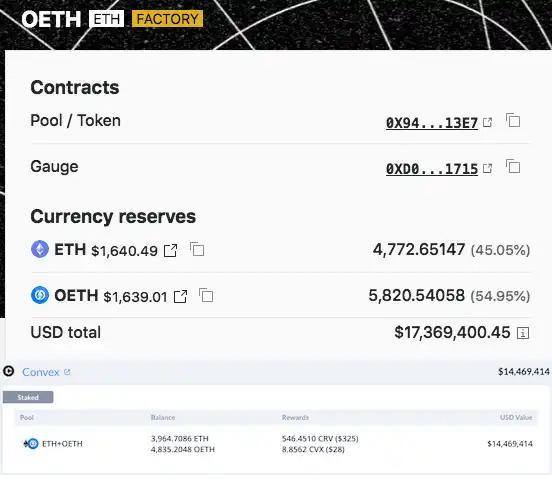
Since mid-May, Origin has been providing voting incentives in the ETH/OETH pool on Votium and StakeDAO Votemarket. The incentives are paid in OGV governance tokens and have reached a weekly amount of approximately $40,000 in the latest epoch (week of June 14, 2023). These incentives allow Origin to exchange their native tokens for CRV/CVX emissions, with the AMO strategy currently recovering 83% of emissions. The emissions are sold to obtain WETH and allocated to the Dripper contract, increasing the earnings of OETH holders. Therefore, a large part of the earnings earned by OETH depends on the emissions of Curve.
Hosting Risk
Trust in the OETH system relies on signers holding multi-signature keys. These signers are responsible for correctly handling assets within the system and must be trustworthy, not engaging in behaviors that could destabilize the system, such as unlimited minting. To provide a level of security and trust, a 24-hour time lock mechanism is set up. This ensures that major actions cannot be executed immediately, providing a time window for discovering and resolving potential issues.
OETH also introduces significant smart contract risks by utilizing DeFi platforms such as Aave, Compound, and Curve. Although these partnerships are with platforms that manage billions of assets and undergo security audits, it cannot be absolutely certain that they will continue to operate flawlessly. Any failure in these underlying strategies could potentially result in losses for OETH holders.
Governance
Origin Protocol uses Origin DeFi Governance Token (OGV) to achieve decentralized decision-making within its ecosystem. Similar to OUSD, governance of Origin Ether will ultimately be carried out by veOGV holders, and any upgrades to the contract will be delayed by a 48-hour time lock. According to the team, if any significant issues are discovered during the early deployment of OETH, a multisig with 5 to 8 signatures will control OETH in the coming weeks.
As of the time of writing this article, the governance of OETH Vault is set to the Governor contract. The manager of this contract is set to a multi-signature with 5 or 8 signatures. The delay time for executing votes is set to 1 day. Only the manager can queue proposals and execute votes. As OETH Vault is an upgradable proxy contract that contains all underlying assets and is the center of all strategies, the multi-signature with 5 or 8 signatures effectively holds all user funds.
If the key signing process is distributed and diversified among multiple participants, multi-signature can increase security. Adding external entities to the list of signers can further enhance this security measure.
Another potential governance risk is manual allocation of funds. There is currently no functionality to change the composition of collateral. Therefore, any deposited ETH either goes into Convex or remains idle.
As far as future governance is concerned, additional strategies are expected to be introduced, but this may bring new risks. (For example, a strategy called Morpho was recently added, but it was quickly discontinued due to potential vulnerabilities.)
Access Control
The access control of the contract is controlled by 5 groups of 8 (Admin) and 2 groups of 8 (Strategist) multi-signatures. The identities of these signers are not disclosed. Origin claims that they are all unique and trustworthy individuals closely related to Origin.
· 0xAbBca8bA6d2142B6457185Bec33bBD1b22746231
· 0xce96ae6De784181d8Eb2639F1E347fD40b4fD403
· 0x336C02D3e3c759160E1E44fF0247f87F63086495
· 0x6AC8d65Dc698aE07263E3A98Aa698C33060b4A13
· 0x617a3582bf134fe8eC600fF04A194604DcFB5Aab
· 0x244df059d103347a054487Da7f8D42d52Cb29A55
· 0xab7C7E7ac51f70dd959f3541316dBd715773158B
· 0xe5888Ed7EB24C7884e821b4283472b49832E02f2
Admin 5-of-8 multisig:0xbe2AB3d3d8F6a32b96414ebbd865dBD276d3d899

Currently, Admin multi-signature has complete ownership of contracts and underlying assets, but all contract changes must go through time locking. As OETH is a new protocol, the team hopes to quickly respond to any unforeseen issues, so this is a temporary situation. Full governance rights will soon be transferred to veOGV holders, such as OUSD today. Once the transfer is complete, Admin multi-signature will no longer have special privileges.
Strategist 2-of-8 multisig: 0xF14BBdf064E3F67f51cd9BD646aE3716aD938FDC
Some functions, such as adjusting funds between strategies or temporarily pausing deposits, require less time and fewer authorizations, allowing the Origin team to quickly respond to market changes or potential security issues. Strategist can only execute a set of restricted functions with the approval of two of the eight authorized signers. Strategist can only allocate funds between previously approved strategies.
Strategist multi-signature can perform the following operations on the insurance vault:
· Re-allocation - Moving funds between strategies.
· setVaultBuffer - Adjust funds stored outside of the strategy to achieve cheaper redemptions.
· setAssetDefaultStrategy - A strategy for casting and redeeming a certain asset.
· Extract all funds from the strategy - Remove funds from a single strategy and send them to the insurance vault.
· Extract all funds from all activity strategies - Remove funds from all activity strategies and send them to the insurance pool.
· Pause on benchmark adjustment - Pause all benchmark adjustments.
· Pause Capital Operations - Pause all minting and redemption
· Cancel suspension of capital operations - Allow all minting and redemption
Oracle Risk
OETHOracleRouter contract has been set as the priceProvider for OETH Vault. This contract uses Chainlink's price feeds to obtain the prices of all underlying assets and reward assets (CRV/ETH, CVX/ETH, rETH/ETH, cbETH/ETH, stETH/ETH), with the exception of frxETH/ETH which is always programmed to have a value of 1 ETH.
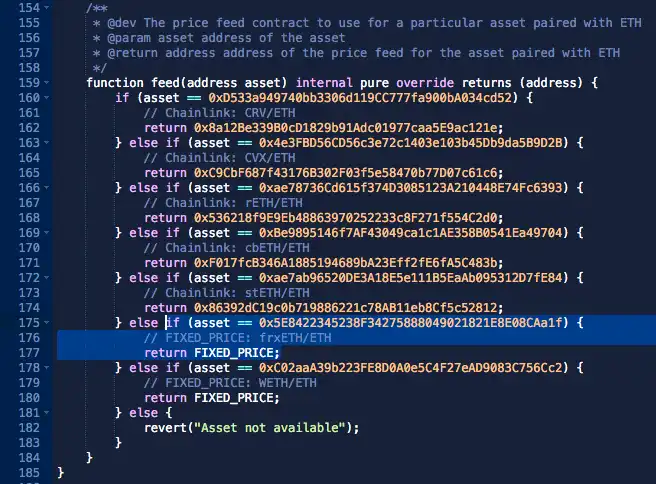
The purpose of the price oracle is to ensure that the protocol does not overpay for LST that may be priced lower than the trigger price. As 1 OETH is always backed by 1 ETH, it may need to adjust the amount of minting or redemption based on current market data. Additionally, when tokens are sold for additional yield, the protocol uses the price oracle to check if the price slippage exceeds a reasonable limit.
One key issue regarding Oracle is that Origin uses a hardcoded 1:1 ratio of frxETH/ETH. This means that if frxETH experiences significant decoupling, the Strategist multisig will need to manually pause deposits. If the multisig takes too long to react or if the decoupling persists, it could result in losses. The Origin team has stated plans to implement a Curve frxETH/ETH pool EMA Oracle. This trust assumption and protocol risk are explicitly disclosed in the Origin Protocol documentation.
Under normal circumstances, AMO aims to restore the peg and ensure that all funds remain safe during this process. In addition, if the amount of ETH in the pool decreases, AMO's strategy increases its allocation to restore balance and become more profitable. This is a dynamic response mechanism used to maintain the stability of OETH value. As AMO owns most of the funds in the Curve pool (over 80%), it is almost impossible for the detachment to continue unless there is a failure in the underlying protocol (such as a smart contract vulnerability leading to user fund loss).
OETH may decouple from its expected value in several ways. These include adding or removing a large amount of funds from the Curve pool, strategies resulting in losses, or vulnerabilities related to automated market making operations (AMOs). For example, if a major shareholder sells funds into the Curve pool, it may temporarily disrupt the peg.
Mortgage Risk
The risks faced by OETH holders are related to the strategies deployed within the system and LSD tokens (such as penalties), making risk assessment challenging. Given the complexity and constantly changing nature of these strategies and LSD, understanding and quantifying potential risk factors can be complex. Users must closely monitor underlying assets and remain vigilant to changes in system policies. While the system's design takes into account robustness and security, the complexity of its components emphasizes the importance of cautious participation and a comprehensive understanding of its operational mechanisms.

The security of collateral may heavily rely on the timely response of multi-signature. For example, on June 2, 2023, the Strategist multi-signature temporarily withdrew funds from the Morpho strategy by calling withdrawAllFromStrategy(tx) and returned them to the OETH Vault to address potential issues with its interest rate model. These funds were re-deposited on June 14 (tx).

Strategist's actions are being communicated in the "Strategy Allocation" topic in the #DeFi-Governance-Forum channel on the Origin Discord server.
Origin also provides risk analysis for some of its LSDs.
frxeth-sfrxeth:
https://docs.oeth.com/security-and-risks/risk-reports/frxeth-sfrxeth
reth:
https://docs.oeth.com/security-and-risks/risk-reports/reth
LlamaRisk Evaluation Criteria
Centralization Factor
1. Can a single entity manipulate users?
Cannot, however, Strategist and Admin multi-signature have important permissions. The identity of the signatory is not known to the public, and users must trust that the Admin multi-signature will not perform operations that are against the interests of the users, such as upgrading contracts to transfer underlying assets.
2. If the team disappears, can the project continue?
Cannot. The project currently heavily relies on manual operations executed through multi-signature. There is a plan to transfer control to a DAO managed by veOGV Token holders, at which point the project will no longer depend on the core team.
Economic Factors
1. Does the feasibility of this project depend on additional incentive measures?
To some extent, the ultra-high returns provided by OETH depend largely on mining incentives, although the income generated by LSD hosted by Origin establishes a minimum APY. The flywheel token owned by the protocol ensures that as long as mining activities exist, CRV and CVX will remain valuable, and there will always be additional rewards.
2. If the demand drops to 0 tomorrow, can all users receive full payment?
Okay. Under normal circumstances, OETH always maintains a support relationship with ETH at a 1:1 ratio. All active strategies (sfrxETH strategy, MorphoAave strategy, Convex AMO strategy) and LSD Token are easy to liquidate, so that all users can exit to ETH in the worst case where demand drops to 0. Redemption will first attempt to extract funds from the OETH Vault, and if the Vault liquidity is exhausted, it will be extracted from the strategy without permission.
Security Factor
1. Are there any worrying signs displayed in the audit results?
No. OETH has undergone two audits and its functionality is similar to OUSD, which has also undergone multiple audits. The underlying strategy has also been audited before deployment. In addition, there is an Immunefi bug bounty program that offers up to $250,000 in rewards for responsible disclosure of OUSD vulnerabilities.
Risk Team Recommendation
Although OETH is a new product, Origin Protocol has integrated it with Curve's OUSD/3CRV pool since August 2021. OETH shares many similarities with its previous products and leverages the trend of Ethereum's liquidity mining to create a diversified, yield-generating Ethereum token.
The current version of OETH has some less than ideal centralization factors, but considering the early stage of the product and the need for quick response in emergency situations, this is understandable. 5 Admin multisignature accounts have significant control over the system, including supervision of user funds. Although it is unlikely that the team-controlled multisignature accounts will be hacked or maliciously operated, this may expose the protocol to regulatory risks. The team plans to transfer control to the DAO of veOGV Token holders, and users should closely monitor the team's active measures to achieve decentralized governance.
Another weakness in the current design is the hard-coded price of frxETH. This makes users dependent on the multi-signature account of the strategy when withdrawing funds from the strategy in a timely manner to protect the protocol. The team plans to implement the Curve EMA oracle from the frxETH/ETH pool, so users should closely monitor this process. Overall, the performance of OETH depends on the responsible management of the multi-signature account of the strategy, which deploys and has the power to pause minting/redeeming and pause adjustments.
There is a reasonable way to overcome the centralization factors in the current OETH, and the team has a good track record in gradually decentralizing the protocol. The system is transparent, with clear and detailed documentation. Users can independently verify the deployment of assets and determine whether the system is suitable for their risk tolerance, although they should pay close attention to changes made to underlying strategies. OETH meets our requirements for the Curve gauge.
Original article link
Welcome to join the official BlockBeats community:
Telegram Subscription Group: https://t.me/theblockbeats
Telegram Discussion Group: https://t.me/BlockBeats_App
Official Twitter Account: https://twitter.com/BlockBeatsAsia

 Related Articles