Bankless: Top 5 potential projects in the LSD track, challenging the leading newcomer Lido.

Original Title: "LSD Competitors: Five Newcomers Challenging Lido's Dominance"
Original Author: 563
Original Translation: TechFlow Deep Tide
In 2023, liquidity collateralized derivatives (LSD) became one of the hottest topics. These protocols receive deposited ETH, pledge it to ensure network security, and pass the pledge rewards to users holding their LSD (minus some fees). This greatly simplifies the user's pledge process and also allows them to use their LSD in DeFi.

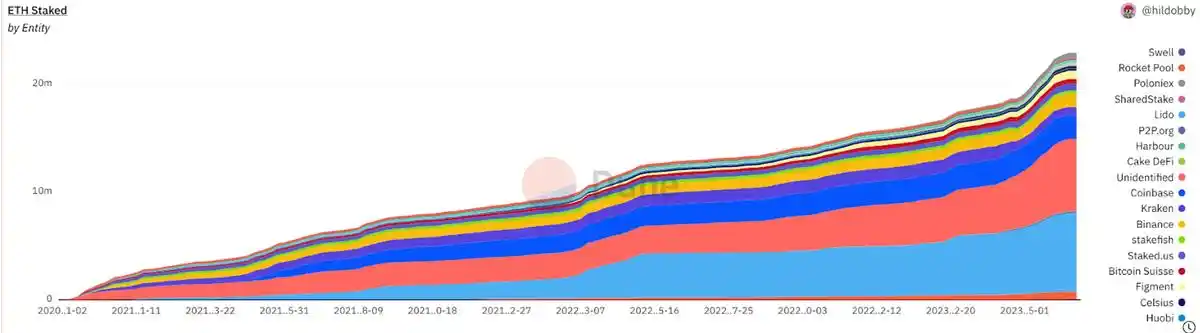
Lido's leading position is mainly due to their first-mover advantage. And they are able to leverage their network effects to become the "safest" choice for users to enter the ETH staking world.
So how do other protocols compete?
Market participants often act in their own best interests, although some purists may be unwilling to believe this. To overthrow this king (or weaken its dominance), these new challengers must offer something that is clearly better than Lido.
From our perspective, these advantages may include:
Higher return rates;
Easier to get started;
More combinability and/or security;
In this article, we will focus on five early competitors who hope to make a name for themselves in the LSD field by offering innovative solutions.
1.Prisma
The first Mirror article of Prisma caused a sensation, calling itself the "ultimate game of liquid staking tokens". Prisma aims to promote the widespread adoption of their stablecoin (acUSD) using the Curve flywheel. Similar to projects such as Gravita and Lybra, Prisma uses the Liquity model and has made adjustments to enable acUSD to be minted against the top five LSDs (Lido's stETH, Coinbase's cbETH, Rocket Pool's rETH, Frax's frxETH, and Binance's WBETH). The weight and future integration are currently undetermined.
In theory, holding acUSD will incentivize more users to use liquidity staking tokens to stake their ETH.
除了交易费用外,acUSD liquidity providers will also receive CRV, CVX, and PRISMA tokens, as well as their standard ETH staking rewards;
Prisma will integrate closely with Curve, Convex, Frax, Conic, and LlamaNodes from the very beginning.
2.Swell
Due to its current Voyage incentive plan, Swell's swETH LSD has received widespread attention from the community and has surpassed a total locked value (TVL) of $50 million. Swell positions itself as a platform aligned with Ethereum's values and aims to provide a simpler onboarding process for new users.
Users can purchase ETH directly through Google/Apple Pay, credit card, or bank account.
Partnerships integration allows users to directly earn profits from swETH by providing liquidity.
3.unshETH
unshETH aims to incentivize benign competition in the LSD field by offering diversified LSD consisting of a basket of underlying LSD. The weight of the basket is balanced through governance and currently includes Lido's wstETH, RocketPool's rETH, Coinbase's cbETH, Frax's sfrxETH, Anker's ankrETH, and Swell's swETH. As arbitrageurs are incentivized to balance the weight of the underlying LSD in unshETH, economic activity is sure to follow each governance decision.
In addition to the standard staking rewards from the basic LSD basket, unshETH also earns additional income through rebalancing fees.
Established on LayerZero means that unshETH can be transferred across different chains, providing the possibility for new liquidity strategies.
Being included in unshETH has created new buying pressure for the emerging LSD project, making unshETH a clear potential partner.
4.Origin Ether
By combining automated yield generation strategies with Ethereum staking rewards, Origin Ether can provide attractive incentives for its depositors. Similar to other mentioned LSDs, OETH supports deposited ETH at a 1:1 ratio and seeks yield through diversified investments in the DeFi space. Currently, yield comes from the following sources (in order of weight):
ETH-OETH Convex liquidity pool;
Rocket Pool's rETH;
Frax's sfrxETH;
Lido's stETH.
High returns have enabled Origin Ether to accumulate approximately $35 million TVL in just one month.
Over the past 30 days, the annualized yield of Origin Ether is approximately 9%, which is twice that of some competitors.
Origin's automated strategy eliminates confusion for users, who no longer need to search for the most lucrative returns.
5.Diva
Diva hopes to combine the composability of liquidity mining with the decentralization brought by distributed verification technology. In short, DVT achieves verifiable distribution of validator private keys by minimizing trust in key sharing. In practice, users can combine the composability of LSD with the majority of the decentralization benefits of running their own ETH node without requiring a minimum stake.
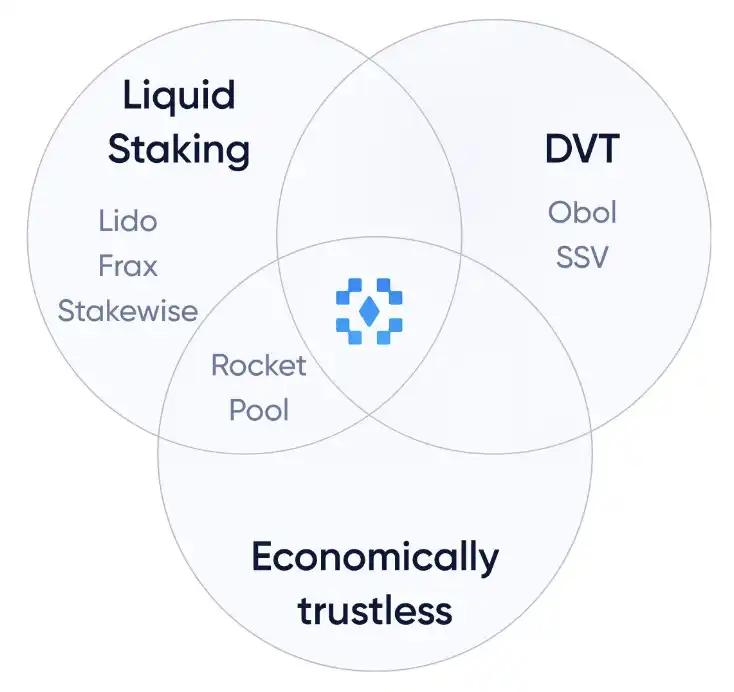
DVT is a new technology that brings further decentralization to ETH staking.
DVT allows for node redundancy and better uptime, which helps to stabilize rewards.
The story is far from over
Let's take a step back and look at it from a different perspective - with the completion of the merger, ETH staking is still in its early stages. Compared to other Proof of Stake (PoS) layer one networks, the percentage of ETH used for staking is still less than 20%.
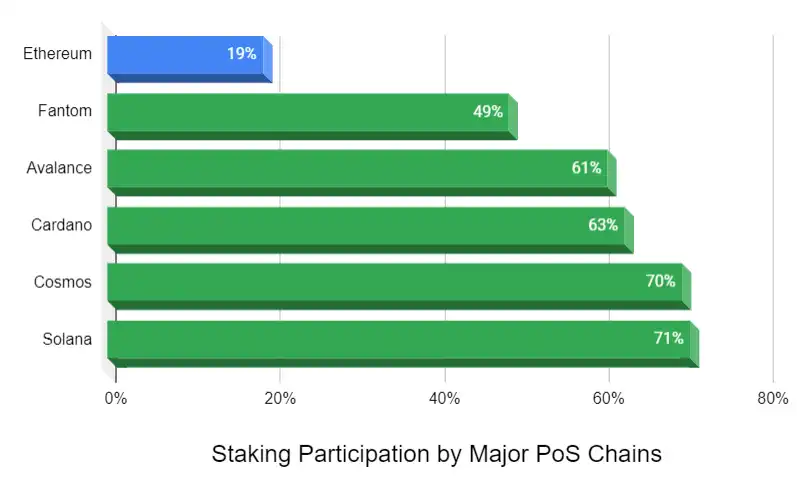
If we assume that ETH staking will eventually align with the majority of PoS, then the staking protocol has enough time to carve out its own niche in the market. Here we showcase some projects that offer their own unique liquidity staking derivatives, whether it's easier entry, new technology, new use cases, or higher APY; there are many exciting things happening in LSDfi.
Original article link
Welcome to join the official BlockBeats community:
Telegram Subscription Group: https://t.me/theblockbeats
Telegram Discussion Group: https://t.me/BlockBeats_App
Official Twitter Account: https://twitter.com/BlockBeatsAsia

 Related Articles