The 'NFT regression' caused by ordinals is not an idealistic return.

From the transfer of BRC-20 Token issuance model to ETH's $FERC, to directly inserting images converted to Base64 strings into the Hex Data field of ETH transactions to achieve the Bitcoin NFT engraving method known as ETHscriptions, the "engraving" method of Bitcoin NFT has recently been frequently transferred to ETH, attracting the attention of many players.
It seems that the idealistic beauty of "immutable, fair, and decentralized" Bitcoin NFT has been transmitted to ETH through the slightly clumsy NFT generation method that replicates the characteristics of Bitcoin. However, is this really a return to idealism?
ETH's "On-Chain" NFT
ETH NFT ecosystem has developed to this day, and as players, we may feel helpless about many issues, such as PUA based on whitelist mechanism, "scientists" who eat up a large number of shares during public sale, lack of new narratives, and the proliferation of "dogs" that are known to be fund manipulation but still have to rush into. However, as a well-tested NFT ecosystem, ETH NFT has also had profound discussions on many issues and has been answered by the market.
"Immutable" or "fully on-chain storage" may seem like a "technical issue", but it is actually a "market issue". There has been discussion about this issue on ETH for a long time.
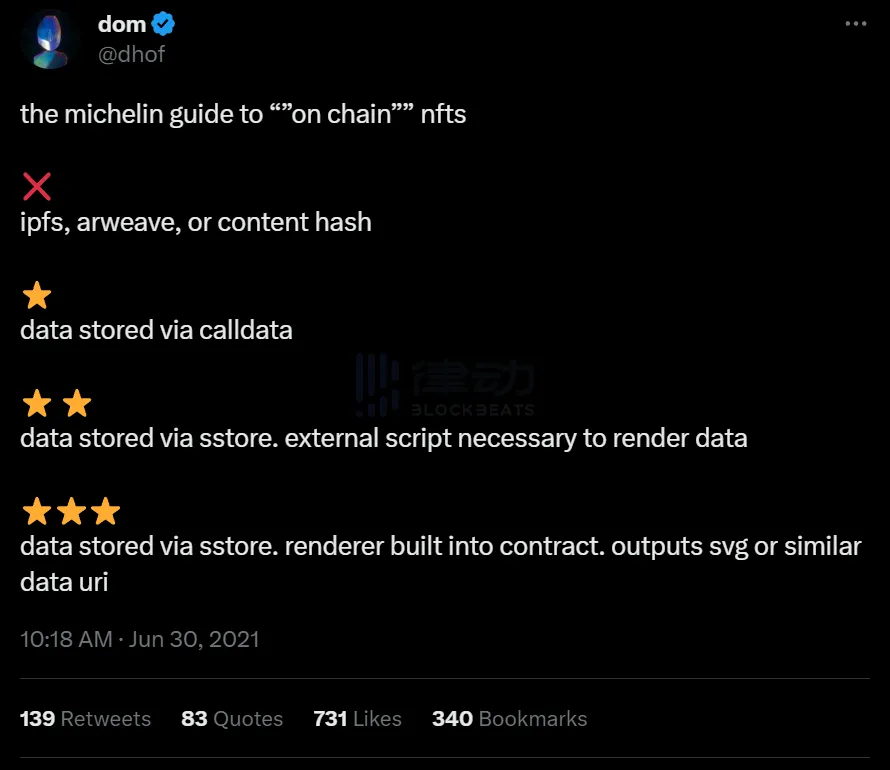
This is a tweet I found from 2 years ago. @dhof classified ETH "on-chain NFTs" based on different implementation methods. One-star NFTs store data in the calldata field of ETH transactions, two-star NFTs store data through EVM opcode sstore and render data through external scripts, and the highest three-star NFTs store data through EVM opcode sstore and render data through built-in renderers in smart contracts to output SVG images or similar data URIs.
If we rate Ethscription according to this standard, it can only receive a one-star rating. As mentioned at the beginning of its official website, Ethscription achieves data storage by storing data in the calldata field of ETH transactions. The rendering of images is done through off-chain indexing, and by making the indexing open source, off-chain operations are also decentralized.

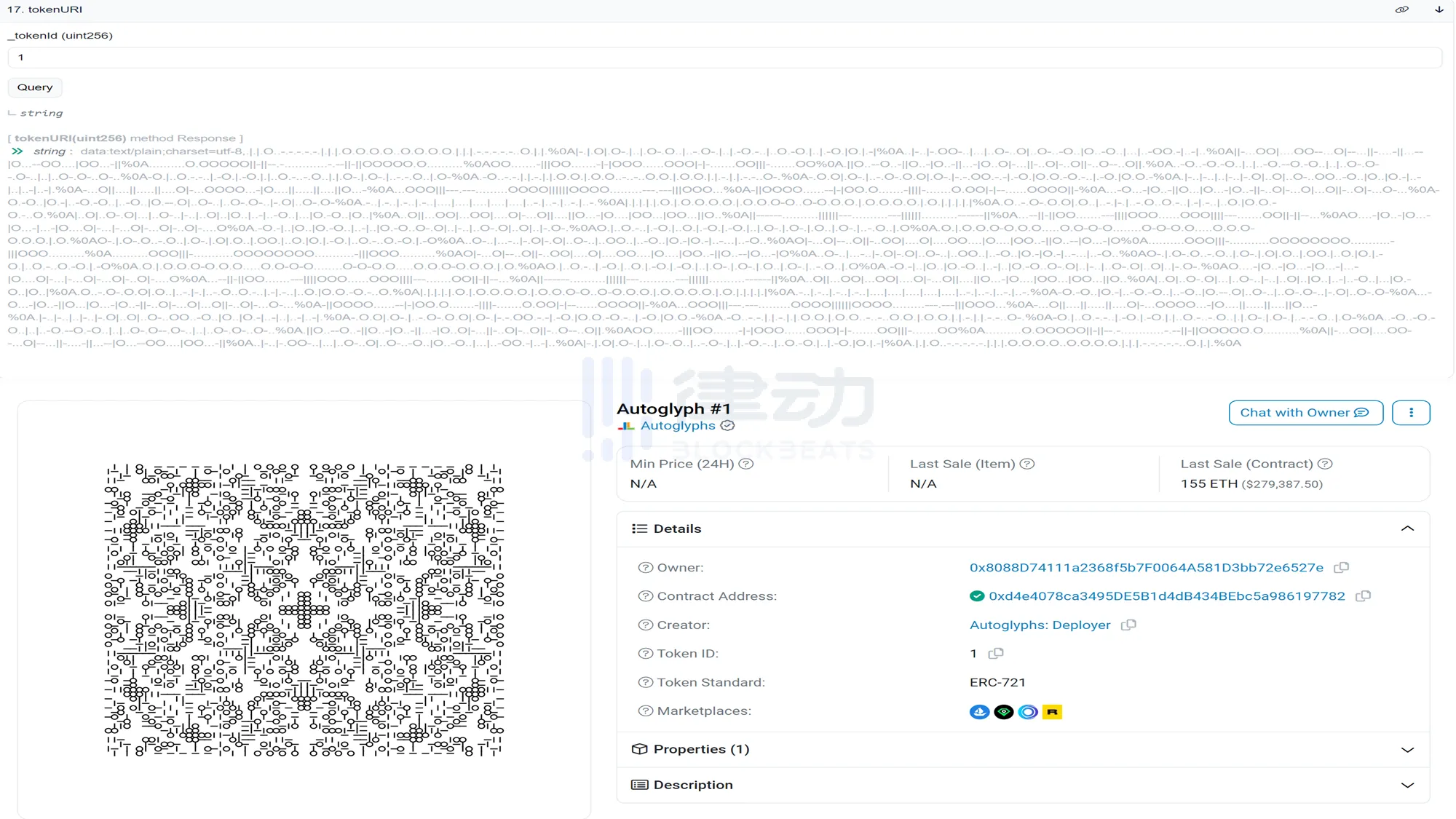
For ETH, "whole-chain NFT" is not a new thing. I can quickly come up with several project names in my mind - Autoglyphs, Larva Lads, Chain Runners, and OnChain Monkeys, which are also active in Bitcoin NFT now.
Retrieve the tokenURI of Autoglyphs and you will find a long string. By breaking down this string, a picture can be generated.
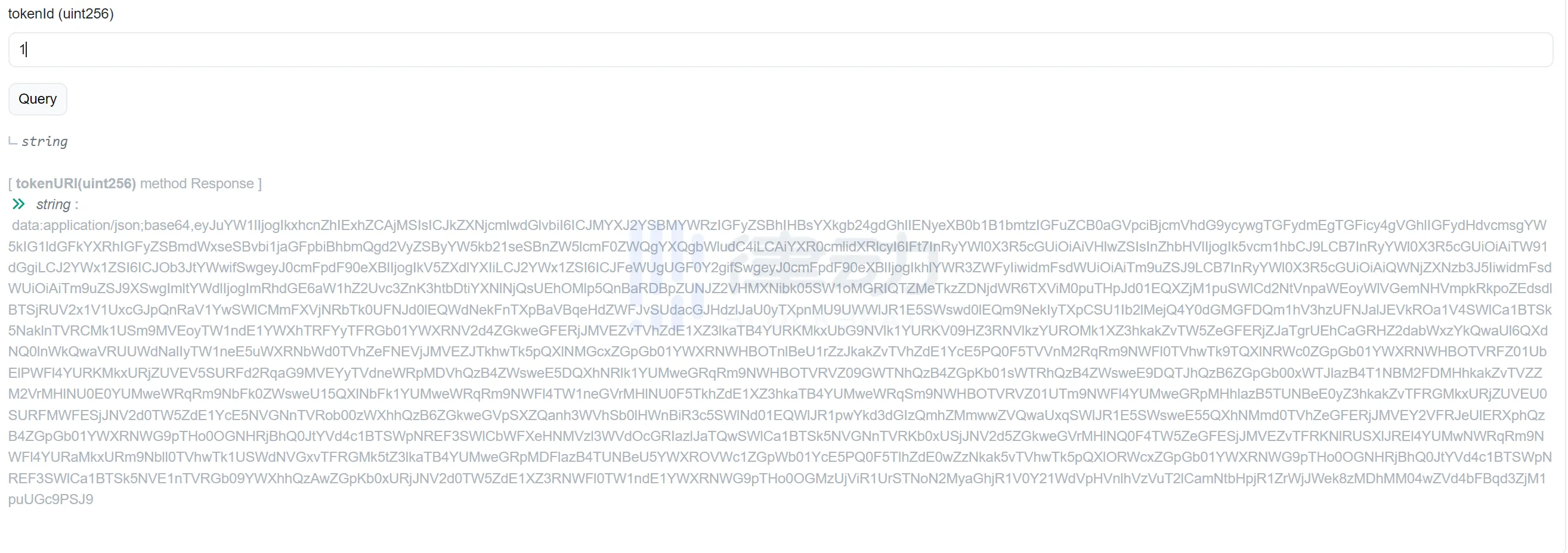
Retrieve the tokenURI of Larva Lads and you will find a long string of characters, but the type definition is in JSON format and the content is a base64 string. Larva Lads has built-in decoding and rendering operations in the contract to ultimately output an SVG image.
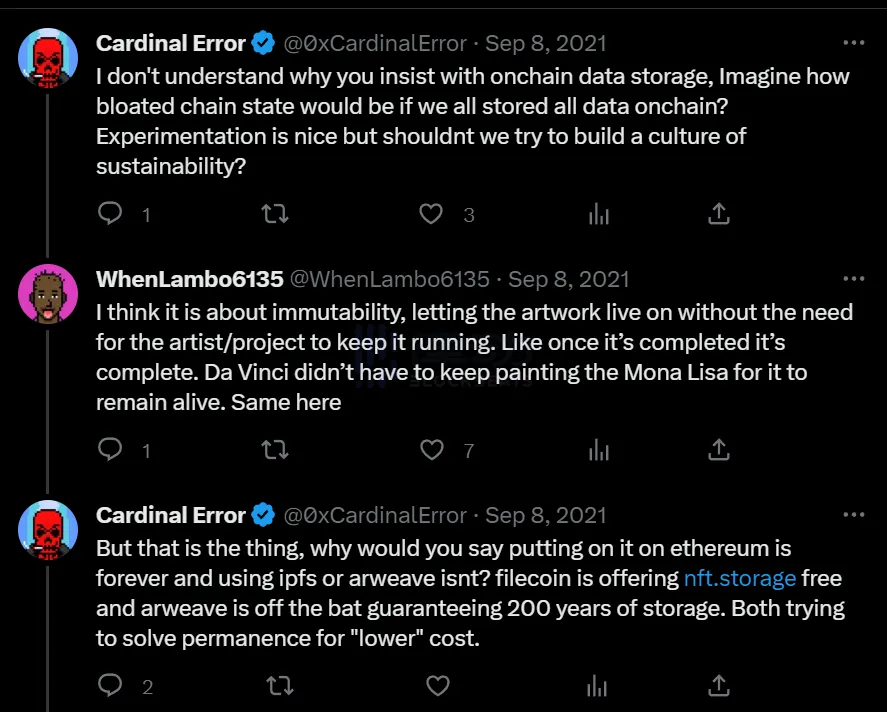
@0xCardinalError expresses confusion about why @dhof is so focused on on-chain storage. While on-chain storage is cool as an experiment, what's more important for NFTs is to focus on "building a sustainable culture." He also notes that solutions like IPFS and Arweave have lowered the cost of minting NFTs, which is actually a "market problem" rather than a technical one. Although IPFS and Arweave are off-chain storage solutions for ETH, there is still a risk of data loss, but the ETH NFT market has already made its choice with real money.
@WhenLambo6135 then explained the meaning of "immutable" very well - allowing works of art to exist even when the creator/project disappears, just like how Da Vinci doesn't need to continuously paint the Mona Lisa to keep it in existence, as long as the painting is not lost and is properly preserved. In a sense, this is also another understanding of blockchain - a medium for storing information that relies on modern technology and consensus. Compared to paper paintings, blockchain paintings do not require troublesome maintenance, only the internet and computers not disappearing, as well as people's faith in the blockchain network.
@0xCardinalError mentioned the "building of a sustainable culture" which, like the art creators who are indispensable to the thriving development of the ETH NFT ecosystem, has gradually been forgotten in one "get rich quick" story after another. The principle of Ethscription is not new to ETH, but it has been promoted and speculated on, and viewed from the perspective of speculation, it naturally has the famous "don't be biased" theory. However, looking at the market, most of the things that Ethscription and various "new technology concepts" on Bitcoin have brought out are direct copies of ETH Rock and CryptoPunks, and the most popular ones are still meme tokens. For example, the so-called first BRC-20 Token imitation $ETHS issued by Ethscription has no index, no trading market, and even lacks the technical documentation that BRC-20 has prepared, but it has reached a high price of 100U per sheet off the market. When I was writing this article, I even saw a KOL post a BRC-20 on BSC, and I searched Twitter and found only the KOL's source of information, with a Mint tutorial selling for $8...
This is really a return of "idealism"?
"Development" relies on "market intervention"?
Transferring the BRC-20 Token issuance model to ETH is the main narrative of $FERC, a practitioner in the encryption industry. However, on June 19th, @kkk_ethe's exposure sparked a discussion about $FERC developer Jackygu's "market intervention" despite the emphasis on "fairness and decentralization."
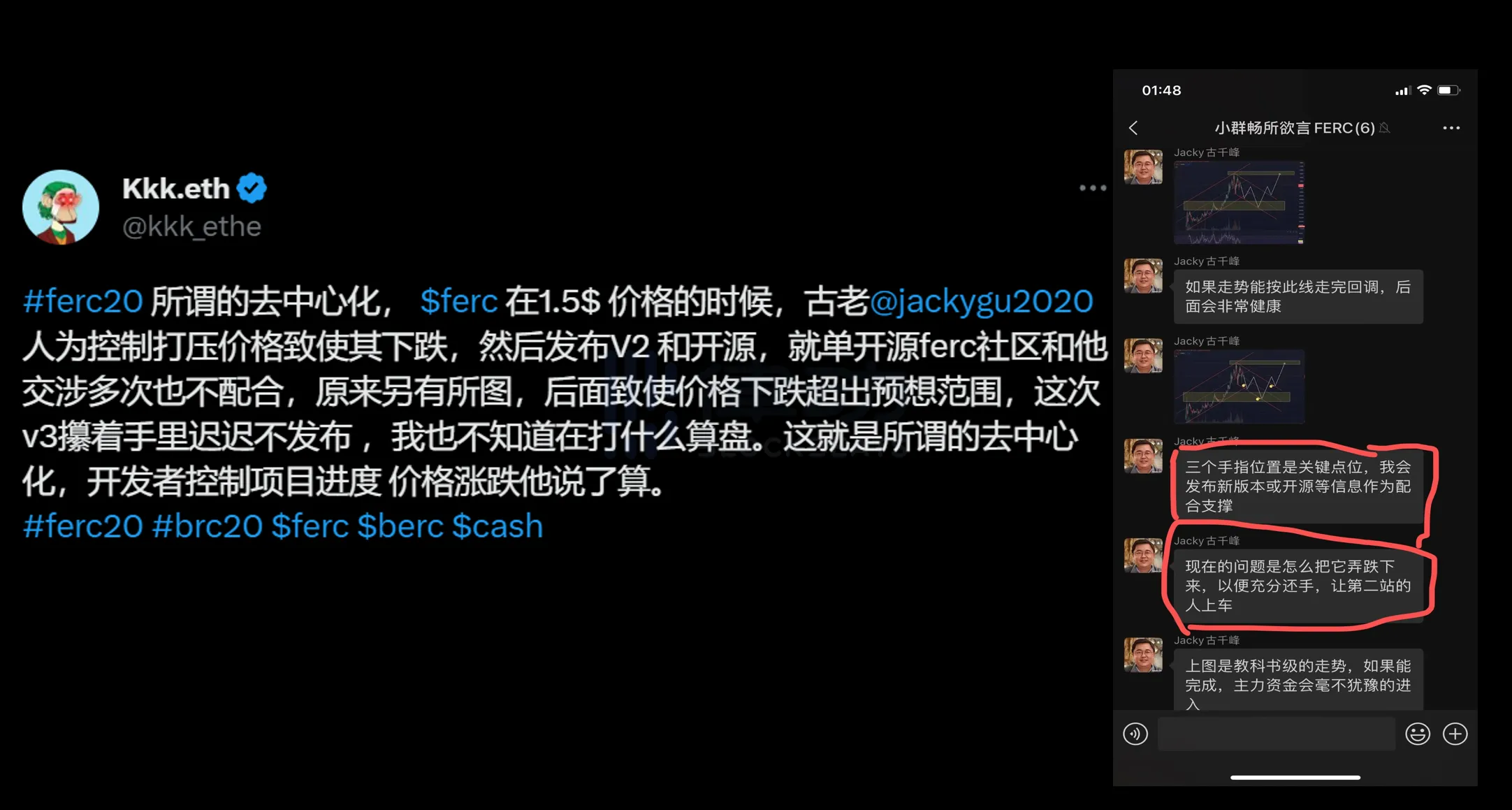
Jackygu's response to this is:

Okay... I'm sorry, I can't understand. I can only understand that the launch of $FERC is "fair". But can the development of the project be achieved through "market intervention"? Bitcoin, ETH, and even Doge, which one has not experienced severe fluctuations? The ones that can't be knocked down will only become stronger in the end.
Actually, what cannot be disrupted by price fluctuations is "consensus". The word "consensus" has been overused now. It is not about buying and shouting 100x to wait for someone to take over today, but it has truly formed emotional connections and ideological resonance. Just like when Bitcoin was still very cheap, if you met someone on the street who also believed in Bitcoin, you might both be fascinated by each other, which is a simple and direct manifestation of "consensus". If there were no early selfless developers and true dreamers, could Bitcoin really have stood the test of time? If Bitcoin started to "intervene in the market" when it rose to $1, would it still have "healthy development" afterwards?
As mentioned earlier, many ETH NFT players are currently dissatisfied with certain aspects of ETH NFT. There are indeed many "unfair" practices that have caused dissatisfaction among players, such as VC/CEX taking away a large number of initial chips, whales "occupying" Launchpad, and meme tokens setting up a bunch of rules such as "blacklists" and "transaction taxes"...
But these are not "technical" issues, they are "human" issues. In a decentralized world, it is already ironic to use "decentralization" as the narrative of a project... On the road to "making money", we have gone too far. When can we go back, and do we really want to go back? Just like the "Token Withdrawal Movement" that has been mentioned all the time, if we firmly say "no" with our actions, then the so-called "unfairness" will disappear, but the reality is not so.
Conclusion
At the end of the writing, I am speechless. Let's use the title as the conclusion:
Ordinals triggered the "NFT retrogression", not an idealistic return.
Welcome to join the official BlockBeats community:
Telegram Subscription Group: https://t.me/theblockbeats
Telegram Discussion Group: https://t.me/BlockBeats_App
Official Twitter Account: https://twitter.com/BlockBeatsAsia
 Related Articles