iZUMi Finance: Improving on the UniSwap V3 concept to create a new DL-AMM mechanism.
Original Title: "DL-AMM created by iZUMi: Improvement based on UniSwap V3 ideas"
Original Source: Biteye
Since the launch of Uniswap V3 more than a year and a half ago, its concept of "aggregated liquidity" has become commonplace among users.
Currently, the analysis data provided on the Uniswap official website shows that the TVL of V3 is approximately three times that of V2, and the daily trading volume is more than 10 times higher.
Concentrated liquidity allows users to actively choose the price range at which they provide liquidity, significantly improving the efficiency of LP funds in V3. However, it does not change the constant product formula that defines LP, which means that impermanent loss still exists and is relatively amplified as fund efficiency improves.
Users still experience slippage in their trades and are vulnerable to sandwich attacks. From a user's perspective, limit orders are a more familiar and advantageous way of trading, but V3 has not yet achieved this.
Uniswap V3 actually has the concept of price range, and the liquidity definition of each range varies depending on the upper and lower limits of the price range, as follows:
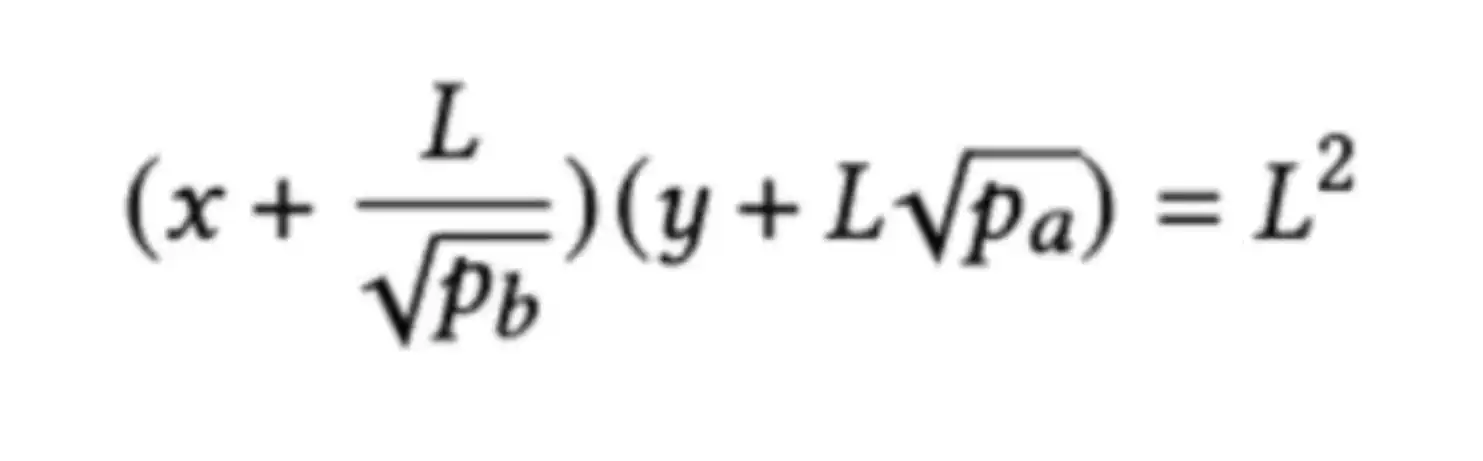
Due to the inability of LP to track market price changes in real time, once the price exceeds the selected range, LP will become a single currency liquidity, which will result in losses relative to the current market price.
When it comes to tracking market prices, institutions and professional investors clearly have an advantage. However, a recent data analysis indicates that investors providing liquidity for Uniswap V3 are overall in a state of loss, with transaction fees not exceeding impermanent loss.
https://twitter.com/thiccythot\_/status/1589022227437039616
Does the AMM industry really have to stick to the "xy=k" formula? Recently, the author has noticed a new design approach in the AMM industry and would like to share it here.
01 iZUMi's DL-AMM Model
DL-AMM model originates from iZiswap in the iZUMi product matrix. Its design concept was first proposed in a paper published by two co-founders of iZUMi in November 2021.
https://assets.izumi.finance/paper/dswap.pdf
This paper proposes an innovative algorithm to address the shortcomings of Uniswap V3. The following features are included:
1. Discretized Concentrated Liquidity
DL-AMM does not use a constant product formula, but instead places liquidity at discrete price points, with each price point following a constant sum formula (x + y = L).
Countless discrete price points are connected to form a complete AMM price curve similar to Uniswap. At the same time, when placing liquidity in the interval, DL-AMM uses a new "liquidity" quantification definition (L = x*p + y/p) to convert the integral summation of UniswapV3 into a geometric summation, which can also be efficiently completed in constant time.
2、Grouped Limited Liquidity
The liquidity in DL-AMM will be divided into two categories: LP liquidity and limit order liquidity. The former is the same as V3, while the latter is one-way. Once the target price is exceeded, the tokens will not be exchanged back and will be held until the user "claims" them.
If the intra-group liquidity has not completely crossed the target price, "claim" follows the principle of first come, first served. Traditional trading matching engines need to poll all orders at a price point. With innovative algorithm design, DL-AMM can complete matching in constant time for the first time, and ensure time correctness, fairness, and complete non-custodial security of funds.
Compared to Uniswap V3, the DL-AMM proposed by iZUMi avoids transaction slippage at each price point by applying a constant summation formula at different discrete price points, and combines discrete price points (and based on this, liquidity depth) to achieve on-chain order book functionality. Later projects such as Trader Joe's liquidity bin are based on the design of DL-AMM.
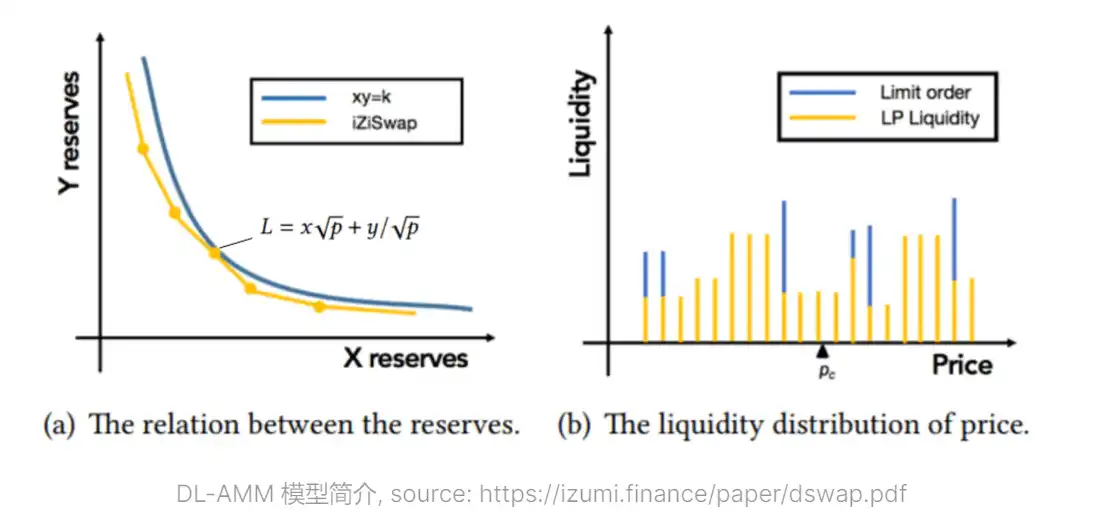
DL-AMM Model Introduction, source: https://izumi.finance/paper/dswap.pdf
As shown in the figure, the constant sum formula used by DL-AMM corresponds to different (p, L) for different discrete price points. The LP curve (yellow line) is different from the constant product formula (xy=k) used by Uniswap, as shown in the left figure.
You can see that if the price range is dense enough, the yellow line can approach the blue line infinitely, and there is no difference between the two in terms of actual trading experience and operation experience.
The right figure represents the support of DL-AMM for limit orders. Limit orders will be provided as a special LP (single currency) along with regular LPs to provide liquidity, which brings the limit order function to iZiswap that Uniswap cannot achieve.
Through these clever improvements, DL-AMM has expanded the potential of Uniswap V3 in limit order functionality and provided a complete on-chain order book function. Based on iZiswap DL-AMM's on-chain order book, it can perfectly avoid the technical difficulties encountered by traditional approaches and provide new development directions.
iZiswap was launched on May 20, 2021 and has undergone continuous iterations. Currently, the total value locked (TVL) in the entire chain is approximately $94.7 million.
iZUMi has launched iZiSwap Pro, which features an on-chain order book for spot pool matching (AMM mode). At the same time, the zero-slippage and MEV-resistant decentralized limit orders are also refreshing.
https://twitter.com/izumi_Finance/status/1603215989227032576
iZiswap has successively launched on multiple chains such as BNB chain/Arbitrum. Since its launch on ZkSync on April 21st, it has become the DEX with the highest TVL on ZkSync in just three weeks.
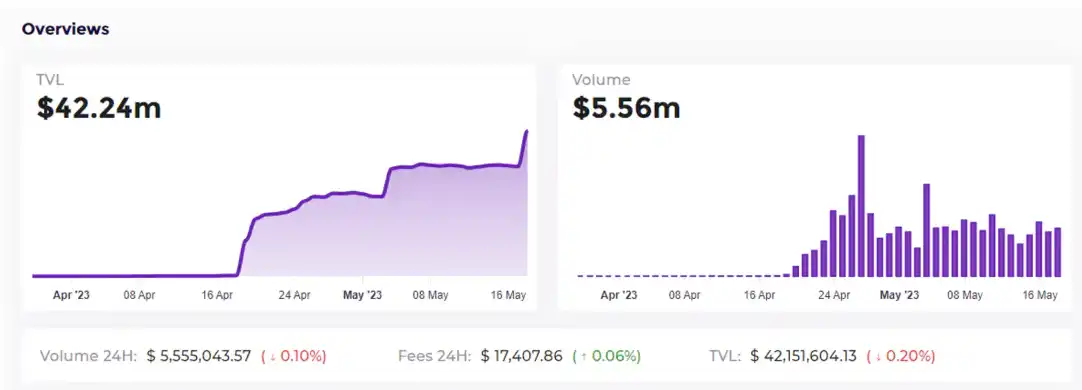
iZiSwap data on ZkSync
Currently, Ref finance on Near and Arctic on Aurora both use iZiswap's proprietary DL-AMM solution. The former is the largest DEX in the Near ecosystem, with a peak TVL of $270 million.
02 Trader Joe's Liquidity Book
Traderjoe follows the approach of DL-AMM and sets multiple discrete liquidity bins for LPs. Each LP within a liquidity bin is also defined by a constant sum formula (as shown on the left in the figure below).
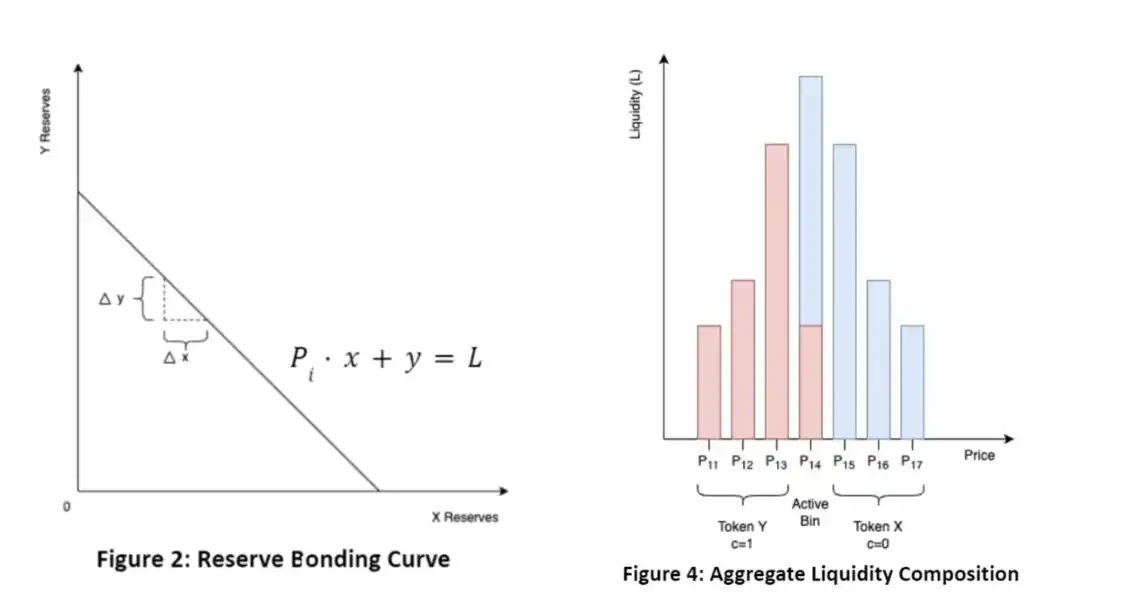
Each price box's liquidity is provided by multiple users. It can be easily deduced that the proportion of token Y in price box c is between 0 and 1, based on c being the ratio of the current market price in the price box.
Price boxes with prices greater than the market price have liquidity provided by token Y (c=0); price boxes with prices lower than the market price have liquidity provided by token X (c=1).
At this point, the design of Liquidity Bin is basically the same as DL-AMM, which means it can also achieve lower slippage.
On its official website, it also provides users with some liquidity addition strategies based on this, allowing users to freely match the flow box to achieve their own strategy combination.
https://help.traderjoexyz.com/en/trader-joe/liquidity-book/liquidity-strategies
For example, the "Bid-Ask" strategy shown in the following figure:
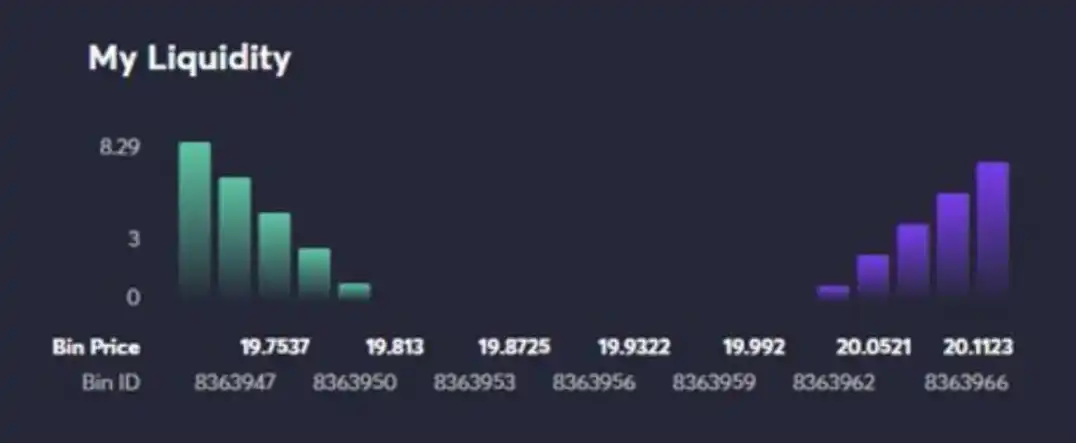
Liquidity Bin has designed a transaction fee mechanism that is correlated with price volatility in order to further reduce impermanent loss.
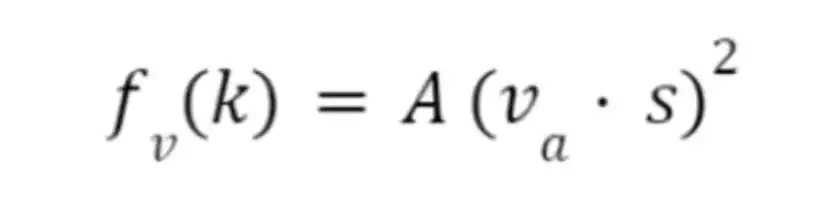
Its transaction fee includes not only the basic fee that is the same as the traditional mechanism, but also a variable fee (formula as follows).
This part of the cost is in quadratic relationship with the volatility accumulator (v_a) (s is the price box length). v_a is used to measure the degree of price volatility. If the price fluctuates too quickly in a short period of time, the variable cost will increase accordingly to reduce IL through stable fluctuations and attract liquidity when the volatility is too low.
Liquidity Book can be seen as a combination of iZUMi's DL-AMM concept and dynamic fees. Its core still lies in replacing the constant product formula of discrete price points with a constant sum formula for the global market. However, it currently does not support the functionality of Limit Orders.
Since the launch of Uniswap, xy=k has been the "Bible" of the AMM field, as it is simple and effective enough.
Due to the limitations of the xy=k formula, many teams have gradually begun to explore new possibilities. The DL-AMM model proposed by iZUMi is one of the practical and elegant solutions.
It can support both the trading depth and experience of the original xy=k model, as well as bring about a reduction in slippage and MEV, and new features such as on-chain order books.
I believe that there will be more innovations based on DL-AMM in the future, which will bring richer liquidity adding strategies to the chain, as well as the emergence of new applications (such as the chain's order book that users are unaware of), laying the foundation for technology.
DL-AMM will be the future? Let's wait and see.
Original link
Welcome to join the official BlockBeats community:
Telegram Subscription Group: https://t.me/theblockbeats
Telegram Discussion Group: https://t.me/BlockBeats_App
Official Twitter Account: https://twitter.com/BlockBeatsAsia

 Related Articles