Uniswap, the most successful US internet fintech company under the Web3 dividend.


With the support and coercion of various VCs such as a16z and Paradigm, Uniswap has embarked on a distinct style of operational and management development path. Following the collapse of FTX, Uniswap has become the most successful Internet Fintech company in the current Web3 world.
As of now, Uniswap's market share in the DEX market has exceeded 80%, with a weekly trading volume of up to $16 billion, far surpassing its competitors by several times. Recently, the team announced the launch of front-end transaction fee functionality, further highlighting their approach of separating from the protocol, and finding a feasible compromise for Web3 entrepreneurs.
Team Operation Institutionalization: Compliance, Compliance, or Compliance
As an absolute leader in the DeFi industry and a typical symbol of the Web3 permissionless world, Uniswap's every move is influencing the direction of the entire industry. However, upon closer observation, we will find that Uniswap is not like a "Web3 team" defined by mainstream, but rather a US internet startup company.
It can be said that Uniswap is truly unique in the Web3 world, and this is partly reflected in its "corporatized" team operations and management.
"全美团队", Uniswap's executive appointment and employee management
From the personnel appointments of Uniswap Labs executives, you can't tell that this is a Web3 startup team at all. From regulatory compliance to experience in internet giants, Uniswap has everything.
On May 19, 2022, Uniswap announced in their blog post that Salman Banaei will be the new head of policy at Uniswap Labs. The announcement can be found in the official blog post at https://blog.uniswap.org/welcome-salman-banaei.
Before joining Uniswap Labs, Salman worked in public service at the US Commodity Futures Trading Commission (CFTC) and later on public policy at Chainalysis. During his time at the CFTC, Salman led the Dodd-Frank Act team in implementing reforms to the US derivatives market after the financial crisis, earning recognition from then-CFTC Chairman Gary Gensler (yes, that Gary Gensler) and receiving the Outstanding Employee Award.
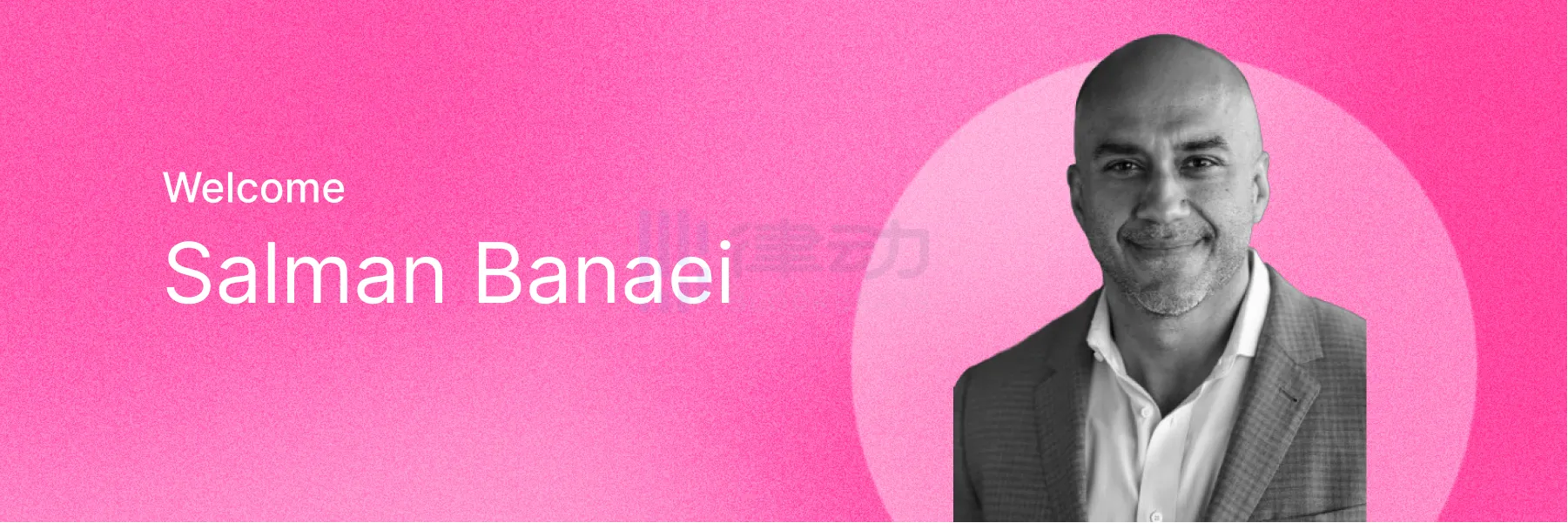
In Uniswap Labs' appointment announcement, Salman wrote: "Uniswap Labs reflects the goals of the Dodd-Frank Act to democratize the market and Nakamoto's goal of reducing friction in value transfer. The Uniswap protocol it created is a breakthrough invention that can achieve the goals of the series of Dodd-Frank reforms we are working to implement at the CFTC. Like previous internet protocols, the true potential of this technology can only be realized through constructive and active participation by public sector leaders."
Earlier this year in March, Uniswap hired Chad DePue, former Senior Engineering Director at Snap Inc., as the Vice President of Engineering for Uniswap Labs.
During his tenure at Snap, Chad DePue led the development of several popular mini-programs such as Snap Minis, Snap Kit, and PlayCanvas. He later served as CTO at Whisper App before moving on to become Vice President of Engineering at BlackBerry and Developer Tools Lead at Microsoft. Upon joining Uniswap, Chad's main focus is to bring his experience in building simple, secure, and seamless products (including mobile products) to the Uniswap Labs team.
Chad DePue stated in his announcement of his appointment that Uniswap founder Hayden was a key reason for him joining the Uniswap team. "When you meet Hayden, you quickly realize that he is one of the few people with the vision and wisdom necessary to have a huge impact... The strong leadership of Hayden and others based on an inclusive vision and ethical commitment is crucial for Web3 to attract the next wave of users."
On July 21st, Uniswap announced the heavyweight executive Will Ruben joining as Vice President of Product.
Will Ruben was in charge of the Web3 social experience in Coinbase and its wallet application as part of the leadership team. Prior to Coinbase, Will spent 9 years at Meta (formerly Facebook) as the head of the Feed and Relevance departments for the Instagram team, leading the release of key products such as Instagram's content ranking algorithm and interest search.
Will wrote in his appointment announcement: "After working for ten years in a large technology company, I was attracted by the challenges and opportunities presented by a smaller, more entrepreneurial company with great development potential in the next ten years... Without a simple and high-quality user experience based on the web3 protocol, we cannot unlock universal ownership or make the global financial system more inclusive. Uniswap Labs is at the core of this work, and I am excited to bring my experience in building consumer products on a large scale (especially mobile products) to this outstanding team."
Compared to most leading Web3 projects, Uniswap has a very comprehensive and compliant process for employee recruitment and management, in addition to its absolute advantage in the executive level.
According to BlockBeats, the Uniswap team currently has over 100 employees with clear job responsibilities. When you visit the Uniswap official website and open the recruitment page, you will see the following sentence:
"The Uniswap protocol is the largest decentralized trading and automated market-making protocol on the Ethereum network... The Uniswap Labs team is the main contributor to the Uniswap protocol and is now focused on building a suite of products to support the Uniswap ecosystem. Our team is one of the most influential in the cryptocurrency industry and our headquarters are located in the SoHo district of New York City. Depending on the position, we offer the option for partial or fully remote work."
Currently, Uniswap Labs is mainly divided into three departments: Engineering, Growth and Strategy, and Finance and Compliance. Among them, the Engineering department has the most positions, with 7 open positions for recruitment. By entering the job details page, we can learn about the full-time employee benefits offered by Uniswap Labs:
1. The minimum annual salary is $180,000 to $220,000, disclosed in accordance with the New York City Salary Transparency Act.
2. Equity, tokens, and other compensation elements are determined based on the specific job position type.
3. Unlimited and encouraged vacation, as well as up to 16 weeks of paid parental leave;
4. All medical expenses for myself and my family members will be reimbursed.
5.401(k) Plan (American retirement plan);
6. $1,500 education allowance per year;
7. Remote employees are provided with a home office setup allowance, while New York headquarters staff are provided with lunch.
Additionally, Uniswap Labs is an EEO (Equal Employment Opportunity) employer and provides equal employment opportunities to qualified individuals with disabilities in accordance with US law. According to their official website, Uniswap Labs aims to have at least 7% of their employees be individuals with disabilities. As such, applicants are required to fill out a detailed questionnaire when applying for a position and must re-fill it every 5 years after being hired.
However, there is a prerequisite to obtaining these highly attractive benefits - you must be a legal worker in the United States and "all benefits require payment of corresponding taxes."
Previously, BlockBeats reporter had reported on the front line during the Token2049 event. Mary-Catherine, CEO of Uniswap Labs, stated at the event that Uniswap's team is located in the United States and has a physical office in New York City. However, despite this, Uniswap's products, wallets, and web applications are available globally. Uniswap is actively focused on the growth of the Asian market and is committed to making Uniswap an international product brand.
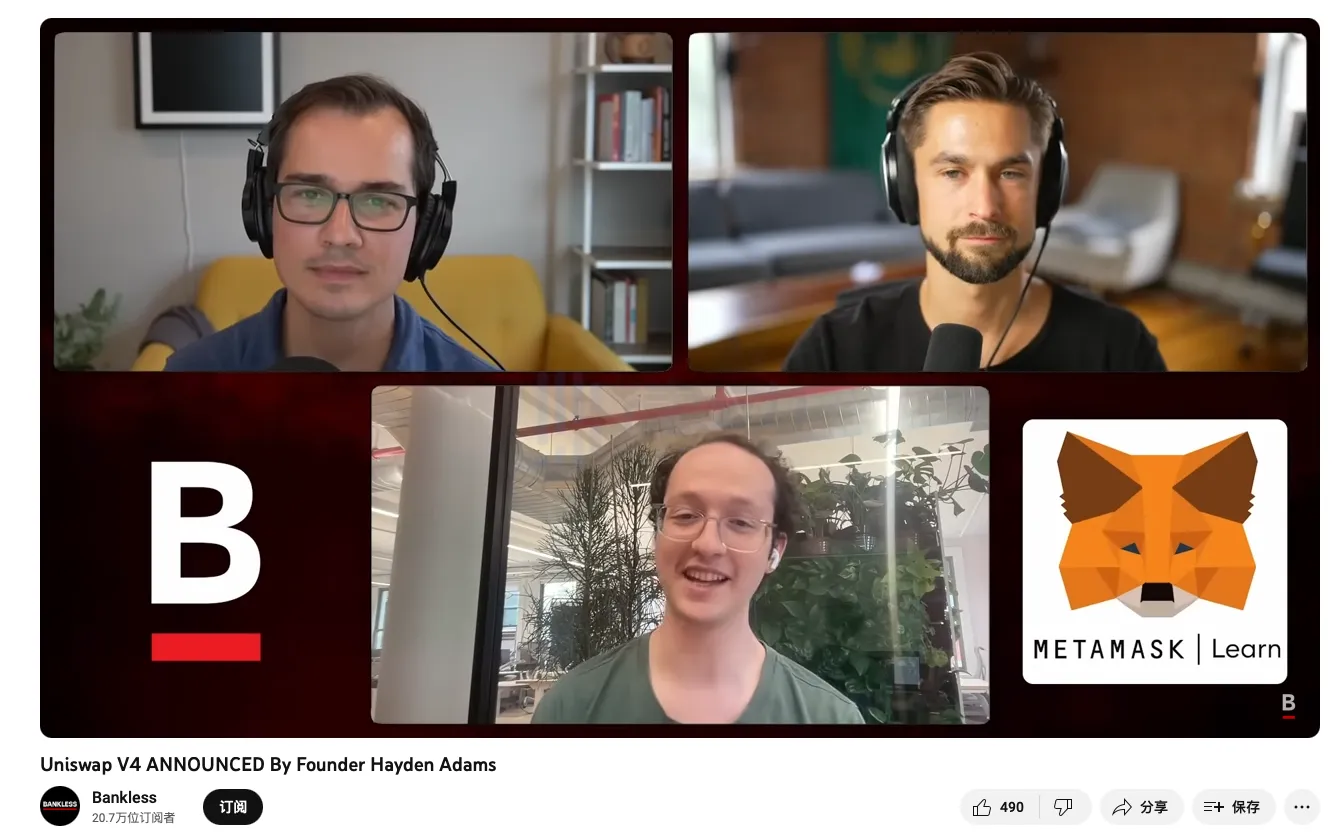

Going back to 2018, Ric described his deep friendship with Hayden and the joint efforts they made for the cryptocurrency industry and the Uniswap project. At that time, Ric was the CEO of Balance.io, a company that focused on providing interface services for Dapps on Ethereum. Ric believed that most Dapps had a lot of room for improvement, so he funded multiple projects including WalletConnect, The Graph, and Uniswap.
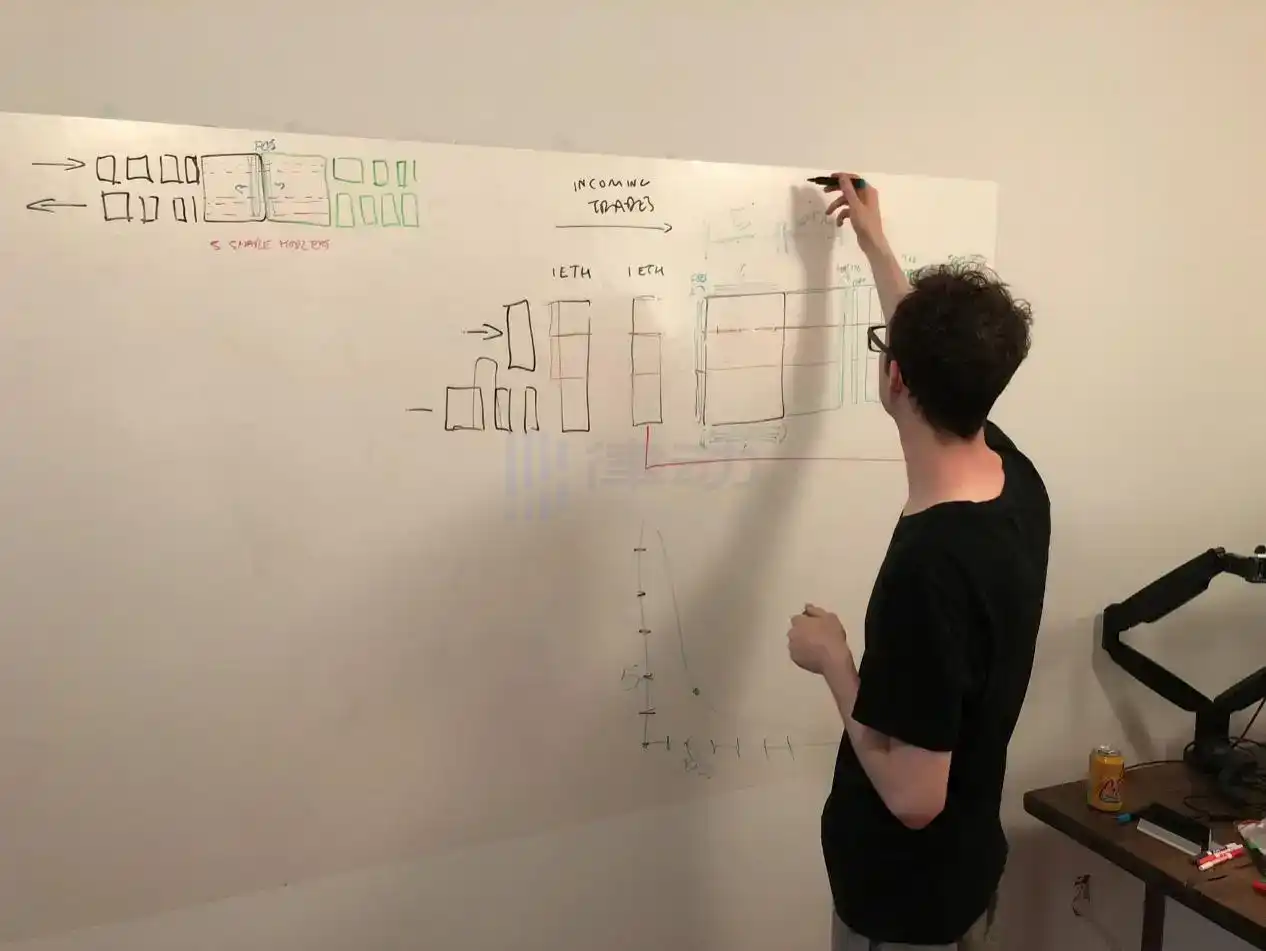
Hayden's unique insights into Automated Market Makers (AMMs) and his passion for the project piqued Ric's interest, prompting him to offer assistance. During that time, the two had an exceptionally close relationship, with Ric even referring to himself as a friend willing to "take a bullet" for Hayden.
However, as time passed, especially in March 2019, things began to change. Ric received an email from one of the co-founders of Balance during his grandmother's funeral, telling him that he needed to resign from his position as CEO. Meanwhile, the situation with Uniswap was improving, as Hayden Adams successfully raised $1 million in funding. Ric had originally thought he would be invited to participate in this project, but Paradigm's involvement changed everything.
After discovering that he did not receive Uniswap dividends, Ric felt deeply betrayed by Hayden. It wasn't until the UNI Token plan began that Hayden brought up the issue of "repayment," but with the condition that Ric sign an NDA. In a fit of anger, Ric decided to sue Hayden.
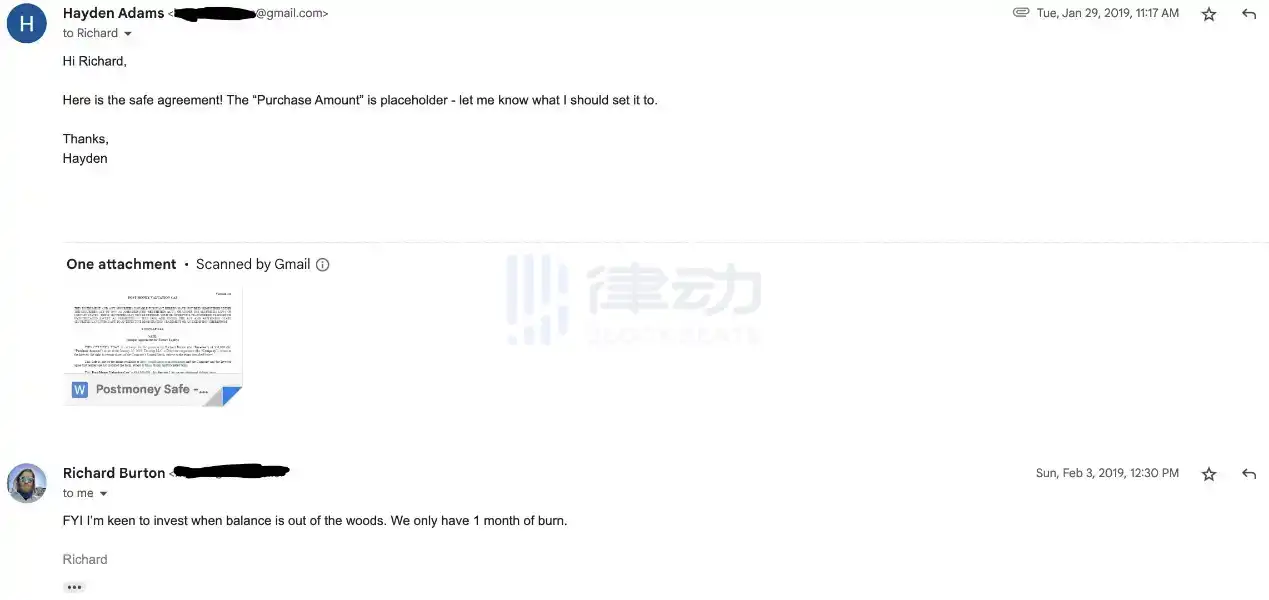
Hayden responded by saying that Ric's comments were extremely misleading and completely false. "At the time, Ric Burton did have the opportunity to invest in Uniswap. I sent him a Simple Agreement for Future Equity with the amount left blank so he could fill in the amount he wanted to invest. However, he chose not to do so because his company, Balance, could only sustain operations for about a month at the time."
Finally, both sides compromised and Hayden also expressed gratitude to Ric for his role in the development of Uniswap, and will not make any further response.
To outsiders, Ric's Drama seems to have left Hayden with the impression of "mutual aggression with investors". However, in reality, Uniswap is closer to a shareholder-controlled corporation than any other project in the Web3 team, and this board of directors is made up of several giant VCs behind Uniswap.
"Major Shareholders" Invade, Capital's Support and Hostage of Uniswap
On August 6, 2020, according to SEC documents, Universal Navigation Inc., the development company behind Uniswap, completed a $11 million financing round on June 5. The round was led by a16z, with participation from USV, Paradigm, Version, and others. Silicon Valley Web2 capital giants entered Uniswap at this time.
In the governance game of Uniswap DAO, a16z is undoubtedly a key player. They not only actively participate with their own 15 million UNI votes, but also delegate governance rights of about 40 million UNI to multiple external organizations. One of the most impressive examples for the community is that when the decision was made to deploy Uniswap V3 on BNB Chain, over 80 million UNI votes participated, far exceeding 50% of the UNI votes participating in governance voting.
Uniswap had originally planned to enter BSC through Wormhole, but a16z unexpectedly voted against it, hoping to open up a path for their investment in LayerZero. Meanwhile, a16z's competitor Jump Trading has explicitly stated that they support Wormhole. When the dust settled, Wormhole became the bridge for Uniswap DAO governance based on Ethereum on BNB Chain due to the voting advantage of UNI tokens it received.
From the perspective of absolute votes, the so-called community of Uniswap is actually insignificant. The real "decision-makers" behind the development of Uniswap are still the capital giants behind it.
According to DAO governance researcher @lurenbian's observation, after the entry of giant VCs, the temperature test of Uniswap DAO has soared from an initial participation of only 34,000 UNI votes to nearly 30 million votes for the latest proposal. Official data shows that a total of 31 proposals have been submitted, of which 28 have been implemented, demonstrating a pass rate as high as 90%.
Among these proposals, multi-chain deployment has become the main theme, but the regularity of the vote changes is not strong. @lurenbian told BlockBeats in an interview that for operations such as multi-chain deployment, VCs almost never reject them as long as they are legitimate. For projects on the target chain, being able to access Uniswap liquidity is a win-win situation for VCs without any harm.
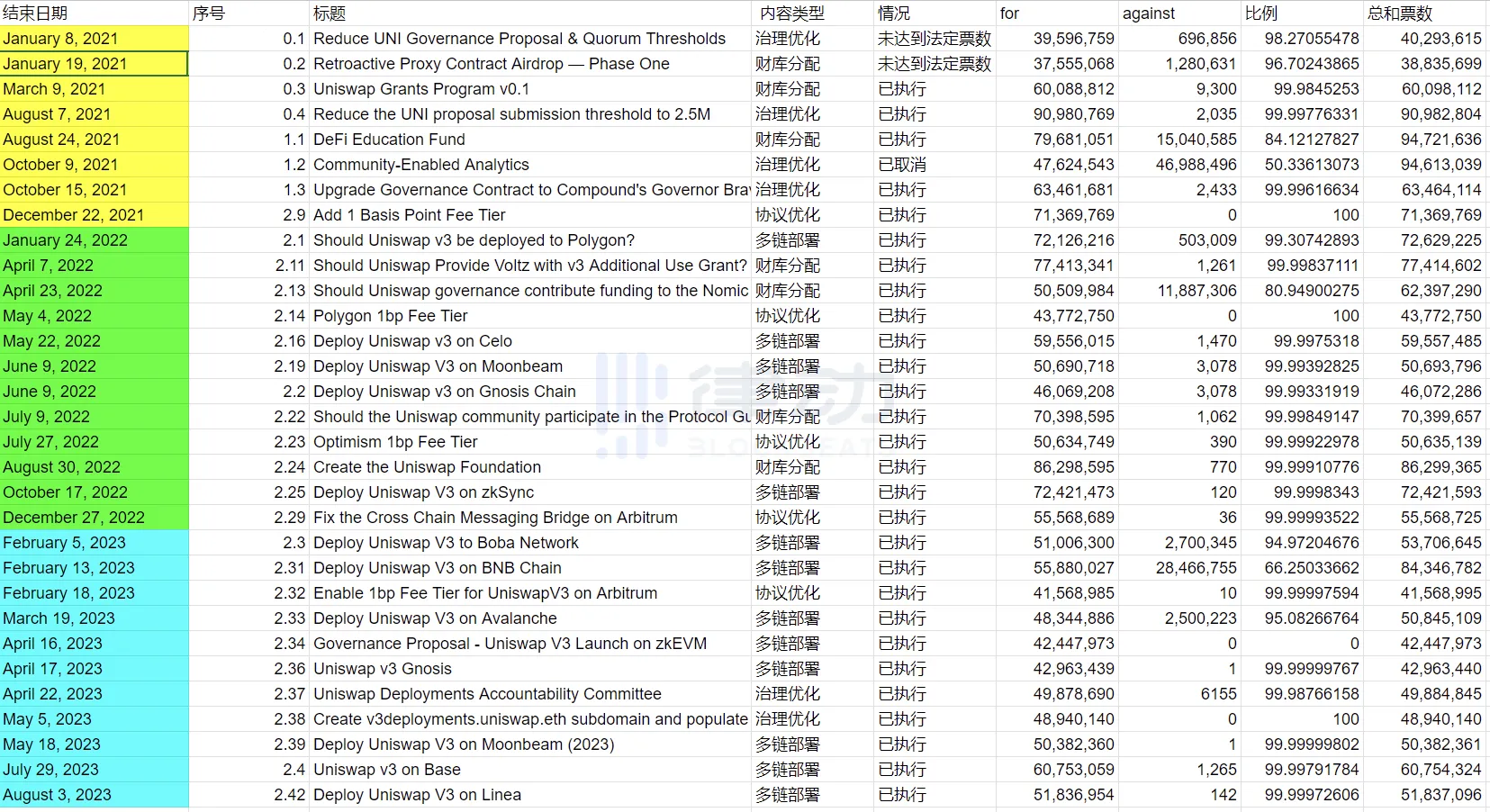
Another example of this is the Educational Fund case. After selling 500,000 UNI and receiving 10.2 million USDC, a proposal regarding the DeFi Education Fund (DEF) sparked strong dissatisfaction within the Uniswap community. The proposal ultimately received 72.64% of the vote and, after announcing the allocation of 1 million UNI from the Uniswap treasury, DEF will disclose a detailed budget within 90 days. However, things did not go as expected. Before the community could understand how the 1 million UNI funds were allocated, DEF suddenly announced that 50% of them had been sold.
Some observers from the community have questioned whether the proposal was led by a16z, a major investor in Uniswap, and whether there was a situation of "proposing and voting for oneself". Although all doubts were dispelled after Uniswap founder Hayden expressed support for DEF, the community has gradually realized that in the so-called governance of Uniswap DAO, only "major shareholders and board members" have the final say.
Product strategy follows the Web2 approach: Orthodoxy takes a back seat, market share becomes the core
In the process of pursuing market advantages, Uniswap clearly did not simply follow the open and decentralized philosophy of traditional Web3 teams. Uniswap Labs has adopted more of a Web2 product strategy, which aims to quickly attract and retain users, ensuring its leading position in the competition of decentralized trading platforms.
Business License, Plagiarism, a Classic Internet Story
In June of this year, Uniswap announced the release of version 4, nearly two years after its previous release, causing a stir in the community. While the introduction of Hooks in V4 has been dubbed the "DEX killer" by many, what is more noteworthy is the continuation of the BSL commercial license from V3, which has doubled its effective time, along with significant updates to the product side.
The Business Source License (BSL) aims to find a balance between the open source spirit and commercial needs. During the effective period, third parties are not allowed to use the source code for any commercial activities without permission. For Uniswap, this is another business killer move besides its product innovation. It is precisely because of the protection of BSL that Uniswap V3 has been able to flourish in its era. After the two-year BSL effective period of V3 ends, various V3 Forks have emerged one after another.
Therefore, when Uniswap implemented the BSL commercial license for V4 version, this decision once again caused considerable controversy in the developer community.
Uniswap founder Hayden firmly believes that BSL is the correct decision that best fits the Uniswap community. During the ETH Paris event, Hayden responded to BlockBeats' question on this matter, saying, "This is entirely dependent on governance decisions." Hayden stated that UNI holders who disagree with this choice can propose changes through governance voting. However, in the eyes of most people, there is no substantive difference between "them" and Uniswap's "VC shareholders".
Interestingly, while the "license dispute" surrounding version 4 has not yet subsided, Uniswap has been hit by a "plagiarism controversy".
On July 17th of this year, BlockBeats reported that decentralized exchange platform Uniswap announced the launch of its non-custodial, Dutch auction-based protocol, UniswapX. According to official announcements and documents, UniswapX will gradually achieve many functions such as aggregating liquidity sources, resisting MEV, and enabling gas-free transactions, with the aim of gradually catching up with centralized exchanges (CEX) in the DEX space.
UniswapX was highly anticipated upon its release, and Paradigm researcher Dan Robinson gave high praise to UniswapX on social media, stating "I believe UniswapX has changed the game rules for decentralized exchanges, MEV, and interoperability."

However, the community quickly pointed out that UniswapX was copying the CoWSwap mechanism, and the previously released V4 version was suspected of copying CrocSwap. Curve Finance responded to Dan Robinson through its official Twitter account, "Dan, forgive me for being blunt. The rules of the game changed a long time ago: when 1inch first conducted high-quality aggregation, and when CoWSwap introduced the Solvers model. UniswapX is good, but it is not the creator, nor even the second player."
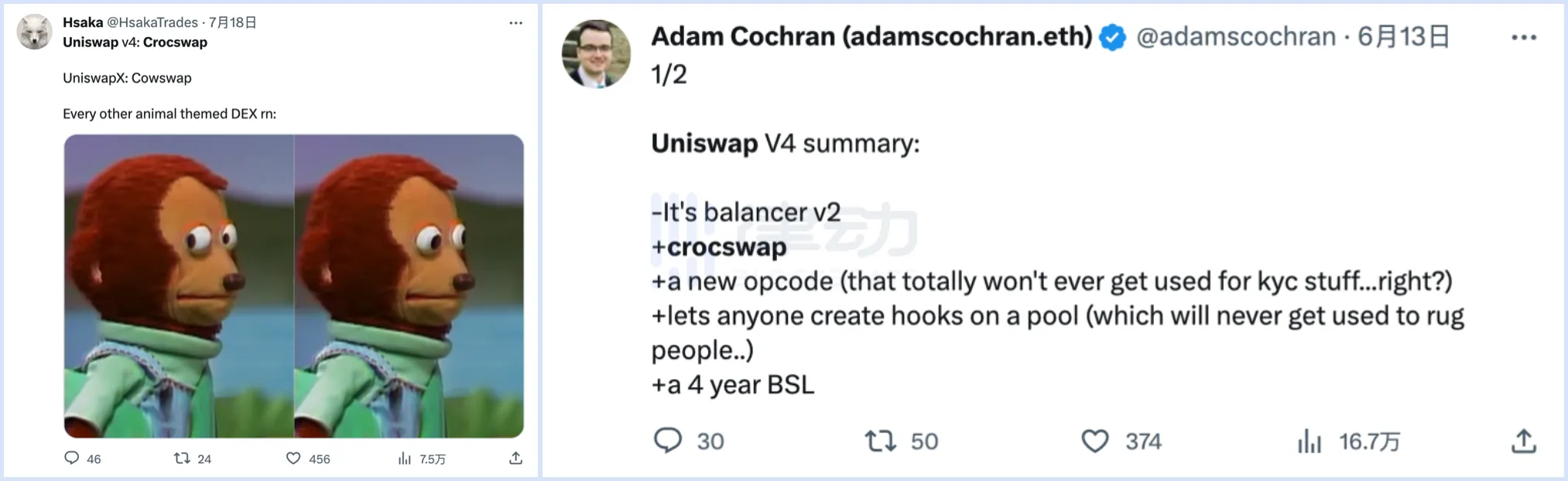
CoWSwap's official account also tweeted several times, welcoming Uniswap to further validate its trading design, while mocking Uniswap's imitation of its mechanism.
Related reading: "Uniswap: Praised and Criticized, Is It Really the "Tencent of the Crypto Industry"?"
When responding to the "V4 plagiarism issue," Uniswap Labs developers, like BlockBeats, stated that the Uniswap team had started developing the V4 version two years ago. It was just that the CrocSwap team released their whitepaper earlier, but the product development was too slow. They were forced to hurriedly release their own new product only after Uniswap launched V4.

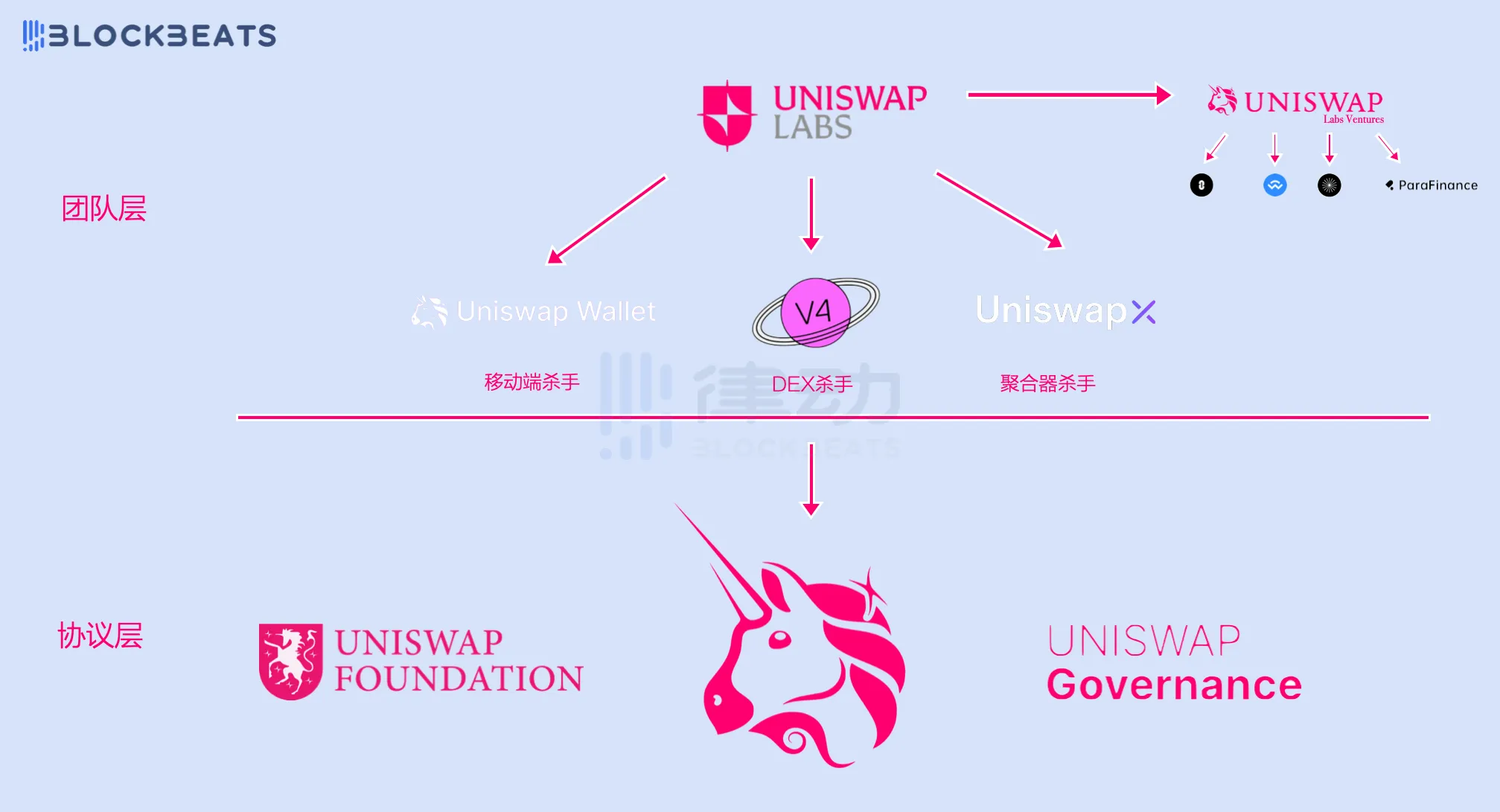
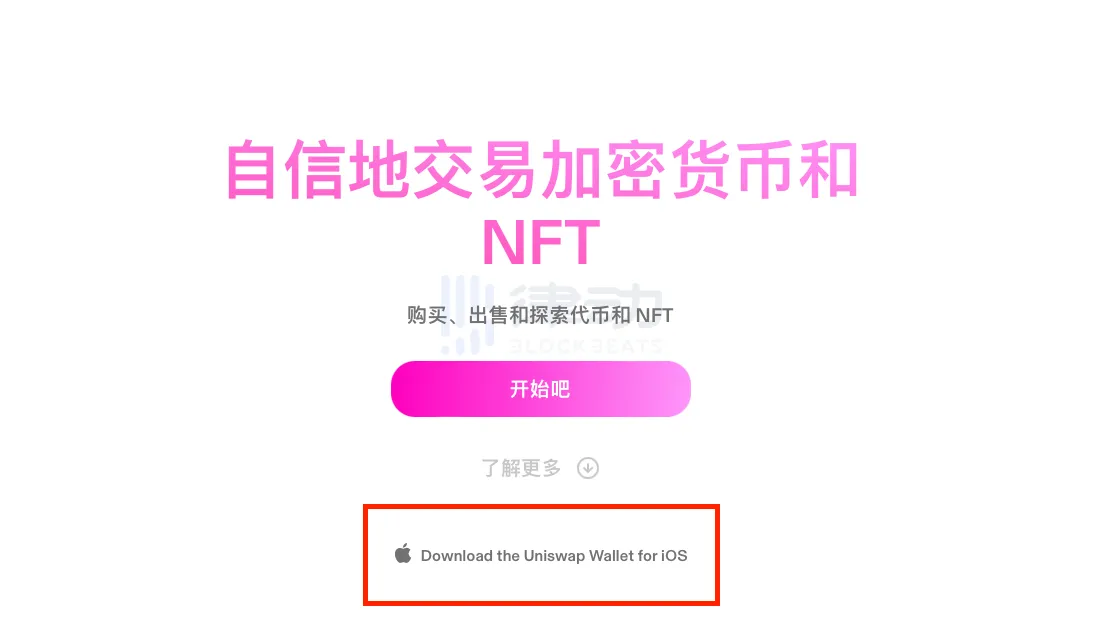
With the promotion of the mobile Uniswap Wallet product, the Uniswap team can attract both Web3 and Web2 users, as well as compete with Web3 wallet products launched by exchanges such as OKX and Bybit. Additionally, by enabling front-end fee functions on both web and mobile platforms, Uniswap Labs can generate significant cash flow revenue without regulatory risks, killing three birds with one stone.
When BlockBeats asked about the potential monopoly issue of Uniswap, a team member raised their hand and said, "This is not a problem we need to consider."
"On November 2, 2018, Uniswap was publicly announced and deployed on the Ethereum mainnet. At an exciting and anxious moment, I posted a public announcement tweet to my approximately 200 fans. For many people, this was the first time they had heard of this project. For me, it was the highlight of over a year's work and a tremendous help along the way. Uniswap changed my life."
On the Uniswap official blog webpage, you can find the history and vision statement written by Hayden in the early days of Uniswap. In the article, Hayden expressed his original intention of creating Uniswap: to bring Web3 to everyone. The links to the history and vision statement are available here and here.
You have to admit, Uniswap did it. At the same time, it has also found a feasible compromise path for countless Web3 entrepreneurs in terms of economic returns and protocol development, that is, the separation of team and protocol.
During an interview with BlockBeats, an Amazon Web Services employee said, "Currently, the needs of Web3 clients (teams and project parties) are very simple, just nodes and APIs. Ultimately, this is because Web3 applications do not have real consumer demand. In comparison, the needs of CEX clients are much more complex."
In fact, in a Web3 world where all interactions rely on Web2 cloud providers, Uniswap's approach can provide valuable insights for Web3 entrepreneurs.
In the development process of Web3 in the future, entrepreneurs don't need to emphasize "decentralization" anymore, but focus on protocol innovation and openness. By creating open protocols with practical C-end application scenarios, and using C-end customer demand and front-end API fees to generate revenue, sustainable development can be achieved. Backend contract calls can still be implemented without permission, like Tornado Cash, which may be the true future of the Web3 world.
Of course, the most awkward thing is the UNI token, as well as the tokens of all projects that adopt this approach in the future. UNI itself is a product that emerged under the pressure of Sushi Swap's vampire attack. After Uniswap Labs and the protocol were further separated, UNI's role became even more awkward. If it plays the role of team equity, UNI is subordinate to the Uniswap protocol rather than Labs, which are two different entities. At the protocol level, VC giants will not agree to empower UNI aggressively due to regulatory factors.
Ultimately, users are still paying for their beliefs. However, there is also a saying: assets without empowerment are the most imaginative assets.
Welcome to join the official BlockBeats community:
Telegram Subscription Group: https://t.me/theblockbeats
Telegram Discussion Group: https://t.me/BlockBeats_App
Official Twitter Account: https://twitter.com/BlockBeatsAsia