Don't let Pond's fool you. Web3 games must become truly decentralized
Article Title: Stop being Fooled by Pond's, Web3 Games Must Go Truly Decentralized
Article source: TEDAO
Introduction:
Why do so many Web3 games end up as ephemera or Pond's endorsements? This is because they are all centralized in nature. The token economy model, however well-designed and optimized, is only a more subtle and subtle form of Ponzi deception. Only by starting from the ground up and building a truly decentralized game, with bottom-up protocols designed to use the token model as an aid, can the game economy become sustainable and avoid GameFi's problems and move towards Web3 Gaming. Building a truly decentralized Web3 game requires a much more sophisticated infrastructure.
"Preface"
Games have long been seen as a potentially important application area for Web3. However, like anything that is new, the first generation of Web. The game has many flaws. These games are often hard to play, full of gimmicks and lack real substance. Because of excessive financialization, it attracts a lot of speculators, and real gamers don't want to get into these games. These games focus too much on the game economy and token model, but ignore the core essence of Web3 games -- decentralization. In the end, the so-called "players" left the game when they found that they were not making a decent amount of money.
To achieve true decentralization, move towards it. Web3 Gaming, Next generation Web3 Games need to take advantage of verifiability, asset ownership, and programmability. At the same time, you need to focus on building a true game cycle of user acquisition and retention, not just token speculation. The real focus is on the unique advantages that Web3 games have shown over Web2 games, which offer players unprecedented gaming experiences and are expected to reshape the future of the gaming industry. At the same time, many big game studios are moving into the blockchain space and linking their game IP. This will bring more opportunities and recognition to Web3 games, as well as increasing the vitality of the industry. These studios combine their game worlds with blockchain technology to bring new gaming experiences and more possibilities to players.
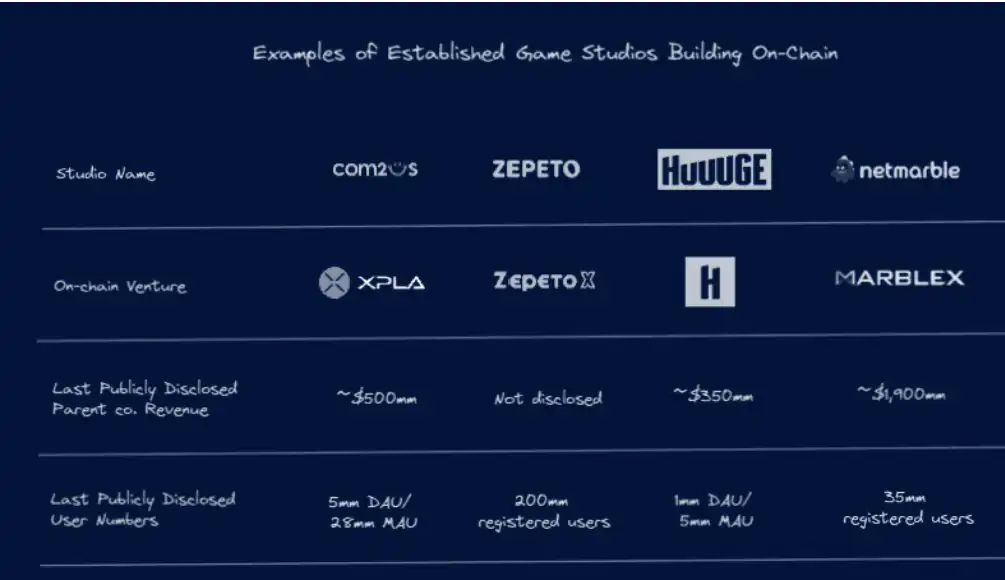
Photo credit: Jump Crypto The current conditions for on-chain games are relatively basic. What we need is perfect infrastructure. Only with perfect infrastructure can users enjoy the same smooth and pleasant experience in Web3 games as traditional games. Web3 The types of games, features and innovations, and the infrastructure needed to make them happen.
Part 1 Classification of Web3 Games
True decentralization is necessary, yet complete decentralization may be difficult or even unrealistic at first. More centralized vision and control is often necessary in the early design stages of the agreement/project to facilitate easier implementation of Product-Market Fit. In addition, Web3 games are limited by infrastructure and other factors. Thus, Web3 games can be progressively decentralized, but the key is to ensure that early protocol/project design is in preparation for true decentralization in the future.
According to the degree of the chain, that is, the degree of decentralization, Web3 Games are divided into the following types: optional on-chain games, half-chain games, and full-chain games. (Note: This is a reference to Jump Crypto's classification of Web3 games)
Type #1: Optional on-chain Game (Optional Cosmetic Mints, OCM)
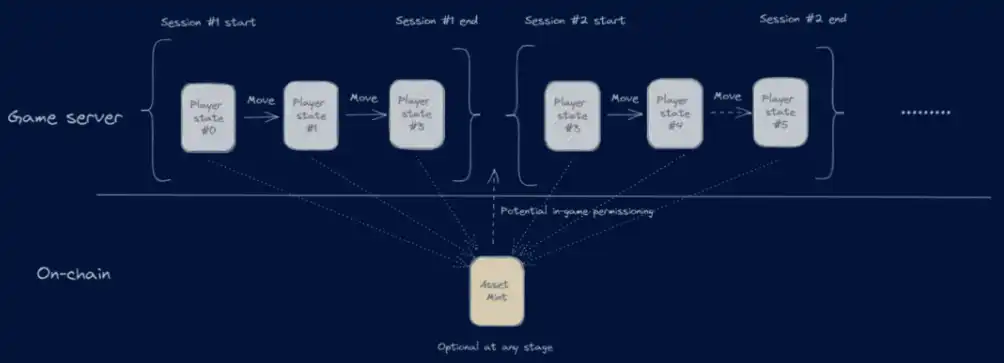
Photo credit: Jump Crypto
"Optional online games" are essentially centralized. Much like traditional Web2 games, the title and status updates of game assets are recorded in an off-chain database, and the distribution of game assets and currency is managed by a centralized organization. However, unlike traditional games, players have the option to mint some of their in-game assets into NFT and chain them up to allow for free circulation of assets. At the same time, the game developer will also sell some rights or features to the player in the form of NFT.
However, the game project and developer still have the subjective power to decide whether or not a lot of information is available to the player. With the current infrastructure, full-chain and half-chain games can be too much of a drag for players. An optional chaining game is probably the easiest to accept because it has the least resistance to the player.
Type #2: Half-chain Game (On-chain assets, OCA)
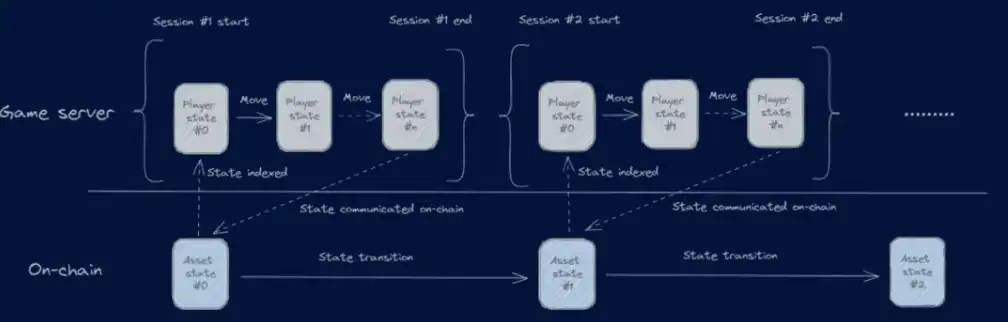
Photo credit: Jump Crypto
"Half-chain play" is not truly decentralized. It is a form of play where player assets are stored on the chain, but the actual game action is still taken down the chain. This format is common in most Web3 games today. Half-chain games solve the problem of verifying asset ownership and asset programmability, focusing on the items and properties in the game, and paying less attention to the rest of the game state.
It introduces a trust-free mechanism that allows players to make secondary sales within the game, resulting in a verifiable economy of game assets. This type of game is suitable for games that are action-packed and feature-rich, such as massively multiplayer online role-playing games and first-person shooters. However, such games require strong infrastructure, including fast indexing, standards that can update information about items on the chain, and data relay devices that can transmit in-game state to the blockchain and automated execution based on relay data. Without these facilities, it will affect both the player experience and the developer's acceptance.
Type #3: Fully on-chain games (FOC)
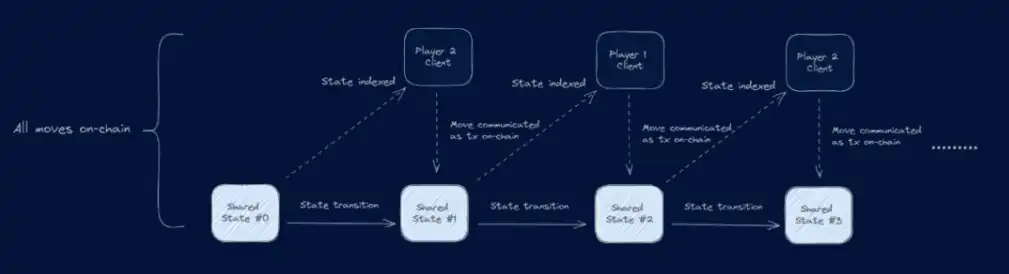
Photo credit: Jump Crypto
Also known as "full chain game", is a true decentralized game. Instead of a traditional centralized game server, it uses blockchain to store all players' data on the chain, index and write it. The on-chain shared state records not only the data related to the asset, but also all the information related to the game state. This approach makes the game durable, censor-resistant, and self-developed by the community.
However, due to the lack of adequate infrastructure, the frequent status updates involved in the game, and the associated gas costs, will limit the design space. That's why we need to focus on improving the game infrastructure.
To sum up, to achieve the same smooth "full chain game" and "half chain game" experience as the "optional chain game", and gain more advantages, the key is to establish and improve the adaptation infrastructure. A progressive decentralization approach can be taken while improving the infrastructure.
No matter what type of on-chain game is used, the game project should proactively disclose information about what parts of the game are connected and what parts are not connected before it is truly decentralized. Once the game is deployed, through the DAO, the community can participate in the governance and operation of the game, including adding and changing game parameters and rules.
Part.2 Web3 game Features and Innovation
Web2 games and Web3 games have very different characteristics. Web2 games use a closed system where game assets circulate within the game, have little interaction with external markets, and are free of financial activity or market manipulation. Game developers are free to tweak the parameters and rules of the game from the perspective of God to make the game more entertaining. Web3 games, on the other hand, build an open game system, so that game tokens and assets can circulate freely in the external market and generate financial behavior, and players have the opportunity to get rich returns through tokens. In addition, the decentralized nature of Web3 games has brought a number of innovative elements to game design, creating entirely new gaming experiences and developing new types of games. Next, we'll take a closer look at the features and innovations of half-chain and full-chain games. (Note: All of the benefits of half-chain games mentioned below apply to full-chain games, but the benefits of full-chain games may not apply to half-chain games.)
Half-chain game
1. Composability: An important factor in building a truly decentralized gaming ecosystem. Through the interaction and sharing of data between different games, players can enjoy a coherent gaming experience across multiple games without being confined to a single closed game world. This also promotes collaboration and innovation among game developers and enhances the interaction and growth of the game community.
2. Player participation in creation: By storing game assets on the chain, anyone can create content around those assets without prior permission. This openness increases the possibility of user-generated content, expands the reach of games, and allows users to create more playable games than Web2 games.
3. Player asset Risk under Centralized control: This type of game focuses on the design of the game economy model. Although game assets are linked, key elements related to the asset, such as core metrics and rules, are not fully linked and are still controlled by the game and developer. This gives them a certain amount of control and room for manipulation, and means that the value of game assets in the hands of players can be affected by centralized regulation, and in some cases can be reduced to zero instantly. This is a huge blow to players who have invested a lot of time and effort to acquire precious items or virtual wealth. Even worse, the value of the so-called permanent assets in the player's hands is almost wiped out when the project becomes unprofitable and runs away from the game.
Full chain game
1. Player-driven economies and autonomous game worlds: In a truly decentralized environment, economies are driven by the actions and decisions of players, rather than by game developers or central authorities. Players trade, cooperate, or compete to acquire and manage in-game assets and resources. At the same time, players can also participate in the governance of the game and make rules, to achieve the autonomy of the game world. This player-driven economy and autonomous game world gives players a richer, freer experience.
2. Continuous game experience and state tracing: Serverless architecture and on-chain storage enable game persistence, independent of developer servers. The player can continue playing without being affected by the server. Zero-knowledge proof is adopted to protect privacy without disclosing operational details. Full-chain games avoid tracking and verification by central authorities, and enhance player data privacy and game reliability.
When building a truly decentralized Web3 game, a fully decentralized architecture is required to enable continuous gameplay experience and state traceability. Such games will build player-driven economies and autonomous game worlds, providing unprecedented gaming experiences.
However, if Web3 games are not truly decentralized and lack public transparency, a number of problems can arise. Game parameters and rules change directly affect entertainment and financial behavior, may cause market manipulation suspicion, and even face legal restrictions and investigation. Therefore, when building Web3 games, it is critical to ensure true decentralization and transparency in order to maintain the fairness and credibility of the game.
Part 3 Moving beyond token economy and embracing Decentralization
Early Web3 games relied too much on the token economy, resulting in many games eventually going Pond's way or dying out quickly, raising questions about the sustainable development of Web3 games. Real gamers begin to wonder if it's worth the time and effort invested in such games. To achieve long-term growth in the game economy, we must move beyond the token economy and embrace true decentralization. However, to achieve this goal, sound infrastructure is also indispensable. Next, we'll look at some typical infrastructure projects today.
| StarkNet
StarkNet was created by StarkWare. The L2 solution, known as the Arsenal of on-chain gaming, is used to create an off-chain execution layer on Ethereum.
StarkNet uses zk proof to enable low-cost and fast transaction processing on Ethereum. It works by processing multiple transactions in bulk and effectively publishing this data to the Ethereum network. StarkNet is more popular and affordable because it can split the cost of Ethereum verification. In fact, as the volume of transactions increases, so does the cost.
In addition, StarkNet offers a native account abstraction and contract wallet, which is more suited to the interactive needs of on-chain games. In terms of ecological construction (see the picture below), StarkNet focuses on the cultivation of native applications, co-hosting hackathons with partners, and successfully incubating many on-chain game ecological projects. For more details and a roadmap for the future, see StartNet Community Information.
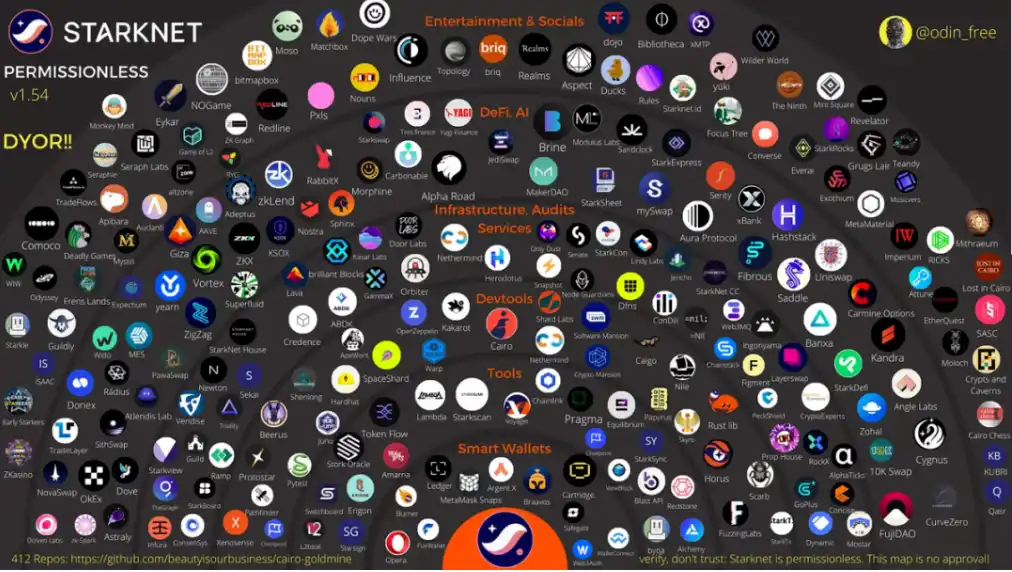
Photo credit: @odin_free
| MUD
MUD, a Solidity based full-chain game engine developed by Lattice Studios, is one of the more mature projects in the field. Muds can help developers quickly deploy game logic into smart contracts and synchronize it with client state, thus greatly improving development efficiency.
In large-scale game development, the game engine plays a key role. For full-chain games, similar tools are needed to quickly deploy game logic, reduce development time, and provide data standards to facilitate iterative development and interoperability in an open ecosystem.
But while MUDs are an excellent framework and have been successful with full-chain Opcraft-like games, there is still a lot of room for exploration and development as an infrastructure for game development.
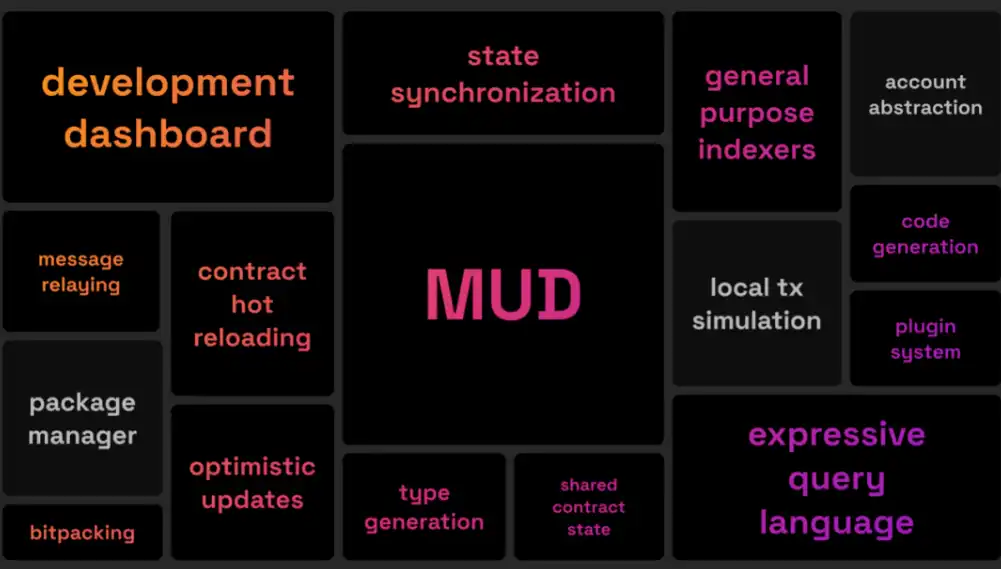
Image credit: MUD
| ARC (Action Registry Core)
ARC is an open source framework developed by Jump Crypto for managing layers of assets on the game chain. This framework is scalable enough to handle the increase in the number and interdependence of game assets while avoiding the technical debt that might come with an object-oriented programming approach. ARC's basic architecture uses a three-tier onion model, consisting of a core layer, registry contracts, and operational contracts. The framework is now open source on GitHub, and more details can be found in previous translations.
Infrastructure is key to game development (Part 2) : Explore a new framework -- Action Registry CoreInfrastructure is key to game development (IV) : How does ARC architecture Work?
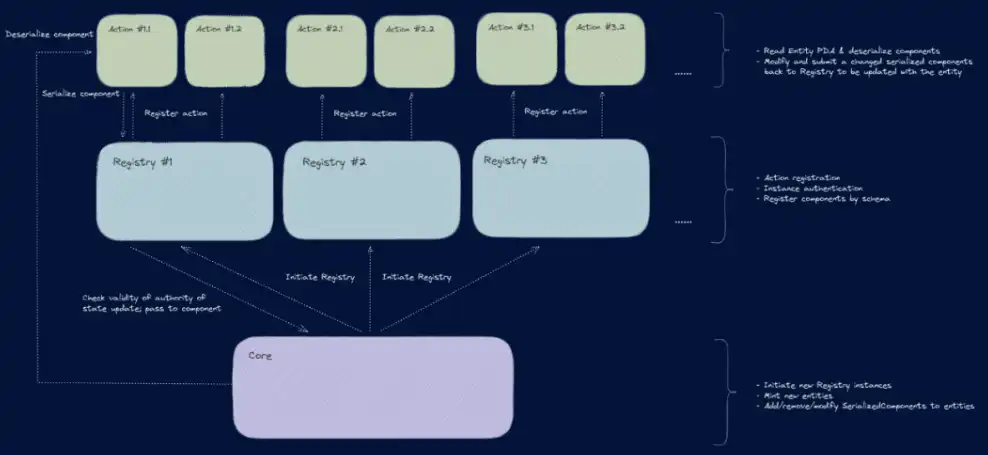
There are many challenges to building a full-chain game, including the shortcomings of the underlying infrastructure and the immaturity of the ecosystem. These issues directly affect the game's response time, cost, and speed of iteration. However, in addition to the projects already mentioned, there are a number of infrastructure projects that are actively being explored and practiced in order to further the development of the Web3 gaming ecosystem.
It is important to note that in order to build a fully decentralized game, these infrastructure projects must be composable and follow the principles of decentralization. This means that projects need to be able to work together and be compatible with each other to form a unified infrastructure network. This combination of composability and decentralization will give game developers greater flexibility and innovation, while providing players with a richer and more diverse gaming experience.
"At last"
Web3 Gaming has tremendous potential to bring new possibilities to the gaming world. In order to achieve true Web3 Gaming, games need to be built on bottom-up protocols with token models as ancillary means to ensure the sustainability of the game economy and avoid GameFi issues. In such games, players can actually own assets and freely trade them without the control and restrictions of a centralized institution or platform.
Looking ahead, we can expect further maturity and innovation in infrastructure projects, including better blockchain technology, smart contract platforms and storage protocols, to provide a more efficient, secure and reliable gaming environment. This will accelerate the growth and popularity of Web3 games, and players will be able to participate in a game world full of creativity, freedom, and real value, rather than just chasing the financial benefits of tokens. This will attract more players to invest their time and energy, which will help the entire ecosystem thrive and grow.
Original link
Welcome to join the official BlockBeats community:
Telegram Subscription Group: https://t.me/theblockbeats
Telegram Discussion Group: https://t.me/BlockBeats_App
Official Twitter Account: https://twitter.com/BlockBeatsAsia

 Related Articles