Elixir Protocol: DeFi protocol to decentralize market making

In recent years, the rise of DeFi has made crypto trading volume shift from CEX to DEX. Both users and institutions attach more importance to DEX. However, it is undeniable that CEX plays an important role in encryption, and most daily crypto trading takes place in CEX. Even the DeFi native token still needs CEX pairs to obtain the seer for decentralized lending, perpetual Swap and other functions.
While market making is an important part of DeFi, the current market making contract would require the project party to provide a certain number of tokens to the financial entity in exchange for the liquidity supply of its CEX pair. Market makers agree to provide high liquidity to the order book for at least 90% of the life of the contract in return for 2-5% of the total token supply of the project. In the long run, putting so many tokens in the hands of one entity will ultimately cause a decisive or even devastating blow to token price behavior, Harm investors, users, and the project itself.
The Elixir Protocol is a unique and innovative DeFi Protocol that allows projects to access liquidity for their centralized and decentralized trading pairs with cost savings of up to 99%. Democratizing and decentralizing projects improves community consistency and transparency.
Elixir makes markets
Market making refers to the buying and selling of tokens to provide crypto market liquidity to maintain market efficiency and depth. In TradFi, market makers are usually investment companies that take on the risk of owning a certain number of shares in a particular security in order to facilitate their trading. And seek to profit from the spread between the bid-ask spreads. A market maker is an important part of the crypto market as it ensures that liquidity is always available to traders seeking to buy or sell tokens.
With Elixir, projects can now access better trade pair market making than those offered by the centralized platform, as well as see exactly how their liquidity is being provided, thus releasing full transparency for all participants.
Elixir CEX makes markets
For market making, Elixir deployed the most advanced market neutral algorithm. Elixir used Avellaneda & A variant of Stoikov's algorithm (which is one of the best known market maker algorithms) to provide tight bid-ask spreads and deepen order book liquidity for token pairs. Elixir provides a cheaper way for agreements to ensure liquidity on the CEX in two ways: bonds and liquidity mining.
bond
Elixir's bonds allow projects to purchase Elixir LP tokens from the community, thereby enabling the project's centralized trading platform token coin pair to make markets in perpetuity, a process also described as "buying liquidity."
To create a bond, projects set parameters for the bond, including the bond hardtop, the amount of the reward and the duration of the exchange period, as well as select the trading platform and specific token pair to which they wish to deploy the liquidity. After creating and launching the bonds, the Elixir protocol will handle the rest and the project will begin algorithmic market making for the centralized trading pair of their choice.
From a user perspective, the user contributes 50/50 liquidity to the binding contract (50% LP token, 50% USDT) and receives LP tokens in return, which can then be exchanged for 100% of the bond's original tokens. Bond-buying liquidity through Elixir is a win-win for both the project side and the user. Projects receive permanent liquidity, while users receive LP tokens, which can be exchanged for native tokens of bonds and receive bonus tokens of an additional percentage. The Elixir agreement uses the liquidity it has to make markets through the Elixir Foundation.
Flow mining
Elixir enables projects to incentivize users to provide liquidity for their centralized trading pairs through liquidity mining, connect their personal trading accounts to Elixir through apis, and users can receive subsidized APY on top of any profits they make from actual market making. This process has been described as "rental liquidity" for crypto assets.
The project incentive liquidity mining process is simple. Users can select the desired trading platform at the front end of Elixir and confirm the specific token pair to which liquidity will be provided. Elixir supports most major trading platforms. In addition, they can add token rewards for liquidity mining activities and set a period for token emissions. token awards will be distributed equally to liquidity providers in proportion to their ownership of the pool.
From the user's point of view, they can connect to MetaMask and exchange accounts through the API on the Elixir front end. They can view all available liquidity mining activities or select by which they are eligible to participate, filtered by exchange platform support and token balance.
Elixir DEX makes markets
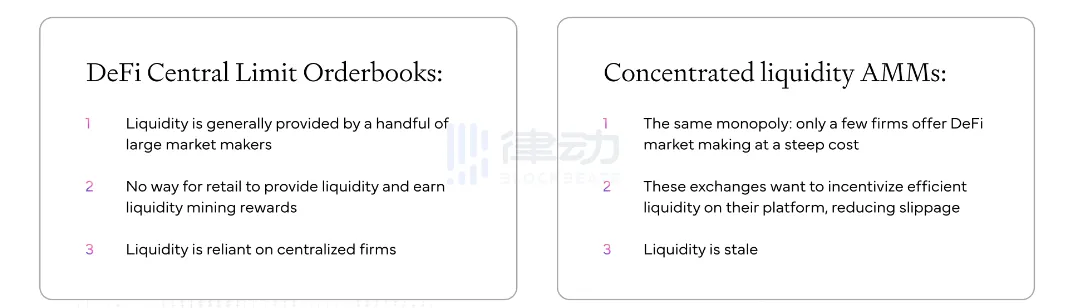
Elixir's active liquidity provision greatly improves the capital efficiency of DeFi ecology: for DeFi CLOBs and centralised liquidity AMMs.
CLOBs on the chain
Elixir applies the concept of active algorithmic market-making to chain-built CLOBs (central limit order books). The protocol is capable of making markets for specific token pairs on these platforms, just like making markets on CEX's order book. DeFi protocols that build CLOB infrastructure on a chain can integrate Elixir into their back end, allowing users to provide liquidity to trading pairs. Increased liquidity by users reduces slip points, tightenedbid-ask spreads, and reduces volatility.
Elixir can also connect directly to most on-chain CLOBs without local integration, allowing users to make markets on order books previously dominated by centralized finance firms that reap the bulk of market-making incentives and benefits on these platforms.
Centralized liquidity AMM
Data shows that centralized liquidity AMMs are among the most powerful liquidity venues available to traders, even surpassing centralized trading platforms in terms of the +/-2% slip point of mainstream token pairs.
The problem with centralizing liquidity is that it requires manual manipulation by the user, who needs to manually adjust the upper and lower limits of their liquidity targets. If volatility occurs, the asset may quickly hit an illiquid gap in the bond curve, but Elixir enables on-chain market making through its active liquidity deployment. In essence, a centralized liquidity pool is very similar in practice to an on-chain order book, enabling Elixir to provide a tight liquidity range around the price as the in-pool price moves.
Elixir architecture
Elixir's underlying infrastructure is decentralized and high-throughput, allowing consensus to be reached on every calculated order on the trading platform. The architecture is not easy to understand, but here are its components:
Exchange Feeds
The exchange stream holds read-only credentials for each exchange and subscribs to a single update stream, sending the data to the data aggregator.
Data aggregator
The data aggregator collects data from multiple exchange streams, combines them into a deterministic data framework, signs them, and passes them to validators and auditors. This part of the Elixir technology stack enables the validator to act on accurate data related to the flow of the trading platform.
Verifier network (DPoS)
Elixir's verifier network operates in a decentralized proof-of-equity system that requires a 66% consensus and is enforced at the relay node, where end users delegate their equity to the verifier, and the verifier with the highest equity receives the largest share of the rewards.
Relay node
The relay node holds the transaction key for each trading platform and counts the order proposal framework from each validator. When the order proposal is overdue, it is passed to the auditor to verify its correctness.
Dispute Resolution (Auditor + Controller Node)
The dispute resolution layer ensures that the validator runs the market-making algorithm and sets the parameters correctly according to initial guidance. In addition, auditors incentivize validators for honest behavior with bonuses and punish dishonest behavior.
Elixir token ELXR
ELXR is a native utility and governance token for the Elixir ecosystem that drives consensus. In essence, Elixir ecology cannot function in an efficient and safe manner without the ELXR token.
The node and validator infrastructure at the heart of the protocol will be primarily driven by ELXR. All verifiers and nodes need to pledge a certain number of ELXR tokens in order to maintain their active infrastructure and good standing. This requirement for authenticators and nodes to pledge ELXR tokens plays a larger role in the overall security of the platform: keeping incentives consistent. Dishonest nodes and verifiers that try to compromise the agreement will harm the value of their own tokens (cutting into the number of tokens they pledge).
The ELXR token is also a governance token in the ecosystem, giving holders and network participants the ability to make and vote on proposals for the future development of the protocol. Governance participants are free to determine the value generated by the Elixir protocol.
After the launch of the future Mainnet, Elixir will roll out a plan to help move the network into a fully decentralized state. The plan will include a fully decentralized technology architecture, a functional governance forum run by ELXR Tokens, and a number of proposals to the forum to push the value of ELXR Tokens and away from the private foundation behind Elixir. The overall objectives of Elixir will be to: create effective governance mechanisms; ELXR becomes the core security element of Elixir protocol; Make the platform completely decentralized and permissionless.
audit
Elixir is currently in beta network, and after conducting several internal tests of its beta network, Elixir will release its smart contract audit process to the community.
conclusion
In financial markets, lack of market liquidity is the biggest problem. Elixir Finance addresses the issue from a fresh perspective, recognising the importance of CEX to the market and diversifying market-making on them through its infrastructure and token model. Elixir Finance is currently on a test net, and it will be some time before the main net goes live, Look forward to its main network online after the new action.
Welcome to join the official BlockBeats community:
Telegram Subscription Group: https://t.me/theblockbeats
Telegram Discussion Group: https://t.me/BlockBeats_App
Official Twitter Account: https://twitter.com/BlockBeatsAsia