Dissecting LSD leveraged mining: the source and risks of excess returns.

Original Title: "Disassembling LSD Leveraged Mining: The Source and Risks of Excess Returns"
Original Author: 0xLoki
Recently, I have been discussing the issue of LSD leveraged mining with many friends on Twitter and Space. The main issue is:
(1) What is the essence of high-yield leverage staking? Where are the risk points?
(2) Is the high yield of leveraged staking sustainable?
The synthetic method of leverage staking can refer to the article of CapitalismLab. The article mentions that the loop lending was also widely used during the early defi summer when borrowing rates were negative in both lending and borrowing rates of Bendao, essentially arbitraging the interest rate differential between different targets. It is very similar to the reverse repurchase of government bonds in traditional finance (which is one of the reasons why I prefer to call LSD "ETH nationalization").
Related articles: "Why is the loan agreement the biggest hidden winner of LSD?"
A simpler implementation method is:
1) Alice currently has 10 ETH, and AAVE lends 90 ETH to Alice at an interest rate of 3%.
2) Alice staked 100 ETH to Lido and received 100 stETH in return.
3) Alice's 100 stETH became collateral for AAVE, with an LTV of 93% for stETH on AAVE.
4) If the current exchange rate of stETH-ETH is 0.98, then the borrowable value is 91.14 ETH, and borrowing is safe.
5) Alice can earn 4.9ETH staking rewards annually at a rate of 4.9% and needs to pay 2.7ETH in interest at a rate of 3%. Her net income is 2.1ETH, equivalent to an annualized return of 11%.
This approach simply encapsulates the tedious process of loop borrowing, which is actually being done by third-party income aggregation tools and AAVE. At the same time, the leverage ratio of this borrowing method is not unlimited, and we can derive the formula for the maximum leverage ratio. According to current data, the highest leverage ratio is 13.6 times.
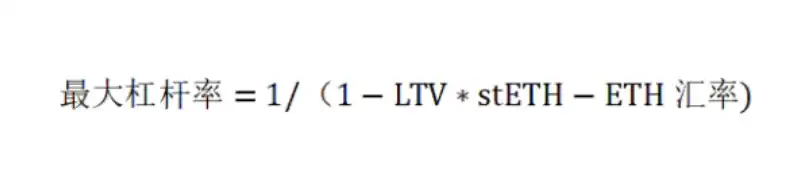
Meanwhile, we can derive the profit formula for leveraged mining:

With these two formulas, ETH leveraged mining will become very easy to understand. The source of income for leveraged staking comes from the difference in interest rates between staking and ETH borrowing, and the reason for the existence of this interest rate is because the two types of underlying assets have different risk characteristics and liquidity features:
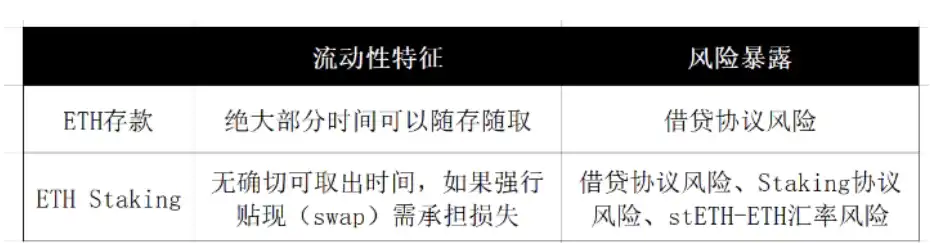
It can be seen that the difference between Staking and lending is essentially the liquidity premium and the risk exposure premium. Choosing Staking requires sacrificing asset liquidity and taking on greater losses. The reason why returns of up to 10%-20% are currently achieved through leverage is mainly due to the uncertainty of the ETH upgrade in Shanghai. The longer the uncertainty, the higher the volatility risk of stETH. As shown in the table below, if the exchange rate of stETH remains above 0.9, leverages of up to 6 times are safe, and the highest interest rate that can be obtained is 13.2%.
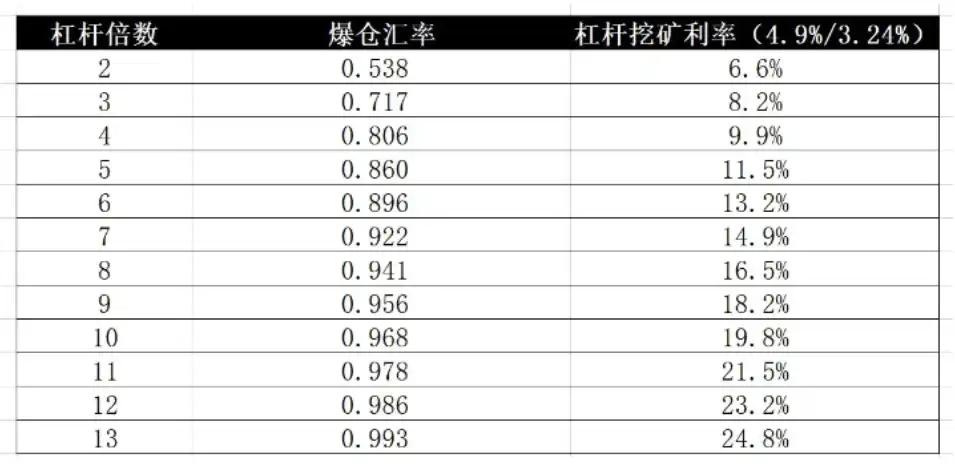
Understanding the source of income makes the sustainability of earnings easier to understand. The reason why there is such a high interest rate currently is mainly due to the uncertainty of Shanghai's upgrade. Staking has a clear expected time for unlocking, which will make pricing more transparent and risk management more controllable. A inevitable result is that the amount of ETH staked will continue to rise, reducing Staking returns, while the demand for ETH borrowing will increase, pushing up deposit/lending rates.
Therefore, after ETH opens Staking redemption, a highly deterministic result is the narrowing of the interest rate spread, ultimately forming a balance, and the returns of leveraged Staking returning to a reasonable range. Another highly deterministic result is that borrowing and lending becomes one of the leveraged ways of Staking, and the lending market of LSD becomes more prosperous, just as pointed out in the CapitalismLab article, borrowing and lending becomes the hidden winner of LSD.
Other than ETH, two other markets that caught our attention are Cosmos and Cardano, both of which have over 40% staking rates and billions of dollars in staked assets. Building similar products on Cardano is very difficult, due to both the technical development difficulty and the fact that Cardano has only a waiting period and no unlocking waiting period, leaving very little potential for interest rate differentials.
But Cosmos is different. Cosmos offers a staking rate of over 20%, far higher than ETH. At the same time, the Cosmos ecosystem generally has a 14-21 day unlocking period, which, although not as long as ETH, still provides some space. Osmosis' staking product also shows us the sensitivity of users' liquidity. Providing an 8% current account loan interest rate and lending ATOM to leveraged miners at a rate of 12% seems feasible in terms of product.
Of course, there are many complex issues involved in actual implementation. However, one thing that is relatively certain is that POS public chains need LSD to improve asset efficiency and staking rate (or so-called public chain Token national debt), which will inevitably bring interest rate differentials. Interest rate differentials will provide new market space for lending, which is very important for lending protocols because it is one of the few businesses that has rigid demand and can bring real protocol revenue.
Original Link
Welcome to join the official BlockBeats community:
Telegram Subscription Group: https://t.me/theblockbeats
Telegram Discussion Group: https://t.me/BlockBeats_App
Official Twitter Account: https://twitter.com/BlockBeatsAsia

 Related Articles