A Brief History of Cosmos LSD: More research, less product
原文标题:《 Cosmos LSD 简史:研究多,产品少》
原文来源: ibcbull ,深潮TECHFLOW
This article assumes that you have a general understanding of LSD, such as what LSD is, where LSD is currently used, and preferably with an LSD product like Lido. It is better to have a basic knowledge of Cosmos, such as having worked with IBC (Osmosis works with IBC).
The history of Cosmos LSD is discussed in this installment, and the current situation in the next. This article can be divided into two lines, one is research and discussion, the other is specific application.
Mainline 1 study
Cosmos Ecology's research on LSD dates back to 2020 or earlier, less than a year after Cosmos Hub (ATOM) went online.
Why is LSD more studied in Cosmos?
I think it was because of Tendermint as the most standard and classic (single slot finality, unlocking pledge needs to wait for some time and slashing these features) consensus used for pos. Tendermint, a standard consensus module in the Cosmos SDK, is used in dozens of Cosmos chains today.map of zone), also used on Polygon POS, Oasis chains that are not based on Cosmos SDK. And it inspired a series of pos consensus. So there has been a lot of research and discussion on pos in the Cosmos community, and the thought of LSD naturally follows.
Why is Cosmos more LSD research but less product?
I think the most widespread use of LSD I've seen so far is on DeFi, such as in places like circular mortgage, in short. LSD is in demand where DeFi is developed. Cosmos has long had mostly vote-only coins such as ATOM, and by 2022 Cosmos (not Terra) had some mature dex, Osmosis and Crescent, but lending was still very early, It was only recently in early 2023 that lending matured (umee and mars became operational), so Cosmos had a low demand for LSD. LSD is developed only in places like Terra where DeFi is developed.
Despite the lack of products, here are three important LSD-related events.
Theme 1 Chorus One x ICF's LSD report
Chorus One and the interchain foundation together released a research report on LSD in 2020, dozens of pages of very detailed discussion of the history of pow and pos and how LSD was conceived. At that time, since neither lido nor cex had actually launched LSD, the report was mainly based on deduction and analysis experiment projects, in which the potential harm of LSD was rarely discussed (for example, the impact on pos security hypothesis, for example, if all LSD is turned into LSD, How about the long wait for unlock pledges introduced to limit validator evil). You can read it sometime.
Gauntlet wrote a similar article at the same time, which is worth reading.What PoS and DeFi can learn from mortgage-backed securities
Note: The interchain foundation (ICF) is the Cosmos equivalent of the Ethereum Foundation or Polkadot's Web3 Foundation and is responsible for funding the growth of the Cosmos ecosystem as a whole, not just Cosmos Hub, Focus on Tendermint Consensus, IBC and Cosmos SDK development.
Note:Chorus One Is a professional pos node service provider, it and Figment.P2P.stakefish(Fishpond's pos department) are all validators as a service representative, they are close to Cosmos Ecology, and they are also the ideal pos host for retail investors in my mind. Chorus One CEO Brian was also an early member of Cosmos, which also made lido on solana and the earliest solidity IBC light client and the IBC light client in wasm. They work with community validators (a lot of them hard to name), cex validators, Core teams of validators (such as informal systems, which are Cosmos core developers and nodes) together make up the validator ecology for most pos chains.
Theme 2 Iqlusion liquid staking module
Because Cosmos chains come with a pledge feature, and because there is a long wait to unlock a pledge (usually 21 days for ATOM, or 14 days for OSMO), it has been suggested that this unlocking period is a hindrance to the spread of LSD. iqlusion has developed a Cosmos SDK module that allows you to convert your coins to LSD without unlocking pledges.
This module has not been applied in the main network environment, more is still in the stage of proof of concept, but later will probably be stride and quicksilver adopted to improve the user experience (with can skip the unlock period).
Note: The modules of the Cosmos SDK can be regarded as the basic logical units of the Cosmos chain. The Cosmos SDK has some default modules such as pledge, governance, IBC, etc., which together form a working pos chain. At the same time, each chain can also add custom modules to achieve their own functions (Cosmos SDK is an application chain framework), such as Terra stable Coin module, Osmosis dex module.
Note: Iqlusion is one of the core contributors to Cosmos Ecology, a company led by Zaki Manian.
Theme 3 Cosmos Hub Proposition 69: In order for lido to support ATOM to deploy CosmWasm on the Hub
The proposal talks about whether to deploy a licensed cw on Cosmos Hub (similar to today's cw with Osmosis, deployment contract to vote), but the main purpose of deploying cw is to deploy lido contracts, Basically, the previous lido contract on terra was deployed to support stATOM, because that contract was the cw contract, which had locked up a lot of money so it was safe (bLUNA/stLUNA had a huge circulation and was worth billions).
The bill failed to pass the vote, which was sensitive to leverage on the LSD, fears that ATOM would be concentrated in the hands of Lidos instead of native governance, concerns that the cw itself would be unstable, and concerns that shared security was coming and that Lidos could be deployed to other security chains. In short, the debate is very heated (seevoteAnd forum discussion).

Note:CosmWasmcw is the most popular virtual machine in Cosmos. Similar to EVM in Cosmos, it is also implemented by a Cosmos SDK module, so any Cosmos SDK chain can be upgraded with one click to enable cw. All of Terra's previous ecosystems (with the exception of the stable Coin issue and destruction features) were done in cw (anchor, mirror, astroport, lido, etc.), including today Osmosis, Injective, Juno, secret, to be followed by Sei, Neutron and Cosmos smart contract platform chains are cw (with a few exceptions such as gno and agoric). Many Cosmos ecologically appapps can deploy in many places or migrate from Terra to Osmosis because everywhere is cw. Something like uniswap can be forked to each evm. The discussion on whether to develop with cw or to customize a Cosmos SDK development can be discussed in a single session.
Note:Shared security(ICS) is Cosmos' solution to the problem of finding validators from scratch and low security. Simply put, Cosmos Hub's validator set also validates another chain. The chain that rents hub security is called consumer chain. ICS itself is also an IBC based app. Theoretically, it can be accessed by introducing the Cosmos SDK shared security module and voting yes. ICS is not as efficient as the parallel chains of rollup (eth rollup and celestia rollup) and polkadot, but is now focused on solving 0 to 1 problems, as long as it works. Then slowly optimize.
Shared security will be in3/7Cosmos Hub is officially online.NeutronIt will also be available by the end of March.
Mainline 2 product
Before moving on to today's Cosmos LSD, it is necessary to review the history of Terra LSD to predict the future course of Cosmos LSD. Not only the LSD, but the whole Cosmos DeFi can be predicted by reference to Terra DeFi. It won't be exactly the same, because of the IBC, but there's a lot to learn from it.
Topic 1 lido x Terra
bLUNA, a collaboration between lido and Terra, was created as collateral for anchor and was handled by the p2p team. anchor is a special loan arrangement. It accepts only LSD as collateral (bLUNA, bETH is stETH) and lends only UST. The 20% deposit interest is paid partly by LSD earnings, partly by ANC issuance, and partly subsidized by TFL. One of the main reasons for Terra's final collapse was that there was too little borrowing demand, too much deposit, and too much UST issue, half of which was still in anchor. As a result, it had to be subsidized by TFL until 2020/4 when the floating deposit rate was introduced, which was already too late and collapsed in May.
Despite the collapse of anchor and UST, bLUNA is actually quite successful, storing very, very large amounts of both anchor and astroport, and has never had an accident. This provided p2p with critical experience in developing and maintaining cw contracts, as well as preparing for Neutron.
Note: p2p is a core participant in the lido ecosystem,p2p central figure Vasiliy Shapovalov is arguably one of the original designers of lidoAt present, p2p is mainly engaged in neutron, a smart contract platform chain sharing security with Cosmos Hub, similar to Terra2 and Juno. However, it is trying to make various development tools to more friendly support cw app that can use IBC. Developers can deploy in Neutron and then connect to the entire Cosmos ecosystem.
If you have time, read the following two lido forums discussing Terra's collapse:Whether to deploy lido on Terra2.Disable the lido on Terra1.
Topic 2 Other LSDS
bLUNA was born for anchor after all, and it was impossible for lido to motivate it with a lot of LDO all the time, so space was given to other LSD. Here are three that were used, all in 2022, and Terra collapsed shortly after that.
Prism isn't about LSD, it's about the more sophisticated DeFi, which has three products
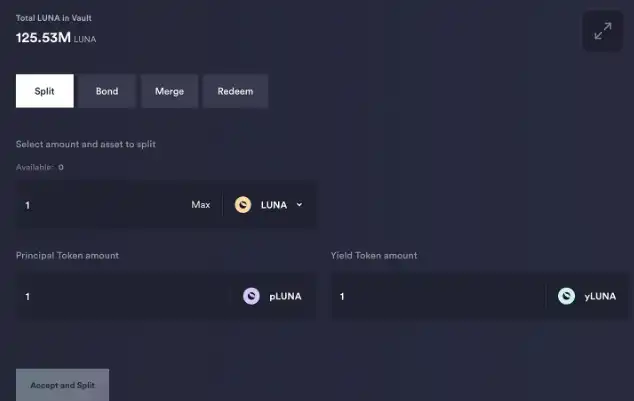
cLUNA: Similar to bLUNA, common LSD. But 1 cLUNA can be broken down into 1 pLUNA and 1 yLUNA.
pLUNA: represents the principal part of LUNA and the right to govern. After all, Terra is the standard cosmos chain, on which there are many rules, and LUNA is often used to vote.
yLUNA: Represents the revenue of LSD.
There are many tricks to play here. There are p/yLUNA with different maturities. pLUNA and yLUNA can also be separately priced and separately used as collateral. Unfortunately terra crashed shortly after prism was online, but prism also had several b's tvl at the time (also due to LUNA's height at the time).
Prior to Terra's collapse Prism, like all LSD products, was not intended to support LUNA alone, but to extend to Ethereum and other Cosmos chains. Now Prism is preparing to launch its own Cosmos chain, which will be covered next time.
stader is one of those typical LSD projects that every ecosystem has. It's not very innovative. It's just getting its own coin to motivate liquidity and having dex do it with it.
After Terra collapsed, it went to other chains, near, hedera, polygon.DeFillama), now also to engage in the chain of move, I will generally stay away from this project, let alone buy its governance currency (can see the trend, typical farm& dump).
Steak is an active developer on the cwlarry(delphi labs people, they are mainly working on loan agreementsmars protocol, v1 is on terra, v2 is its own cosmos chain, now supported by v2osmosissteak is about simplicity. Don't underestimate simplicity. This is the most forked LSD on terra2 and juno. Steak doesn't have its own governance coin, so it doesn't have mining incentives. It's a power generation project.
larry went to work on the mars v2, Steak was not maintained, and the fork operation was so-so. If you didn't learn from cw development, you wouldn't pay much attention to it. Steak code is the best from a learning perspective, Prism is not open source, lido is open source but a bit complicated because it has the most features, stader is open source but of average quality.
Original link
Welcome to join the official BlockBeats community:
Telegram Subscription Group: https://t.me/theblockbeats
Telegram Discussion Group: https://t.me/BlockBeats_App
Official Twitter Account: https://twitter.com/BlockBeatsAsia

 Related Articles