Multi-ecology LSD Development Report: The track is magnificent and the project is very early
Original title: Multi-Ecology LSD Development Report: The Track is Grand, the Project is very Early
原文来源: waynezhang.eth
Last week, we published the LSDFi Ecology /LSDFi War report and the impact of the Shanghai upgrade on LSD, but both the project chosen and the context of the thinking is Ethereum. That's because Ethereum liquidity pledges alone are worth more than $14 billion.
Today, this report will explore the development and gameplay of LSD in other public chain ecosystems, observe the development and trend of LSD in other ecosystems from the data side, and the impact of data on the LSD industry, as well as the discussion on the design and justice of LSD products. This survey will include: BNB Chain, Cardano, Polygon, Solana, Polkadot, Avalanche, Cosmos, Aptos (the top 25 public chains ranked by Coingecko MC).

BNB Chain
The current pledge status of BNB is similar to that of Ethereum, the pledge rate is 15.44% (Ethereum is about 15.43%), and the average annual yield of current pledge is about 2.84%, which is low. Among them, Ankr, the largest decentralized pledge platform of BNB Chain, accounts for about 0.56% of the circulation.
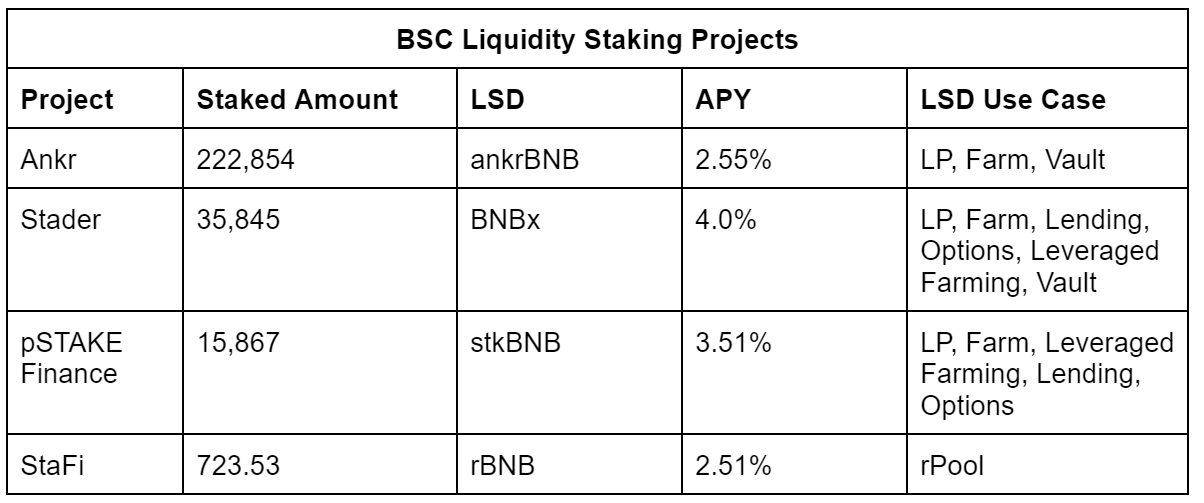
I think the reasons for the slow development of BNB Chain's LSD are as follows:
1. Profitability of BNB native DeFi protocol. It can be seen from the DeFillama data that among 337 transaction pairs involving BNB, the average annual rate of return exceeds 80%
2.BNB utility
BNB is also the platform Token of the Binance exchange, and holding BNB placed on the exchange can receive a discount on fees and other services.
Binance also has its own dedicated services such as Launchpad, which tempt users to put BNBS in their wallets or exchanges. The most recent Space ID launchpad, for example, has 8,677,923.94 BNBS. The number of participants reached 103,598. That is nearly 39 times the total amount pledged by Ankr.
For transactional holders, the benefits and stability are higher, whether it's getting a discount on Binance or participating ina variety of DeFi products on DEX. The potential for LSD in BNB Chain is much smaller than that in ETH chain.
Cosmos
Cosmos Hub 的质押率约为 61.96%,平均质押收益约为 25.92%,且质押后解除质押需要自申请时等待 21 天。Cosmos 的质押状态相较于 ETH 与 BNB 链极具技术特色,由于 ATOM 仅作为 Cosmos Hub 的通证,在 Cosmos 生态系统内推出的任何应用链都可以不使用 ATOM Token 。因为费用逻辑是每个应用链原生的(开发者选择以何种 Token 支付 gas),每个应用链都有自己的验证者网络。
As a result, we can not only take ATOM chain protocol as statistical basis in statistics. Stride, QuickSilver, etc., have their own chains to build protocols, so we will statistical Cosmos and its ecological IBC chain LSD protocol (mainly focusing on ATOM, OSMO, Osmo, etc.). STARS, JUNO, Luna, Evmos).
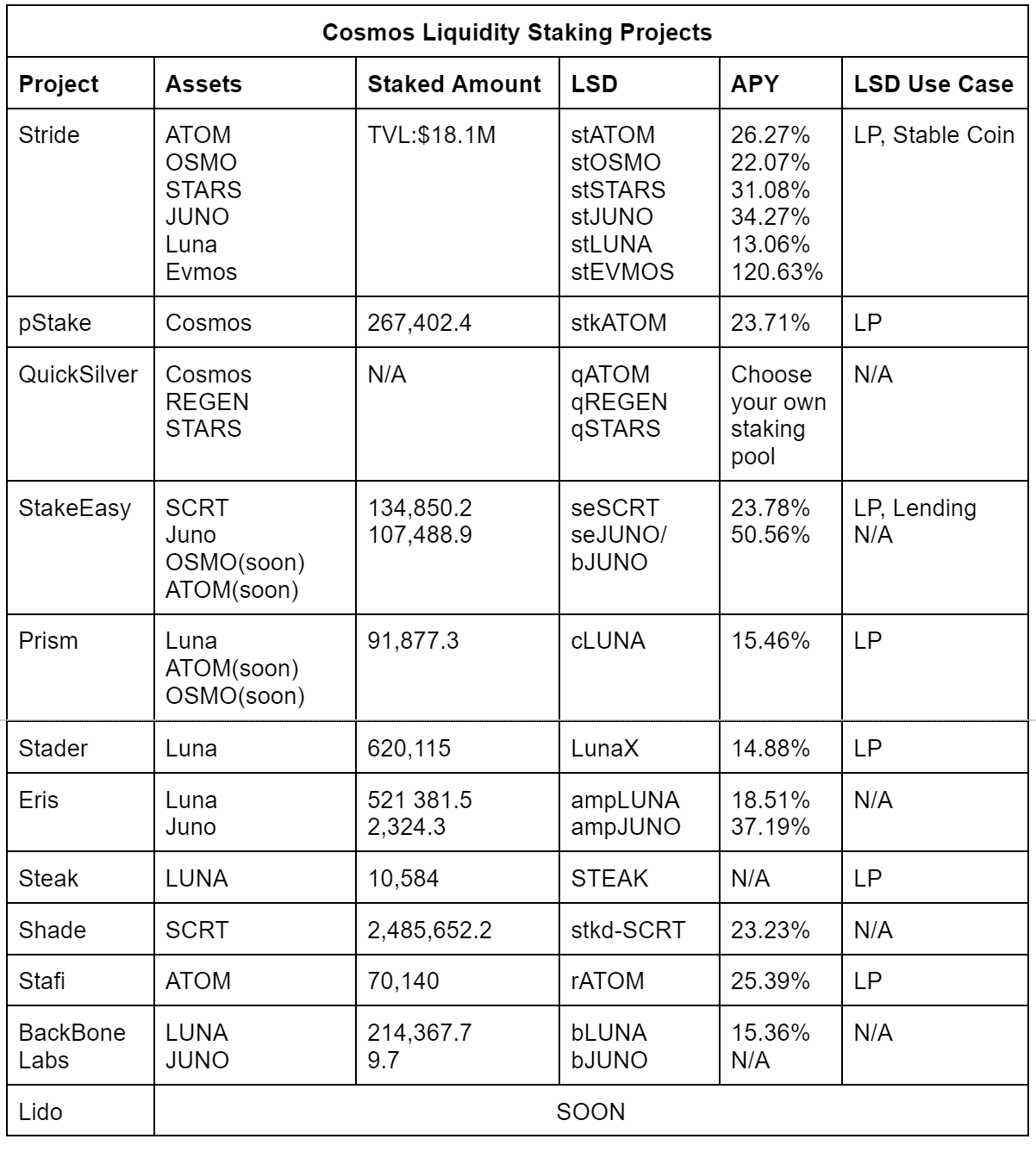
You can see two interesting points from the table above:
Cosmos ecology is now out of a separate, LSD scale is small, and LSD application cases are not many, Stride as the current boss of Cosmos LSD, the total TVL is only $15MLuna appeared in many LSD projects, and has many types of LSD.
1. Why is LSD small?
The Cosmos ecosystem actually has many similar L1 chains, but these ecosystems cannot get out of the Cosmos for the time being. Cosmos is not a unified public chain, but through the IBC protocol but with special functional chains and Appchain chains such as Kava with Osmosis. Universal chains like Canto, Juno, and Evmos are in their infancy.
Luna once had more than $30 billion worth of LUNA pledged on various agreements on March 2, 22, surpassing the $28 billion worth of ETH pledged, becoming the second largest pledged asset in mainstream cryptocurrency. At that time, Lido also participated in the design of LSD like bLUNA, but the Luna-UST incident occurred later. At that time, Terra had rich infrastructure, and LSD could be used as UST collateral, lending and so on.
Opportunity cost:Looking down on the whole, high yield brings opportunity cost, taking ATOM as an example, if the holder does not pledge ATOM, then his opportunity cost is about 26%, you can check the Osmosis liquidity list, only three ATOM LP is higher than 26%. Of course, there are other high-yield methods, but they are not as stable and safe as direct pledge. This also creates a vicious circle: low DeFi utilization yields less than pledged users reduce DeFi participation DeFi utilization is low
By air drop:Stride,Quicksilver 等 Cosmos 项目在上线时通常会将一定比例的 Token 直接空投给 Cosmos Token 生态质押者,而据我调查得到的结论是 LSD 中质押好像不能得到空投。所以机会成本进一步增大。
Liquidity risk: After ATOM pledge is LSD, it will take 21 days to unlock the account (Stride is 21-24 days). Not only LSD, but also pledge nodes are affected by this.
But Cosmos LSD still holds great promise
1.Cosmos 2.0: Interchain security will enable ATOM to be used as a security token for other IBC chains. With enhanced composability of the interchain account ATOM, Cosmos officials will soon support a liquidity pledge feature to improve ATOM liquidity. The value of ATOM will further increase, which will have a direct impact on the DeFi's prosperity within the ecosystem
2. Osmosis and Kava's DeFi have worked hard to build more of a lending and revenue infrastructure for LSD. For example, SiennaLend accepts seSCRT as collateral. New LSD protocols, such as Quicksilver, will be airdropped to attract more attention from holders.
3.Stride and Quicksilver can provide proxy voting and other governance functions, before there will be a vote by the entrusted node, now can be directly entrusted to LSD, and then let LSD statistical pledge to choose proxy voting
4. Liquidity benefits: The unlock time of 21 days pledge can gain capital efficiency through LSD
5. External factors: The LSD War brought by the Ethereum Shanghai upgrade will directly promote the influence of LSD and indirectly promote the development of Cosmos LSD
6.Cosmos Ready to launch Liquidity Pledge Model
However, LSD may not be able to solve one problem. For example, QuickSilver's pledge mechanism is that users can choose the pledge node to pledge and obtain qAssets after the pledge. In this process, QuickSilver acts as a "middleman" entrusted by users. Although in theory, the "middleman" represents the user pledge to the verifier, it directly pledged to the node, is in line with the ecological project airdrop conditions, but many airdrop has the pledge limit, such as Stride airdrop application, the maximum effective pledge is 4200ATOM, This means that QuickSilver, even if it can receive airdrops by proxy, will only receive its share of 4,200 ATOM. It may be possible to design multiple accounts, but it is only a guess that the data risks and technical costs associated with managing separate accounts are not yet known. Or maybe the LSD contacted the program to ask for a credit, which is just a guess. The program wouldn't give you a credit for no reason, unless you could be of benefit to them.
Polygon
Polygon POS is an EVM-compatible side chain in which Matic acts as Gas and is pledged to nodes to complete POS consensus. Polygon POS has a pledge rate of 39.92% and an average annual return of 8.82%. 12% Matic will be awarded as a pledge.
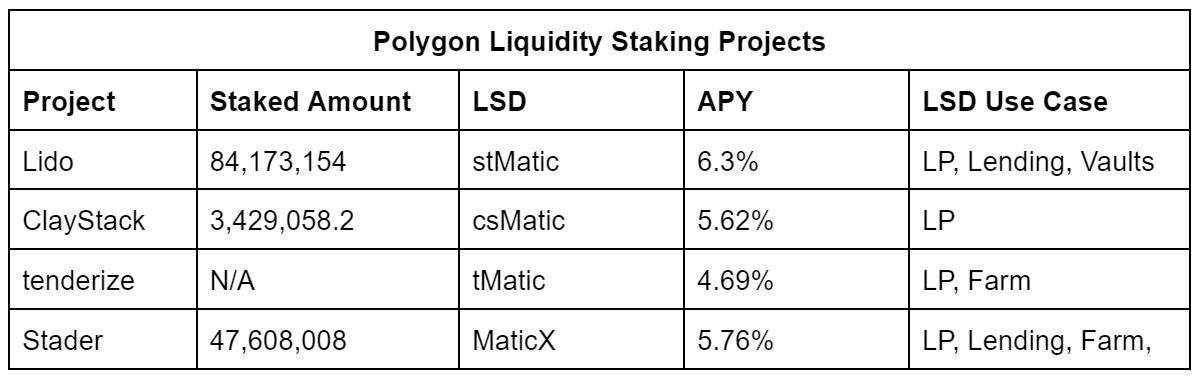
An interesting point is that Lido on Polygon has the highest APY, and I searched for MATIC transaction pairs on DeFillama. Among the transaction pairs over $10M on TVL, stMatic involved four. As a direct result of this influence, Lido is likely to dominate Polygon LSD today and in the future.

Solana
Solana's network pledge rate is 70.75%, and the average annual rate of return on pledge is 70.75%. There are 3,165 verifiers in Solana, and the verifier with the largest number of entrusting only accounts for 2.86% of the total number of pledges.
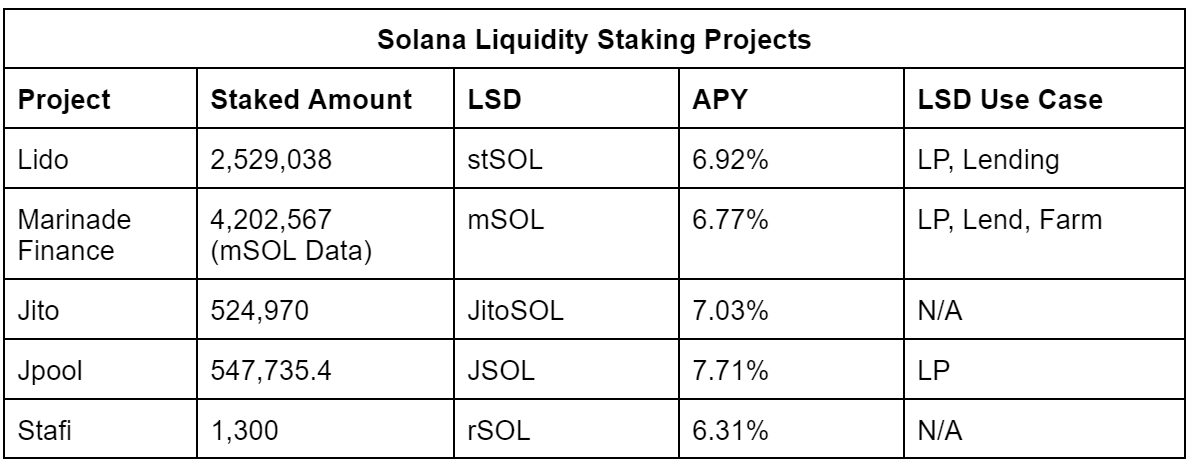
In the statistical process, aSOL, Eversol, Socean and other LSD projects have been declining since TVL in May, 22. Until now, their Twitter accounts have been deleted and cannot be found. New entrants, led by Stader, may bring new growth to Solana LSD.

Cardano
Cardano's current pledge rate is 68.73%, and the average annual return on the pledge is 3.26%. It is down 7.1% since my last Cardano Ecology Report (18 December: 74.05%). But TVL is about to break through its previous high in ADA.
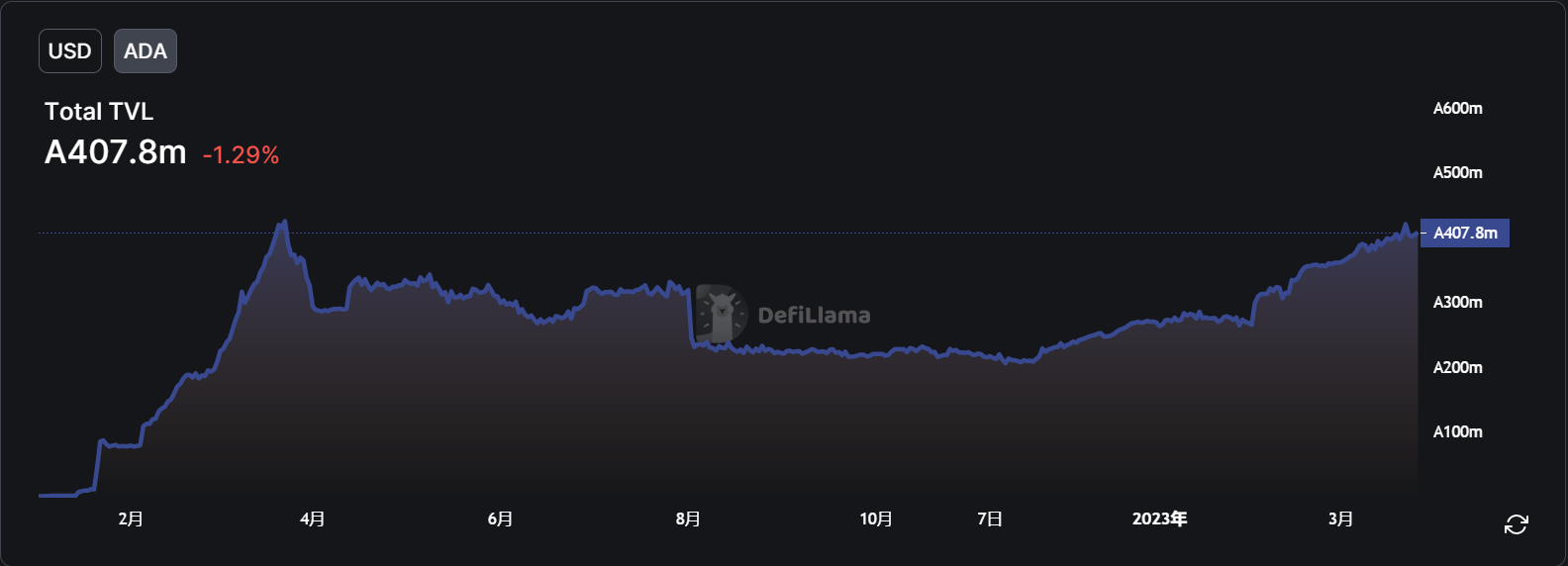
Cardano's special technical architecture makes it difficult for LSD to develop in its ecology, and ADA is not locked in a certain period of time during the pledge period or needs to be transferred to the mine pool, etc. When users pledge to the SPO, the SPO has no access to your assets, and their fees are deducted from the total rewards generated by the pledge pool, which means that Cardano's pledge is not only unescrow but flexible. They can also be used as collateral for payment or in DeFi services, such as iUSD collateral.
Another point is that Cardano is free of forfeiture and user assets are not lost due to SPO misconduct. When the SPO fails, the network will cancel the bonus for this epoch, and the bonus drop caused by multiple failures will lead the user away from the unqualified pool. However, the average annualized rate of Cardano operators is 4.99%, about 35% more than ordinary pledge users, which attracts many users to go directly to the SPO, and the threshold is low, currently there are 3,206 pledge pools.
Avanlanche
Avanlance's online pledge rate is 62.05% and its average annualized revenue is 8.48%. The technical architecture of Avanlanche is divided into the main network.
C Chain (contract chain) : The app's smart contract platform P chain (platform chain) : for AVAX pledge and entrustment, X chain (transaction chain) using UTXO technology: a chain for transferring funds, with a fixed transfer fee
The default way for non-technical users to participate in chain security is the Pledge Center on Avalanche Wallet, pledging through this venue only involves using the P chain and locking AVAX, after locking, it takes 21 days to resolve the pledge. After entrusting AVAX, the rewards for verification will accumulate to the P-chain address you provide. So what the LSD project is going to do is issue synthetic replacement assets of the pledged position using the alternative assets on the C chain. Therefore, there is a certain technical difficulty, which requires the LSD to design the contract connecting the AVAX of the P chain to the LSD of the C chain. I've only found two LSD projects so far, of which Benqi's sAVAX is the decisive leader.
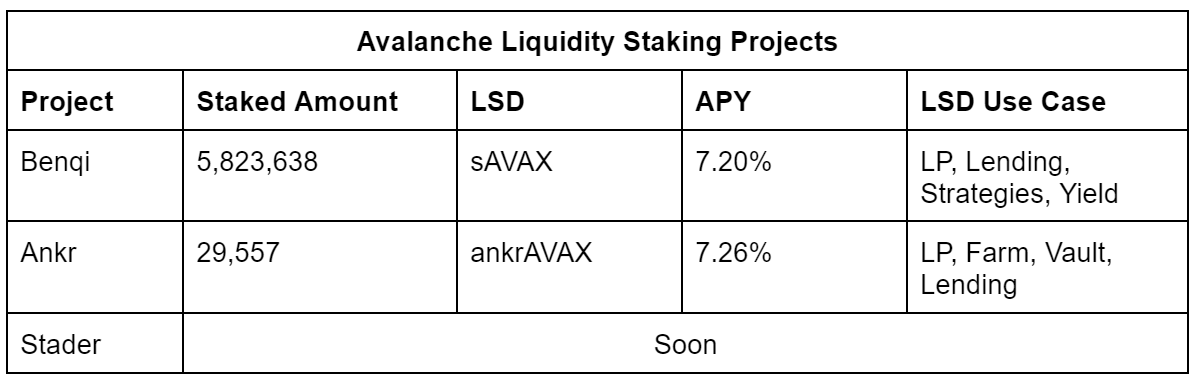
Benqi, the LSD leader, accounts for 1.7% of AVAX in circulation, and sAVAX is highly liquid, both in terms of lending (revolving lending increases yields), LP and other DeFi products.
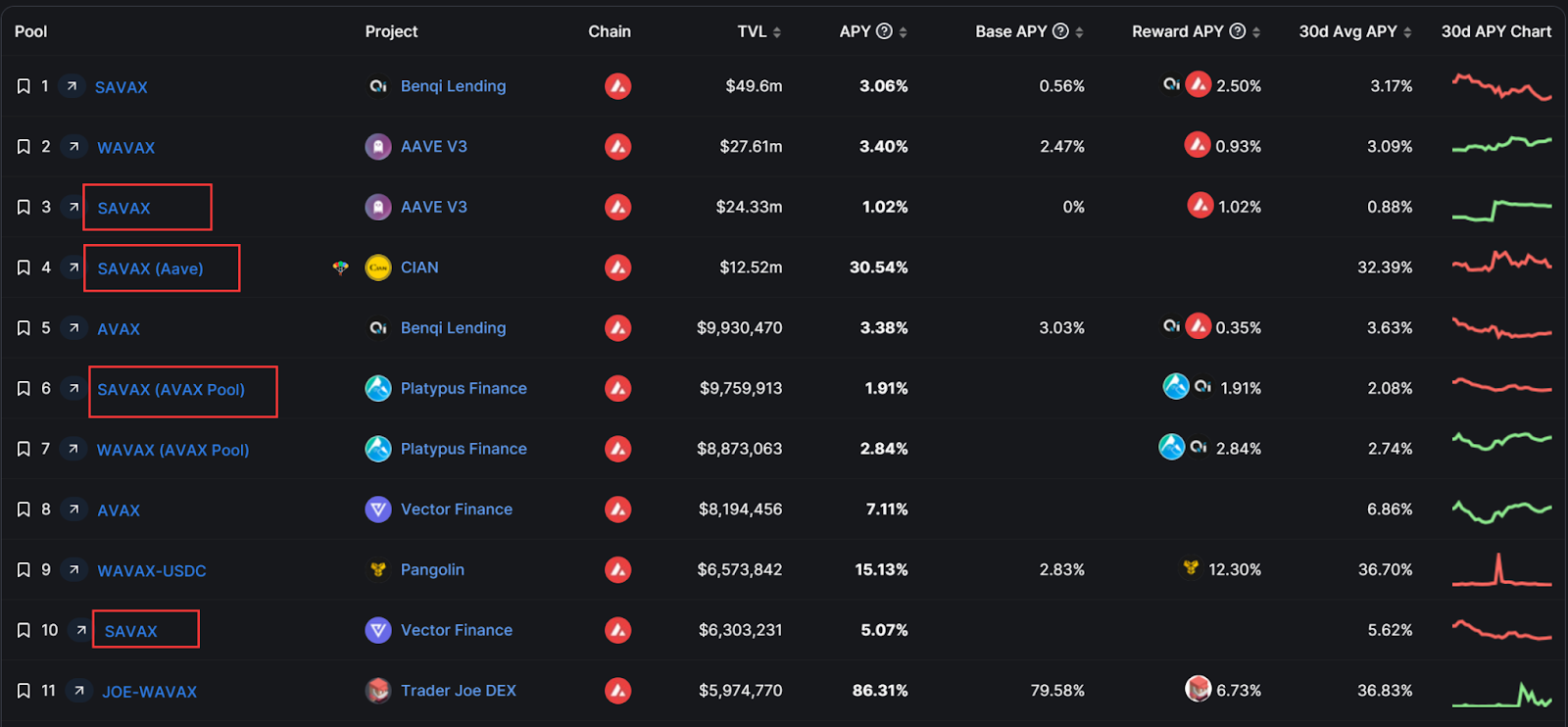
But Avanlanche's DeFi is doing better, leaving Wonderland at $635.75m and TVL close to $830.91m. A variety of DeFi products can be found at Avanlanche. Avalance's DeFi competitive landscape is unique in one way: Among the Top 15 DeFi, AAVE, Curve and Beefy are newcomers, among which AAVE directly takes 36.95% of the market share, the original lending Bneqi has developed multiple businesses and the scale is less than 80% of that of AAVE, while GMX has its own ecology. Stargate chooses multi-chain development, and also prospers in other chain mixes, such as GMX, which is directly the leader in Arbitrum, accounting for 32.96%. In addition, the TVL of GMX and Stargate is less than 100M, and the TVL of GMX and Stargate is more than half different.

But why are there so few LSDS? In addition to technical reasons, this DeFi pattern may also be an influencing factor. The old DeFi are busy with multi-chain development, and the new multi-chain DeFi are often single business. For them, if they open new LSD business, they will mostly start from their original development chain. This may bring difficulties in terms of competitiveness and resource cooperation for new native projects that simply do LSD business.
Polkadot
The pledge rate of Polkadot is 47.05%, the annual yield of pledge is 15.29%, and the pledge is locked for 28 days. The consensus mechanism of Polkadot is NPOS (Proof of Nomination Interest), which has two roles of verifier and nominator. The verifier needs to run the verification node, and the nominator obtains income and protects the network by selecting excellent verifiers and pledging DOT to support the verifier's work. If the nominated verifier complies with the network rules to maintain network security, the nominee can share in the pledge reward they generate. Otherwise, if the verifier acts improperly, the verifier will be forfeited and the user will lose the DOT reward.
Another feature of PolkaDot is its card slot auction mechanism: it allows multiple dedicated blockchains to communicate with each other in a secure, untrusted environment, thus enabling blockchain scalability. The parallel chain is connected to the relay chain, which requires a parallel chain slot. The simple understanding is that the relay chain is the socket, and the parallel chain is the electrical appliance. The socket holes are limited and need to compete through auction. Therefore, the project invented Crowdloan (PLO), and the project raised funds from the market to participate in the auction. But items that don't participate in the auction can also use Parathread, which is free for unlimited use, as opposed to the parallel chain, which is pay-as-you-go. Here are some examples of PLOs. LSD is not attractive in terms of yield due to the existence of Crowdloan. Many defIs are built around PLOs.

On March 15, Lido officially suspended Polkadot and KSM pledge deposits. I checked the proposal at that time, and the comments of the proposal sponsors soyome (head of Lido partner MixBytes) and Marin (BD of Lido) were as follows:
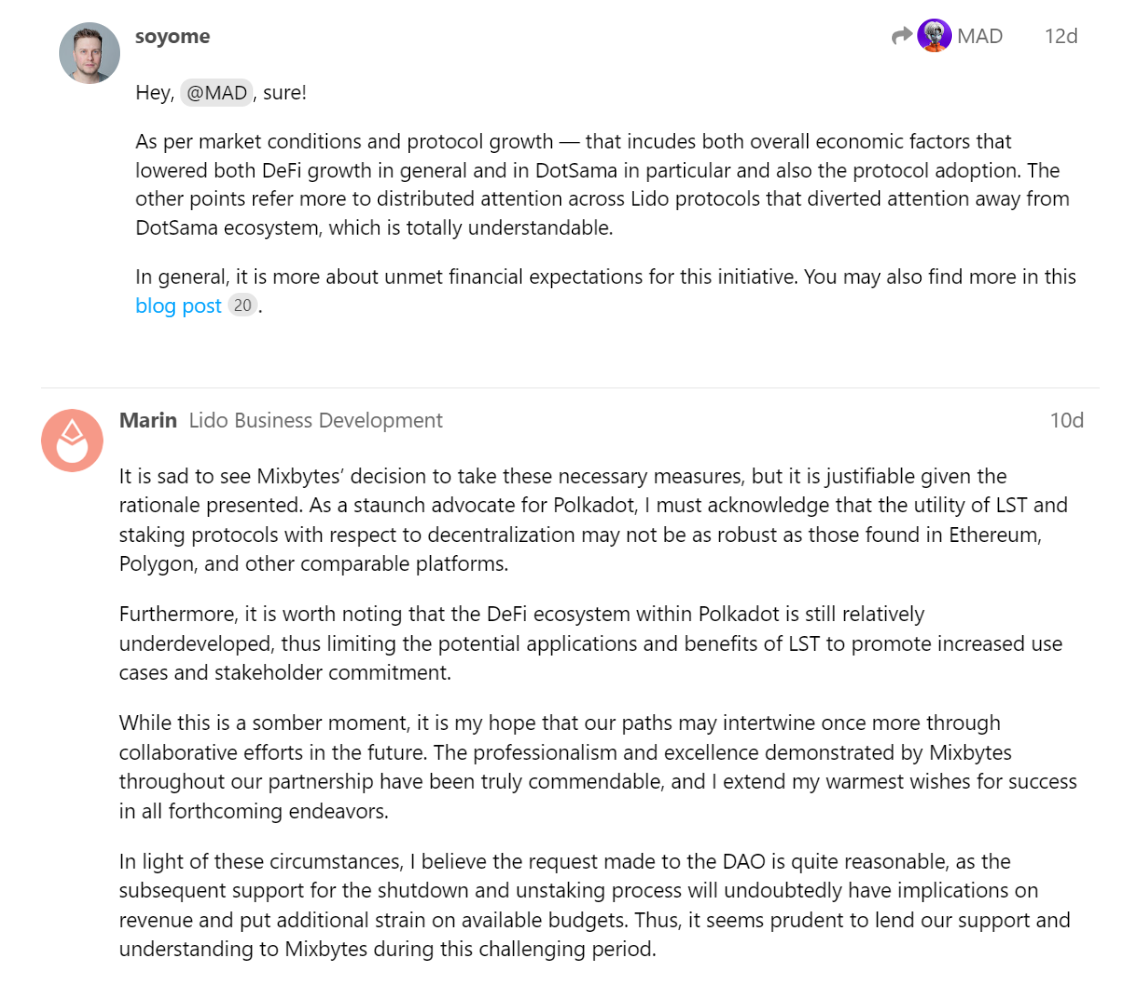
The DeFi ecosystem in Polkadot is still relatively underdeveloped, limiting the potential applications and benefits of LSD as well as some marketing and operational issues. Because the ecology of PolakaDot is relatively complex, I only carried out a simple study on it, without going too deep into the causes of its ecological development. However, when collecting data, many articles on Polakadot and crowdlending were published in the years of 21 and 22, and there are really few new articles recently. Messari's report, State of Polkadot Q4 2022, may give us some answers.
Aptos
According to the data of Aptos Explorer, the amount of node pledge of Aptos accounts for 82.5% of $APT supply, and the average annual income of miners is around 7%. During the investigation, we actually found many APTOs-related LSD projects. However, most of them stopped their Twitter updates after October 2022. The websites of these projects cannot be opened temporarily, and the current TVL of Aptos DeFi is only $37M, and the corresponding LSD base agreement is even less. From the perspective of LP pools of Pancake and Liquid Swap, the APY of the highest pool reached 10%+ (whUSDC-tAPT LP), while the rest were all below 2.78%. However, the holders of tAPT and stAPT reached 45.2K and 29.9K respectively, which was much higher than other ecological LSD of the same scale.
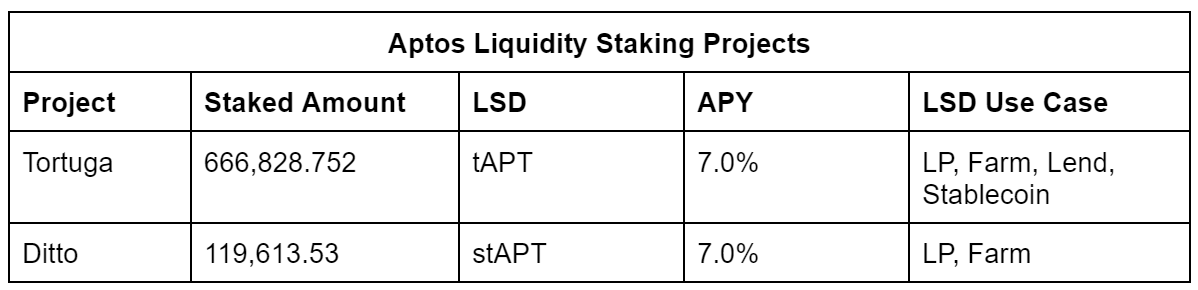
Theoretically, Aptos and Sui both belong to Move ecology, and if LSD protocol can manage APT, it can also manage SUI. The main network of Sui will go online in Q2, will it promote DeFi development of Move ecology and create more infrastructure and use cases for LSD? That's something to look forward to.
summarize
1. As can be seen from the multi-chain planning of LSD such as Lido, Stader and Bifrost, multi-chain of LSD business is an inevitable trend. Only from the perspective of pledge, as long as POS mechanism, LSD can be created theoretically. But in the case of these projects, the vast majority of LSD projects should start with one chain or ecosystem before moving on to other public chains.
2. Operational problems: In the process of data sorting, UI experience of many LSD projects is very poor. In addition, LSD of many projects has many Use cases, but users are not told how to use it, so the overall UX experience is poor.
3.CEX is a factor that cannot be ignored. As the largest traffic entry of Web3, it is also the gathering place of various tokens. This will also influence token speculators to pay more attention to the LSD track.


4. The shutdown of some LSD protocols after the launch of the Aptos main network also gave us a reminder. Please pay attention to the LSD protocols in the new L1s/L2s ecosystem that will be launched soon, and choose sustainable projects to invest your assets.
5. Recently, FVM is online. LSD schemes such as SFT, MFIL, STFIL, and HashMix are ready to be online. LSD has become a mandatory DeFi protocol for public chains.
6. Earn bonus sharing through LSD, or access to LSD Pool and LSD DeFi products can provide real income. For comprehensive DEFIs, LSD service may become a new revenue growth point for old DefIs.
7.MetaMask announced the availability of Ethereum Pledge in January and is currently in Beta. In Cosmos, Keplr wallet is the entry point for many people to pledge their assets, Cardano has a similar wallet entry for pledged SPOs, and the BD of the LSDFi project may be able to put partners in the wallet end.

Discussion (subjective view area)
Whatever analysis I've done before, it's all based on one thing: Will holders look for stability and high returns? However, one point is ignored: the correctness of pledge, participation in governance and maintenance of network security. The main purpose of pledge of POS or modified POS mechanism is to maintain network security. However, in fact, the decentralized distribution of nodes and the basic distribution of tokens have already been determined at the beginning of the financing link and the test network stage of most public chains. Second is governance, cosmos's Stride and Quicksilver's proxy voting solution is a good case for gaining revenue and participating in governance.
Do LSDS need to be combined to generate revenue? I can't answer that directly, but two cases come to mind:
In some small African country with poor financial facilities, you should worry about currency inflation, but if you are on Wall Street, you think more about creating higher financial instruments and financial products.
There are a lot of tokens with minimal utility in the market, which can be counted up to over 100 billion or so. And behind LSD is ETH, the second value currency in the crypto world, which can carry the development of more products in both actual value and stability. Why give up this broad market of LSD? It's a bear market. More than $200 billion, so how big is the LSD imagination?
Are LSDS of other chains necessary? Yes, LSD can promote an ecological network pledge, improve network security, and at the same time provide liquidity for DeFi, promote the development of DeFi within the ecosystem.
The biggest influencers in the LSD wars are likely to be node operators and CEX. Lido, as the largest lSD leader, holds only 4.87% of the ETH ecosystem, while in some ecosystems, such as Cosmos's $ATOM, Large operators may entrust ATOM with more than 4.4% (stake.fish), while ATOM holdings of Binance, Kraken and other nodes far exceed those of LSD projects. The chips of VC's own nodes marked by the circle in the following figure may also become the impact factors of LSD War.

Can non-POS network native assets do LSD? There is no suitable case to be found, but there is an idea that without the need to maintain network security, the use of governance rights may be designed, Token locked into xToken, xToken represents the asset redemption right after a certain period, can also be bound to governance, if this agreement determines the income distribution through governance, Then you can develop products based on xToken to determine revenue and so on.
Original link
Welcome to join the official BlockBeats community:
Telegram Subscription Group: https://t.me/theblockbeats
Telegram Discussion Group: https://t.me/BlockBeats_App
Official Twitter Account: https://twitter.com/BlockBeatsAsia

 Related Articles