A&T Capital: Why do we like Scroll and invest in it
原文标题:《 A&T Family:Scroll 完成 5000 万美元新一轮融资 - 我们为什么在天使轮参投? 》
AnT Capital
Ethereum expansion project Scroll has announced the completion of a $50 million round of funding. Polychain Capital, Sequoia China, Bain Capital Crypto, Moore Capital Management, Variant Fund, Newman Capital, IOSG Contributing were Ventures and Qiming Venture Partners. The round brings Scroll's total funding to $83m at a valuation of $1.8bn.
A& T Capital participated in Scroll's first round of financing in 2021. As an early investor in Alpha, we reviewed our investment judgment at that time.
Why do we invest in Scroll?

Project introduction
Scroll, led by NYC PhD Ye Zhang and OG Sandy, is a Layer2 solution that aims to solve the expansion problem of Ethereum (build an extra layer of more efficient network structure on top of it based on the network consensus and security of Ethereum). More domestic and foreign top CS professors as technical advisor; This scheme belongs to ZK-Rollup (ZKR) school based on zero-knowledge proof. The team's research results in the direction of hardware acceleration are its unique advantages over other ZKRS, which will help it to have higher computing efficiency.
Business model:
As a network base layer similar to Ethereum, Scroll's profit model is similar to Ethereum's "network usage fee". Scroll plans to make profits by charging commission for transactions in its network (part of which is captured).
Investment logic and risk assessment
Investment logic:
1. Ethereum expansion is imminent, the market is still in the blue ocean phase, and the potential return on investment Scroll is huge.
The market is blue and the scale is huge: among the expansion schemes, Ethereum 2.0 cannot be implemented for a long time, and the expansion schemes that have gone online other than Layer2 have the bottleneck of low security. In Layer2, the performance of OPR is theoretically weaker than ZK-Rollup, while other ZKRS still need a period of time to be implemented, and the market has a window period. As a proxy for market cap demand, Ethereum currently generates at least $16 million worth of network usage per day, making the potential value of the expansion option huge.
2.ZKR schemes have not been implemented, Scroll is in technical selection (hardware & Software) has advantages over other ZKRS and can be seen in the future.
ZKR project requires strong technical strength. Starkware, Matter Labs and Hermez are the only three qualified teams in the market at present, but they have not been implemented yet. Scroll still hopes to compete to be the first ZKR scheme to be implemented and win significant competitive advantages.
Advantages of Scroll technical solution: Scroll has participated in the development of Ethereum Foundation's EVM-compatible ZKR framework, so it has stronger legitimacy, and its hardware acceleration scheme can theoretically improve the efficiency of zero-knowledge verification by an order of magnitude, which is not available in other schemes.
Investment risk:
1. Network effectiveness to be tested:
Risk: The advantage scheme of Scroll has not been realized, and the actual effect after implementation needs to be tested.
Solution/Our understanding: Solution/our understanding: Scroll team has strong technical strength and is at the forefront of the industry in terms of implementation.
2. Risks of industry competition:
Risk: Starkware and Matter Labs have been the first mover for 2-3 years and have accumulated rich market recognition. They are strong rivals in Scroll's battle for market share.
Solutions/Our understanding: the easy-to-use solutions that can be implemented first can quickly sweep the market. Considering that Starkware/Matter Labs has not yet been implemented, Scroll also has opportunities.
Industry trends and status quo
Ethereum becomes the "standard" : Thanks to the fact that it has carried the majority of the development positions of the public chain developers from 2016 to 2020, the core "decentralized" developer community has formed a habitual dependence on the development environment of Ethereum, and providing EVM compatible environment has become the "standard" of each new high-performance public chain
In addition to developer resources, Ethereum also precipitates the most assets in the decentralized world. The multi-chain ecology with Ethereum as the core is likely to be the future pattern of public chain system.
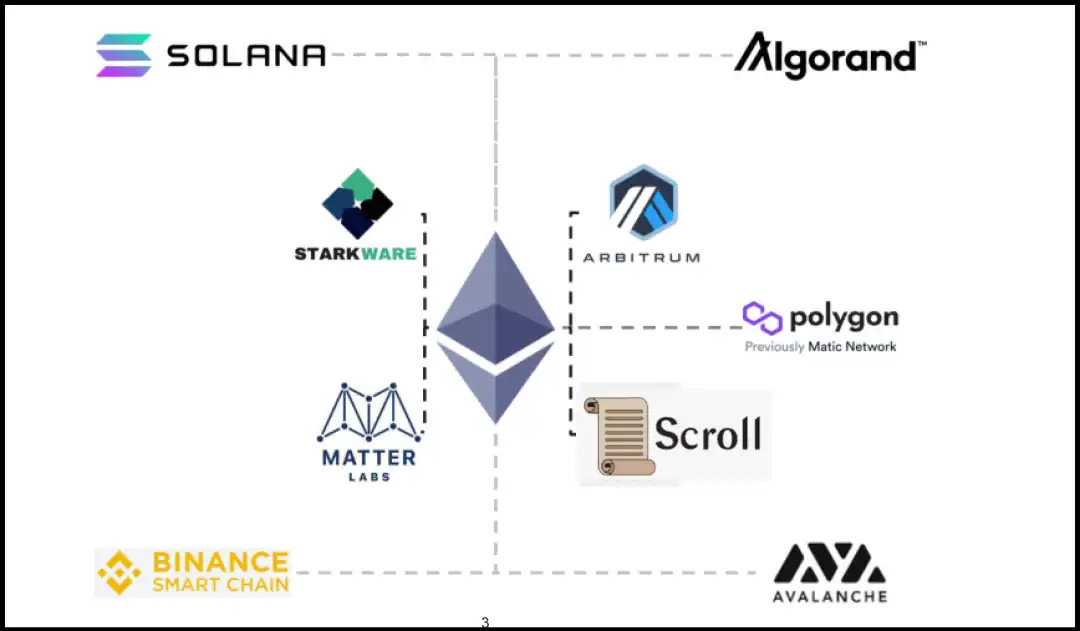
The "legitimacy" of Ethereum: Considering BSC (a heterogeneous chain that, while useful, still doesn't attract the most innovative people on Ethereum) and Polygon (Plasma solution, which attracts a small amount of Ethereum talent), Vitalik's claims to "legitimacy" are somewhat true. The closer the project is to Ethereum's decentralized nature, the more legitimate it is).
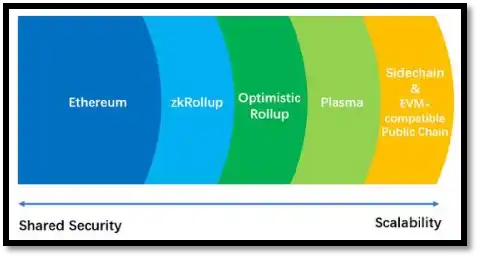
Extension of application layer: Reference to the legitimacy (i.e., Ethereum is the most secure), the security of each chain varies according to the degree of binding of each chain structure to Ethereum, and each application may also be layered in extension according to the value of each transaction: Ethereum will take on the largest and most important utilities, DeFi will move to Rollup (ZKR is more secure than OPR), and gaming, NFT and other long-tail markets will move to more scalable Plasma or side chain & Heterogeneous chain migration; Rollup or Ethereum Layer1) can migrate back to Rollup or Ethereum Layer1 when an app matures and becomes more valuable.
Project highlights
1. Product overview
Scroll's ZK-Rollup is an efficient blockchain underlying structure built on top of Ethereum (so called Layer2, Ethereum is Layer1). Existing/newly developed Ethereum blockchain applications can run on its network;
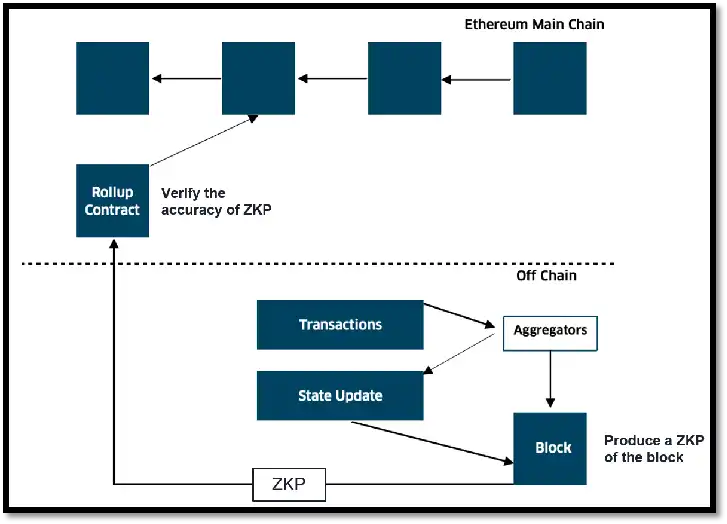
Rollup efficiency comes from: Periodically packaging transactions that occur on Layer 2 networks and sending them to Layer 1 networks for recording (Layer 2 networks can have their own consensus on recording);
In contrast, the security of Ethereum is based on the verification of the authenticity of each transaction by the nodes of the whole network, while for Rollup network: since the state of its network will eventually be recorded on the Ethereum layer, that is, the security of the two-layer network is reflected in the authenticity of the packaged content.
ZK-Rollup generates a zero-knowledge proof for each packaged content of the layer 2 network, sends the proof to the layer 1 network, verifies the correctness of the proof by the corresponding contract of the layer 1 network, and counts the verified layer 2 network transactions into the layer 1 network.
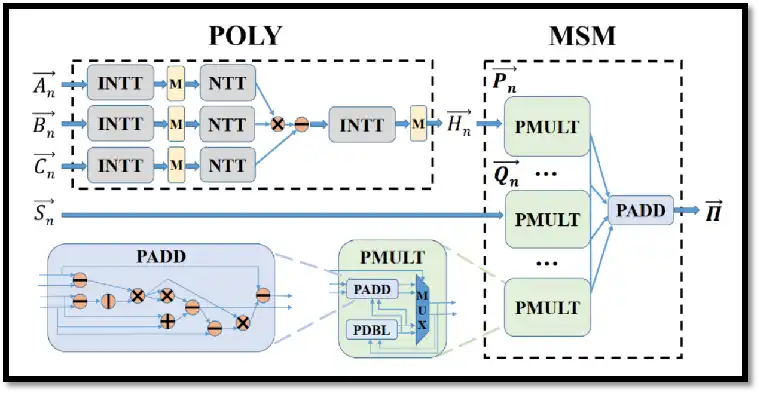
PipeZK: In this paper jointly published by Ye Zhang, Professor Gao et al., PipeZK realized parallel acceleration for Poly and MSN (refer to the figure on the right, which is the basic logic of zero-knowledge proof circuit), so that the computing resources of ASIC are highly efficient and can cooperate with CPU to process the calculation of these two parts:
Thanks to the advent of efficient ASics, Layer2 nodes that generate ZKP are decentralized (they were expensive before), making Layer2 incentivised and more secure.
The ASIC designed according to the characteristics of PipeZK is nearly 20 times faster than the current GPU on the ZKP of the cipher circuit. Can reduce the proof delay of Zcash (ZK-SNARK based anonymous transaction network) by 5 times.
EVM compatibility: Layer 2 Scroll networks will have full EVM compatibility (to attract existing Ethereum developers); This was helped by Scroll's involvement with Ethereum Foundation EVM R&D team in developing EVM compatibility under ZK-Rollup, Enthereum Foundation allows Scroll to adopt this scheme as the selection of EVM compatible framework for the second layer network.
2. A comparison of Scroll and mainstream Layer2 solutions
Horizontal comparison of the first round valuation of Arbitrum and other four direct competitors, the first round valuation of Scroll is reasonable;
Although Scroll started later than Starkware/Matter Labs, considering that the latter two are still not on the ground (which will be difficult to implement in the short term), the collaboration between Scroll and Ethereum Foundation, and the superior hardware solution (which will be difficult to replicate in the short term), Scroll still has room to play; Compared with four competitors, the potential increment space of Scroll is significant.
Source of original text
Welcome to join the official BlockBeats community:
Telegram Subscription Group: https://t.me/theblockbeats
Telegram Discussion Group: https://t.me/BlockBeats_App
Official Twitter Account: https://twitter.com/BlockBeatsAsia