The LSD yield farming war escalates: not only seeking liquidity, but also pursuing high returns.

Original Title: "LSD Matryoshka War Escalates: Not Only Liquidity, But Also High Returns"
Original Author: Rainy Sleep
LSD (Liquid Staking Derivatives) is expected to be the most popular narrative in the cryptocurrency market in the first half of 2023, or even the whole year. We can see that since January 10th of this year, tokens related to LSD have started to lead the market. The original intention of LSD is to liberate liquidity, that is, to issue liquidity certificates for the liquidity pledged by users, just like what Lido Finance is doing - users can obtain stETH liquidity certificates after pledging ETH.
Why do we pay long-term attention to and have a positive outlook on the LSD-related ecosystem?
To give a simple analogy, if ETH is considered the "dollar" of the crypto world, then stETH is the "US Treasury bond" with rigid redemption and built-in yield. However, whether it is Lido Finance, Rocket Pool, or SSV.Network, they are all aimed at solving pain points in Ethereum staking, such as difficult node setup, high minimum staking threshold, and low capital efficiency. It wasn't until Frax Finance launched new products related to LSD that yield became a focal point of attention.
frxETH hopes to increase user profits through DeFi: users can choose to provide liquidity in the frxETH-ETH liquidity pool on Curve, or they can stake frxETH for sfrxETH to enjoy staking rewards. Its high yield comes from two aspects. Frax Finance shares all ETH collateral yield behind frxETH with sfrxETH stakers, and it bribes Convex to provide higher returns for the frxETH-ETH LP (frxETH holders do not enjoy staking rewards).
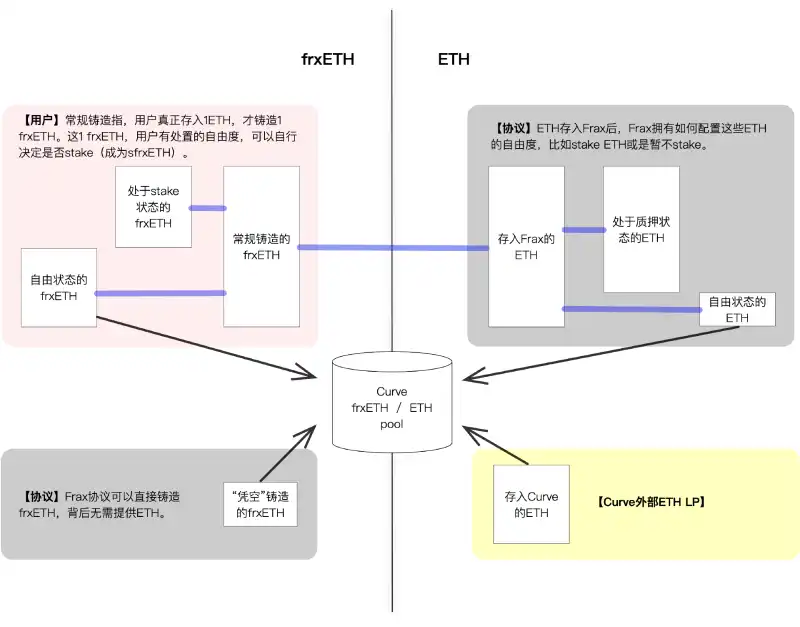
After Frax Finance, the trend of DeFi yield farming is becoming more and more intense. The LSD protocol not only needs to provide liquidity, but also needs to have higher yields in order to compete for users and funds.
Next, we will focus on introducing three protocols: Yearn ($YFI), Pendle Finance ($PENDLE), and Aura Finance ($AURA).
Yearn
Yearn is a DeFi yield aggregator based on Ethereum, launched by Andre Cronje in early 2020, dedicated to providing users with higher yields for ETH, stablecoins, and other tokens.
On February 22nd of this year, Yearn officially announced the upcoming launch of a new product called "yETH". The aim is to cover a basket of LSD assets in the form of yETH tokens, while diversifying risk and increasing yield.
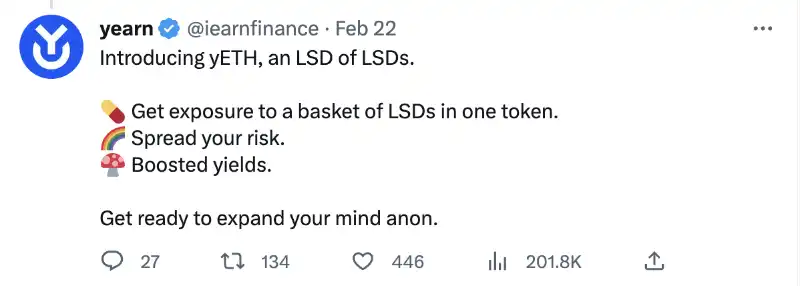
According to community speculation, yETH launched by Yearn is built on first-layer LSD assets such as stETH and frxETH, and yETH can also enjoy the skew of veCRV governance resources held by Yearn itself. In order to compare profits, Twitter user @MStiive created the following profit calculation comparison as shown in the figure below.
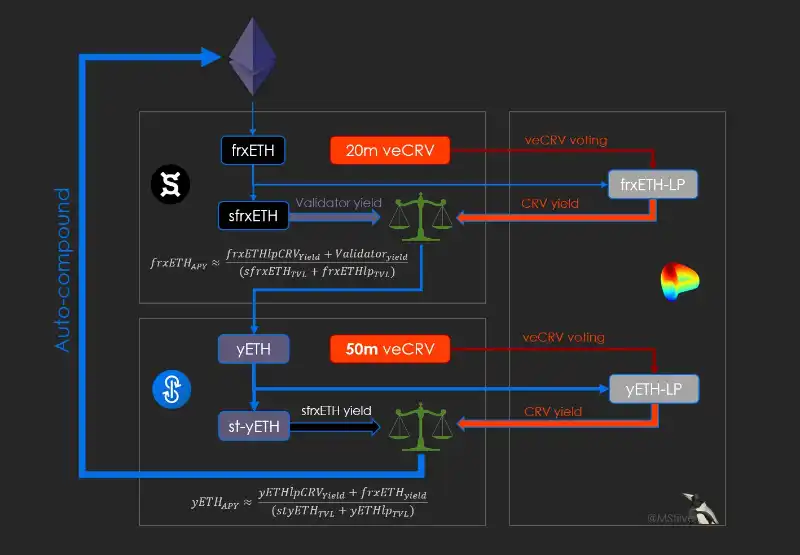
Actually, as shown in the model in the figure, Yearn and Frax Finance do not have a direct competitive relationship, because the underlying asset of yETH is not ETH, but LSD assets such as stETH and frxETH. yETH will provide higher returns for stETH and frxETH holders, which will drive the emergence of a huge Ethereum staking wheel or a new wave of yield farming.
Of course, the above are all speculations. Everything should be based on official announcements.
Pendle Finance
Pendle Finance is a DeFi protocol built on Ethereum, Arbitrum, and Avalanche that tokenizes yield. It allows users to tokenize and sell future yields of certain assets.
It is how to run?
Pendle will package interest-bearing assets into SY (Standardized Yield Token), and then divide SY into PT (Principal Token) and YT (Yield Token). Since calculating yield requires a time scale, Pendle is essentially using time to package SY and divide it into PT and YT.
YT is the profit of PT within a certain period of time, and PT can be exchanged 1:1 for SY after the given time ends. Users can also trade PT and YT through the Pendle v2 AMM. The v2 AMM adds a time decay factor to the traditional AMM model for users to trade the yield of interest-bearing assets.
Token YT.Would splitting Pendle in this way maximize the potential returns from interest-bearing assets?
Based on Pendle, users can execute more advanced yield strategies, such as purchasing interest-bearing assets at a discounted price - for example, purchasing $ETH at a 6.59% discount or purchasing $APE at a 20.85% discount.
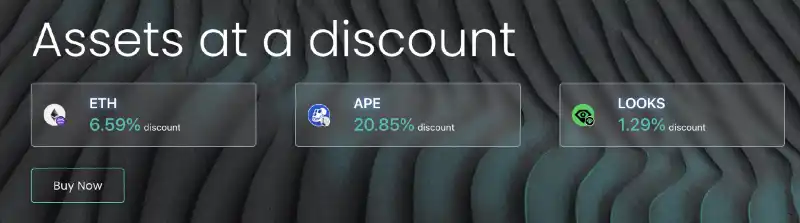
Alternatively, users can also lock up their idle assets, such as staking ETH in Lido, to receive PT stETH and YT stETH Tokens in advance, and realize the yield of YT stETH Tokens in advance through v2 AMM.
In short, the LSD protocol helps users stake ETH and seek the highest yield, while Pendle is actually realizing the future returns provided by the LSD protocol for users in the present.
Currently, Pendle supports the relevant LSD assets provided by Lido Finance, Rocket Pool, and Aura Finance.
Aura Finance
Currently, stETH and cbETH have occupied the majority of the LSD market share. For smaller participants who want to make a comeback, the easiest way is to provide more incentives:
1. Higher Yield
2. Increase liquidity
3. Integrate DeFi for greater composability and strength.
Aura Finance can achieve this. It is an ecological yield governance platform built on Balancer. Aura is to Balancer what Convex is to Curve.
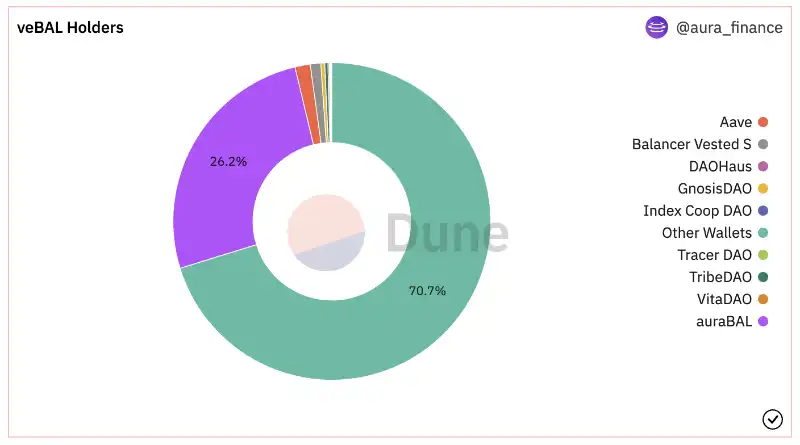
According to Dune data, Aura's $veBAL holdings account for 26.2% of the total. Through $veBAL governance bribery, LP holders will receive higher yields. The advantage of Balancer's liquidity governance war over Convex lies in its higher bribery capital efficiency, ultimately benefiting Aura as well.
In the previous section, we showed the results of the Curve liquidity governance battle between Frax Finance and Yearn - Frax Finance holds 20 million $veCRV while Yearn holds 50 million $veCRV. As time goes on, Lido Finance and Rocket Pool have also started to compete for Balancer's liquidity. As a veteran DeFi protocol, Balancer has a TVL (total locked value) of $1.1 billion, and Aura Finance will be the beneficiary of the Balancer liquidity war.
Aura Finance mentioned in a tweet that the LSD protocol will start with DeFi in order to increase the utility of LSD assets. For example, it will become a popular collateral type in CDPs and currency markets. ETH has become a mainstream collateral type because of its strong liquidity, which allows the protocol to quickly liquidate ETH and ensure that there are no bad debts.
And in order to ensure that LSD assets have sufficient liquidity, the liquidity war will begin, and Aura Finance will be the leader of this LSD liquidity war on Balancer.
Through Aura Finance, LSD protocols will have the opportunity to launch liquidity flywheels for LSD asset USD trading pairs and altcoin trading pairs. If the flywheel is activated, the liquidity network effect of LSD assets will dominate the market and become the default trading pair in the market.
Currently, Aura Finance has partnered with almost all mainstream LSD protocols, such as Lido Finance, Rocket Pool, Swell Network, Stakewise, Stader, Ankr, and StaFi. It can be foreseen that these LSD protocols will also initiate Aura governance power wars to ensure their own market share.
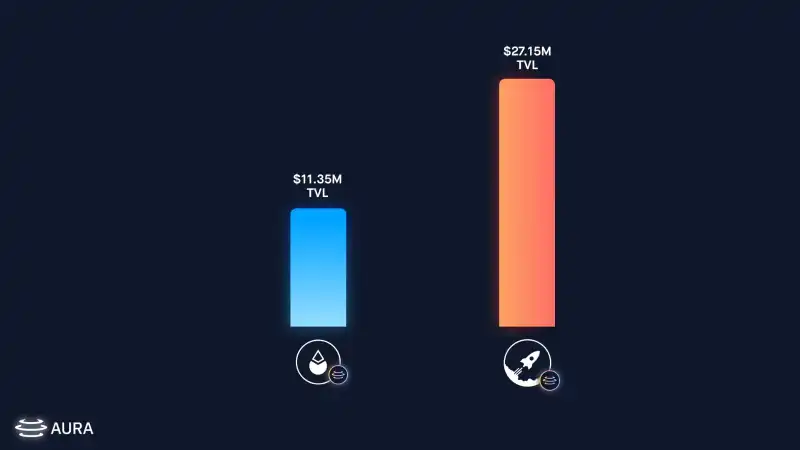
Rocket Pool is the first LSD player to participate in Aura Finance's liquidity incentive. According to official statistics, the TVL of the counterfeit currency liquidity trading pair of rETH, which has gained the first-mover advantage, has exceeded $27 million, although the TVL of the counterfeit currency liquidity trading pair of Lido stETH has already exceeded $11 million.
Frax Finance CEO Sam Kazemian has also hinted in the community that he will accumulate AURA positions.

Essentially, the war surrounding Aura Finance and Balancer is a competition among various LSD protocols for liquidity.
Final
In this LSD war, we can look at this emerging track from two perspectives.
From the user's perspective, the LSD protocol solves the minimum staking limit and provides higher yield. The representative protocols are Lido Finance and Frax Finance.
From the perspective of the LSD protocol, survival and expansion are the top priorities of the protocol. In other words, the LSD protocol needs to expand its market share to ensure its own survival and development. Yearn and Pendle are more like catalysts for the LSD protocol market, and their selection may have the opportunity to promote the corresponding protocol to expand its market share faster. Aura may have the opportunity to become the core protocol for LSD protocol market share competition, and its governance rights may become the object of competition among various LSD protocols.
Original article link
Welcome to join the official BlockBeats community:
Telegram Subscription Group: https://t.me/theblockbeats
Telegram Discussion Group: https://t.me/BlockBeats_App
Official Twitter Account: https://twitter.com/BlockBeatsAsia

 Related Articles