Title: Stacks Thesis
Original article by Hal Press, North Rock Digital
TL; DR:
1. The halving of BTC will take place in about a year. After the halving, security will bring more attention to the second layer of BTC, and the market is also looking for trading opportunities related to the halving with higher volatility.
2. STX is the most complete BTC Layer 2 and the only circulating Token project in BTC Layer 2. The FDV ratio of Ethernet to Ethernet L2 has reached 200/60 = 3.33x, but the ratio of BTC to layer 2 of BTC is only 480/1 = 480x.
3. Although the valuation of Ethernet layer 2 is reasonable compared with that of BTC Layer 2, the gap should not be 144 times. If the gap is reduced to 14 times, STX still has more than 10 times of appreciation space. In addition, STX itself is estimated to be close to the head Ethernet layer and the public chain of about 10 Bn FDV is not unreasonable.
4. As with ETH: LDO during Merge, the market will tend to look for small cap opportunities associated with a halved trade BTC. The narrative of STX is similar to that of $1 Solana at that time. It is very easy to obtain the allocation of BTC fund managers who do not want to own the broad market, and at the same time has extremely high upward elasticity.
在 Ordinals NFT 推出之后,Stacks 的 Token STX 存在着一个巨大的交易性机会。
We've been thinking about how to trade bitcoin in half in about a year (to be specific, early March 2024) -- past BTCS never had to worry about reducing security costs after halving the price as they continued to build consensus. After all, each time BTC-denominated block rewards halved, the price did go up more than a dozen times. But from this halving cycle, as a more mature asset, it is hard to argue that prices will continue to double every four years to keep the network safe. In other words, if BTC were to double every four years, it would exceed global M2 in 20-24 years, which is obviously not sustainable.
As a result, the BTC's safety issues will either be resolved by removing the hardtop, or miners will receive a higher transaction fee in addition to the Block Reward. The former is clearly unlikely -- apart from shattering the BTC's own narrative that it will never inflate, even the white paper has written that its long-term security should be underpinned by fees. So how to greatly increase the commission on BTC, is the community needs to be very concerned about the focus of the future period of time.
BTC itself as L1 is not designed for composability or smart contracts, so as an application, building on L2 with BTC security is obviously a better solution, and that's why Stacks exist.
As the three major L2 protocols on BTC, Lightning, RSK, and Stacks, Stacks (STX), as the most advanced L2 protocol of Bitcoin, it undoubtedly goes the farthest in the application level: It has the most Apps by comparison, the most complete NFT ecosystem, a BTC Naming Service and more DeFi protocols coming online soon this year, and most importantly, Stacks is the only one of the three in coin.
Of course, Stacks aren't strictly a layer 2 like Ethereum L2. The fact that Stacks have their own authentication node sacrifices some assumptions of trust: resistance to censorship comes from Stacks signers (STX collateral, who don't need to be BTC miners and tend to switch BTC from L2 back to L1), and resistance to reorganization comes from Bitcoin. Bitcoin itself does not offer censorship resistance directly because of its design. The advantage of this system is that it feeds directly into the BTC loyal community + creating native commissions for BTC, and if BTC can integrate anti-censorship features in the future, Stacks will look more like the Ethernet L2 we see in Stacks. Of course, this will be a long time in the future, and Stacks' ecology will probably be more robust by then.
The Nakamoto upgrade coming this year will make it easier for apps such as Opensea/Uniswap to be built on top of Stacks/BTC. By then, Subnet will be introduced to support EVM/Solidity, greatly eliminating migration costs. In addition, Nakamoto can also help the birth of synthetic BTC on Stacks, directly stimulating the prosperity of DeFi ecology on Stacks. Finally, with the completion of the Nakamoto upgrade, the Block Time on Stacks will go from 10-30 minutes in the past to within seconds. As a Princeton team that has been building Stacks since 2017 and has been helping with bitcoin development since 2013, completing the upgrade to Nakamoto will make Stacks an unprecedented presence on BTC, similar to Ethereum L2. With development coming up in the next few years, we believe that the security at Stacks will be more deeply tied to the security of BTC, and its block out + confirmation speed will increase further. These details were released by the company last monthWhite paperGet in.
Culturally speaking, some of the most respected members of the Bitcoin community have expressed dissatisfaction with Bitcoin Maximalism over the past year, and as BTC security issues continue to evolve in the future, we expect the community to become more flexible and focus on solutions that will make its network more robust. This openness of mind is evident in Ordinals: Ordinals allows data to be recorded on individual satoshi (sats) on the Bitcoin blockchain, effectively creating the ability to transform each individual satoshi into its unique NFT equivalent. This new feature has directly triggered on-chain activity -- Bitcoin network fees have tripled in the past month (see details here:https://twitter.com/n3ocortex/status/1626675145631756289?s=20)。此外,这种活动与 Stacks L2 上构建的比特币命名服务(BNS)的快速采用相结合,引发了 Stacks 活动的重大增长:
Stacks Number of transactions
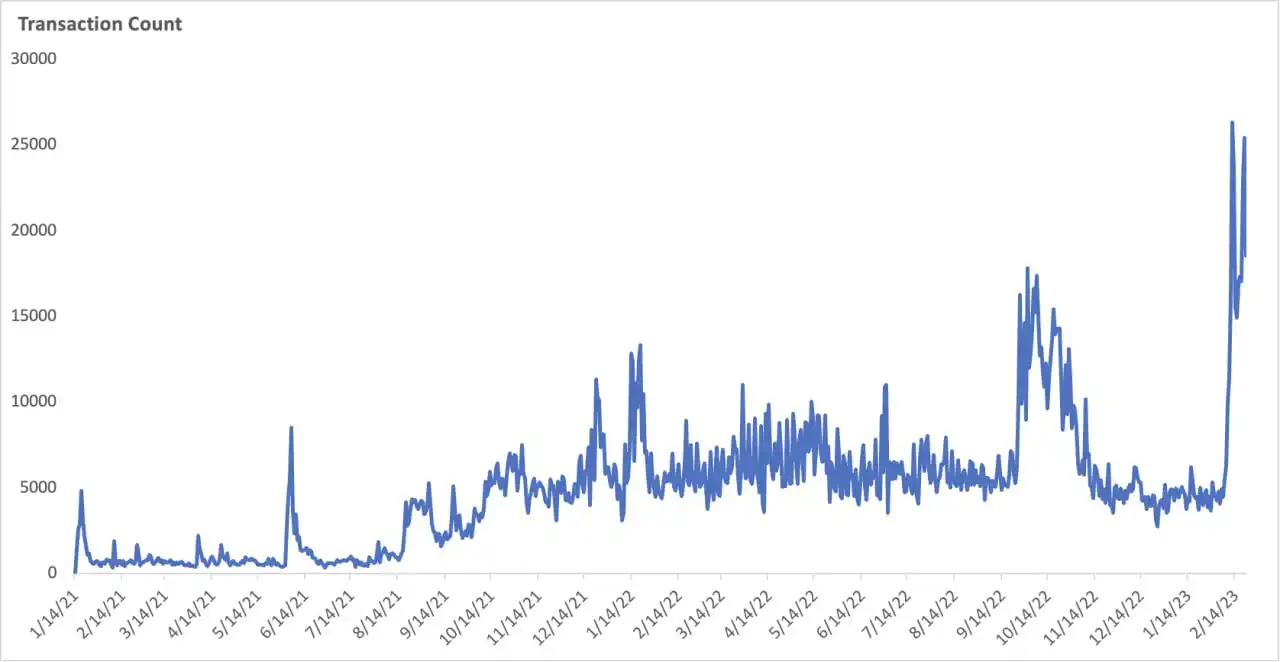
这种热情不但让更多人参与到 Buidling 当中,也同时展示了在 BTC 上直接做应用是一件多么难得事情 – 进而会使更多得注意力和开发者资源导向 Stacks。目前,Stacks 上正有 30 个团队正在开发不同的项目,而我们认为其上面的生态在 Nakamoto 升级完成后,有着最强的爆发潜力。
The Proof-of-Transfer mechanism of Stacks is similar to Proof-of-Work: miners confirm Stacks transactions, but must bid for each stack block and the winner will receive the STX reward. And the currency they bid on can only be BTC, and the BTC that is paid will be put on the pledge of STX. The current BTC rate of return on pledge is about 7% annualized (https://staking.staked.us/stacks-staking#instructions), and with the improvement of the efficiency of network use, when the block space becomes more valuable, the BTC cost that miners need to pay will also increase correspondingly, and the rate of return of STX pledge will be increased simultaneously.
Ethereum's current market cap is $200Bn, and the total FDV of all Ethereum Layer 2 networks is about $60Bn. The ratio is about 3.3x. The market value of bitcoin in the premise of 480Bn, as a two-layer network, STX FDV only 1Bn, the proportion of about 480x, in which 480/3.3 = 145 times of the gap, is the appreciation space STX can capture. Of course, Ethereum's overall design is better suited for two tiers, but even if the multiple changed from 145x to 14.5x, STX would easily get a tenfold increase in value. In addition, as a Bitcoin consensus and the strongest ecosystem L2, even if STX alone has a 10Bn FDV valuation, compared to the current leading layer 2 network on the ether (MATIC/OP are more than 10Bn), it is not too much.
In addition, the halving of Bitcoin will encourage more investors to start looking for related investment opportunities. BTC, as the most direct beneficiary of halving, is naturally unnecessary to mention, but its huge volume, as most investors, may want more explosive force, higher multiple target. After combing through the entire BTC-related circuit, there should be no more immediate target than STX. Just as Merge did for Ethereum, the smaller, more explosive, but equally relevant LDO of the same period returned about 600% in the six weeks of July-August, far outperforming Ethereum. The relationship between STX and BTC should be the same. If the BTC ecosystem grows more robustly, STX will be able to appreciate at least 10 times over the next 12 months as SOL did at $1.
In addition, the STX circulation plate is extremely large. The relative FDV ratio is about 0.75. Basically no VC unlock disk pressure.
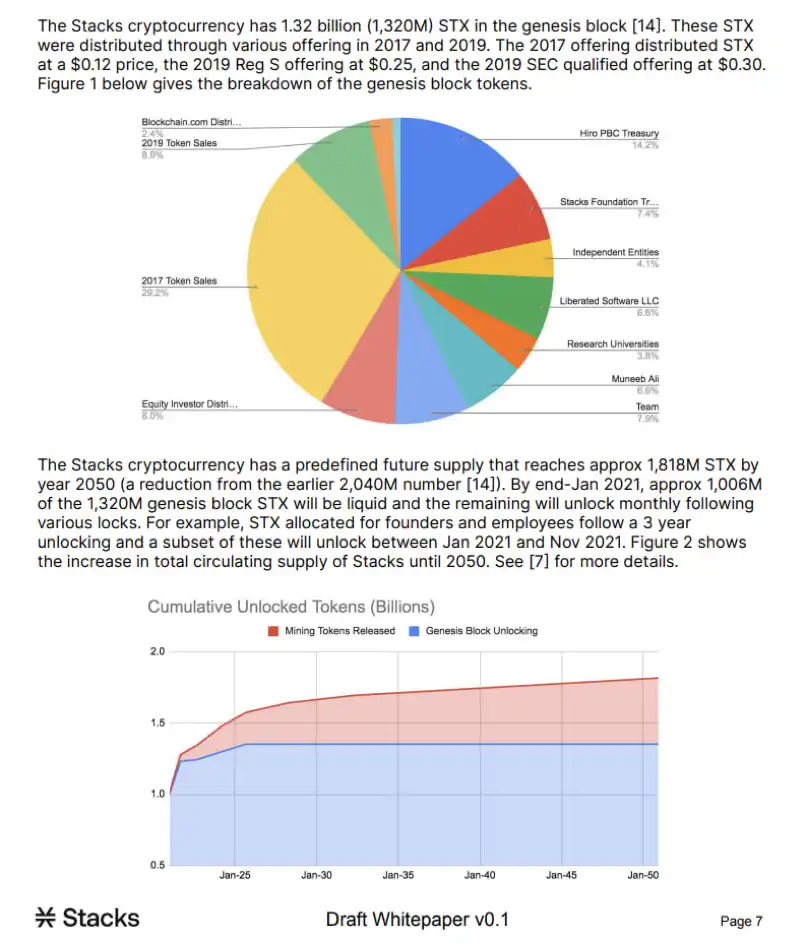
STX 是 SEC 前所未有的首个合资格 Token 发行,已在 2019 年充分去中心化地释出,在今天这个美国监管日渐严格的行业里,风险已经被极大摊薄。
Original link
Welcome to join the official BlockBeats community:
Telegram Subscription Group: https://t.me/theblockbeats
Telegram Discussion Group: https://t.me/BlockBeats_App
Official Twitter Account: https://twitter.com/BlockBeatsAsia




 Related Articles