Stacks has launched sBTC, injecting new impetus into the BTCFi ecosystem
Original source: Stacks
What is sBTC?
In a sense, the $2.1 trillion Bitcoin (the latest CoinGecko data on December 18, 2024) is the largest "sleeping pool of funds" in the crypto world.
Unfortunately, most of the time it has neither brought benefits to holders nor injected vitality into the on-chain financial ecosystem. Although there have been many attempts to release the liquidity of Bitcoin assets since the start of DeFi Summer in 2020, most of them are repetitive, and the overall BTC capital inflow attracted is very limited, and it has never really leveraged the BTCFi market.
Against this backdrop, sBTC, which has just been launched on the Stacks mainnet, is a 1:1 Bitcoin-backed asset on Stacks L2, committed to leveraging Bitcoin’s security (100% Bitcoin finality) and fast transactions to release BTC capital and open up new use cases, thereby completely revitalizing the Bitcoin economy.
Currently, sBTC is operated by a large-scale signatory network consisting of institutions such as BitGo, Asymmetric, and Ankr. It is expected to become one of the most decentralized L2 Bitcoin assets, bringing unprecedented opportunities to DeFi, dApps, and other fields. This article will further explore the specific operating mechanism and relative advantages of sBTC.
How does sBTC work?
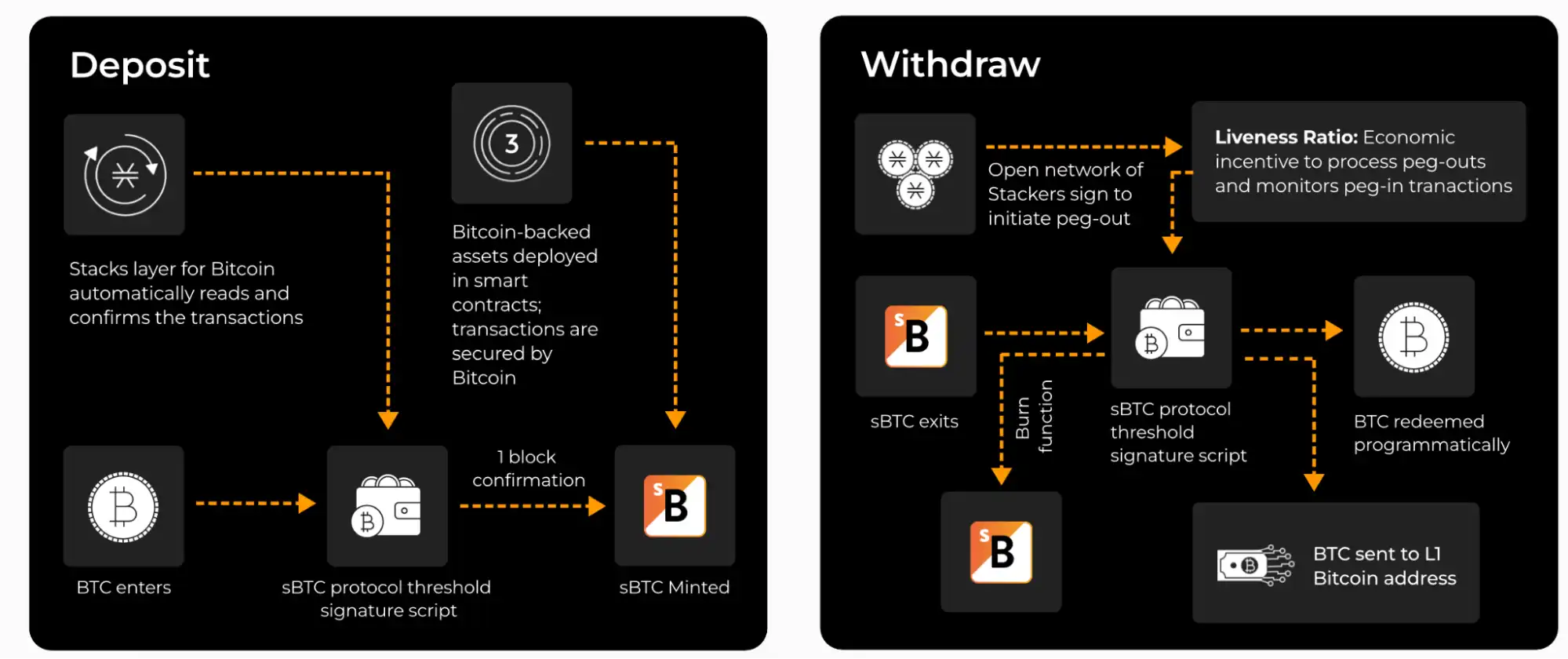
Users first deposit BTC into a multi-signature protocol monitored by the Stacks decentralized signatory group through a Bitcoin mainnet transaction.
After BTC is deposited, sBTC is minted on Stacks, and users can interact with DeFi dApps.
Users can use Bitcoin DeFi without noticing. For example, Zest Protocol will support mainnet BTC deposits and automatically convert them to sBTC. In the future, sBTC is expected to become a fee token on Stacks, further improving the user experience.
Will there be a deposit limit for sBTC?
At the current stage, the deposit limit is 1,000 BTC to allow for controlled testing and gradual security enhancement.
Only deposits are supported in the early stage, and withdrawals are temporarily unavailable.
Will sBTC generate income?
Imagine earning Bitcoin income just by holding BTC.
No staking, no points, no complicated processes, just holding BTC will earn rewards. sBTC early users will receive 5% annualized Bitcoin rewards by connecting their wallets to https://bitcoinismore.org/ (launched at 22:00 on December 17, Beijing time).
Now, all this is possible through the sBTC reward program. Early users can earn BTC rewards just by holding sBTC, and the rewards will be distributed in the form of sBTC.
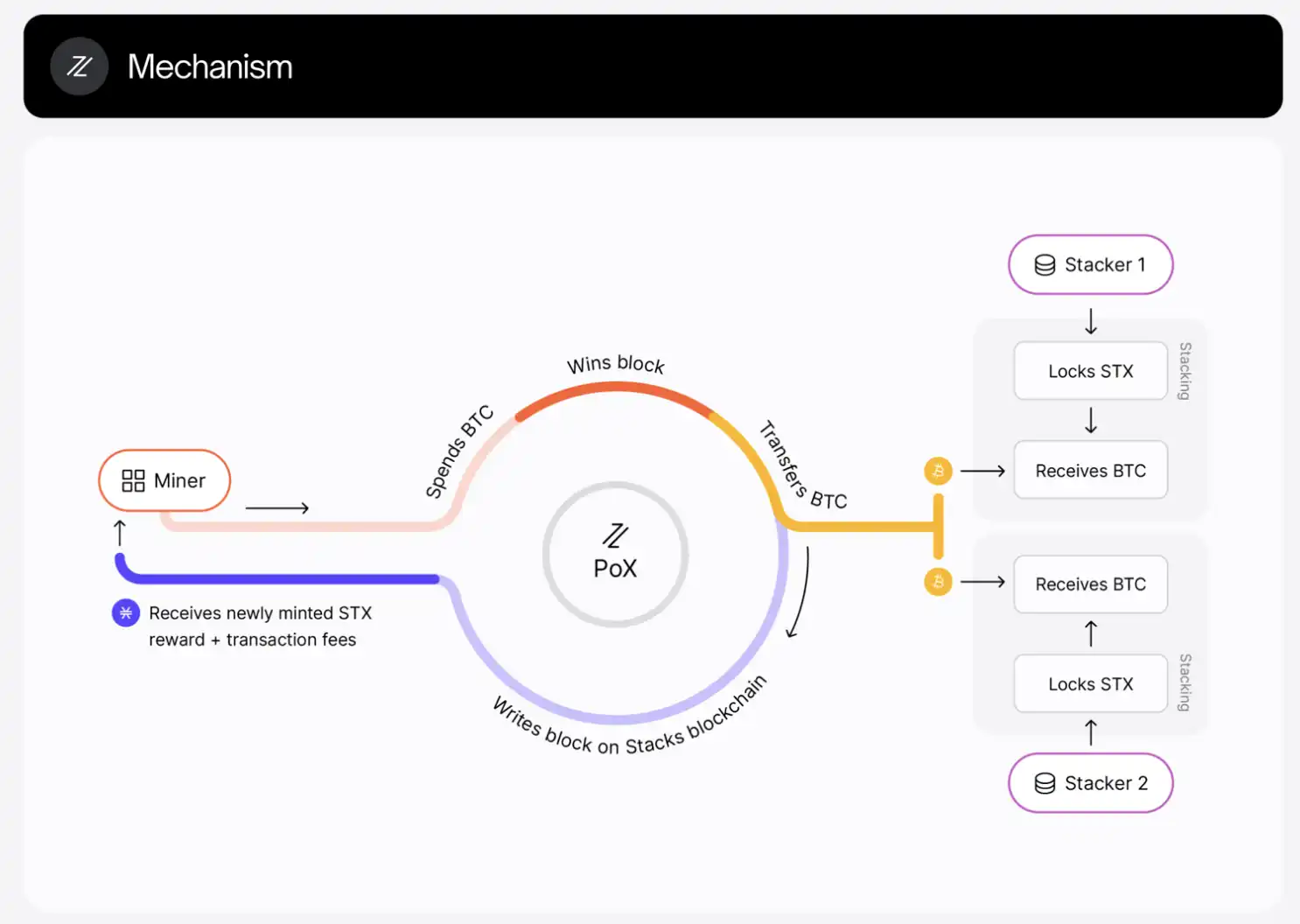
sBTC Rewards Program Powered by stackers who “Stack” STX.
When staking STX, stakers earn BTC through Stacks’ consensus mechanism. To enable the sBTC rewards program, these stakers contribute the corresponding proof-of-transfer BTC rewards to the sBTC rewards pool.
BTC from the rewards pool is deposited directly into a smart contract that deposits BTC into sBTC and distributes rewards to sBTC holders proportionally. The protocol takes a daily snapshot of users’ sBTC holdings and distributes rewards every two weeks — the length of a PoX cycle.
The current estimated annualized BTC reward is 5%, and rewards will be paid out every two weeks.
sBTC Key Features
Where can sBTC be used?
Multiple DeFi protocols will support sBTC, allowing users to earn an additional 5% above the target by simply holding sBTC:
· Liquidity Pool: Users can deposit sBTC into Bitflow's liquidity pool, facilitate transactions and earn a certain percentage of transaction fees.
· Liquidity Mining: Liquidity providers can stake their LP (liquidity provider) tokens in the liquidity mining program to receive additional rewards, which usually come from trading activities or platform incentives.
· Early predictions show that the annual return of deploying sBTC will increase by 10-30%.
· Bitflow Runes AMM: Bitflow has introduced Stacks L2 Runes AMM, and you can bring Runes to L2 for a better user experience.
· sBTC will be listed on the Zest Protocol lending market on the first day.
· Zest Protocol will run yield raising campaigns on the Zest Protocol lending market from day one, with up to 10% BTC yield on sBTC supply
Zest will also unlock more DeFi strategies involving sBTC, such as:
1. Deposit sBTC to earn up to 10% APY on BTC
2. Borrow USDh stablecoins with BTC (or other stablecoins and convert them to USDh)
3. Stake USDh on Hermetica to earn up to 25% APY on stablecoins (25% APY on stablecoin USDh on Stacks).
Reminders:Hermetica's DeFi protocol offers USDh, the first yielding stablecoin backed by Bitcoin. Yields are sustainably generated through perpetual funding rate payments on centralized exchanges, and paid daily.
stSTXbtc is a new liquidity staking token that users can deploy on Stacks DeFi. By holding this token, users will receive stacking rewards of up to 10% of the API, paid directly to your wallet in sBTC.
· Liquidity Provision:Users can provide sBTC to Velar’s liquidity pool, facilitate transactions and earn a portion of the transaction fees generated by the platform.
· Liquidity Mining:By participating in the liquidity mining program, users can stake liquidity provider (LP) tokens earned by providing sBTC liquidity to receive additional rewards in the form of Velar native tokens or other incentives.
· Staking:If Velar introduces an sBTC staking option, users can lock their sBTC in a staking contract to receive rewards, such as additional tokens or percentage returns, to support network operations.
· Velar will have its own incentive program, allowing you to earn Velar’s native token VELAR by deploying sBTC on one of its DEX pools.
Arkadiko will allow sBTC to be used as collateral within its protocol through a governance vote, enabling users to borrow USDA or other assets against their Bitcoin holdings.
5) ALEX DEX
Users can deposit sBTC into a liquidity pool on ALEX and pair it with another asset such as STX or a stablecoin. By doing so, they facilitate transactions on the platform and earn a portion of the transaction fees generated by the pool.
ALEX will receive bonus income in the form of native tokens ALEX through the Surge event. This means that in addition to the sBTC reward program 5% APY, you can also earn income by pooling sBTC, as well as additional ALEX token rewards.
6) Granite (not yet launched) - lending protocol
Borrowers can obtain stablecoin loans by pledging Bitcoin, while liquidity providers earn yield by providing stablecoins to the protocol
· Lending:Users can deposit sBTC as collateral to borrow stablecoins, and then deploy the stablecoins into various DeFi strategies to earn yield.
· Participate in liquidation:Users can act as liquidators and repay part of undercollateralized loans in exchange for collateral and rewards, thereby earning yield through the liquidation process
Granite currently has a waitlist, allowing those who register in advance to enter early. Eventually, the points system will bring additional benefits, and early access registered users will gain significant advantages.
How is sBTC different from other Bitcoin assets such as wBTC, cbBTC, ecc, etc.?
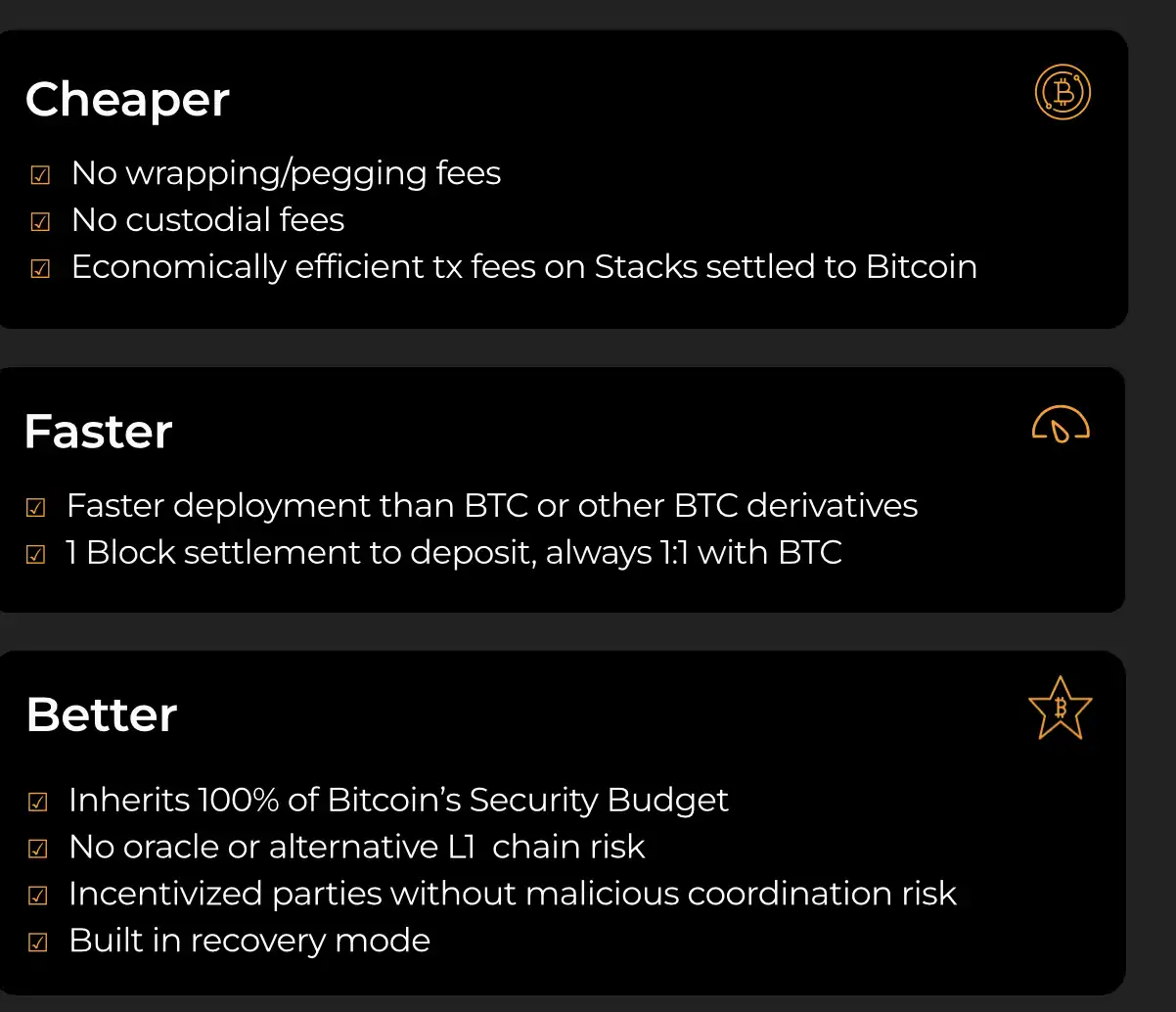
These BTC assets typically require sending BTC to an intermediary or relying on a trusted consortium of signers/small multi-signers.
sBTC will initially rely on a group of 15 signers, including enterprise-level institutions such as BlockDaemon, Figment, Luganodes, and Kiln, to handle hooks and pegs. Over time, this responsibility will be transferred to all Stacks signers, allowing anyone to participate in the security and decentralization of the network. BitGo, Aptos Foundation, and others are also expected to join this work.
In addition, thanks to the design of Stacks, sBTC will benefit from 100% Bitcoin finality, meaning that transactions on the Stacks layer will be irreversible like Bitcoin.
Reminder: Signers are responsible for verifying and approving each produced block; anyone can become a signer, provided that there are enough STX accumulated to become a separate signer - similar to the concept of a validator
Extra:
1) sBTC Additional Materials:
sBTC Website|sBTC Documents|sBTC Deck
2) Nakamoto Upgrade Information:
Nakamoto Website|Documentation
The Nakamoto upgrade is critical because it provides:
· Fast block production (reduced from the current 10 minutes to less than 1 minute, and optimization is underway)
· 100% Bitcoin finality
Fast blocks: Fast blocks bring a Solana-like experience to transactions and Bitcoin DeFi interactions, greatly improving the overall user experience of interacting with Stacks L2.
The Stacks DeFi ecosystem has grown a lot this year, and now applying DeFi strategies takes only seconds, facilitating onboarding and retention.
Before the Satoshi hard fork, Stacks blocks were in sync with Bitcoin blocks (10 minutes on average), making the chain slow and inadequate for DeFi activities. This limitation is no longer in place. Instead, Stacks blocks now take only seconds, with performance increasing regularly. Once a Bitcoin block settles, Bitcoin’s security can still be leveraged.
100% Bitcoin Finality: With the Satoshi upgrade, transactions occurring on Stacks L2 will leverage 100% of Bitcoin’s security budget, meaning that Stacks transactions become irreversible like Bitcoin once consecutive Bitcoin blocks settle.
Bitcoin blocks are no longer tied to a single Bitcoin block, but to a miner’s term, during which they mine several Stacks blocks that settle within seconds.
There are already 50 signers, including enterprise-level institutions such as BitGo, Aptos, Luganodes, Kiln, etc., responsible for verifying and approving each block produced during the miner's term.
The fast block time of Bitcoin's finality makes Stacks the most scalable and secure Bitcoin L2, running with a decentralized network of signers, which will allow BTC to move decentralization to L2 in the future through the upcoming sBTC upgrade.
3) Stack Analysis Platform:
Signal 21|DefiLlama|Stack Explorer
This article comes from a contribution and does not represent the views of BlockBeats
Welcome to join the official BlockBeats community:
Telegram Subscription Group: https://t.me/theblockbeats
Telegram Discussion Group: https://t.me/BlockBeats_App
Official Twitter Account: https://twitter.com/BlockBeatsAsia