Is a bear turning bull Really Happening? We analysed four cycle LTH-STH chain indices
原文标题:《 「熊转牛」真在发生?我们分析了四轮周期的 LTH-STH 链上指标 》
cryptoslate
Moni, Odaily Planet
The bitcoin market typically has a 4-year up-and-down cycle due to "halving." When short-term holders of Bitcoin realize the price and long-term holders realize the price, a measurable market FOMO will be created, which will also trigger a new round of "parabolic" growth.
Eg. The data show that the flip is well documented. After a nine-month bear market in 2011, a bull market. 11 months into 2015, a bull market. It entered a bull market six months into 2019. And now, it's been five months since 2022, when the realized price for short-term bitcoin holders fell below the realized price for long-term holders -- the numbers don't lie, so let's dive deeper into the possibility of a bear market reversal.
Concept description
Realized price is an indicator used to identify bearish and bullish trends. The realized price is calculated by dividing the purchase price of all Bitcoins by the value of the total bitcoins in circulation. Realized price effectively shows the cost basis of the Bitcoin network.
In addition, grouping can also help us further understand the total cost basis of different holding groups. Long-term holders (LTH) and short-term holders (STH) are the two main groups currently driving the market, generally holding more than 155 The address of the day is treated as LTH, while holding less Bitcoin. 155 The day's address is treated as STH.
LTH-STH The LTH-STH cost basis ratio (LTH-sth cost basis ratio) is a measure that evaluates the realized price of long-term and short-term holders. Given the different behavior of long-term and short-term owners over the history of bitcoin, this indicator can basically tell how the dynamics of the Bitcoin market have changed.
For example, when short-term holders have more realised losses than long-term holders, The cost-basis ratio will then trend upward, indicating that short-term holders are selling to long-term holders, indicating that the market is entering a bear market phase and long-term holders are beginning to accumulate. On the contrary, when nbsp; LTH-STH When the cost-basis ratio is trending down, it indicates a bullish allocation phase, where long-term holders sell bitcoin for profit and short-term holders buy.
LTH-STH Cost basis ratio is higher than 1 ", indicating that the cost base of bitcoin for long-term holders is higher than that for short-term holders, which historically is when a bear market fades and turns to a bull market. Next, let's go through the analysis. 2011, 2015, 2018 And 2022 Four years of data to see the next bear market reversal.
2011 years
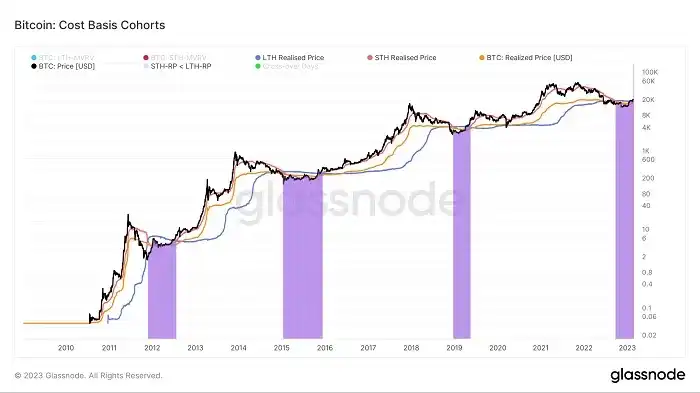
2011 Bitcoin hit its first bear market in 2001, during which the realized price for short-term holders was lower than the realized price for long-term holders. This trend also marked the beginning of a bear market. 2011 Year 11 Month 22 And continues through July 17, 2012.
Throughout the bear market, long-term holders have used dollar cost averaging (DCA) to accumulate bitcoin (similar to fund placement), while also reducing their cost base. During periods of price pressure, buying by long-term holders spurred new short-term holders to pile in, subsequently driving up the price of bitcoin. As the accumulation of bitcoins by short-term holders increases, so does the realized price by short-term holders, thus increasing the overall cost base of the network.
2015 years
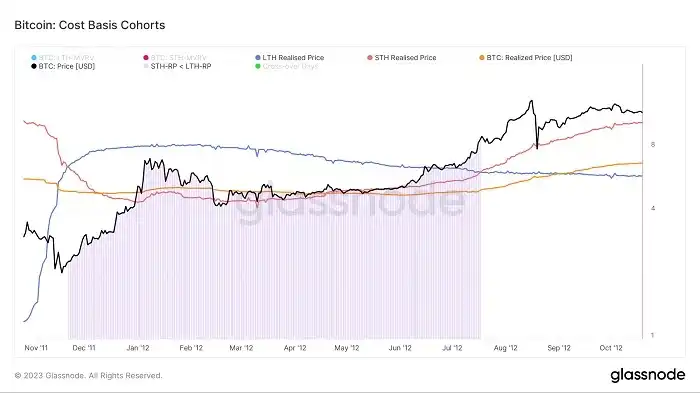
The 2015 bear market followed a similar pattern.
On January 8, 2015, the realized price of short-term holders fell below that of long-term holders, triggering a bear market that lasted until December 8, 2015.
While the price of bitcoin began to recover in early November 2015, it wasn't until early December of that year that realized prices for short-term holders exceeded realized prices for long-term holders. Back then, the overall cost base of the network increased slightly, triggering a bear market reversal and bitcoin topping $400.
2018
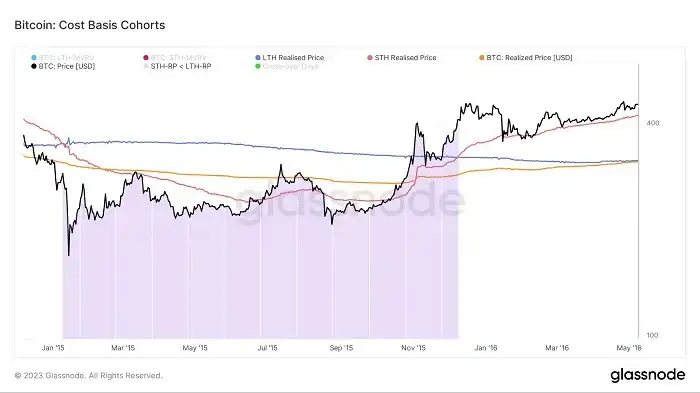
Bitcoin hit 20 by the end of 2018. $000, but that mouth-watering rally ended when short-term holders had realized price declines. The realized price for short-term holders fell below the realized price for long-term holders on December 20, 2018, again triggering a bear market that ended on May 13, 2019, when the realized price for short-term holders exceeded the realized price for long-term holders.
2022
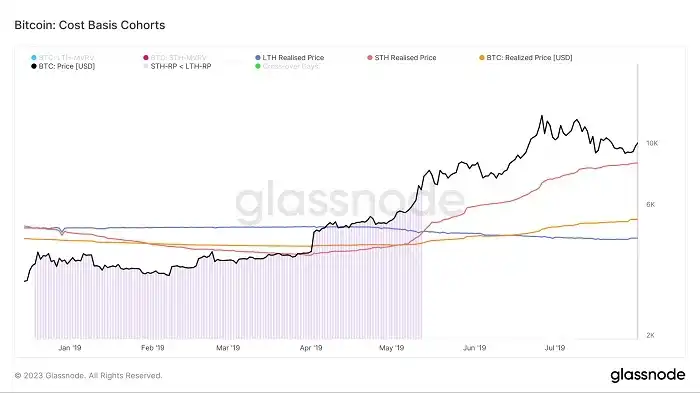
From early September 2022, realized prices for short-term holders began to move lower, and fell below realized prices for long-term holders on September 22, 2022. This continued downward trend continued until January 10, 2023, before beginning a slow but steady rebound.
As it stands: Bitcoin short-term holders have realized a price of 19. $671, while long-term holders realized a price of 22. At $228, Bitcoin has a realized price of 19. 876 dollars.
Original link
Welcome to join the official BlockBeats community:
Telegram Subscription Group: https://t.me/theblockbeats
Telegram Discussion Group: https://t.me/BlockBeats_App
Official Twitter Account: https://twitter.com/BlockBeatsAsia

 Related Articles