Balancer: LSD Track another protocol to watch

Original author:naly, DeFi researcher
Leo, BlockBeats
In the crypto space of 2023, the rise of LSD has been widely expected. To some extent, liquidity pledge is also a more secure way for crypto users to profit. With deals like Lido, Rocket Pool, Frax, and more, there may be even better innovations on the LSD track as the Shanghai upgrade is delayed, but when it comes to competition on the LSD track, there's one deal worth watchingBalancerBalancer has made technical improvements and is committed to higher pledge income. DeFi researcher naly wrote a brief analysis of the advantages of Balancer protocol in LSD track, BlcokBeats compiled as follows:
The rise of LSD is inevitable, and Balancer is ready for improvement. For users, why should they hold ETH when they can hold the interest-bearing version? With the surge in LSD tokens, some protocols may see an influx of money. Simply put, Balancer tech LSD offers the most efficient way.
There are three key factors that make Balancer tech rise:
- Unique vault architecture
- interest rate provider
-Phantom BPT
vault architecture
Anyone using Balancer technology can take advantage of the interconnected liquidity base layer, and the vault has its own gold House. For the other Dexes in DeFi, the pool contract must actively manage the assets (logically) and also perform all pool account work. Balancer Vault simplifies this with two steps (figure below) :
- Separate pool account work from logic
- Place all account assets under one contract

Because all the account assets are under the same contract, the pool only needs to calculate the amount exchanged, deposited and withdrawn, rather than actively managing the assets in it. What are the benefits of this?
When trading on other DeFi protocols, tokens are usually moved between multiple pools, a highly gas-consuming process known as multi-hop trading, including logic. For example, here is an example between BTC and stETH (you can see the high Gas consumption).
BTC > ETH to ETH > wstETH

On Balancer, this type of heavy Gas consumption is improved by having all accounts in one environment where only the final number of tokens are transferred to and from the vault. BTC > stETH, Balancer eliminates the need for frequent Gas consumption logic, an innovation known as BatchSwap.
As shown in the figure below, you can see how efficient Balancer BatchSwap is in terms of Gas consumption costs. With the innovative Vault design, all LSD stored in Balancer can be traded seamlessly using its liquidity center.

Interest rate provider
Moving on to actual pools, LSD is a type of pool that utilizes a constantly efficient rate of pledged assets (as opposed to a stable pool). These pool types are called composible stable pools. The standard stable pool trades as if the ratio of LSD to the underlying asset is 1:1. Not very reasonable, but how effective?
Not so good for investors. As an LP, your potential LSD gains are actually milked by carry traders who profit by arbitraging inaccurate interest rates in the pool.
However, composable stable pools solve this problem by having a built-in function called the rate provider to query tokens and update them to the correct ratio whenever a transaction occurs, a function that means that the proceeds of liquidity pledges actually go to the liquidity provider.
Phantom BPT
Why "composible"? Composability is a very common word in the DeFi world, but these pools are a really good example.
Suppose there is a Miike (DAI USDC USDT).

The composable stable pool allows this particular pool to be "embedded" into the LSD pair, and the rETH can be paired with this triple pool to allow all underlying stablecoins to be connected and paired extremely efficiently. rETH-(DAI USDC USDT)
That sounds similar to the Curve, but what's different about the Balancer Curve? What really sets Balancer apart is how the "embedding" process is done. Although vault unlocks the basic layer of liquidity, it still needs to invoke the underlying exchange, deposit, and withdraw functions.
Each entry consumes a lot of BPT tokens as Gas to mint as it flows through these embedding pools. For example, to replace rETH with DAI, the process is: rETH > mint > USD (pool token) > DAI, the mint process consumes a lot of Gas.
The Balancer pool provides a more efficient process with an innovative primitive called Phantom BPT. Balancer does not need to mint BPT tokens in exchange for underlying assets, but mint an almost unlimited number of BPT tokens while creating the pool. These "Pre-mint BPT's" unlock efficiencies unmatched by other Dexes. Instead of frequent Gas consumption each time they deposit into a pool, traders use the seamless flow of their Gas for efficient exchange.
By embedding and vaulting design, all Liquid Staked protocols provide an efficient and interconnected liquidity hub for their LSD and other tokens.
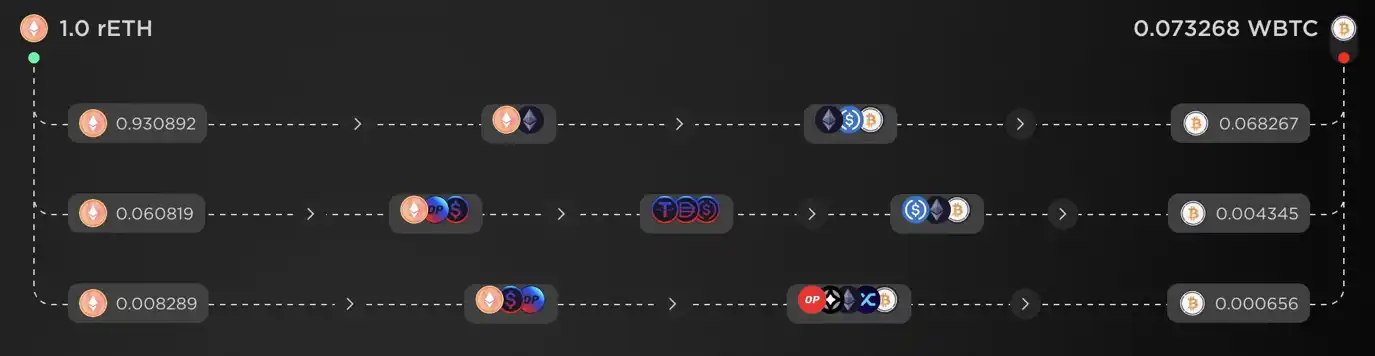
At the same time, through the interest rate provider, users can take advantage of the latest and most efficient technology to obtain interest bearing tokens.
summarize
The technology is very flexible and may even evolve further, which we won't delve into, but for the user, Balancer does allow traders to match their ETH with a higher yield than the ETH and LSD in the typical LSD pool.
All in all, the Balancer technique provides the best place for LSD because:
- Connected Vault architecture
- Efficient batch switching
- Super rate provider
- Composable and efficient Pre-mint BPT
DeFi's future is likely to be dominated by LSD tokens, so where will all this money go?
Original link
Welcome to join the official BlockBeats community:
Telegram Subscription Group: https://t.me/theblockbeats
Telegram Discussion Group: https://t.me/BlockBeats_App
Official Twitter Account: https://twitter.com/BlockBeatsAsia

 Related Articles