Bitcoin's legitimacy debate: Is Ordinals a blessing or a curse?
原文标题:《 比特币交易的「合法性」之辩:Ordinals 是福还是祸? 》
Original article by pourteaux
0x11, Foresight News
Since its inception, the purpose of bitcoin trading has been the subject of much debate in the community. Is Bitcoin primarily used for financial transactions, or should it become a secure distributed data storage system for everything from app data to domain names? The debate was quiet for years, but a new NFT protocol called Ordinals broke all that up. Here I will describe:
The early debate over what constitutes a "legitimate" Bitcoin exchange.
OP_RETURN establishes the limit,
And how SegWit and Taproot allow Ordinals to break these limits.
This is an area of debate within the Bitcoin community, and my goal was to list different perspectives in different historical contexts.
In 2010, there was a heated debate on the Bitcoin Talk forum over a proposal to support BitDNS, the Bitcoin DNS service. The proposal advocates hosting Web domain names on Bitcoin to reap the benefits of Bitcoin's decentralized trust-free and permission-free approach. However, there are concerns (including Nakamoto's) that this will inflate the Bitcoin blockchain, making it harder to verify the financial transactions that are supposed to be the main (or only?) part of Bitcoin. Use case:
Stacking all the proof of work quorum systems in the world into a single data set is not scalable. Bitcoin and BitDNS can be used separately, and users should not download data from both but only use one or the other.
- Satoshi Nakamoto (December 2010)
Interestingly, Satoshi didn't say that alternative blockchains that support non-financial use cases shouldn't exist (implicitly accepting "altcoins"), he just said that they shouldn't be on Bitcoin.
From this perspective, Bitcoin should focus primarily on financial transactions, and trying to do all the use cases on a technology that simply can't scale (like blockchain) is bound to compromise Bitcoin's financial use. That's what happened: BitDNS eventually found a home on a separate blockchain called Namecoin. This is good for today's Bitcoin holders, who, if BitDNS were built on Bitcoin, would probably end up having to download all the BitDNS data when trying to sync a new full node.
Namecoin: The altcoin that was born after the adoption of BitDNS on Bitcoin was blocked
However, the debate continues: should the Bitcoin ledger (1) be used only to record financial transactions, or (2) be a secure distributed data storage system for any potential applications. Given that blockchain is not inherently scalable, Option 1 is more sustainable as Bitcoin grows into a global financial network. Option 2 allows for more experimentation to develop the bitcoin ecosystem in the short term and provide additional income for miners.
There was no ultimate winner, but a compromise. In May 2014, Bitcoin Core (the main client for the Bitcoin node) enabled extremely short (80 bytes) messages in a function called OP_RETURN. This size is large enough to store some hashes linked to external services, but they must make efficient use of the Bitcoin block space. Importantly, messages stored on OP_RETURN are "expurgable," meaning that while they must be downloaded by each full node, they are not expended (not UTXOs) and therefore do not need to be kept in the memory of the Bitcoin node.
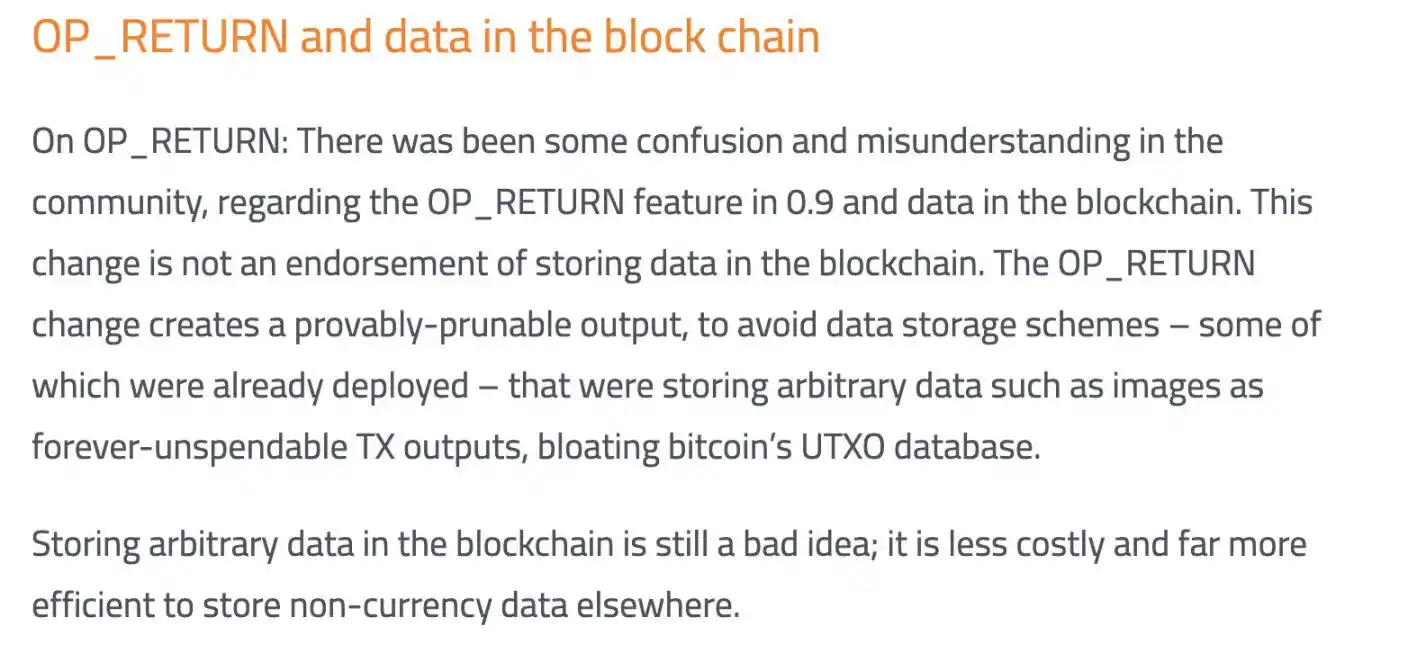
The release of these OP_RETURN Bitcoin core clients indicates that the core developers allow non-financial data storage using the Bitcoin ledger
From 2018 to 2019, about 20% of bitcoin transactions were OP_RETURN transactions. These transactions were used for Omni (the basis for the early Tether stablecoins), Counterparty (an early NFT protocol for Rare Pepes), and Veriblock (a Bitcoin-based altcoin). Each of them relied on OP_RETURN to run, and their popularity made Bitcoin networks quite expensive at the time. Proponents of these OP_RETURN apps assert that high fees are a good thing: it increases demand for bitcoin block space and pays miners more to secure the network. Opponents argue that they crowd out financial transactions in the Bitcoin network.
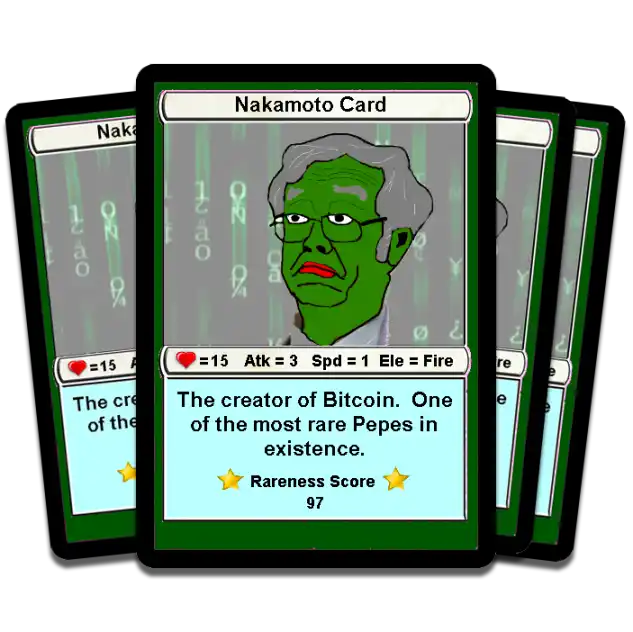
Rare Pepes: OG NFT of Bitcoin using Counterparty (OP_RETURN based)
Veriblock, Omni, and Counterparty have met a similar fate as BitDNS: they are out of use, and OP_RETURN itself has crashed. Even Rare Pepes are now wrapped in Ethereum. Despite the crash, Veriblock and Omni added about 10GB of data to the bitcoin blockchain in 32 million transactions that all Bitcoin nodes must store forever. Thankfully, these transactions are at least expurgable and therefore have no memory cost, as they are not part of the Bitcoin UTXO set.
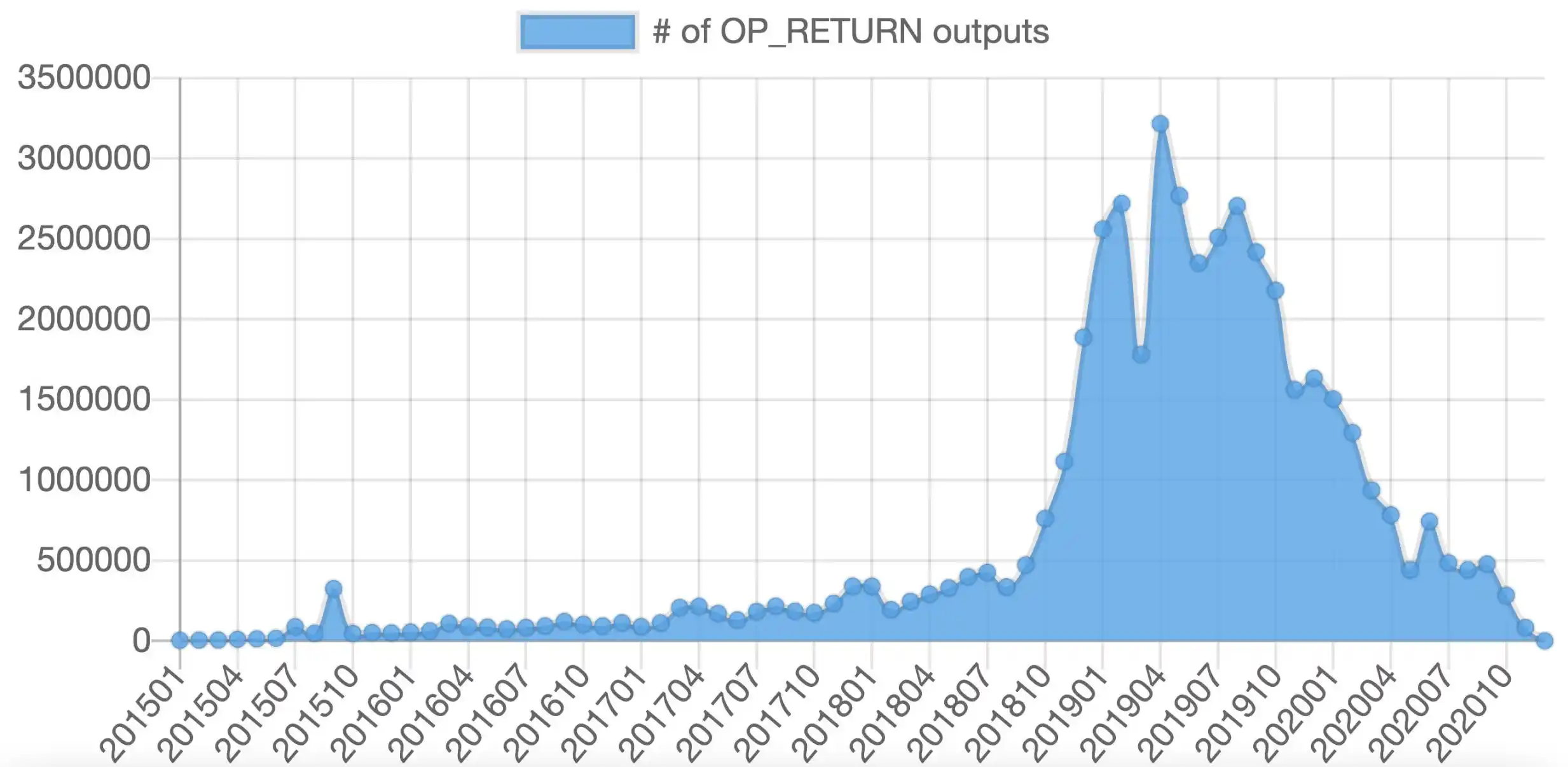
OP_RETURN adoption declined as Omni, Veriblock, and Counterparty fell out of favor, source: opreturn.org
Until now, OP_RETURN has barely been used, bitcoin blocks don't fill up very often, and block space is cheap. However, this situation may be about to be upended, as a design of Taproot (the 2021 Bitcoin upgrade) inadvertently allows unlimited Bitcoin data storage to shorten the block size limit without using OP_RETURN at all. This feature has been codified into Bitcoin's new NFT protocol, called Ordinals.
Ordinals individually tracks individual satoshis (the smallest unit of bitcoin) and reuses them as NFT. In practice, satoshis are fungible, but ordinal theory is a convention by which irreplaceable characteristics can be assigned to fungible satoshis. This may be a difficult idea to grasp at first, but it is similar to accounting rules in personal finance.
For example, I bought Disney stock at many different prices over several years. I then decided that I wanted to sell a unit of Disney stock and had to determine which entry price to use to calculate the gain I would make on the sale. Which admission price do I use? Well, there's no way to distinguish between the different units of Disney stock I buy because they're all the same, but I can opt for an accounting standard like LIFO (" last in, first out "), where the units sold first are assumed to be the units I buy last. Similarly, Ordinals uses FIFO (" first in first out ") rules to keep track of individual satoshis ina way that is consistent for those who wish to participate in the system, but does not affect the fungability of those Satoshis for everyone else.
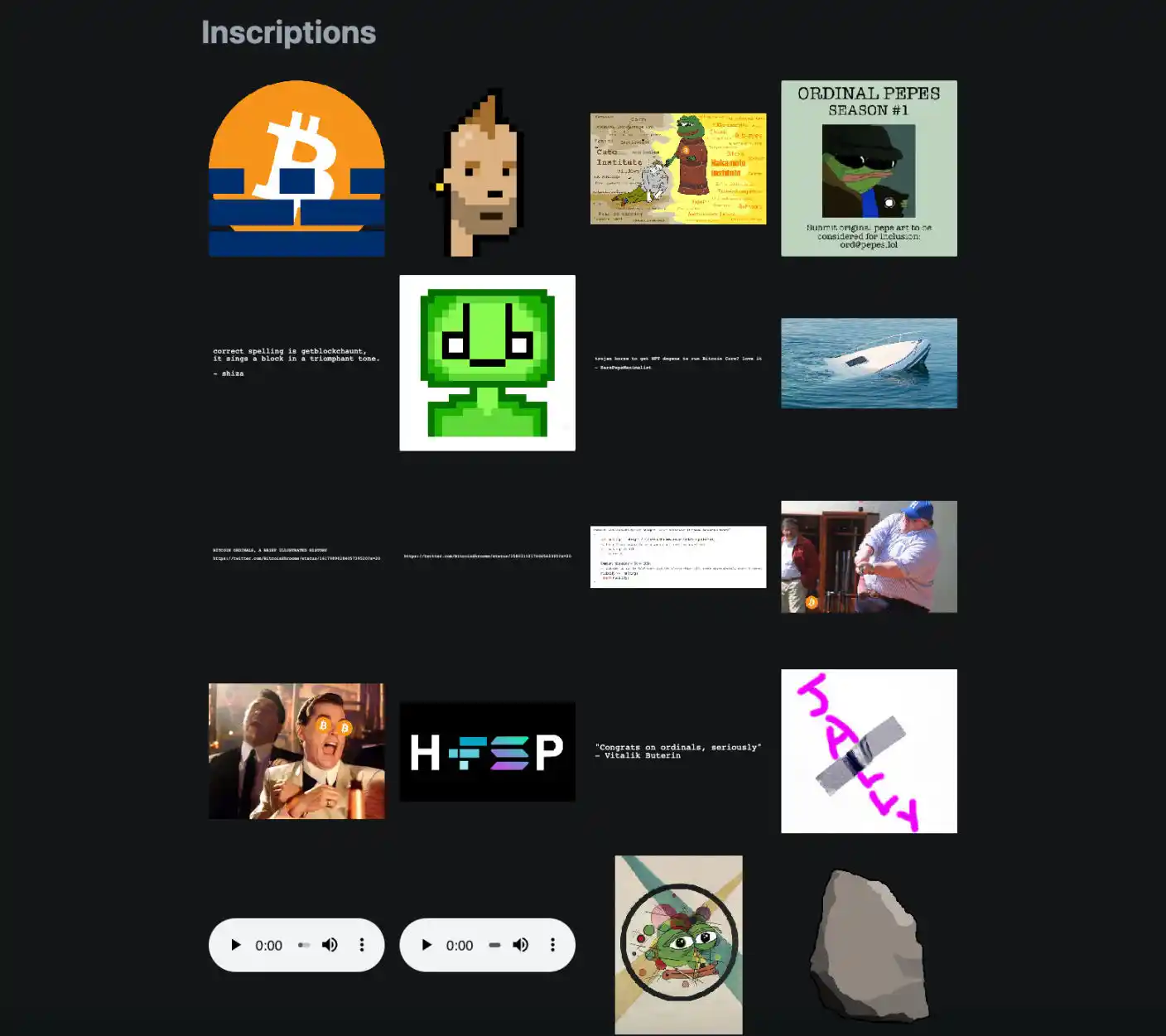
The NFT on the Ordinals is called the inscriptions and is assigned to specific satoshis. This is the latest inscription on bitcoin, including images, audio, video, pdf and more. These are actually stored on the Bitcoin blockchain and are stored by all full nodes, they are not links to images on the server. Source: ordinals.com
I think this method of making NFT (called "inscriptions") from a single satoshis is very elegant because it implements the function of non-fungible tokens without compromising the fungibility underlying Bitcoin's design. Moreover, these NFTS get all the benefits of the bitcoin blockchain (immutability, security, decentralization) and do not require any changes to the Bitcoin protocol. You can send one of these NFTS to an existing bitcoin address today. Challenges remain, however, because existing Bitcoin software does not adhere to "ordinal theory," so satoshis you attach personal value to could accidentally be sent as transaction fees or as payment. Therefore, there is Ordinals specific software that allows you to keep track of these individual satoshis so that they are not used accidentally.
据我所知,Ordinals 架构组成毫无争议。这令我感到兴奋,因为我是一个比特币长期主义者,同时我也喜欢 NFT,我相信 NFT 是加密货币中为数不多的能够实现持久产品与市场契合的领域之一。我花了很多时间在比特币上试验其它 NFT 和 Token 提案(比如 Counterparty 和 Omni),发现它们笨拙、低效,而且坦率地说,它们由于维护不善而被弃用。
One part of Ordinals that is sure to cause controversy within the bitcoin community is how the NFT is stored as an inscription.
The NFT on the Ordinals (" inscription ") is stored entirely on the chain. In the broad sense of NFT (as on Ethereum), this is generally considered a positive attribute, as the "art" is truly stored in a decentralized manner, not just pointing to JPGS on a centralized server that can be changed at will. Many of the most acclaimed NFT projects on Ethereum (such as CryptoPunks) actually store JPGS on Ethereum (as opposed to the "cloud"), so JPGS are as secure and uncensored as Ethereum itself.
However, OP_RETURN's size limit is intended to limit the ability to store non-financial data on Bitcoin. This limit is set to 80 bytes, which is essentially a short text string. However, Ordinals launched on the main Bitcoin network only a few days ago, and already people store not just images, but short videos and even PDFS of Satoshi Nakamoto's Bitcoin white paper. Again, these are not links to white papers or videos, but real white papers and videos that become a permanent part of the Bitcoin blockchain and must be downloaded and stored by all full nodes. How is Ordinals able to store such a large file on the bitcoin blockchain despite OP_RETURN restrictions?
Ordinals took advantage of the recent Taproot upgrade to store NFT data in the Taproot script path expenditure script. SegWit relaxed restrictions on the size of witness (signature) data, and Taproot made it easier to store arbitrary witness data in Bitcoin transactions, allowing Ordinals developer Casey Rodarmor The old opcodes (OP_FALSE, OP_IF, OP_PUSH) were re-used in what he described as "envelopes" to store arbitrary data for NFT called "epigraphs". That, of course, is not the purpose of the Taproot or SegWit upgrades, which aim to make it easier to store data and loosen restrictions on the size of witnessed data to allow for future bitcoin contract features.
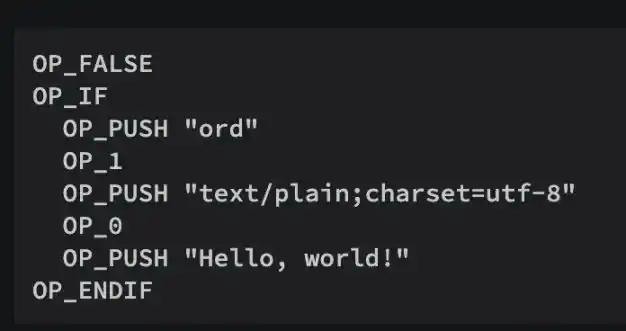
Contains "Hello, world! NFT (" inscription ") of the text
The net result is that there is virtually no size limit to what can be stored on the Bitcoin blockchain using this method (fortunately, like OP_RETURN, inscription transactions can still be cut). In other words, if you broadcast such a transaction to a miner, it is possible for an inscription transaction to take up the entire 4MB block space (in fact, the Bitcoin core limits this size to 400,000 bytes). However, even though 400,000 bytes is a smaller limit, it is still 5,000 times the OP_RETURN limit, which was the source of all controversy in 2014. While this can be done with SegWit, it is easier to use Taproot because you can store arbitrary data in a linear segment of the witness section. These combine to remove any technical limitations beyond the size of Bitcoin's data storage block: if it can fit into a block, it can be a Bitcoin transaction.
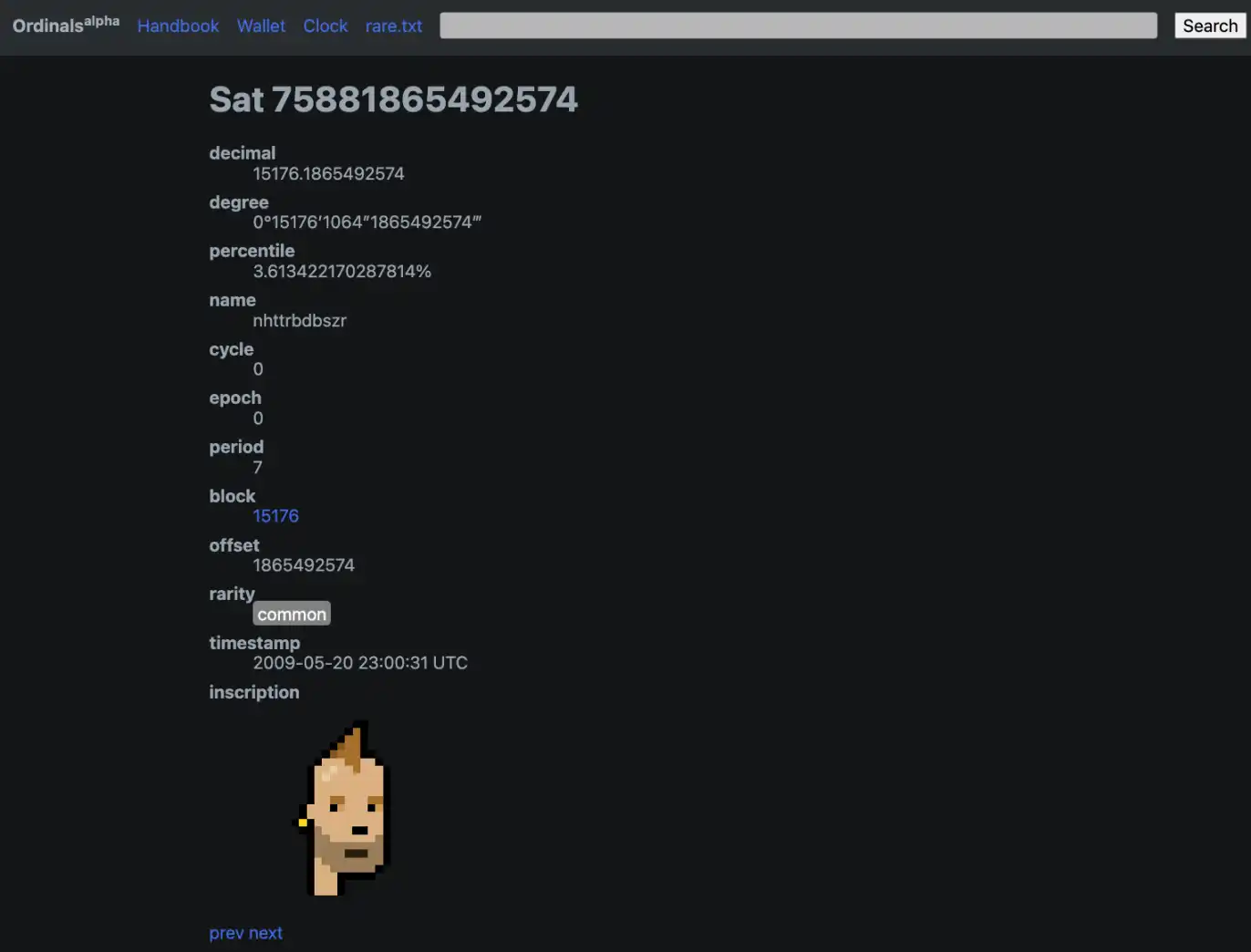
I used Ordinals (with the help of a friend) to mint my CryptoPunk on bitcoin. The NFT was "inscribed" on a satoshi mined in 2009. The size of the NFT is 220 bytes (about three times the OP_RETURN limit). This was not possible until Taproot relaxed the witness data size restrictions
Is that a good thing or a bad thing? I can't answer that question yet, but I've talked to both active advocates and opponents about this new use for Bitcoin. Before delving into their differences, let me list the points on which they generally agree:
It was not the Taproot developers' intention to use tapscript to store arbitrary data
There is probably no way to limit the use of this tapscript
In defense of Ordinals and inscriptions, NFT is interesting. NFT was the OG Bitcoin concept of the color coin era, but due to Bitcoin's design limitations, most NFT activity has moved to Ethereum.
Bitcoin owners want NFT on bitcoin for a number of reasons, not the least of which is that bitcoin needs fees to survive in the long term. Bitcoin miners currently receive subsidies to maintain the network through mining, but with each halving, the subsidy is reduced, and at some point the network will need to survive on transaction fees alone. Inscription and NFT compete for limited block space, thereby generating fees to pay miners and help the Bitcoin network grow sustainably.
Just a single application like Uniswap on Ethereum generates more fees today than the entire Bitcoin network, so maybe we should open up Bitcoin to its own applications for sustainable fee-based security. In addition, Bitcoin does not require a license. Who is to judge which transactions are legitimate and which are not, as long as you pay a commission can be put into the block? Just as no one can say whether the financial transactions I make on Bitcoin are "illegal", no one can say that making non-financial transactions (such as minting NFT) is illegal.
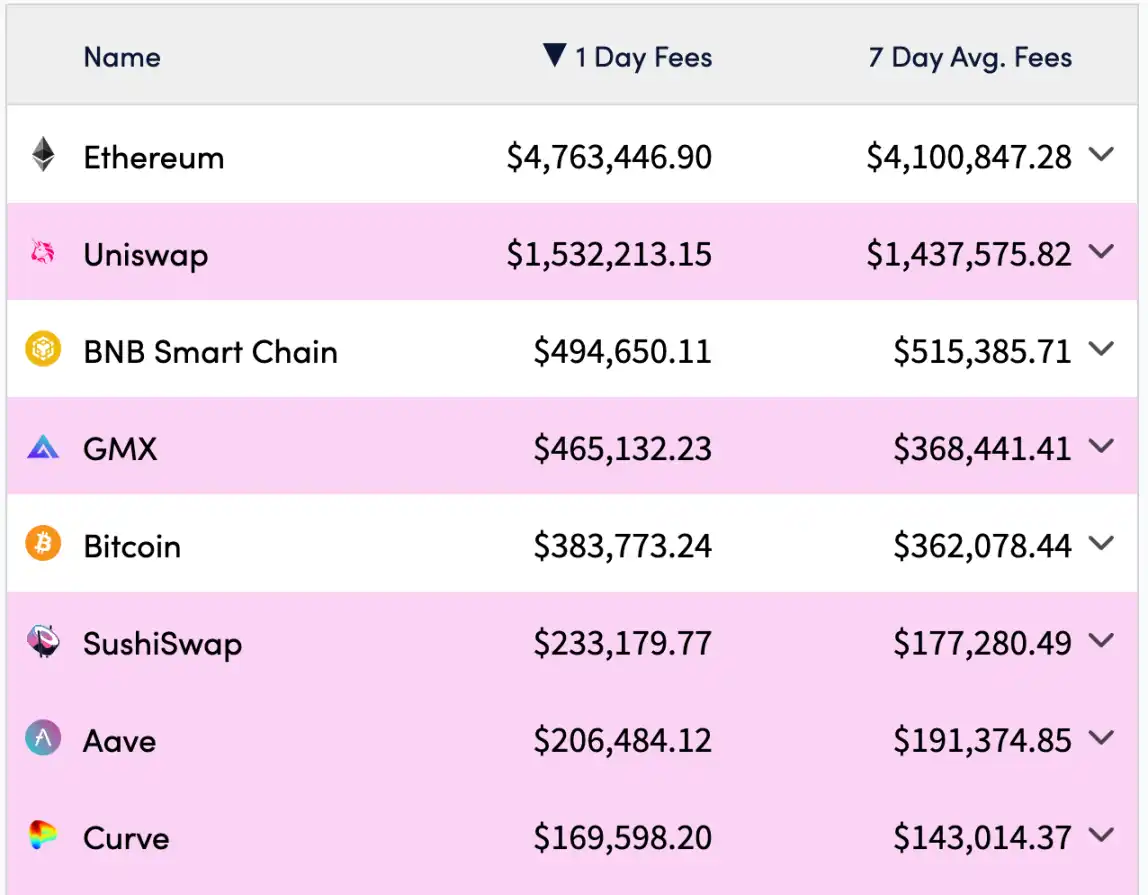
Uniswap has generated five times more fees in the past seven days than the entire Bitcoin network. Source: Cryptofees.info
The flip side of this conclusion is that bitcoin block space, while cheap today, is very limited as a future global financial network. The Bitcoin base layer can no longer support a single transaction for everyone (e.g., everyone opens their own lightning channel), let alone scale to non-financial use cases. As a result, non-financial uses of the Bitcoin block space could crowd out "legitimate" financial transactions. Bitcoin is a peer-to-peer cash system whose primary goal is to be used for financial transactions. Skeptics of Ordinals and Inscription also point to more efficient methods of toking bitcoin, like the upcoming Taro (also enabled by Taproot), and assert that Ordinals is an abuse of tapscript, It breaks the OP_RETURN restriction on the data store on the chain. If an entire block is taken up with testimonial data of epigraphic transactions, it could delay confirmation of "legitimate" financial transactions, thereby undermining Bitcoin's credibility as a reliable financial network.
There's another problem: the part of the Bitcoin transaction where the NFT is stored is called witness data. SegWit allows witness data to get a steep discount of 75% compared to data in other parts of the transaction, such as input, output, and even OP_RETURN values. This means that those who choose to use this feature of Taproot to mint NFT or store their data on Bitcoin enjoy a very deep discount compared to those who conduct more typical financial transactions. This, in turn, limits the contribution of such data storage to the fees market, especially relative to the size of the data stored on the blockchain, increasing the risk that these discounted deals crowd out financial transactions.
Given these differing views, it is possible that there is a middle way to use the inscriptions on Bitcoin without significantly crowding out financial transactions. Ordinals, for example, could be a niche way to mint particularly high-value or retro NFT's that place a high premium on Bitcoin's cyber security and trustworthiness. Especially as bitcoin becomes a major financial asset and block space becomes scarce, Ordinals NFT may be limited to particularly old or valuable NFT's. It is unlikely to be the foundation chain for the ordinary pfp series, as there is a cost to cast each NFT (unlike in Ethereum, where the cost of casting a series of 1 or 10,000 NFT is the same). In many other chains, you can mint low-value NFT essentially for free, and there's no reason to do that with Bitcoin.
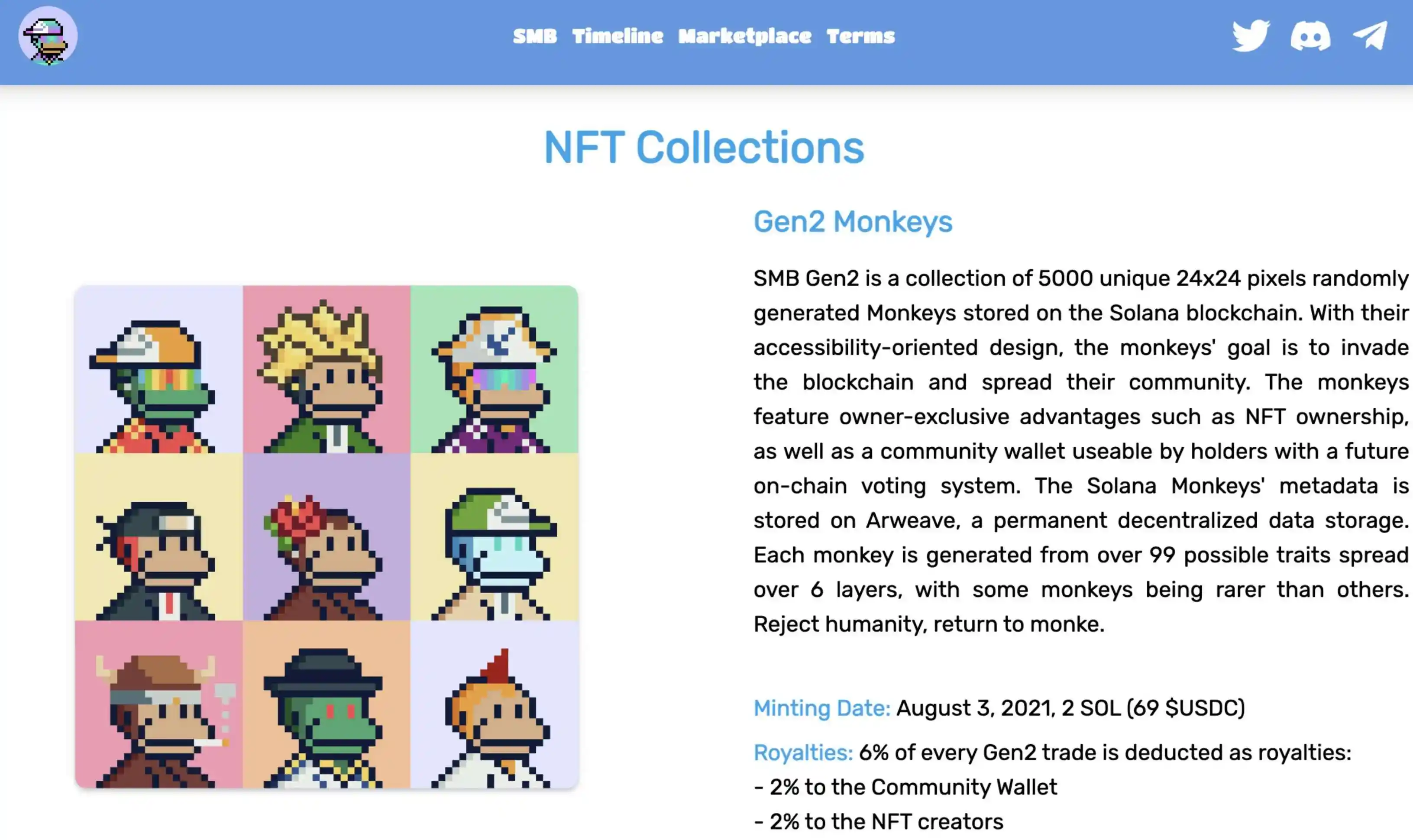
These standard animal pfp NFTS have other platforms for which they are better suited. Public chains other than Bitcoin are cheaper, so there is little incentive for these projects to use Bitcoin. This is Solana Monkey Business.
The debate in the Bitcoin community over financial transactions and data storage has lasted almost as long as Bitcoin itself. While this debate seemed to be temporarily settled in 2014 with OP_RETURN, the debate is about to be reignited as tapscript inadvertently frees itself from the limits of data storage size. The most hawkish bitcoin owners insist that there are many interesting applications for cryptocurrencies beyond financial transactions, and NFT is one such example. Of course, financial transactions are the most important part of the Bitcoin network, and any non-financial use ideally supports rather than undermines that principle.
Special thanks to those who helped me get up to speed: Casey Rodarmor, Rijndael And an unnamed bitcoin developer.
Extended reading:
https://twitter.com/pourteaux/status/1361821171709337601
https://bitzuma.com/posts/op-return-and-the-future-of-bitcoin/
https://opreturn.org/op-return-per-month/
https://docs.ordinals.com/
Original link
Welcome to join the official BlockBeats community:
Telegram Subscription Group: https://t.me/theblockbeats
Telegram Discussion Group: https://t.me/BlockBeats_App
Official Twitter Account: https://twitter.com/BlockBeatsAsia
 Related Articles