Termination of service! SEC to head platform challenge, Ethereum LSD track pattern change?
原文标题:《 终止服务!美 SEC 向头部平台发难,以太坊 LSD 赛道格局生变? 》
Terry, Blockchain in Plain English
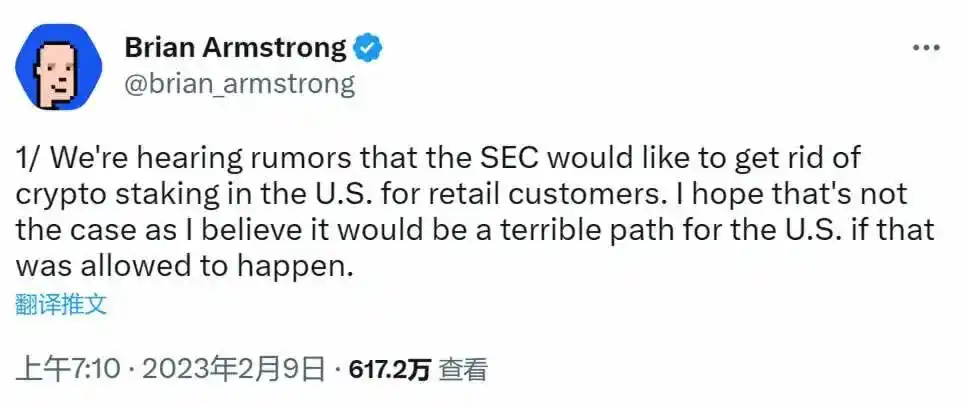
On February 9, Coinbase co-founder and CEO Brian Armstrong tweeted, "We've heard rumors that the SEC wants to eliminate crypto asset pledging for retail customers in the U.S. I hope that's not the case because I think if that's allowed to happen, Would be a terrible path for America."
The next day, Kraken announced it was ending its crypto asset pledge service for U.S. users and paying $30 million to settle SEC charges that it offered unregistered securities. This stone aroused Qianceng waves, the market began to pay attention to ETH liquidity pledge track this more and more important encryption field.
01 dominant Lido, backward centralized agency
At the time of publication, the total amount pledged by Ethereum beacon chain has exceeded 16.5 million ETH, accounting for nearly 14% of the total ETH supply.

Source: dune
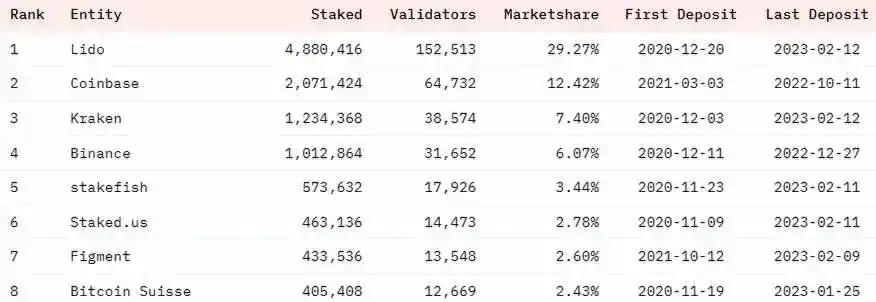
At the same time, among the ETH pledged, the top eight ETH pledge service providers occupy 66% of the market share according to the specific distribution, with obvious head effect.
The number of Lido Finance is about 4.88 million, accounting for nearly 30% (29.27%) of the market, equivalent to the second to the fifth.
Source: dune
Second through fifth place included Coinbase, Kraken, and Binance as well as stakefish, all centralized mortgage provider with the advantage of one-click point-and-click mortgage, no minimum 32 ETH required, while also providing liquidity in the form of centralized stakefish collateral.
But even Coinbase's 12.42% market share is less than half of Lido's, and it's worth noting that Coinbase seems to have temporarily suspended its ETH pledge service since October last year.
According to Coinbase's previous third-quarter 2022 revenue report, Coinbase's pledge revenue reached $62.8 million, or about 11% of its net revenue ($580 million), up from 8.5% in the second quarter.
It also illustrates the importance of pledge services to the business of centralised trading platforms: in the context of the market downturn, it is one of the more stable main sources of revenue.
Meanwhile, Kraken currently pledges about 1,233,700 Ethereum pieces, accounting for 7.42% of the total Ethereum pledges, second only to Lido and Coinbase, but same as other centralized organizations like Binance and stakefish. Its market share is also far behind Lido Finance's 29%.
As a result of the SEC's crackdown, it is predictable that ETH material from centralized institutions will continue to flow to Lido Finance, along with the suspension of Kraken's pledge service.
In general, the decentralized ETH pledge protocol represented by Lido Finance not only has an absolute advantage over the pledge service of centralized institutions at present, but also is expected to accelerate the outflow of pledged ETH in some centralized institutions due to the regulatory impact of SEC in the short term.
02 Unbalanced decentralized liquidity pledge
Are there any new trends or projects worth watching outside of Lido Finance, which is the dominant player in decentralized liquidity pledge agreements?
Hardly.
If decentralised ETH liquidity pledge data is broken down (RocketPool has nearly 400,000), Lido Finance alone has 93.4% of the market.
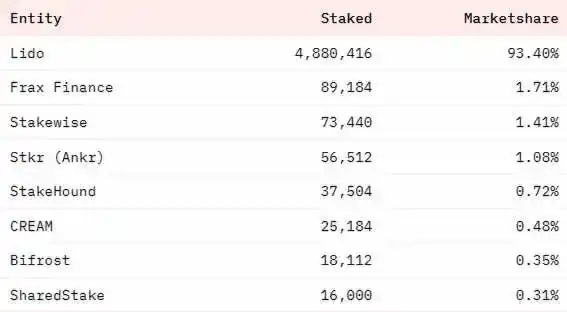
The likes of Frax Finance are barely a fraction of Lido's, and more importantly, Lido's stETH has survived multiple panics and sell-offs in the last year, including Three Arrows Capital events, LP pool of ETH/stETH and expansion of L2 on Curve are also obvious first-mover advantages.
However, it is worth noting that Frax Finance's Ethereum liquidity pledge frxETH has grown at a rapid rate -- from zero to approximately 90,000 frxETH since its launch on October 21, 2022.
Such rapid growth can not be achieved without its high pledge income of 8% on average in the past two months or even over 16% at one time (Lido was only about 5% in the same period) :
This is due to the fact that Frax is the largest holder of CVX and therefore can take advantage of the incentive emissions of the large exchange rate impact Curve to realize the high returns of the frxETH/ETH liquidity pool on Cruve.
This is also the key to Frax's miracle in the last four months. It remains to be seen whether frxETH will become an anomaly in the Ethereum liquidity pledge circuit in the future, and whether other decentralized ETH liquidity pledge services will take advantage of the limitations of centralized institutions.
03 What is the impact on Ethereum pledge?
It is not clear whether the SEC will completely ban the crypto asset pledge services of centralized institutions, but it also involves the question of whether the SEC has enforcement power -- is ETH a security?
If not, the SEC doesn't have the jurisdiction to act on its own (and the SEC has had its own turbulent days), legislation and regulation won't move fast enough, and other regulators like the Commodity Futures Trading Commission (CFTC) have been seeking enforcement authority over crypto markets.
Paul Grewal, Coinbase's chief legal officer, said that Coinbase's pledge service is not a security under the Securities Act and the Howey Test, and that the SEC's action against Kraken could cause serious damage to the growth of the U.S. crypto industry.
It's true that the SEC under Gary Gensler has been doing a lot in the crypto regulatory space in recent years, but if history is any guide, getting caught in the SEC's crosshairs, even when it comes to securities, isn't without a solution:
On September 23, 2019, the SEC reached a settlement with Block.one, the company behind EOS, in which Block.one agreed to pay a $24 million civil penalty to resolve the SEC's charges that it conducted an unregistered Token financing offering. And granted it significant immunity from future business.
It also provides another way of thinking for a number of projects Mired in similar allegations -- be positive and accept the punishment.
As the Shanghai upgrade (which is subject to change) approaches in March 2023, it would be good for the industry in the long run if Ethereum pledgers withdraw their ETH pledges after the upgrade is completed.
On this basis, if regulators such as the SEC really severely restrict liquidity pledge services of centralized institutions in the future, it will only give decentralized pledge circuits a greater share of the pledge:
After all, companies are easily regulated as entities, and agreements are harder to pin down. Lido Finance is unlikely to follow securities rules like Coinbase, a centralised entity registered in the US, which would allow it to snatch up opportunities in markets such as Kraken. Much of the future increase in pledge is likely to shift to liquid pledge agreements such as Lido.
Original link
Welcome to join the official BlockBeats community:
Telegram Subscription Group: https://t.me/theblockbeats
Telegram Discussion Group: https://t.me/BlockBeats_App
Official Twitter Account: https://twitter.com/BlockBeatsAsia
 Related Articles