Who is' in charge 'of Uniswap? What is the future of the DeFi, which has been playing "House of Cards" in turns?
Who's 'in control' of Uniswap? What's Next for DeFi, who takes turns playing 'House of Cards'?
Terry, Blockchain in Plain English
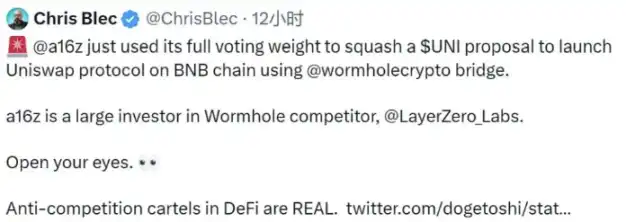
February 5, a16z direction The final proposal to deploy Uniswap V3 on the BNB Chain was voted against, causing Uniswap landing on the BNB Chain to be derailed.
Community Kols directly questioned, "Is Uniswap controlled by a16z?" ", citing speculation that a16z may have been motivated by self-interest: "The reason a16z used its full vote weight to oppose Uniswap's proposal to use Wormhole cross-chain bridge to launch Uniswap protocol on the BNB Chain is because it is a large investor in Wormhole competitor LayerZero".
01 VC figure behind the DeFi protocol
Indeed, a16z is the key player behind Uniswap: Bubblemaps calculates that a16z can control 41.5 million UNI from 11 locations, which is 4.15% of UNI supply.
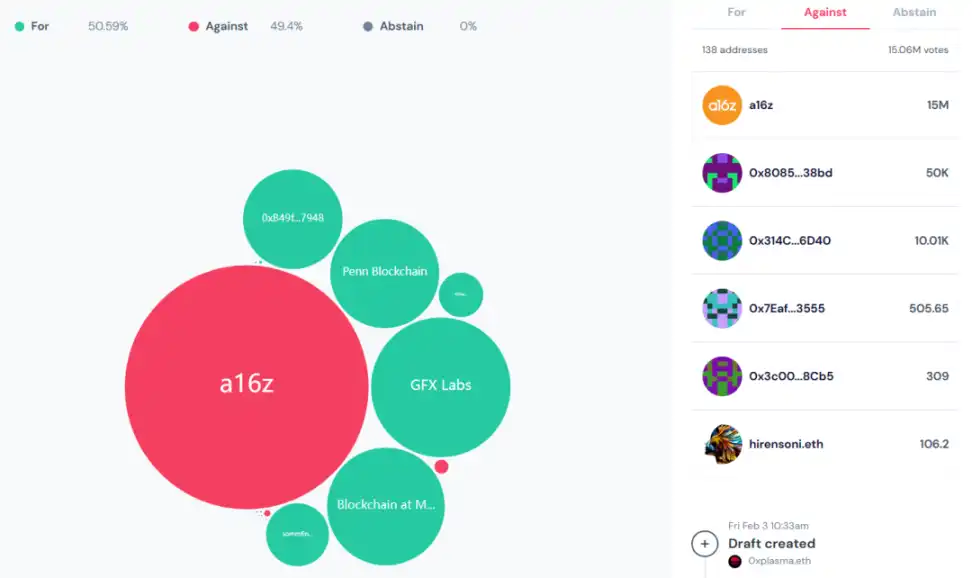
So far in this voting, a16z has dominated with only 1,500 UNI weights, which means that the UNI weight of a16z is the necessary voting power to pass any UNI proposal.
It's not that a16z didn't want Uniswap deployed on the BNB Chain -- after all, a16z voted "yes" when Uniswap decided to deploy in Polygon, Celo, and zkSync.
According to Zhao, the core of this struggle is a16z's reluctance to use Wormhole as a cross-chain bridge for Uniswap to access BNB Chain.
This involves a direct battle between venture capital firms a16z and Jump, which support LayerZero and Wormhole, respectively.
In fact, it is not uncommon for DeFi agreements to take sides, either actively or passively, because of the influence of VCS who provide capital support behind them. As early as August 2021, SushiSwap revealed why it chose Arbitrum rather than Optimism for its Layer2 extension solution for its initial layout.
SushiSwap spoke frankly because of the Optimism that optimism gave Uniswap the optimism that led Uniswap to launch: Although "SushiSwap had gone to the Kovan test site of Optimism to complete deployment and was told that Uniswap would be given the opportunity, Optimism was very direct that Uniswap must deploy first".
Optimism, however, points to SushiSwap's optimism about Uniswap's influence on investors a16z and Paradigm, and the possibility that the two venture capital firms are "colluding" to influence and benefit their vested projects.
02 Governance game in the blockchain world
There's nothing new under the sun, and even earlier, in November 2021, there was another great "House of Cards" drama with Curve, another DeFi leading deal.
First, we need to review the mechanism design of Convex-Curve:
CVX is the native Token of Convex Platform, so holding CVX means that you have the right of control of the Convex Platform, which is the governance Token of the Convex Platform. By locking CVX, LP can vote on the governance decisions of Convex veCRV:
The Convex convexes the user's CRV in exchange for the more attractive cvxCRV incentive.
Convexconvex locked all CRVS for four years in exchange for the maximum voting rights of Curve (veCRV).
After obtaining a large number of VecrVs, the Convex convex controls the Curve.
In other words, when controlling CVX, it means controlling the Convex, and when controlling the Convex, it means controlling Curve. It can then add incentive weight to a specific stablecoin pool, which leads to a lot of interesting things -- such as vote-buying by stablecoin projects.
In November 2021, the USDM team of Mochi Stabilized Coin used Convex to launch a "governance attack" against Curve on "exchange of bad coins to good coins" :
First, Mochi launched the governance Token MOCHI, and launched the liquidity pool incentive of USDM stablecoin (pledge casting, with MOCHI as one of the collateral) in Curve.
Then, the Mochi project side uses the large amount of MOCHI it holds to print a large number of USDM, and then goes to the Curve to change into DAI;
Then, the Mochi project side used the DAI in exchange to buy a large amount of CVX (about 6000 ETH), which was then voted on and successfully increased the rate of return (allocation of CRV rewards) of the USDM liquidity mining pool on the Curve;
Finally, attracted by the high rate of return, more liquidity providers participate in the project until the liquidity pool of USDM stablecoin reaches $100 million, and the project side mints MOCHI into USDM and converts it into DAI in the pool, which directly casches out and runs away, causing a loss of up to $30 million.
The whole process is a textbook case of the Convex governance logic surrounding inferior Stablecoin, Curve and Convex, which also indicates that the Convex has an increasingly important influence on the entire crypto market through its "control" of Curve.
03 What happened to DeFi?
Since the "DeFi Summer" in 2020, the entire DeFi track has achieved considerable development, and the market has derived DEX, borrowing, derivatives, fixed income, algorithm stablecoin, asset synthesis, aggregator and many other segments.
But with the advent of May 19, 2021 Since the historical peak, traditional DeFi blue chips such as UNI, LINK, SUSHI and SNX have been declining gradually. It seems that both old DeFi leaders such as Uniswap and Synthetix and "DeFi 2.0" upstarts such as OHM cannot escape the fate of being gradually ignored by the market.
In particular, in the development of the crypto world in the past 2022, DeFi has been forgotten by most market participants and has become a market narrative that has fallen out of favor after experiencing the prosperity of NFT, DAO, metaverse, Web3 and other narratives.
However, putting aside the dismal performance of vertical DeFi Token in the secondary market for a moment and looking only inside the DeFi circuit, there are some interesting variables going on.
One of the most noteworthy is that in addition to playing the role of low-level components, these protocol layer DeFi leading as the center of the center, around their tool class and application layer DeFi projects also began to evolve, more rich advanced functions continue to strengthen.
It can be clearly seen that more and more DeFi "tool applications" focus on a single underlying "super DeFi protocol", assist it to improve more advanced derivative functions, grow and grow relying on the underlying "super DeFi protocol", and eventually feed the underlying "super DeFi protocol" to achieve greater capabilities. Thus, a unique and self-contained "small ecology" is gradually produced.
Just as Uniswap+ dextools\Unitrade\Yin and so on have applied to liquidity management, and Curve+Convex to stablecoin exchange, what is more interesting is that further integration is occurring between these small ecology.
Curve, for example, is known to be the industry leader in stablecoin exchange, especially in the large stablecoin exchange circuit. Curve's handling fee, exchange slip point and volatility loss are far lower than those of AMM DEX such as Uniswap or Sushiswap.
However, Curve has also partnered with Synthetix to launch a cross-asset exchange service, offering Swap functionality for common assets such as ETH/WBTC pairs.
This is also an epitome of the self-redemption of many DeFi agreements from many channels.
04 summary
After experiencing the Cambrian explosion in 2020 and the peak fall in 2021 and 2022, the scene innovation in the DeFi world has basically reached saturation. How to further improve the governance mechanism and improve the role of the crypto economy model in the whole protocol mechanism is the key to open the second half.
In general, the DeFi world still has a long way to go, whether it is the "governance evolution" or the innovation of Token economy model. Let's wait and see what the future will be.
Original link
Welcome to the official community of BlockBeats
Telegram subscription group:https://t.me/theblockbeats
Telegram communication group:https://t.me/theblockbeatsApp
Discord:https://discord.gg/Q8wuCmzKNk
Welcome to join the official BlockBeats community:
Telegram Subscription Group: https://t.me/theblockbeats
Telegram Discussion Group: https://t.me/BlockBeats_App
Official Twitter Account: https://twitter.com/BlockBeatsAsia
 Related Articles