The relationship between Web3 products and Tokens: "Necessity" or "Potential Trap"?
原文标题:《 你的 Web3 产品真的需要代币吗? 》
Jan Baeriswyl is a researcher at Outlier Ventures
It's a good idea. 11 , Foresight News
Since tokens became popular in the ICO era in 2017, we've gone through a cycle of multiple narratives and use cases, from fundraising using tokens, to empowering community governance, all the way to new ways to launch products. In the process, categories such as "payment Token," "Utility Token," and "governance Token" have emerged.
There is still a lot of confusion and disagreement around tokens, for two main reasons:
First, different Token classes mean different things to different people, such as from a user or investor perspective, or from a legal perspective.
Secondly, different people will have a significant difference in their overall understanding of Token due to the different projects they have been exposed to and the time when they entered Web3.
More recently, Token And the relationship between products has been a focus of discussion. "Do you need tokens for your product?" "Is a common question asked by founders active in Web3. This article aims to answer this question and clarify how Web3 projects can leverage tokens.
The relationship between the product and the Token
Products and tokens can relate to each other in different ways. There are cases where a Token is required to enable a product; It is more common for products to benefit from a Token but not strictly require a Token to operate. In most cases, a Token is not required for a product, but a project may still decide to launch a Token for good reason anyway. We will now look at each of these cases and illustrate them with examples of existing projects in each category.
A product requiring a Token
In fact, only a few use cases and product categories require tokens, without which they cannot provide core functionality.
The most obvious use case is the L1 blockchain: In order to protect the blockchain, all types of consensus algorithms require a native Token asset to motivate the verifier/miner and ensure their incentive consistency. Often, tokens are also used as payment methods for transaction fees using the blockchain. Arguably, this was the original use case for the original tokens of blockchains like Bitcoin and Ethereum, and remains the best practice for today's sovereign chains like the Unique Network.
Another type of use case is a digital resource network, which provides these resources in a decentralized manner and needs to balance supply and demand from storage to computing and even data connectivity. Examples include Filecoin for storage and, more recently, Uplink, a mesh network for decentralizing connections.
Products that can be significantly improved through tokens
More commonly, certain types of products can be said to be significantly improved through the Token economy, and they can also be built without tokens. For example, tokens can improve products that rely on users to provide a given service, such as content authoring or management, including SuperRare and Ocean Protocol.
Financial applications (and any product where user funds are at risk) can leverage tokens to create local insurance to provide an additional layer of security. This mechanism was pioneered by Aave and adopted by many financial applications such as The Rand Network. Nexus Mutual represents decentralized insurance services.
Some product categories that could benefit the most from tokens are characterized by their reliance on network effects to provide services and the need to overcome "cold start" issues in order to function. This includes marketplaces such as Hundo (recruitment) and Lemonade (campaigns). LooksRare is making waves by taking market share from OpenSea with the Token.
Another use case that is relevant to both decentralized content creation and cold-start issues is Data federation, such as Pool Data and Ozone. There are other ways the Token can improve the product, and innovation in this area will continue.
The Potential Pitfalls of introducing Tokens into Products.
It is important to consider that, in some cases, the introduction of tokens may harm the product's prospects. There are some recurring pitfalls that Web3 founders should be aware of and avoid if possible.
First, using native tokens as the only acceptable payment method generally only makes sense in the context of L1 blockchains or decentralized resource networks (products that require tokens). In most other cases, paying for tokens creates significant friction (especially if the target audience is more general or even includes enterprise customers), provides only marginal utility for the Token, and does not sustain long-term value.
Another pitfall is if the Token is merely used as an incentive mechanism without providing a reason for the user to hold or even lock the Token (for example, through a mortgage). The introduction of financial incentives could hurt the incentive for users to hold, and if the only thing they can do with the Token is sell it for cash, the value of the Token will be hard to maintain.
Finally, if the project has previously raised funds in the form of equity, care needs to be taken not to introduce conflict and adverse incentives between Token holders and equity holders. This usually happens in cases where a portion of the product revenue goes to the registered company and another portion goes to the Token holder.
Token or no token?
If the product does not fall into the above categories, answer "Does the product require a Token?" You can get a clear "no." However, there are still good reasons to launch tokens.
Most notably, if the project wants to decentralize control and distribute ownership broadly, whether for legal or ideological reasons, the (governance) Token may still make sense. As long as the above pitfalls can be avoided and the relevant jurisdictions allow it, governance tokens can be used effectively to motivate team members and raise funds for projects. This reasoning becomes more relevant if contributors to a project are spread around the world and expect to raise money from many small contributors.
However, it is also important to note that projects in this situation should carefully consider this decision, not just because they are building Web3-related products. Especially when the overall market is depressed, the introduction of governance tokens may be opposed by investors if there is no sufficient justification. In addition, there are other ways to incentivize users and collaborators that might be more appropriate, such as revenue-sharing or reputation systems.
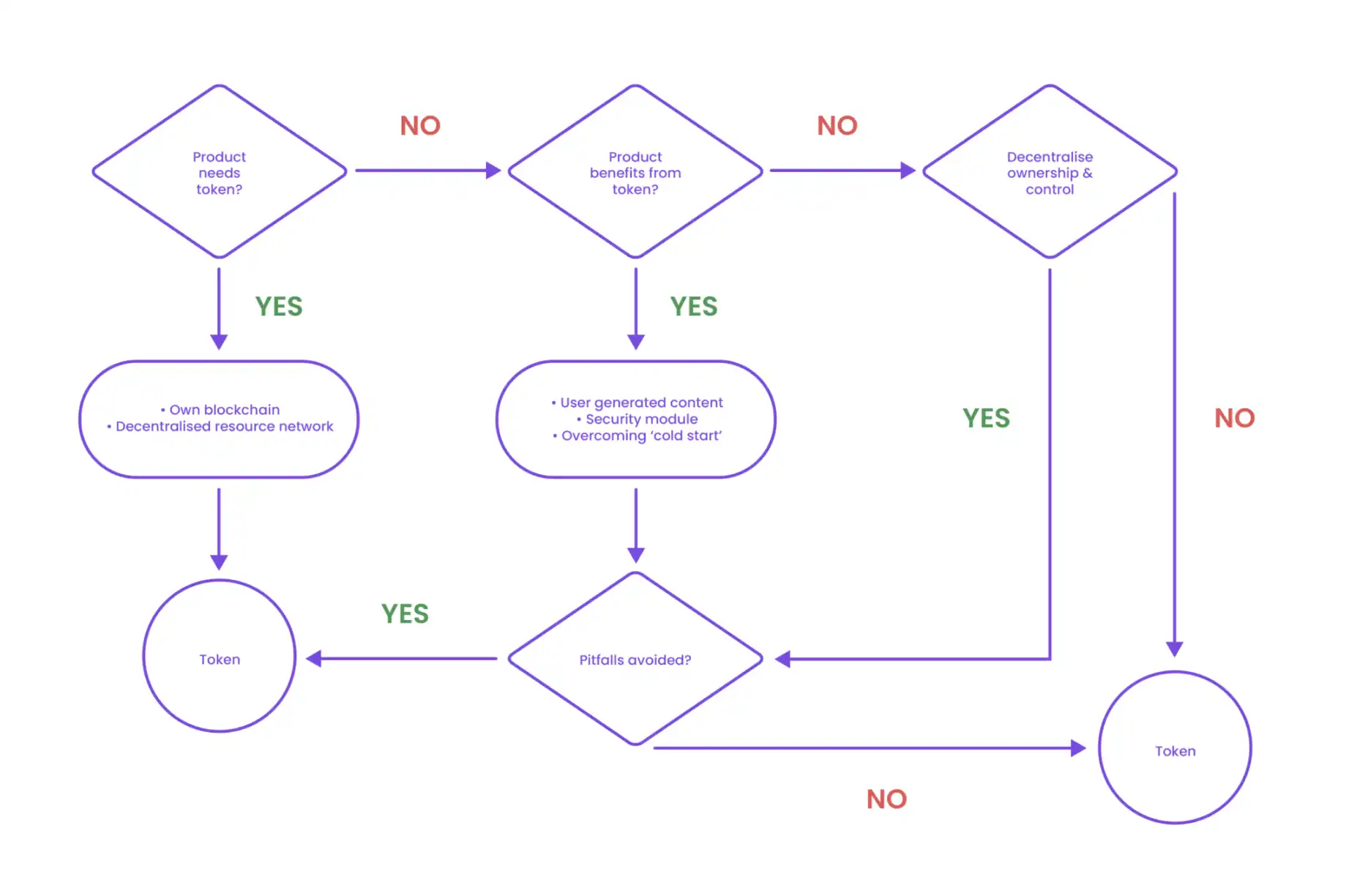
The flowchart above summarizes the considerations described in this article.
We hope it will provide guidance for Web3 founders deciding whether or not to launch their own tokens, and help answer questions about whether or not they need tokens and their purpose. Once a project decides to launch tokens, there are many other relevant factors to consider, such as when, how, and to whom the tokens will be distributed.
In this article, you learned about Web3 products that do and do not require tokens. Here are our top tips:
The narrative around tokens and their use cases changes over time, and people entering the Web3 ecosystem at different times in the cycle may have a different understanding of what the Token is for.
Products fall into three categories: those that require tokens, those that can be improved by tokens, and those that do not. Know which category your product falls into.
Products that require tokens include the Layer 1 blockchain and digital resource networks.
Examples of products that could be significantly improved with tokens are content authoring or management, financial products that use security modules to create decentralized insurance, and products that rely on network effects.
If you think you need a Token for your product, be aware of some pitfalls, such as introducing friction if your Token is the only payment Token, or creating a Token that is used for rewards but may be sold for cash. You should also be careful to alienate existing equity holders.
Governance tokens may make sense in specific situations, but there are other incentives to consider, such as reputation systems or revenue sharing.
Original link
Welcome to join the official BlockBeats community:
Telegram Subscription Group: https://t.me/theblockbeats
Telegram Discussion Group: https://t.me/BlockBeats_App
Official Twitter Account: https://twitter.com/BlockBeatsAsia