After Ethereum merger, DVT distributed verification will become an important key technology
Original title: After Ethereum merger, DVT Distributed Verification Technology is Critical
Original source: TinTinLand
On September 15, 2022, the Ethereum blockchain completed its most significant merger in seven years, from PoW Transition to proof of Interest PoS Consensus mechanism. Apart from reducing energy consumption and barriers to entry, there are also concerns that PoS's consensus mechanism could lead to greater centralised control of the network, since it would give more voting power to those who hold large shares. Therefore, after the merger is completed, developers need to participate in development, testing, minimizing potential network failures, increasing decentralization, and expanding the network.
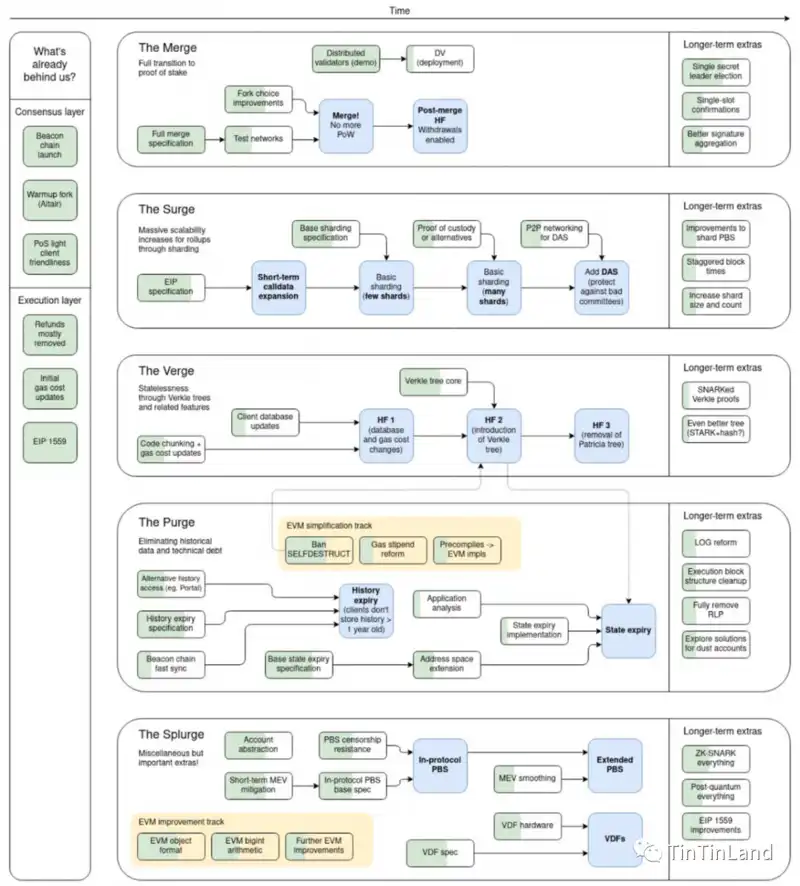
The Ethereum roadmap shows that distributed verification will be the next key for the merged Ethereum. According to Messari DVT could be one of the major developments in the Ethereum network, as it can improve the security of validators.
What is a DVT?
Distributed Validator Technology (DVT) Similar to consensus voting, multiple signatures allow Ethereum PoS validators to vote on multiple nodes or machines. Supporting distributed operation of Ethereum verification is the core purpose of this technology.The technology first appeared in a research paper by members of the Ethereum Foundation, formerly known as SSV. With a 3-of-4 setup (see concepts below), DVT allows individual, community, or community nodes to work together to form a single validator.DVT improves the fault tolerance rate by adding fault tolerant layer to the verifier. In the process of verification, if a node fails, the verifier can still continue to run, thus eliminating the possibility of single point failure, double signature penalty and bifurcated penalty.

Related concepts
,Consensus: The responsibilities of a single verifier are divided among multiple co-verifiers, and signing messages requires co-verifiers to agree on a vote.
,M-of-N Indicates the threshold signature: The private key of the verifier will be divided into N pieces, with each verifier holding 1/N. The signature can be completed when M verifiers vote to sign.
Working principle
DVT consists of four key components: distributed key generation, BLS-signed Shamir key sharing, secure multi-party computing, and the DVT BFT consensus layer.
,Distributed key generation (DKG): The encryption private key is distributed by all participants, preventing one party from directly controlling the entire private key.
,Shamir private key sharing: Private key sharing means that the private key is split and distributed to different participants. If the private key needs to be reconfigured, a predefined share threshold needs to be combined (for example, 3 out of 4).
· Multi-party Computing (MPC) :Multi - party computation is the most important in distributed verifier technology. By scaling calculations, carriers can use their private key sharing to sign messages and perform calculations without having to rebuild on any single device; Multi-party computing enables operators to securely coordinate key generation and reconstruction on different machines in a distributed manner.
,Reach consensusFault tolerance is achieved through the consensus algorithm between threshold signature scheme Beacon nodes, ETH After the verifier connects to the Beacon node, consensus can be reached.
As shown above, first by DVT operatorsThe process of generating shared public key and private key encryption is calculated; Then the private key after being splitShare with different participantsAt the same time, the private key share is distributed to the carrier. Next, by the carrierThe verification node is randomly selected for multi-party calculation(This node shares information with other nodes). After passing the predefined threshold authentication, participants can reach a consensus.
Why do you need DVT?
DVT is designed to address the many issues that arise after the merger, of which centralization is the core threat that needs to be addressed. In addition, under the influence of protocol rules, the assets of the verifier are damaged and the ecological stability of Ethereum is reduced.
Centralized risk
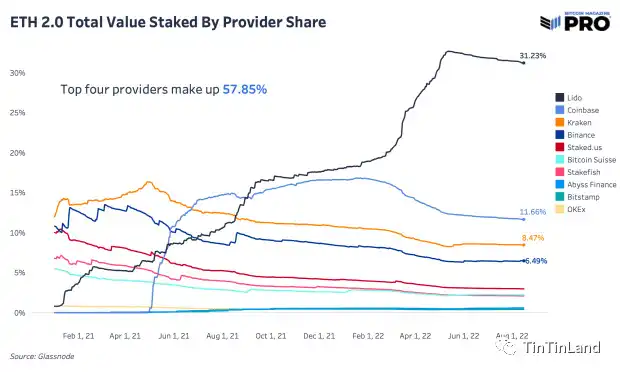
Ethereum rules stipulate that users who hold less than 32 ETH will be restricted from maintaining validators. For these users, the pledge service is the only solution, which further results in a large number of crypto assets being stored on centralized exchanges. Ethereum's largest pledge service. Lido Finance deposited more than 4 million ether coins, accounting for 32% of all crypto assets pledged. . When large amounts of crypto assets are deposited on exchanges, hacking, unreasonable censorship, and technical errors all threaten the Ethereum ecosystem, creating concentration risks.
Single point of failure
The private key is critical to an independent validator because if the private key is lost or forgotten, the asset becomes inaccessible. After the merger, the protocol rules prohibiting redundancy of PoS make each verifier sign only one verifier, which means that if node downtime, hacker attacks and other problems occur, the lack of failure protection of single-node verifier will lead to direct damage of the verifier assets, and further affect the overall stability of Ethereum.
Double signature penalty
If the authenticator uses the same key to sign several times, the user will lose part of the pledge limit due to network failure or cloud failure.
Bifurcation penalty
Under the PoS system, a fork will be established when the Beacon node connected by the verifier fails. However, in such cases, the verifier is affected to be identified as offline, and the verifier will still be penalized.
The consequences of centralization and centralization run counter to the purpose of blockchain, while security threats and asset penalties have a negative impact. In order to solve the above dilemma, distributed verifier technology comes into being.
What is the potential of DVT?
DVT is expected to improve Ethereum decentralization, security and efficiency.
advantage
As a validator running as a node cluster, DVT has high elasticity and low risk, so it can improve the stability of pledge.
,For large validators, DVTS guarantee high availability and reduce infrastructure costsImproved redundancy and lower reduction risk allow fewer verifiers to operate more nodes, thereby reducing hardware costs; By allowing client configurations and addresses to run on multiple nodes, DVT reduces the risk of failure of a single address or client.
· For small validators, DVT can provide a level of protection comparable to larger validators: Use DVT Small validators can provide efficiencies comparable to large validators; By reducing the ETH requirements of running nodes, DVT enables its users to authenticate using community pledge pools or home validators.
· For liquidity pledge agreements, DVT can improve efficiency, reduce risk and allow operators to participateBy providing redundancy in the network, DVTS are no longer dependent on one carrier that could cause an offline outage. In addition, the performance of the pledge protocol is enhanced by the ability of operators to organize into different clusters.
Use case
· Application in decentralized pledge pools: With DVT, the pledge pool can switch to a decentralized model, reducing penalties and cuts by reducing downtime.
· Pledge infrastructure providers: With DVT, infrastructure providers enable active-active cluster redundancy, enabling dynamic deployment and configuration. Previously, in order to meet individual or institutional pledges, infrastructure providers needed to provide redundant solutions for actively passive configured institutions. Now, active-active redundancy can create fault tolerance by spreading validators across multiple machines with the goal of ensuring that redundant systems are always operational.
· Set up independent verifiers: With DVT, the verifier can assign signature rights across multiple nodes in active-active cluster redundancy, thus minimizing the risk of signature failures and penalties due to downtime, double signature, etc.
Related items
Since the introduction of DVT, Obol Network and SSV Network have developed projects based on DVT.
1. Obol Network
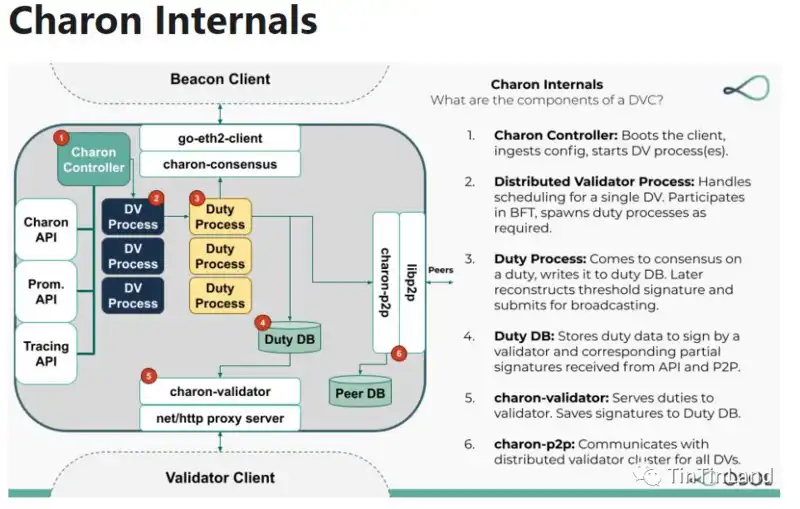
Obol Network introduced plug-in client Charon to enable DVT, which can run in a fault-tolerant distributed manner. By adjusting DVT technology, Obol introduced active-active redundancy to solve the disadvantage of running active-passive systems. Instead of running on one machine, the validator runs on multiple machines to create fault tolerance and withstand partial node failures. Through communication and consensus, multiple Charon clients act together to simulate a unified verifier. In the process, Charon makes the validator available to any client that supports the beacon chain standard HTTP API and maintains the existing remote signature infrastructure. So, Charon provides an easier path to adoption for the verifier.
In the future development direction, Obol Labs will continue to pay attention to DVT and promote its application in applied cryptography and cryptoeconomics.
2. SSV Network
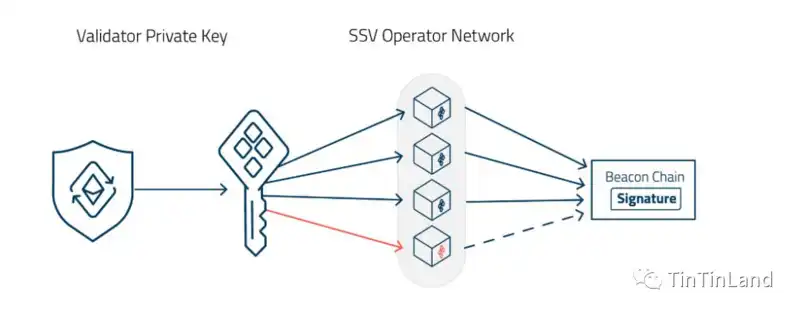
SSV Network has published the network infrastructure layer for decentralized pledge. In the model of SSV, each verifier needs to select 4 nodes from the operator network for multiple signature voting. SSV Network has two different layers, SSV peer-to-peer (P2P) network layer and Ethereum contract layer for network governance: the former mainly reads the operator list and verifier equity allocation from the smart contract, so as to operate the verifier; The latter ranks and evaluates DVT operators, adds operators, creates them, and allocates assets.
SSV Network has funded several projects to implement DVT and will continue to work on building blocks for applications using a decentralized Ethereum pledge infrastructure in the future.
conclusion
For users, DVT solves many challenges of pledge and lowers the entry threshold for ordinary people. For developers, DVTS are also beneficial. With DVT, an organization or independent verifier can enjoy the security and flexibility of the protocol, enjoy the redundancy of the active configuration, and achieve operational diversification based on multiple factors. In the near future, we can expect DVTS to enable pledging, complementary verification node configuration, and collaborative work to achieve a truly decentralized Ethereum.
Reference literature
Understanding Distributed Validator Technology (DVT)
What is DVT and How Does It Improve Staking on Ethereum?
Biggest Ether Staking Service Has a Centralization Problem
Assessing the role of 'Distributed Validator Technology' in ETH's anticipated growth
Original link
Welcome to join the official BlockBeats community:
Telegram Subscription Group: https://t.me/theblockbeats
Telegram Discussion Group: https://t.me/BlockBeats_App
Official Twitter Account: https://twitter.com/BlockBeatsAsia

 Related Articles