EigenLayer announced its mainnet launch plan, has DVT become the target of short-term speculation?

Last night, the re-staking protocol EigenLayer announced that it will use a multi-stage approach to launch the operator mainnet in the next few weeks, which is a key node for the entire re-staking track. Previously, a16z EigenLayer invested US$100 million. In March last year, Blockchain Capital led EigenLayer’s US$50 million Series A financing.
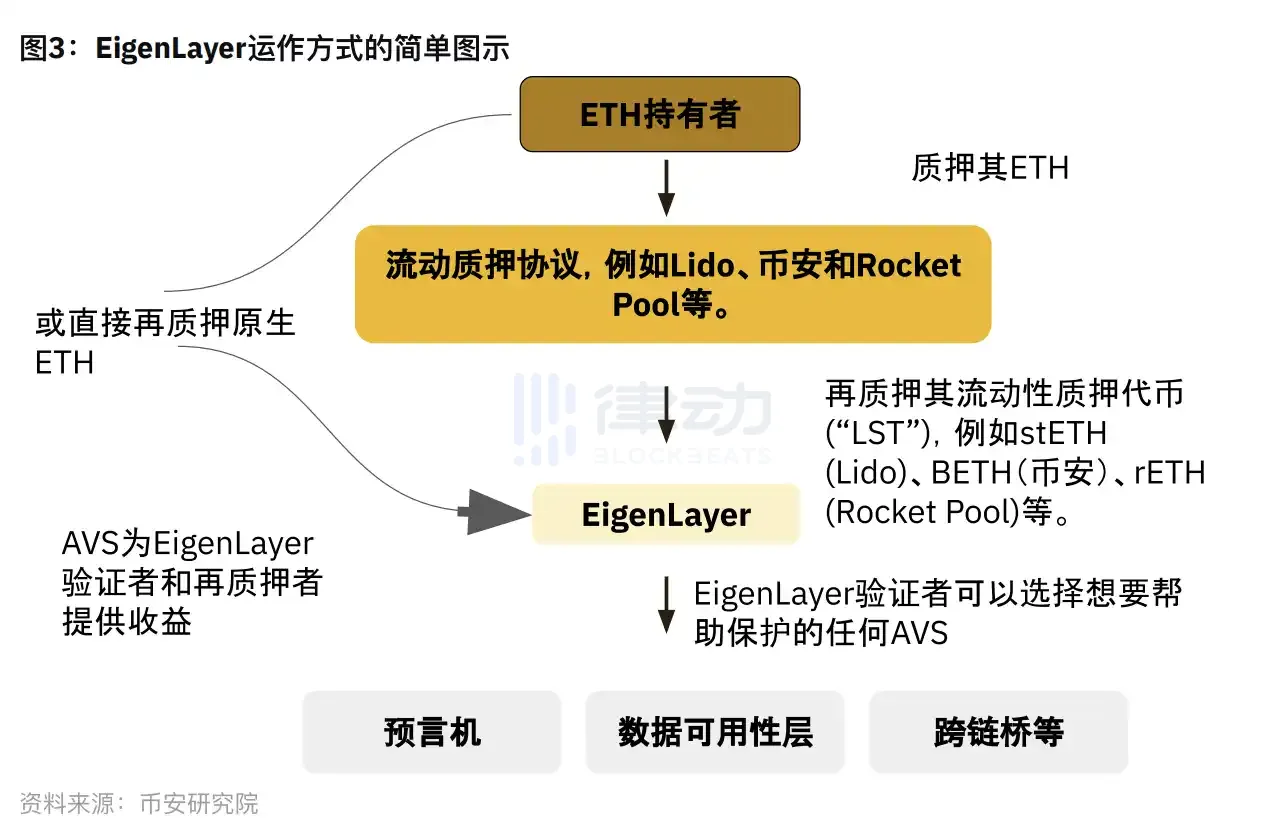
The second phase of the EigenLayer mainnet is online
The official explanation is that the main network will be launched in stages. The online launch is for security and performance considerations, and will be debugged on the Holesky test network before deploying the main network.
First, EigenLayer’s web application and all contracts will be suspended to facilitate the operator’s controlled deployment and go-live on the network, and deposits and withdrawals will be suspended. EigenDA will be officially released after operators gradually register. With the mainnet launch complete, the EigenLayer web application will include a new staker dashboard and operator discovery page. Subsequently, the delegator’s delegation, deposit and withdrawal functions will be reopened.
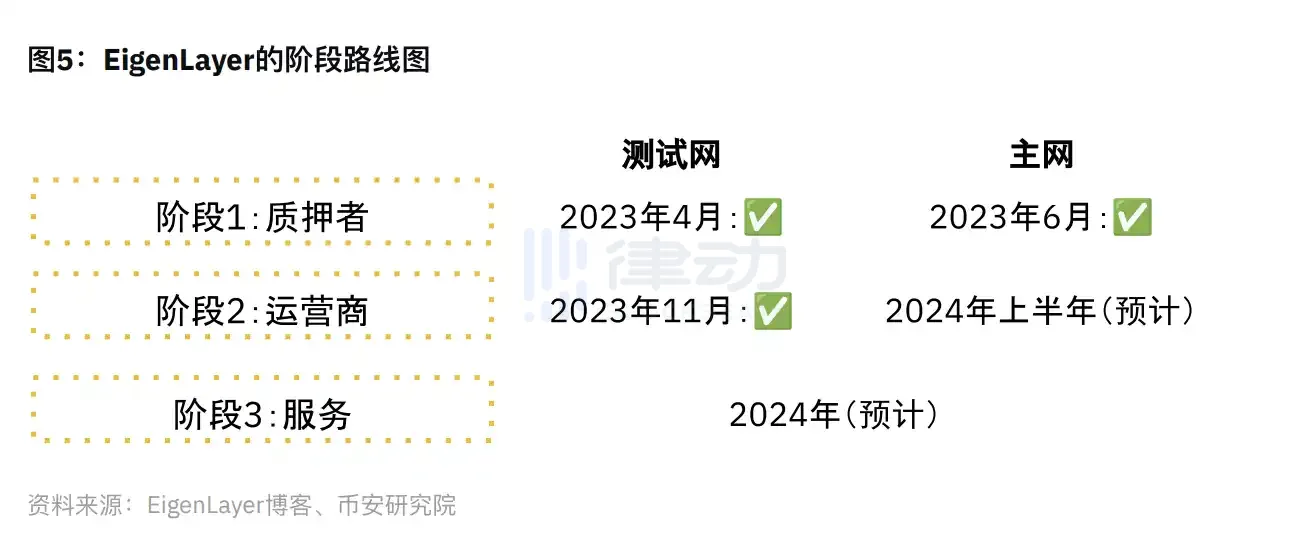
It is worth mentioning that , with the launch of EigenDA, the AVS ecosystem will also be developed on the EigenLayer mainnet. AVS is Active Verification Service. DApps that use re-pledged ETH to enhance its utility are called AVS and are dedicated to attracting re-stakers to help improve security. These AVS are sometimes called modules, and can also be any projects such as new blockchains, DA layers, virtual machines, oracle networks, cross-chain bridges, etc.
EigenDA is the first AVS launched on top of EigenLayer infrastructure. EigenDA supports rollup's extremely large-scale data availability, with a target write throughput of 10 MB/s at launch. EigenDA's adoption of erasure coding, KZG commitment, ACeD and other technologies, as well as the decoupling of DA and consensus, enable EigenDA to provide excellent performance far exceeding the Ethereum DA solution in terms of transaction throughput, node load and DA cost.
When the third phase of the EigenLayer mainnet is launched, more AVS will be launched to enrich the EigenLayer ecosystem.
Related reading: "Binance Research Institute Report: Discussing the Restaking Field 》
Why is DVT needed?
When it comes to AVS, we have to talk about DVT technology. DVT (Distributed Validator Technology) refers to a technology that allows Ethereum's proof-of-stake validators to run on multiple nodes at the same time. It can implement a trusted network for Staking infrastructure to ensure that the blockchain Security and decentralization of the network.
Using DVT, staking pools can switch to a decentralized model, reducing penalties and slashes by reducing downtime. With DVT, infrastructure providers can enable active-active cluster redundancy for dynamic deployment and configuration. Previously, in order to accommodate individual or institutional staking, infrastructure providers were required to provide redundant solutions for institutions in an active-passive configuration. Active-active redundancy can now create fault tolerance by spreading validators across multiple machines with the goal of ensuring that redundant systems can always operate.
《After the merger of Ethereum, DVT distributed verification will become an important key technology》
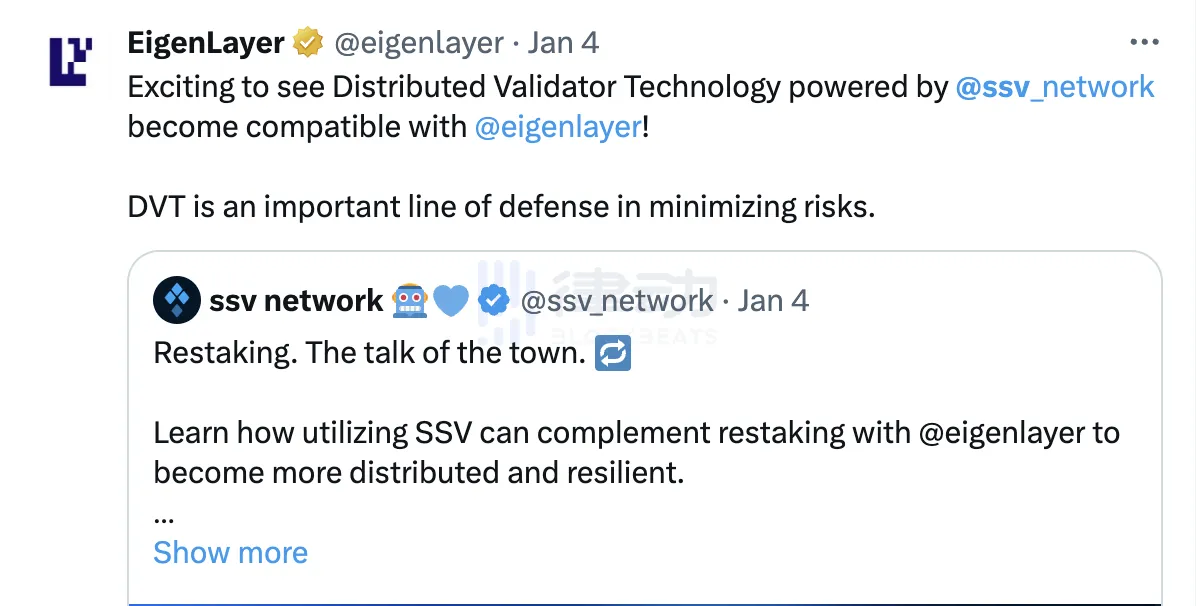
At present, there are two main ones: Obol Network and SSV Network A project is being developed based on DVT technology. On January 4, EigenLayer announced the establishment of cooperation with SSV Network to complement and re-pledge. It claims that a "mainnet" EigenLayer validator is running on SSV. At the same time, both EigenLayer and the stakers can choose to transfer the responsibilities of the validator to SSV and maintain the re-staking status of ETH on EigenLayer to obtain additional income from the SSV incentive main network.
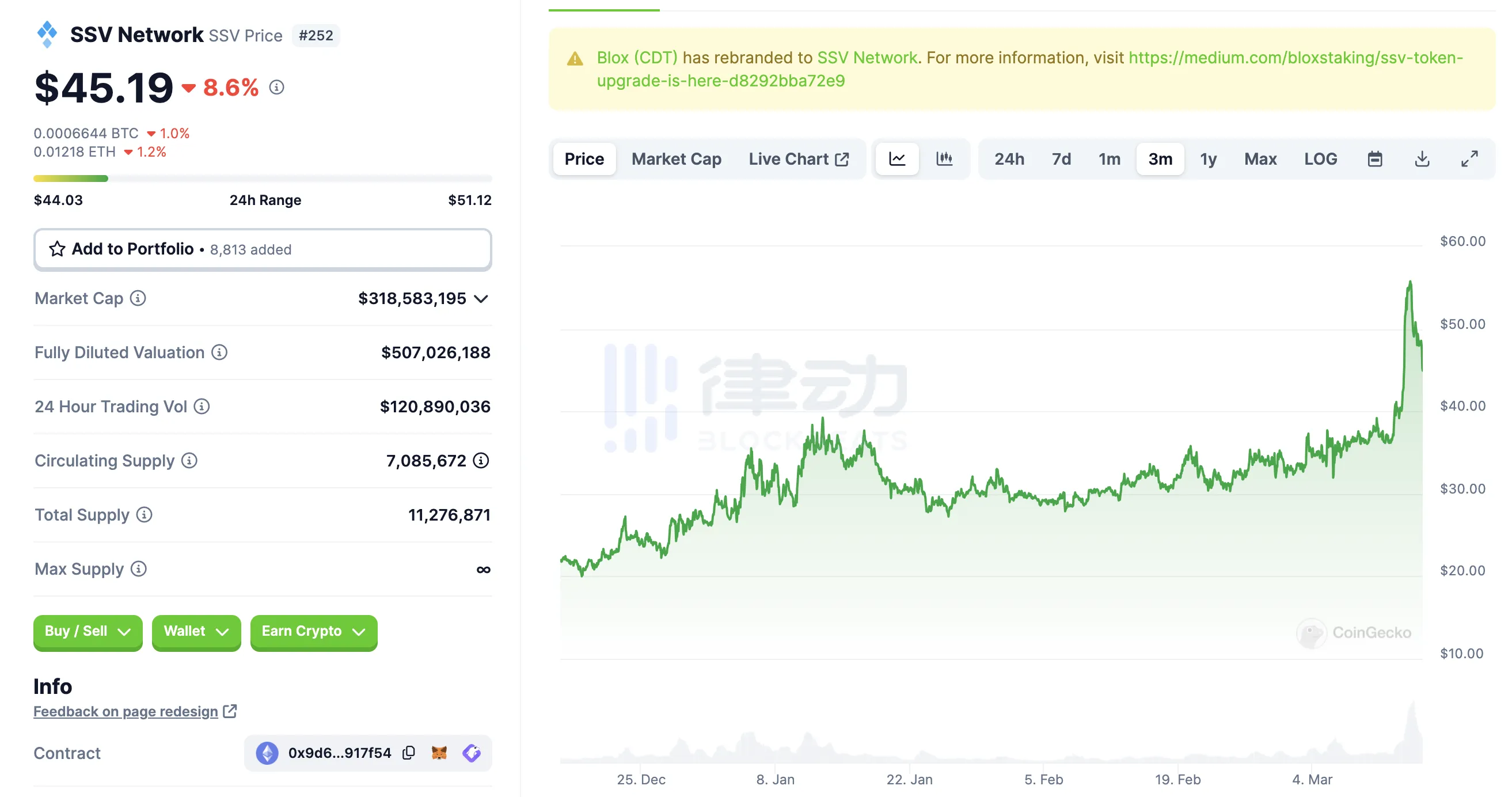
With EigenLayer in the market As the popularity of SSV Network increases, the token price of SSV Network also rises during this period. At the time of writing, SSV is trading at $45.19, with a monthly gain of 43.8%. On March 13, SSV broke through $50, setting a new all-time high.
Currently, SSV Network has funded multiple projects Applying DVT, it will continue to work on building the building blocks of applications using decentralized Ethereum staking infrastructure in the future. After EigenLayer launches the main network for operators, more AVS will join, and with DVT technology, the staking track will still have a lot of room for growth in the future.
Welcome to join the official BlockBeats community:
Telegram Subscription Group: https://t.me/theblockbeats
Telegram Discussion Group: https://t.me/BlockBeats_App
Official Twitter Account: https://twitter.com/BlockBeatsAsia

 Related Articles