What is the difference between on-chain lending with the introduction of "algorithmic collateral rate"

Original article by Nour Haridy
Leo, BlockBeats
Editor's note
In terms of crypto innovation, a recent new DeFi lending protocol.SurgeFi It introduced an "algorithm collateral rate" to liquidate the new concept. People don't know much about Surge protocol, so BlockBeats compiled an article on Medium to help people better understand the new protocol:
Surge Protocol Overview
Ninety-nine percent of the tokens cannot be borrowed or lent, and despite TVL's more than $11 billion, the DeFi lending agreement only supports lending or collateral for a small number of highly liquid tokens. Due to the lack of a reliable and manipulation-resistant price feed, the vast majority of tokens remain incompatible with DeFi lending protocols, including long-tail tokens, LP tokens, NFT, and vault tokens. Since DeFi lends TVL and is used by size, all tokens are supported as loan and collateral options.
While some DeFi agreements have addressed this issue, there are significant trade-offs embedded in current solutions, such as elevated supplier risk, short-term loan maturities, and high risk premiums.
Algorithm mortgage rate
A hitherto unexplored approach is the dynamic mortgage rate, which is based on utilization as a function of time rather than a function of price feed. The Surge protocol introduced the concept of Surge threshold, which introduced the utilization threshold. When the threshold was reached, the pool collateral rate began to decline gradually.
The figure below shows the change in mortgage rates based on assumptions about surge pool utilization:
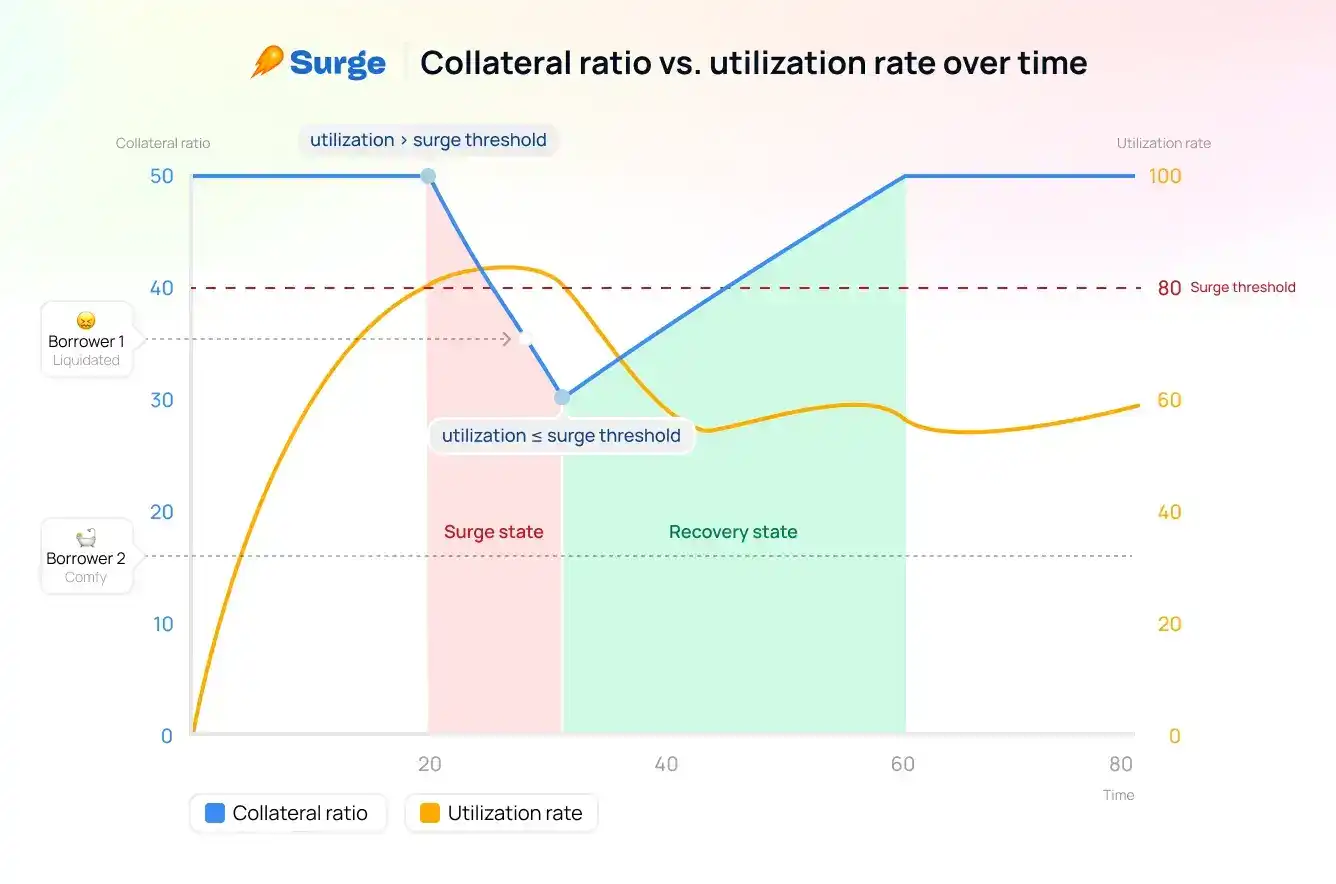
Mortgage rate and utilization over time (hypothetical pool)
In the hypothetical pool above, the pool starts with a maximum mortgage rate of 50:1, which means that the borrower can borrow up to 50 tokens of each unit of mortgage token, and the mortgage rate is independent of the price of the two tokens.
If the mortgage token value decreases relative to the loan token value, the vendor begins to remove liquidity to avoid bad debt, and as the pool utilization rises above the Surge threshold (80% in this example), the pool enters the surge state, Its mortgage ratio began to fall at a constant rate over time.
If the pool collateral rate is lower than that of any active borrower, it may be liquidated. In the figure above, borrower 1 has a mortgage rate of 35, while the pool mortgage rate drops to 30. Borrower 1 can be liquidated, however, borrower 2 avoids liquidation by maintaining more collateral for each token of loan.
As the utilization rate of the capital pool recovers below the surge threshold, the capital pool enters the recovery state and its mortgage rate starts to rise back to the original maximum mortgage rate.
However, if utilization never returns below the surge threshold, the mortgage rate will continue to fall to zero, liquidating all active borrowers, ensuring that the pool remains liquid enough to allow vendors to exit, especially at times of high demand for withdrawals.
No license pool deployment
Deploying a new Surge loan pool is as simple as deploying Uniswap, anyone can deploy a loan pool on any supported chain, and the pool deployer determines all the parameters for the pool, which no one (pool deployer or anyone else) can change once the pool is deployed.
The pool parameters are:
Loan token address: valid token that does not meet the rescheduling basis of ERC20;
Secondary token address: Valid token that does not conform to the ERC20 rescheduling benchmark;
Maximum collateral ratio: Default collateral ratio when the pool is not in a surge or recovery state;
Surge threshold: indicates the utilization threshold for activating surge state and suspending recovery state.
The duration during which the mortgage rate declines from the maximum to zero;
Mortgage rate recovery duration: the duration of mortgage rate recovery from zero to maximum;
Interest rate model: Two interest rate ranges are between zero utilization, surge threshold, and 100% utilization.
Once the pool is deployed, anyone can use it to lend and borrow, there may be multiple pools in the same loan/collateral pair, and depending on the best combination of the risk parameters of the lender and the borrower and the available liquidity in each pool, the pool may be adopted more than others.
Clearing mechanism
Unlike traditional DeFi lending agreements, borrowers are not rendered unliquidable by price fluctuations. On the other hand, they are vulnerable to fluctuations in pool collateral rates due to changes in liquidity.
Because pool mortgage rates fell at a constant rate during the surge state, borrowers could predict the shortest term before they were likely to be liquidated based on the amount of collateral against their loans. When a borrower becomes liquidable, any liquidator can demand collateral from the borrower in exchange for repayment of the debt.
Liquidity restructuring
Because Surge used an isolated pair model rather than a cross-margin model, some might have thought that this model would lead to a restructuring of liquidity.
In a cross-margin pool, risk is shared among all pool participants and each person's position is as risky as the weakest asset in the pool, however, segregation isolates risk against the model, allowing for higher capital and risk premium efficiency (better borrowing rates).
Our goal is to address the liquidity restructuring issue by introducing a supply-side aggregation layer located at the top of the surge pool. Lenders can choose to provide liquidity directly to a single surge pool, or they can pool their deposits in a vault with a limited management role.
For example, anyone can deploy a Surge USDC vault, spread it across multiple Surge pools, and the vault manager redistributes money across different pools on behalf of depositors in exchange for performance fees.
By creating a market for DeFi risk managers and giving lenders the option to passively delegate risk management to anyone, vault effectively provides borrowers with the liquidity they need.
Surge vault was not included in the initial protocol launch.
future
Because surge is a hyperstructure, which means it can't be paused or upgraded after launch, we'll be sharing a private version of testnet with Discord members, and after that, there are plans to deploy Surge on Ethereum, L 2, and other EVM chains (in that order).
Original link
Welcome to join the official BlockBeats community:
Telegram Subscription Group: https://t.me/theblockbeats
Telegram Discussion Group: https://t.me/BlockBeats_App
Official Twitter Account: https://twitter.com/BlockBeatsAsia

 Related Articles