Nansen: Will zkSync be the answer to Ethereum's scalability?
Original title: "Nansen: Will zkSync be the answer to Ethereum's scalability?"
Original author: Osgur Murphy O Kane, Nansen researcher
Translated by: ChinaDeFi
zkSync can be said to be the most exciting L2 solution currently. It has already deployed its mainnet "Baby Alpha" and is expected to launch its full mainnet in the first quarter of 2023. This will be the first Validity Rollup compatible with EVM, and 150 projects have already expressed their intention to deploy on zkSync, including most of the DeFi blue chips.
In addition, zkSync will launch the first L3 concept verification in 2023. So far, the prospect of L3 is purely hypothetical, and it will be very interesting to see how it works in practice.
zkSync's focus on EVM compatibility is a key design choice that may determine its success or failure. There are pros and cons to this approach, with the advantage being the infrastructure and ecosystem of the EVM. Other projects are also focusing on developing new VMs that can better build applications suitable for large-scale adoption. While the native account abstraction in zkSync will provide a good user experience, it remains to be seen whether it can remain consistent with the EVM in the long run.
The customizability and performance of L3, as well as their degree of autonomy in designing any operational method, remain to be seen. However, one thing is certain - zkSync is worth close attention as it approaches deployment on the mainnet.
This report will provide an overview of zkSync and its main features. It also includes an evaluation of its potential competitive advantages, an overview of account abstraction, and an analysis of the future of zkSync's L3 vision.
Introduction
What is zkSync?
zkSync is a general-purpose Validity Rollup platform for smart contracts. It focuses on staying consistent with the Ethereum community and is widely regarded as having the potential to become the first EVM-compatible Validity Rollup on the mainnet.
zkSync is at which stage today?
Source: zkSync
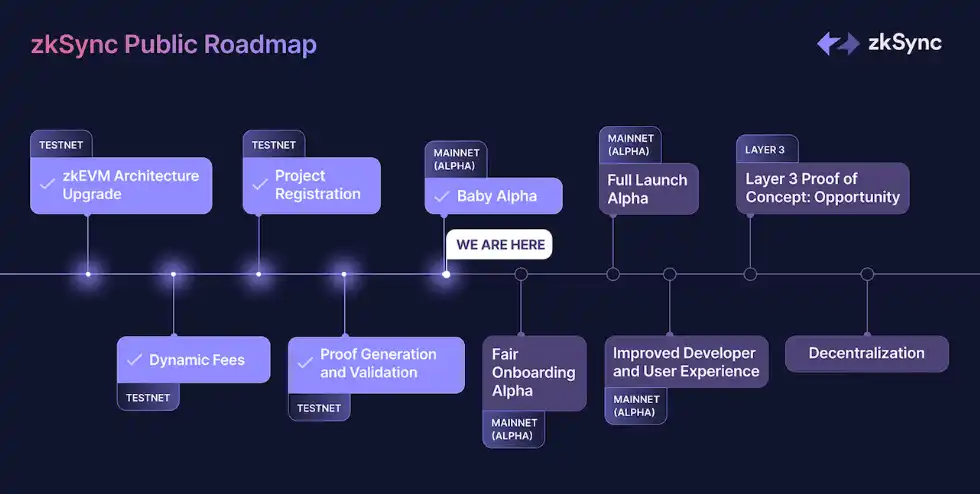
On October 28th, zkSync released their "Baby Alpha", which is only available to teams using the mainnet. Following this, the "Fair Onboarding Alpha" will be limited to registered participating projects. This means they will be able to test their product for any errors or issues before real users enter. At this stage, all code is open source. Finally, the full Alpha version will be released (expected in early Q1 2023).
This gradual approach is meaningful because poor releases could have serious negative impacts not only on zkSync, but also on Ethereum scaling projects.
Financing
Matter Labs has raised a total of $458 million in funding, with its most recent Series C round led by Blockchain Capital and Dragonfly, which raised $200 million. Previous funding includes a $200 million ecosystem fund, a $50 million Series B round led by a16z, and $8 million in Series A and Seed rounds.
zkSync has ample capital and is an undeniable force in the L2 battle.
Starkware: Total funding of $273 million. Fuel: Total funding of $81.5 million.
Financing does not necessarily mean success, but zkSync has raised a significant amount of funds to continue its vision. zkSync is expected to become the first real-time universal Validity Rollup compatible with Ethereum, which could give it a significant advantage. In addition, it has always been consistent with the Ethereum community, which can help it establish a strong ecosystem and competitive moat, while other Rollups may need to work hard to overcome difficulties when deployed to the mainnet.
So what are its main features?
主要特征
translates to
Main Features
Culture
zkSync positions itself as a scaling solution focused on Ethereum. It strives to stay aligned with the Ethereum community. Of course, most Rollups stay aligned with Ethereum because it has many excellent developers and a huge user base. However, some people are still open to the possibility of deploying on other chains and different configurations (this view makes sense; why limit oneself to one network?).
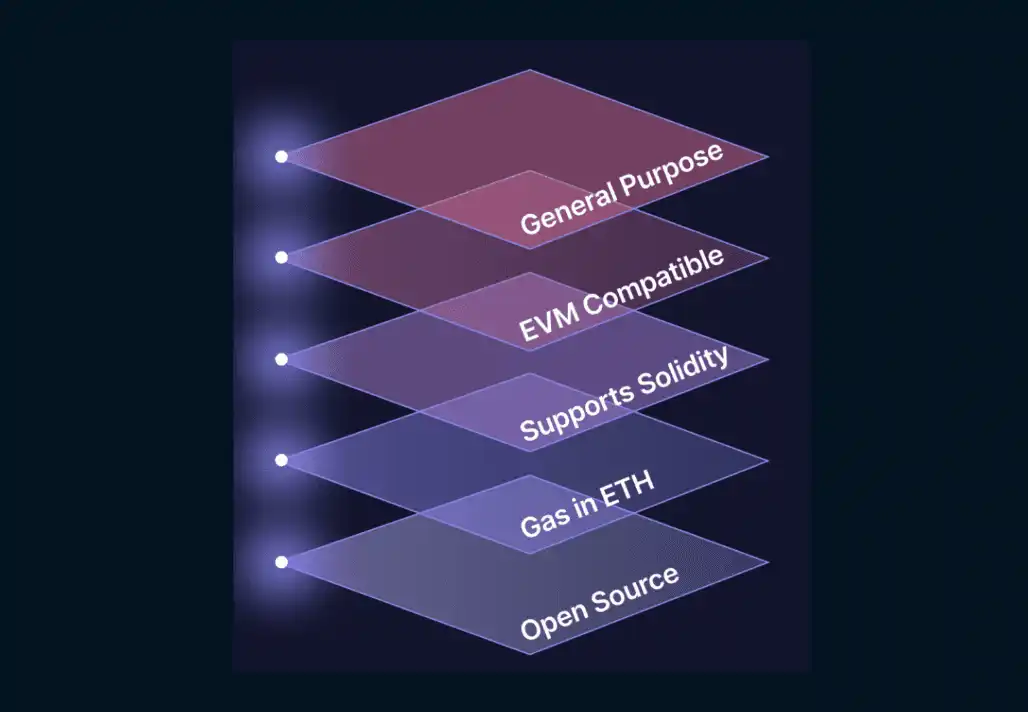
zkSync is fully dedicated to Ethereum and takes pride in demonstrating 5 key qualities that align with the Ethereum community:
UniversalEVM CompatibilitySupport Solidity.
ETH payment gas
Open source
Source: zkSync
This indicates that zkSync is focused on staying consistent with Ethereum. The network effects of EVM are very strong, so this strategy makes sense at least in the short term. However, one argument against this approach is that EVM has many design limitations, and other virtual machines and programming languages are better suited for future applications, which helps bring encryption technology into the mainstream. This is the approach being taken by other scaling solutions such as Starkware and Fuel. However, the wealth spillage around the infrastructure of EVM is not a coincidence, as 9 out of the top 10 TVL chains are compatible with EVM.
EVM Compatibility
zkSync achieves EVM compatibility by having a VM that is compatible with EVM development tools and works well with validity proofs. It is not exactly the same as EVM because Matter Labs has chosen a design that is easier to handle validity proofs.
This design reduces the burden of building a system compatible with all EVM opcodes for Matter Labs, while EVM opcodes are much more complex (such as Scroll).
This means that porting a dApp to zkSync may require some adjustments, rather than using the same design as EVM.
zkSync compiles Solidity code into Yul. Yul is an intermediate language that compiles Solidity into bytecode in LLVM (compiler framework). This enables zkSync to achieve EVM compatibility. The community has already discussed plans to support Rust and Javascript in the future. This may increase the number of projects that can be deployed to zkSync with minimal changes, such as projects already written in Rust for other blockchains. If successful, it could greatly expand the tools available to builders while maintaining composability between applications.
不同的 Validity Rollup 设计
translates to
Different Validity Rollup Designs
in English.
zkSync's EVM compatibility happens at the language level, while Hermez and Scroll go further by building a VM that can interpret EVM bytecode (this approach is significantly more complex and has long been considered impractical).
By deploying at the language level, zkSync does not require validity proofs in any step of EVM execution, which should make the proof process easier to decentralize. Supporters of full zkEVM believe that bytecode-level zkEVM is the gold standard in terms of security.
Deploying on zkSync
Due to the lack of implementation of EVM at the bytecode level, zkSync also adds additional risks (due to differences between the two environments). Will this be a problem? If it is, how big of a problem will it be? These are still to be observed. zkSync claims that 99% of the code can be directly deployed to zkSync 2.0 without any changes. zkSync promises to open source everything this year, and we can describe zkSync as EVM compatible at the language level. This means that zkVM compiles EVM languages (such as Solidity) into SNARK-friendly VM, which adds some compiler risks to the protocol.
Token Economics
Token Practicality is a problematic topic. There is no consensus on how to incorporate a satisfactory value-added mechanism into Token to give it basic value. The reason for this is because projects hope to avoid falling within the scope of security regulations.
For example, protocols like Uniswap (which can be considered the golden boy of DeFi) have a Token with a basic value that is uncertain. Although it is used for governance and rewards, it does not have any actual appreciation properties that give it long-term fundamental value (except for governance, which itself is questionable in value).
Layer 2 Tokens have an additional consideration, which is that they are built on top of another protocol (such as ETH). Adding additional Tokens on top adds additional risk and friction. However, taking incentive measures to develop and maintain the ecosystem is also necessary.
zkSync chooses to pay gas fees with ETH, which is a strong signal of loyalty to the Ethereum and Ethereum community. Some Rollups take certain actions to appease the Ethereum community, but do not demonstrate true loyalty. Paying gas fees with ETH is a strong declaration in the truest sense.
Doing so also helps to avoid additional friction (considering that transactions always need to be settled in the underlying ETH). Using native Tokens as payment Tokens may harm the user experience. Ultimately, user experience will prevail in the increasingly competitive Rollup space.
In addition, Matter Labs remains silent on the use of Token. There are also potential issues with governance of Rollup, as this brings additional risks of governance capture. As for ownership, most Tokens are actually centralized, with only a few participants able to influence governance decisions. This increases the risk.
By adopting the typical PoS Token approach, it will bring additional scrutiny risks to the second layer, and therefore it is also considered undesirable.
The team claims that two-thirds of the Tokens will be allocated to the community/ecosystem, while one-third will be used to incentivize the team and investors. This is a healthy split, as many Tokens are designed to benefit insiders, and one-third of the Tokens should provide sufficient incentives for contributors. For example, Starkware has 50% of its Token supply allocated to insiders, and zkSync CPO Steve Newcomb has said that 50% of Arbitrum's Token supply is also allocated to insiders.
护城河
translates to
Moat
in English.
What are the advantages of being the first to launch?
Although being the first to enter the market undoubtedly brings zkSync a first-mover advantage, how strong is this advantage and how sustainable is it? To explore this, it is necessary to study chains that are compatible with EVM.
In the bull market of 2020/21, EVM-compatible chains have risen rapidly due to their ability to provide alternative solutions for Ethereum mainnet users, while the price of Ethereum mainnet is very expensive.
This brings the following players:
BNB Chain
Polygon
Avalanche
Fantom
All of these chains have developed very quickly. However, the easy deployment across EVM chains has made developers and users very opportunistic, allowing them to quickly move from one chain to the next with little loyalty. Take the BNB chain for example; although it has a first-mover advantage, few projects are considered to have lasting value.
Will zkSync be attacked by profit-seeking developers/users?
zkSync may be different because it is closely connected to the Ethereum community. Validity Rollup is widely considered one of the most promising scaling technologies, and zkSync is working with Ethereum, especially by using ETH as gas token, which may make developers more inclined to develop on it. In fact, 150 Ethereum projects have already expressed their plans to deploy on zkSync, including Aave, Uniswap, Chainlink, Curve, and more.
However, the long-term success of zkSync will depend on the design and user experience of other EVM-compatible Validity Rollups being built, such as Scroll. If these companies can launch objectively better products, then the first-mover advantage will become meaningless. However, if zkSync and its L3 ecosystem can generate strong appeal before competitive rivals launch their products, then its first-mover position may give it a significant competitive advantage.
Account Abstraction
An account abstraction refers to the goal of reducing the two types of accounts on the blockchain to one, which will simplify things for users as they will no longer need to differentiate between different account types.
Ethereum has been working on it since 2017, but it is a very challenging task and has been put on hold due to the support for the scaling roadmap. Now, zkSync (and other L2s such as Starkware and Fuel) will merge account abstraction by default. Essentially, accounts can implement any logic.
Although it may not seem exciting on the surface, it actually brings some very interesting UX improvements.
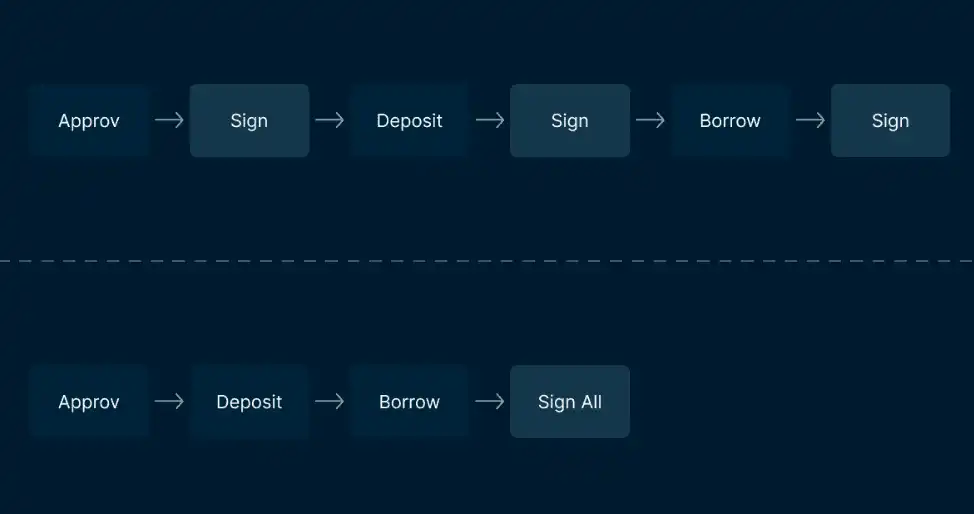
One-time approval for multiple transactions
Using dApps on Ethereum can be frustrating because every on-chain interaction requires a transaction (and gas fees). This is a poor user experience. By abstracting accounts, multiple transactions can be bundled together. The following image shows how it will greatly improve the user experience:
社会恢复
translates to
Social Recovery
One of the biggest user experience issues in the encryption industry is mnemonic phrases, as well as the consequences of forgetting them entirely.
The social recovery allows users who have lost their private keys to authorize a new wallet as the legitimate owner.
can be:
Hardware wallet; trusted friends/family; third-party services; or even a combination of the two.
Through social recovery, users can still safeguard their funds and control their assets. Vitalik is an advocate for social recovery wallets, stating that it is his "preferred method" for protecting wallets.
Multi-Factor Authentication
The account abstraction allows users to set their accounts to: 1. require signatures from multiple keys; 2. only execute transactions when certain conditions are met. While this may sound similar to using a multi-signature solution like Gnosis Safe, the account abstraction can provide wallets with greater customization and usability than typical multi-signature solutions.
The account abstraction can provide users with some customized functions to improve their experience. The security level can be adjusted according to the user's needs.
Any Token
can be used to pay for gas fees.Account abstraction can use any Token to pay for gas. Although it is not yet certain whether zkSync will enable this feature, assuming it can run in the background, the fee Token can be exchanged for ETH.
Session Key
This allows wallets to pre-approve certain rules for interacting with dApps, so users can use them frequently and without having to sign transactions. This is especially useful for blockchain games.
dApp can freely operate within specified boundaries, allowing users to maximize usability while maintaining boundaries and effectively reducing risks. Currently, users need to trust an entity to sign on their behalf (or sign themselves).
Plugin
The account abstraction enabled plugin means that users can add and remove functionality after creating an account.
Limit Time Trading
Another potential feature of account abstraction in the encryption industry is time-limited transactions - users can create transactions to be executed at a specified future time.
Volition
zkSync is also intended to operate as a Volition, known as zkPorter. zkPorter allows users to choose between Validity Rollup (on-chain data availability) and Validium (off-chain data availability). This allows users/developers to choose the desired level of security for their specific applications. For example, a gaming application may choose Validium because the additional cost of security for Validity Rollup is unnecessary for them, while a DeFi application may choose Validity Rollup because it enhances security and on-chain data availability.
zkPorter off-chain data will be sent to the Guardian Network - this will be a PoS network protected by zkSync (not yet released) Token. This increases the trust assumption of two-thirds of honest validators and demonstrates the trade-offs between Validium and Validity Rollup. Validium is much cheaper, but also less secure.
L3
L3 是什么?
->
L3 is what?
In order to understand the meaning of "Layer-3", it is necessary to first understand L2 Rollup. L2 Rollup refers to a blockchain scaling solution that handles transactions on Ethereum L1, settlement on L1, and data availability. L3 is to L2 as L2 is to L1.
L3 enables custom extensions for specific applications that require computation outside of the EVM. The general consensus is that L3 supports custom functionality for applications and leverages L2 for scalability, such as privacy.
L3 is suitable for Validium that may be applicable to specific application use cases, such as games and enterprise applications.
L3 distributes state and execution across multiple servers, which is necessary for compute-intensive applications. Expected benefits include:
The solution to prevent MEV may result in little or no MEV.
You can optimize for applications: cost markets, hardware requirements, etc.
Fractal Hyperchain
Fractal Hyperchain is a term used by Matter Labs to describe their vision for L3 on zkSync. All Fractal Hyperchains will be constrained by the same circuit technology and verified by the same prover. The significance of this is:
There is a native bridge between Hyperchain that shares the same prover. The bridge has always been a key factor in the ecosystem's failure, and a native, trustless bridge will be the key to achieving scalability, secure composability, and interoperability. Matter Labs stated that there will be no bridge between Hyperchain in the future. However, this is purely hypothetical. Despite claims of "infinite" performance, no single solution can infinitely scale, so it will be interesting to see how much scalability L3 can provide when it is released.
L3 will be highly customizable, with many specific application chains envisioned.
L3 users can choose from three data availability options based on their needs:
Validity Rollup (highest security, highest cost)
Validium (data chain availability, fastest, cheapest)
Volition (applications/users can choose between Validity Rollup and Validium for transactions).
zkSync is expected to launch L3 concept verification in the first quarter of 2023, and claims that some big brands are considering deploying on zkSync's L3.
Matter Labs also stated that their LLVM compiler can support any modern programming language, such as Solidity, Rust, C++, etc., which will expand the scope.
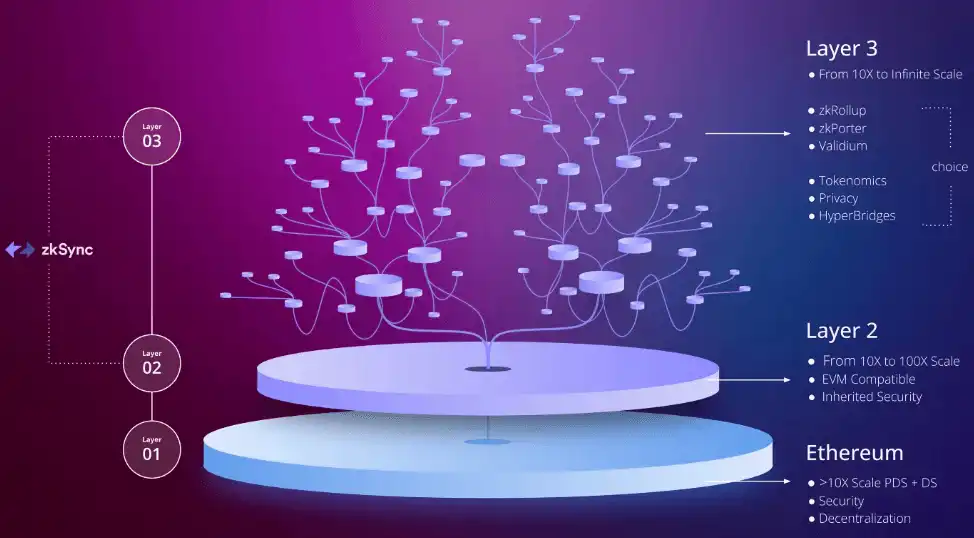
Source: zkSync
Scalability and the Importance of L3
Although the goal of zkSync is to scale Ethereum, it is somewhat ironic that many existing blockchains currently have a large amount of unused block space. This is because there are currently no applications that can attract a large number of users. The potential scalability and customization brought by L3 pave the way for the widespread adoption of Web3 technology. Ultimately, the success of these scaling platforms will depend on the development of applications that are suitable for large-scale adoption.
Validity Rollup
The main battlefield of the war may be the prover.Although many Validity Rollup solutions are competing to launch their mainnet products and trying to build the best ecosystem, the Chief Product Officer of Matter Labs believes that the focus should be on which project can build the best prover.
In order to achieve the vision of L3 Hyperchain, the prover of zkSync needs to be recognized by the industry as the best. If this happens, it may encourage a large number of builders to seek to deploy L3 in a shared prover-enabled, composable, and interoperable network.
If the project/network uses the same prover, they will be able to interoperate with each other (theoretically protected by cryptography). Our vision is that most on-chain activities will utilize the same prover, which will make significant progress in the potential of Web3 technology.
On the Bankless podcast, the Chief Product Officer of Matter Labs used the analogy of SSL to describe the potential of zkSync. SSL stands for Secure Socket Layer, which is a protocol used by browsers and servers to authenticate, encrypt, and decrypt data on the internet. Prior to the adoption of SSL, e-commerce was niche and many people did not trust putting their credit card details online. However, with the widespread adoption and confidence in this technology, e-commerce was able to develop and thrive.
If zkSync's prover can be accepted as a secure and reliable universal standard, then the vision of a secure and interoperable Fractal Hyperchain network could become a reality. Of course, this also depends on whether L3 and blockchain technology itself can achieve global-scale product market fit.
Decentralization
By implementing proto-danksharding and danksharding, Ethereum will transition from a bandwidth-limited environment to a bandwidth-abundant environment. Nansen's report explains Ethereum's scaling roadmap.
There is a viewpoint that believes today's Rollup focuses too much on data optimization rather than bandwidth optimization, leading to issues surrounding growth state. This, in turn, presents challenges for future decentralized prover/sequencer.
L3 / Fractal Hyperchain may provide a satisfactory solution for reducing state growth. However, this remains to be seen, as there may be issues at the L2 layer in the future if they realize their potential for carrying a large amount of on-chain activity.
Decentralization is located at the end of many Rollup roadmaps, but it is currently uncertain how to achieve this goal and how quickly it can be completed.
Composability
Validity Rollup can be combined with the settlement layer, such as Ethereum L1. To achieve this, a validity proof needs to be generated for each block. Of course, the Validity Rollup technology has not yet reached this level; nevertheless, its development speed has even surprised Vitalik Buterin. This will enable L3 to be synthesized with the underlying L2.
However, this requires waiting for the next block to be combined. For most applications, this should not be a problem. One way to solve this problem is for L2 to provide L3 transaction pre-confirmation, which should make L3 and L2 transactions atomically composable. Ultimately, it is possible that n L3s will form the same unified state, and a simple validity proof can verify all L3s. This will result in complete composability.
Polynya believes that, in terms of maximizing security, decentralization, and scalability, this is a feasible path forward.
This is exciting, however, how these Rollup / L3s work in practice remains to be seen. zkSync is leading in this regard and is likely to provide the first instance of L3.
Conclusion
zkSync's latest round of financing is $200 million, with a total ecosystem financing of $485 million, making it one of the best L1/L2 in terms of capital, with a good expansion roadmap.
It is worth noting its consistency with Ethereum, which is demonstrated by paying gas fees with ETH. While this will attract Ethereum developers, it is not yet clear how strong their first-mover advantage as a general EVM-compatible Validity Rollup will be.
Native account abstraction can significantly improve user experience and may push encryption technology towards mainstream adoption.
L3 will become the key battlefield for ZK-Rollup, and zkSync is seeking to become the recognized standard for hosting L3. Their L3 PoC will be launched in the first quarter of 2023, which is worth paying close attention to.
One key challenge (currently without a clear solution) will be decentralized prover.
Original article link
Welcome to join the official BlockBeats community:
Telegram Subscription Group: https://t.me/theblockbeats
Telegram Discussion Group: https://t.me/BlockBeats_App
Official Twitter Account: https://twitter.com/BlockBeatsAsia
 Related Articles