Emerging forces in the field of zkEVM: Discussion on Ethereum Layer 2 expansion technology
Original title: "Comparing 6 Layer 2 Projects of the Ethereum ZK System: Exploring the Technical Differences of ZkEVM"
Original Source: Chain Tea House
It's not hard to see that projects with ZK rollups are all about zkEVM, and last year will be the year that everyday cryptocurrency users will be able to try zkEVM for the first time.
Layer 2 expansion is currently one of the most critical issues in the industry. Originally, L1 was implemented by Ethereum itself, running smart contracts on the Ethereum blockchain platform, but because the original architecture of Ethereum has problems such as throughput limitations and high transaction fees, it is necessary to build an L2 scaling solution to increase transaction speed and reduce costs.
The zkEVM-based project aims to improve the scalability and security of Ethereum by using zero-knowledge proofs, sharding and other technologies to achieve faster , More efficient transactions.
zkEVM (Zero-Knowledge Execution Environment Virtual Machine) is an Ethereum virtual machine that uses zero-knowledge proof to achieve privacy protection. It allows smart contracts to be executed in a manner that protects the privacy of the terms of the smart contract and the data involved in the contract, which is entirely achieved through zero-knowledge proofs.
ZkEVM can be regarded as, during the execution of smart contracts in Ethereum, some data can be processed and verified without revealing the original data. If the project introduces zkEVM, it can effectively improve the privacy and performance of smart contracts. With zkEVM, users can execute smart contracts containing secret calculations at a faster speed while protecting privacy.
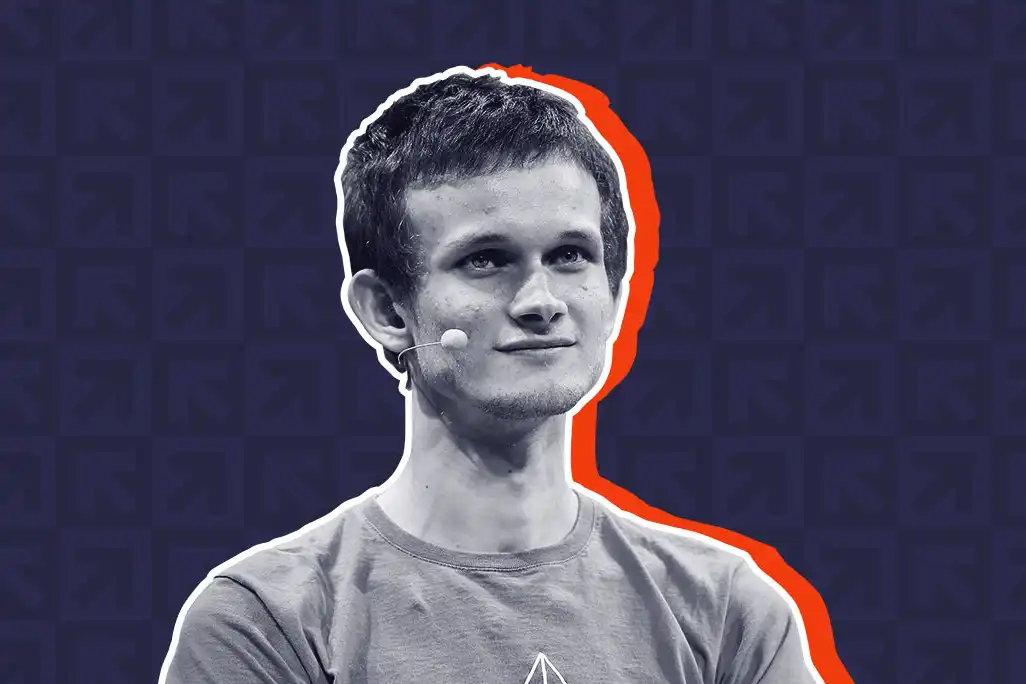
According to Vitalik's interpretation, zkEVM can be divided into:
(1) Type 1 PSE : (Full Ethereum - Equivalent) - zkEVM does not change any part of the Ethereum system and strives for full equivalence.
(2) Type 2 Scroll (full EVM—equivalent)——zkEVM will look completely equivalent to Ethereum, but in terms of data structure and state tree, etc. Aspects are different.
(3) Type 2.5 (EVM——equal to gas, except for cost)—zkEVM significantly increases the cost of GAS to meet the very Certain operations that are difficult to zk prove, and developers need to be careful when deploying dApps here, as these may break some developer tools.
(4) Type 3 (almost equivalent to EVM) - zkEVM is almost equivalent to EVM, but they have to make some sacrifices and remove those difficult Functionality implemented in the zkEVM system.
(5) Type 4 (high-level language equivalence) - these zkEVMs are compatible at the language level (Solidity, Vyper).
They take a smart contract written in these languages and make it possible to compile it in another language used to build the zkEVM system. Currently, zkSync is one such zkEVM implementation.
ZkEVM Classification and Circuit
Currently there are two different competitions in Rollup, the expansion plan of Ethereum According to the Tao, Optimistic Rollup and zk Rollup have similar execution principles, and the main difference lies in the transaction verification process.
It is worth noting that zk Rollup's "Zero-Knowledge Proof (ZKP)" technology uses technologies such as SNARKs, which are cryptographically verified and published on Ethereum its transaction batch.
So ZK rollup can be understood as the combination of off-chain execution and on-chain data through zero-knowledge proof (ZKP), which has gradually become the mainstream solution of ZK .
But in addition to ZK-rollup, there are actually two other solutions - Validium and Volitions.
First of all, the operation of ZK-rollup is simply to package multiple transactions together, publish them on L1, and issue a proof at the same time (using zero-knowledge Proof technology) to claim that these transactions are valid, once verified on L1 that they are valid, the state of zk-rollup will be updated.
This proof mechanism is also called "validity proof". At present, the main proof mechanisms used by ZK-rollup are zkSNARK and zkSTARK.
And then there are Validium and Volitions.
ZK-rollup sends transactions to L1 in batches for execution, which is a kind of "custom security" that does not require trust. Validium is implemented directly off-chain, and maintains data through zero-knowledge proofs, and verifies the validity of withdrawal requests on the main network only when necessary.
So Validium is more scalable than ZK-rollup (currently the highest TPS can reach 20000 above), the disadvantage is , it transfers the right of trust to a "weak trust" third party outside the chain for capacity expansion, and there is a high probability that data will be unavailable or users will not be able to withdraw funds due to attacks.
Among them, the way to solve security is to "use the PoS mechanism" to use economic incentives to ensure that data is stored in each node and is available at any time.
The representative project currently adopting the Validiums scheme is Immutable X, an extension solution centered on NFT. Vitalik also said that Validium is seriously underestimated. In fact, most dApps can already meet their operational needs with Validium.
As for Volitions, it is a Volitions solution created by the StarkWare team in combination with ZK-rollup and validium. As the name suggests, it is about "decision-making ability". Volitions can essentially provide both ZK-rollup and validium services at the same time, because they share the same state root (state root), and users can choose the DA mode of each transaction by themselves.
Even if, as mentioned above, Validium is attacked and the data is unavailable or users cannot withdraw funds, the funds on ZK-rollup can still be guaranteed to be safe. Because users can choose the ZK-rollup mode when important financial transactions are involved, sharing the security of Ethereum, if it is daily entertainment, social networking or small transactions, they can switch back to the Validium mode to increase speed and save costs.
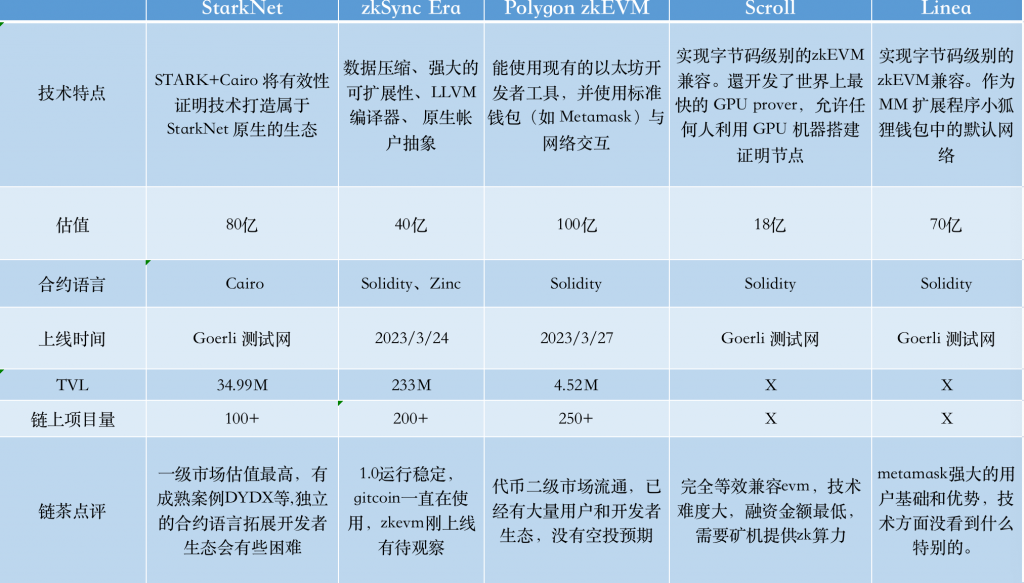
The latest progress and analysis of the zkEVM project
1.StarkNet
According to Dune, the number of StarkNet bridging users reached 318, 253, surpassing Optimism's 317, 758. However, in terms of the total value of bridging storage, StarkNet is still behind Optimism. The former has a bridging storage value of 39, 900 ETH, and the latter has a bridging storage value of 527, 480 ETH, worth more than $1 billion. As the project with the highest valuation among the four major L2 (Optimism, Arbitrum, zkSync, StarkNet), StarkNet ecological project, the recent transaction activity can be seen.
StarkNet has announced on November 16, 2022 that its native token $STRK has been deployed on the Ethereum mainnet for voting, staking and payment of fees. Allocation is still to be determined. StarkWare, the parent company of StarkNet, was established in 2018 and is headquartered in Israel. Its two main products are StarkEx, an expansion engine based on the Ethereum mainnet, and StarkNet, a general-purpose ZK-Rollup. First of all, StarkNet is a general-purpose L2 launched by StarkWare. It adopts a validity proof scheme to obtain the security of the main network. Through STARK+Cairo, the validity proof technology is built into the original ecosystem of StarkNet.
In short, after the user initiates the transaction, the transaction will be sent to Squeencer for verification, sorting and execution, and the batch will be packaged. Squeencer will execute the transaction through Cairo OS ( The Cairo language has zk-friendly features), which is the role of EVM. Squeencer then submits the trace of the executed transaction to Prover, and Prover generates a validity certificate for computational integrity. Prover here also generates a validity certificate for StarkEx, and can aggregate transactions from different StarkEx applications and StarkNet to achieve sharing.
The underlying technologies used by the two are similar. StarkEx is equivalent to using the ZK Rollup technology in advance through the centralized operation of a single App, while StarkNet undertakes The decentralized task of building a network of nodes is realized. A major contribution of StarkWare to the field is to convert all smart contract calculation results into provable polynomial equations through the Cairo language, thus making smart contracts compatible with Validity Proof.
StarkWare has received a total of 273 million US dollars of financing in 7 rounds of financing, of which the parent company StarWare is valued at 8 billion US dollars, which is why it is the four most valuable one of the reasons. In the subdivision track of zk-rollup, StarkNet does not account for a certain proportion of users in zkEVM. At present, the ecology of StarkNet is only in its infancy, and the transaction volume is too rare, which makes it difficult for StarkNet to accumulate enough transactions to evenly share the validity proof The cost of StarkNet leads to a long transaction confirmation time and cannot achieve the ultimate scalability.
However, on January 5 this year, StarkWare announced the official launch of the programming language Cairo 1.0 public version, officially replacing the two-year test and preview version, which also marks the use of It has become possible for this language to write smart contracts on StarkNet, and at the same time, it will also take into account efficient execution efficiency, which has become a milestone event for the ZK-based Layer 2 Rollup technology school.
It can be seen that the development ecology is the foundation of the ecosystem for the project side. According to Electric Capital statistics, StarkWare has twice as many full-time developers as Aptos and Sui , counting part-time jobs may be about three times, and the number is still growing. Increased 214% over the past 1 year, 2220% over the past 2 years. Even if StarkNet temporarily abandons the route of EVM compatibility, it also allows StarkNet to focus on obtaining a more flexible development experience and attracting diverse developers.
2. zkSync Era
ZkSync of Ethereum L2 expansion solution zkSync last October The first stage of the 2.0 mainnet, Baby Alpha, was launched and became the first mainnet released in the zkEVM project on Ethereum. On March 24 this year, zkSync announced that the zkSync 2.0 mainnet has entered the second stage of Fair Onboard Alpha, allowing All registered projects can be deployed on the mainnet, and even decided to rename zkSync 2.0 to zkSync Era and zkSync 1.0 to zkSync Lite. After the zkSync Era mainnet was officially opened to the public, the number of single addresses exceeded 100,000 within 3 days, and 18,000 ETH cross-chained into zkSync Era. As of April 14 this year, the zkSync Era TVL has reached $240 million.
The previous transaction cost of ZkSync Lite was not high, but the overall speed was relatively slow; while ZkSync Era has further improved the transaction speed and greatly reduced the transaction cost. Not only that, but ZkSync Era will have more integration with existing development tools to lower the barriers to entry for external developers. Simply put, after this update, ZkSync Era will be compatible with cloud development environments, such as Google cloud services store data.
Also, both GPU and non-GPU environments can be used for key generation and setting, and GPU acceleration will still be optimized for future development of hardware accelerated devices.
The highlights of zkSync Era are:
( 1) No third-party dependence at all But similar to the security of the main network: it supports Solidity 0.8.x version, which is consistent with the development environment of the Ethereum main network.
( 2) Permission-free EVM-compatible smart contracts: zkSync's EVM compatibility enables smart contracts written in Solidity and Vyper to Available on zkSync. zkSync also built the first LLVM (LowLevelVirtualMachine)-based compiler for EVM languages (Solidity, Vyper, Yul) this time. Thanks to the open source and universality of LLVM, developers can finally use C++, Rust and other languages Write smart contracts.
( 3) Standard Web3 API: Web3 API is almost fully compatible with Ethereum, and developers can use most of the API.
( 4) Retain key EVM features such as smart contract composability.
( 5) Introducing new features, such as abstract accounts: zkSync Era directly uses local abstract accounts, assisting any account on Era to pay with any token Fees, and even allow users to trade with zero fees under the condition that some agreements are willing to subsidize.
( 6) Execution delay mechanism: According to the official news on March 24, zkSync announced one of the zkSync Era multi-layer security mechanisms, That is, "execution delay", that is, each L2 block submitted to L1 will have a time lock before it is executed and finalized. Initially, this delay will be 24 hours. As the system matures, this delay will gradually decrease until Remove the Alpha stage, when the delay will be completely removed. The move is primarily to ensure that the team has enough time to verify any implications of transactions included in a block before it becomes final, and to allow enough time to detect bugs, investigate, and freeze the protocol through governance.
The above is the latest development of zkSync technology. The financing and technical background of zkSync development company Matter Labs should not be underestimated. Matter Labs has completed a financing of 200 million US dollars in November 2022, and the team embarked on the ZK road as early as December 20, 2020, launching zkSync Lite ( zkSync 1.0), but at the time it was relatively inconvenient for developers to use due to the lack of EVM functionality.
Therefore, it can be said that zkSync Era is currently more complete than before, and its technologies for developers and projects, such as open source zkEVM (Zero-Knowledge Ethereum virtual machine) makes it easier for developers to use and build their own ecosystem.
Secondly, zkSync Era also has more technical reserves for accessing Web2 and hardware applications for acceleration and inter-chain scalability.
The current ecology is not only more suitable for developers, but also projects can build their own ecosystem, and it has attracted multiple applications, including DeFi, wallet, cross-chain, NFT , infrastructure and many other fields, but zkSync Era is still in the Alpha stage. Many projects in the ecology are application migrations from other networks, and there are very few native applications, and their risks are still unknown.
3.Polygon zkEVM
Polygon zkEVM mainnet test version officially launched on March 27 , Vitalik completed the first transaction on it, this time it is fully compatible with EVM, which also means that it supports the same program code as Ethereum. Over the past year, Polygon was the highest-grossing chain with over $26 million in revenue, while Arbitrum and Optimism had $19 million and $18 million, respectively.
Since the testnet was launched in October last year, many important milestones have been achieved, including the generation of more than 75,000 ZK certificates, the deployment of 5, ;000 smart contracts, proof of generation costs as low as $0.06 for a large number of transactions, etc.
This time the main network has more breakthrough development, Polygon zkEVM has passed 100% of the Ethereum test vectors suitable for zkEVM, developers do not need to modify or rewrite Any code, and all Ethereum tools can work seamlessly with Polygon zkEVM, which means that ZK Rollup's EVM compatibility has taken another big step, and it is speculated that it has reached the level of type 2, which is completely equivalent to EVM.
It will be said that Polygon zkEVM inherits the security of Ethereum because Sequencer has done a work similar to Ethereum Proposer and proposed a batch of transactions as valid transactions. And it gives the new state after the execution of these batches of transactions; and the verification logic of the L1 contract is equivalent to that all L1 Validators will be executed in their own Ethereum client. In fact, all Ethereum validators act as Rollup verifier, so it can verify that Polygon zkEVM is completely equivalent to L1.
According to DuneAnalytics data, Polygon zkEVM has been online for nearly 24 hours, and more than 2, 500 users have completed more than 2, 700 transactions, 880,000 The cross-chain transaction volume in US dollars, today (4/14 ) Polygon TVL is about 3.6 million US dollars.
Over the past year, Polygon has the highest revenue of any chain with over $26M, while Arbitrum and Optimism have $19M and $18M respectively Dollar.
However, according to Token Terminal, due to token incentives, the average project loses about $300 million per year. As far as the treasury is concerned, it is less than 15% of the proportion .
ZK is a strong competition in Ethereum's second-layer expansion products. At present, Polygon zkEVM seems to win temporarily in terms of EVM compatibility, so we can speculate on the next point of competition It is the time to officially launch the main network, and who will establish a stable ecosystem first. It is predicted that L2 will become a hot spot in the entire market from Q2 to Q3 this year.
4. Scroll
Scroll and Polygon EVM are considered to be the best projects in open source technology by the market. In addition, the compatibility of EVM is also very similar. V The 4 different types of ZK-EVM proposed by God are arranged according to the degree of compatibility or equivalence, Zk-sync is the 4th type, and Scroll and Polygon are both in the 3rd type and are transitioning to the 2nd type of development middle.
Scroll co-founder Sandy Peng announced at the Foresight Hong Kong Summit on April 10 that he will launch a cooperation plan to stimulate ecology, which will be launched in the next 3 to 4 months The main network recently completed the third round of financing at a valuation of US$1.8 billion.
Scroll announced last August that it was piloting the first Pre-alpha testnet, enabling users to transact on the network, and launched on January 16 this year. Completed testnet reset for the first time. According to the latest news, Scroll’s Alpha testnet is now officially running on the Goerli testnet, and has transitioned from the Pre-alpha stage to the Alpha test stage. As of last week, more than 1 million blocks have been generated on the Alpha testnet. From a technical point of view, Scroll has developed the fastest GPU prover in the world, allowing anyone to use GPU machines to build proof nodes and achieve decentralization.
The more nodes are added, the greater the computing power and the lower the cost, thus encouraging the community to update better and faster hardware, iterating ASICs exclusive to ZK, Further reduce the final confirmation time and proof cost of L1. On the ZK Rollup track, Scroll has the highest hardware computing efficiency. In addition to the technical aspect, the Scroll team pursues social and cultural decentralization.
2022 The Scroll team has grown to 39 members spread across more than 20 cities and more than 10 time zones. More than 30 of them are ZK or blockchain researchers and developers.
In addition to the excellent performance in EVM compatibility, Scroll proves that the decentralization of nodes and open source community management all reflect the orthodoxy of Ethereum , reaching the "compatibility" at the value level, and the top hardware speed injects greater potential into Scroll.
And Scroll's three design principles or core values (community-driven, safety first, and decentralization at all levels) are the project's competitive advantages . With fresh funding this year, Scroll plans to continue building out its product, launching its mainnet and expanding its ecosystem. To this end, the team said that Scroll will seek to increase the current team size from about 60 people to nearly 100 in the future.
5.Linea
Polygon zkEVM main network BETA is online, bringing new heat to zkEVM; ConsenSys also officially announced that its ConsenSys zkEVM has been renamed Linea, and has opened the testnet to all developers, users and protocols and natively integrated tools such as MetaMask and Truffle; plus Consensys previously received a total of over 700 million US dollars in financing (more than Arbitrum and zkSync), with participation from Microsoft, SoftBank, Temasek, Coinbase Ventures, etc.
The technical highlight of Linea is that it does not use a translator or a custom compiler to generate zk proofs for Solidity smart contracts, but uses compiled Solidity bytecodes . Not only can the surface risk of vulnerabilities and hacking be reduced, but the innovative prover design they provide ensures faster transaction speeds and lower gas costs.
Linea wrote: "Our innovative Prover design ensures faster transaction speeds and lower gas costs without sacrificing security performance.” Just after opening the Linea testnet to the public, in the first week alone, we saw 2.7 million transactions, 354, 000 unique wallet addresses, 75,000 deployed contracts and 26,000 followers, so ConsenSys officials then announced the creation of an open commemorative NFT to celebrate Linea's public testnet launch.
Conclusion
Let’s not talk about whether Ethereum will have a chance to upgrade to Type 1 in the future zkEVM for further on-chain scaling. From the perspective of the external zkEVM track from Type 2 to Type 4 at present, providing developers and users with unique customization and UX has created a thriving ecosystem, which is often not possible with Ethereum L1.
It's not hard to see that the project with ZK rollups technology is the ultimate goal of zkEVM, and from last year to date it will be one of the times when everyday cryptocurrency users will be able to try zkEVM for the first time Year. At the end of last year, the market gave a suggestion for 2023 that "before zkEVM matures, the market structure should still be dominated by OP and supplemented by ZK", but at the beginning of this year, most ZK projects have confirmed the launch of the main network. It seems that the timing is better than last year's pattern It is faster and more stable technically.
Original link
Welcome to join the official BlockBeats community:
Telegram Subscription Group: https://t.me/theblockbeats
Telegram Discussion Group: https://t.me/BlockBeats_App
Official Twitter Account: https://twitter.com/BlockBeatsAsia
 Related Articles