Crypto revenue halves, yet Robinhood delivers record-breaking financial results.

On October 27, the trading platform Robinhood released its third-quarter earnings report. The company's revenue hit a new high, but profit was lower than a year earlier.
Looking closely at the revenue sources, one change stands out. Cryptocurrency trading revenue fell sharply, while another type of trading product is growing rapidly. Event contracts have generated more revenue for Robinhood than cryptocurrency trading for two consecutive quarters.
In the public imagination, Robinhood was once the gateway for retail investors to buy stocks and cryptocurrencies. Now, in its trading revenue ledger, the business of predicting event outcomes is taking up an increasingly large position.
Who filled the crypto revenue shortfall?
According to Robinhood's third-quarter earnings report, the company's total net revenue reached $1.424 billion, up 12% year over year. Trading is the largest source of revenue.
But the growth in trading revenue does not mean every business is moving in the same direction. Revenue from the cryptocurrency business was down more than half from a year earlier, while options, equities and other trading businesses grew.
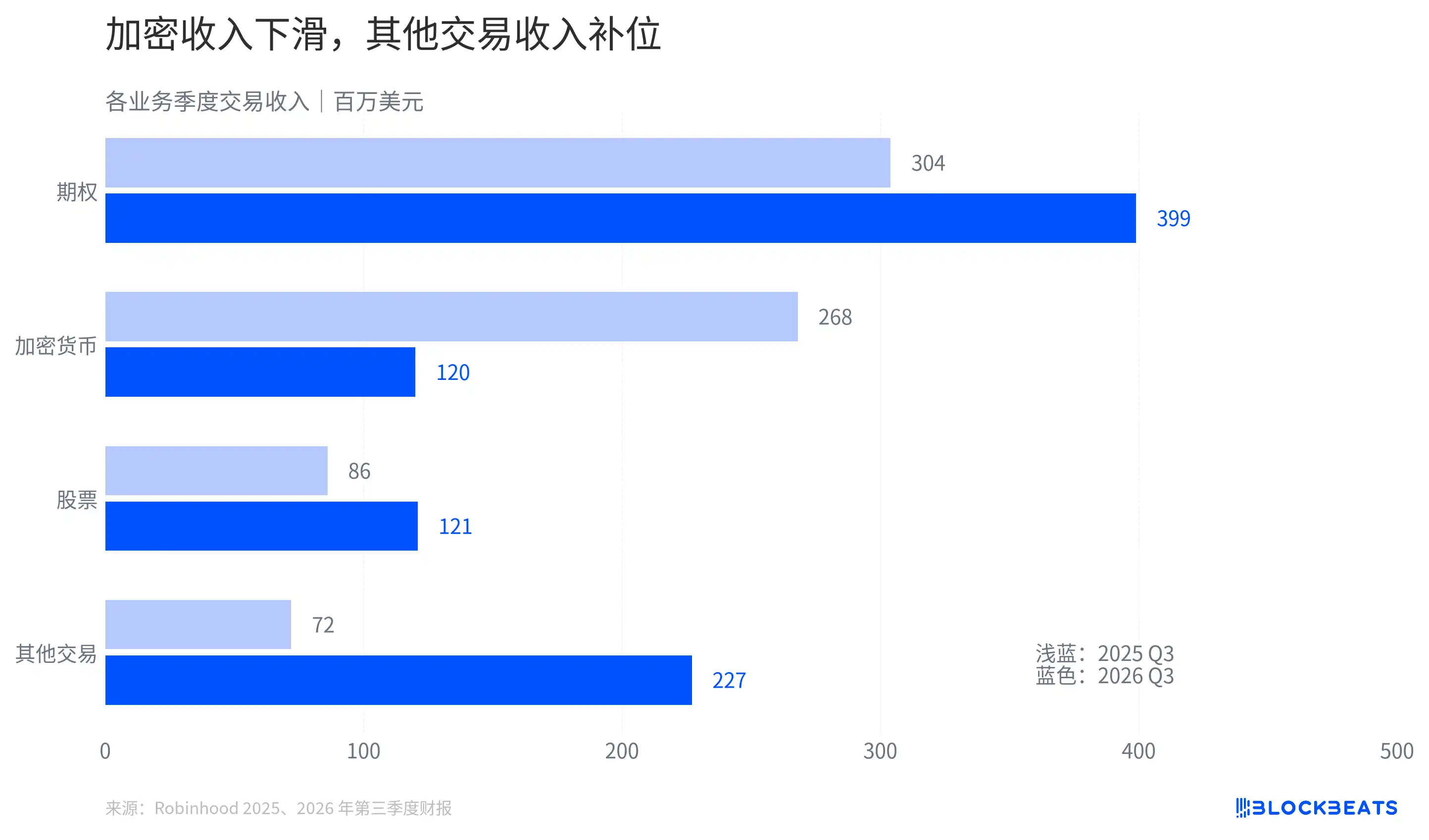
Robinhood trading revenue comparison
The "other trading" line is the balance obtained by subtracting options, equities and cryptocurrency revenue from total trading revenue, and includes event contracts and other trading businesses. It is not equivalent to event contract revenue, nor can all of its increase be attributed to event contracts.
Even so, the changes on both sides are still intuitive when placed together. Calculated from the company's earnings report, crypto revenue fell by $148 million year over year, while other trading revenue increased by $155 million. The increase in the latter roughly covers the shortfall in the former in dollar terms, while growth in options and equities revenue kept overall trading revenue rising.
Options are another pillar on this ledger. Third-quarter options revenue was close to $400 million, ranking first among the listed trading businesses. In other words, the growth of event contracts is eye-catching, but Robinhood's trading revenue is not supported by this new business alone.
The slowdown in crypto trading is also reflected in trading volumes. According to company disclosures, notional crypto trading volume fell 38% year-over-year in the third quarter. This does not mean all revenue declines can be explained by trading volume; trading products, customer mix, and fee structures may also affect the revenue generated per trade.
Why can event contracts surpass crypto trading?
Event contracts let users trade around a specific outcome, such as whether a certain game or event will occur. Contract prices change with the market's judgment of the outcome and are ultimately settled according to the rules. Robinhood's prediction market puts these trades inside a familiar brokerage app.
The monthly metrics disclosed by the company show that each of these contracts has a final settlement value of $1. The number of contracts traded is an activity indicator and cannot be directly treated as the dollar amount users bet, nor can it be directly compared with notional crypto trading volume.
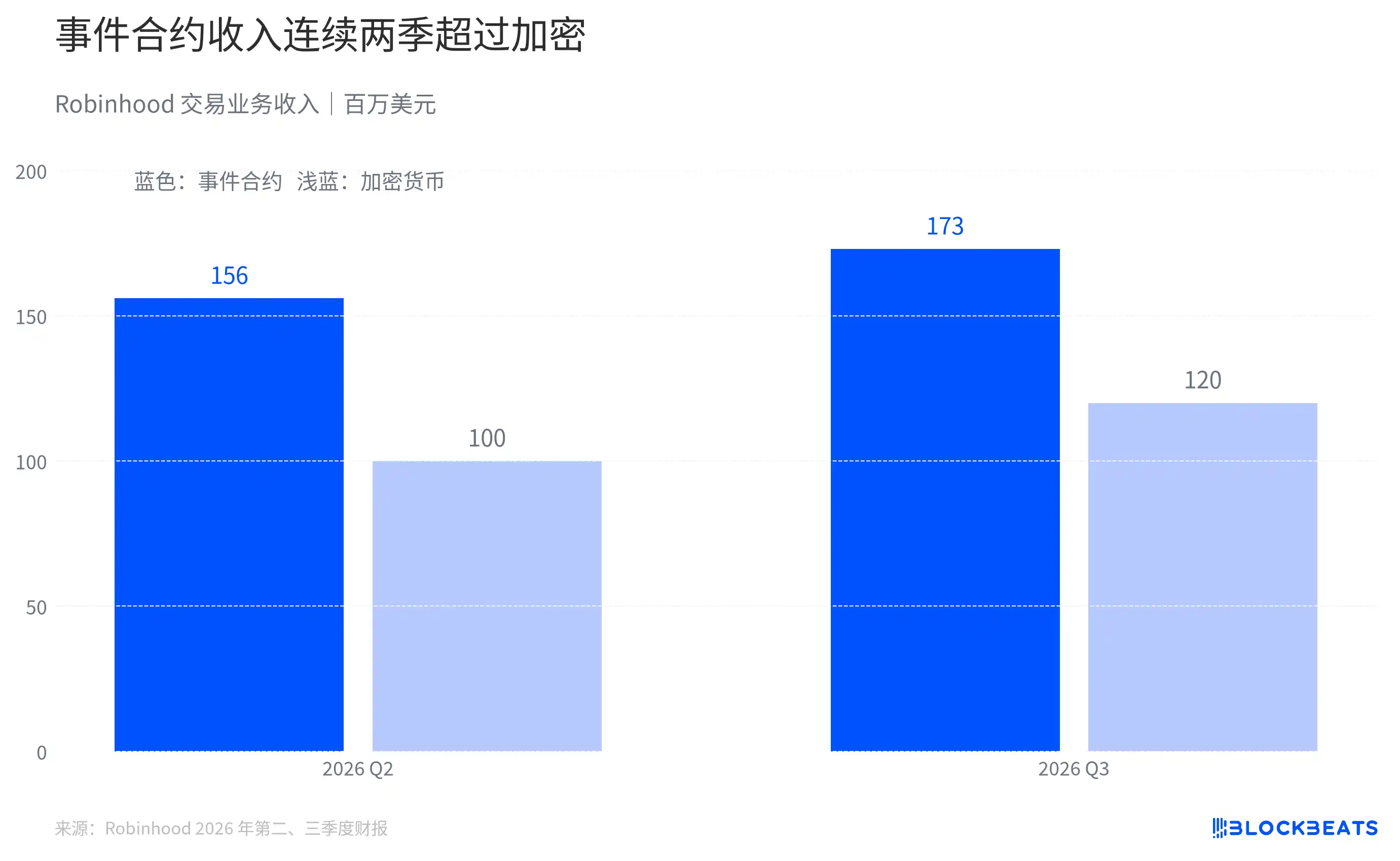
Comparison of event contract and crypto trading revenue
According to the second-quarter earnings report and the third-quarter earnings report, event contract revenue exceeded crypto trading revenue in both quarters. By the third quarter, event contract revenue had grown more than 6x year-over-year.
Trading activity is also expanding. The company said third-quarter event contract trading reached 16.4 billion contracts, compared with 2.3 billion in the same period last year. This counts the number of contracts bought and sold, does not represent the same number of customers, and cannot be equated with company revenue.
This shift shows that Robinhood users' trading interest is not centered only on asset prices. Stocks, options, crypto, and event contracts each have their own trading cycles, and when one market quiets down, another market may still bring trading to the platform.
However, whether event contracts can continue to grow is also affected by product supply and the regulatory environment. In its earnings risk disclosures, Robinhood mentioned that related litigation and regulatory actions could affect the offering of event contracts. Revenue is already showing up in the financial statements, but regulatory risk is also part of this business.
Revenue hits a record high, so why did net profit decline instead?
Beyond the revenue ledger, the income statement presents another picture. Third-quarter total net revenue increased, but net profit fell to $476 million, down 14% year-over-year.
Subtracting the two quarterly income statements line by line shows which changes offset the new revenue.
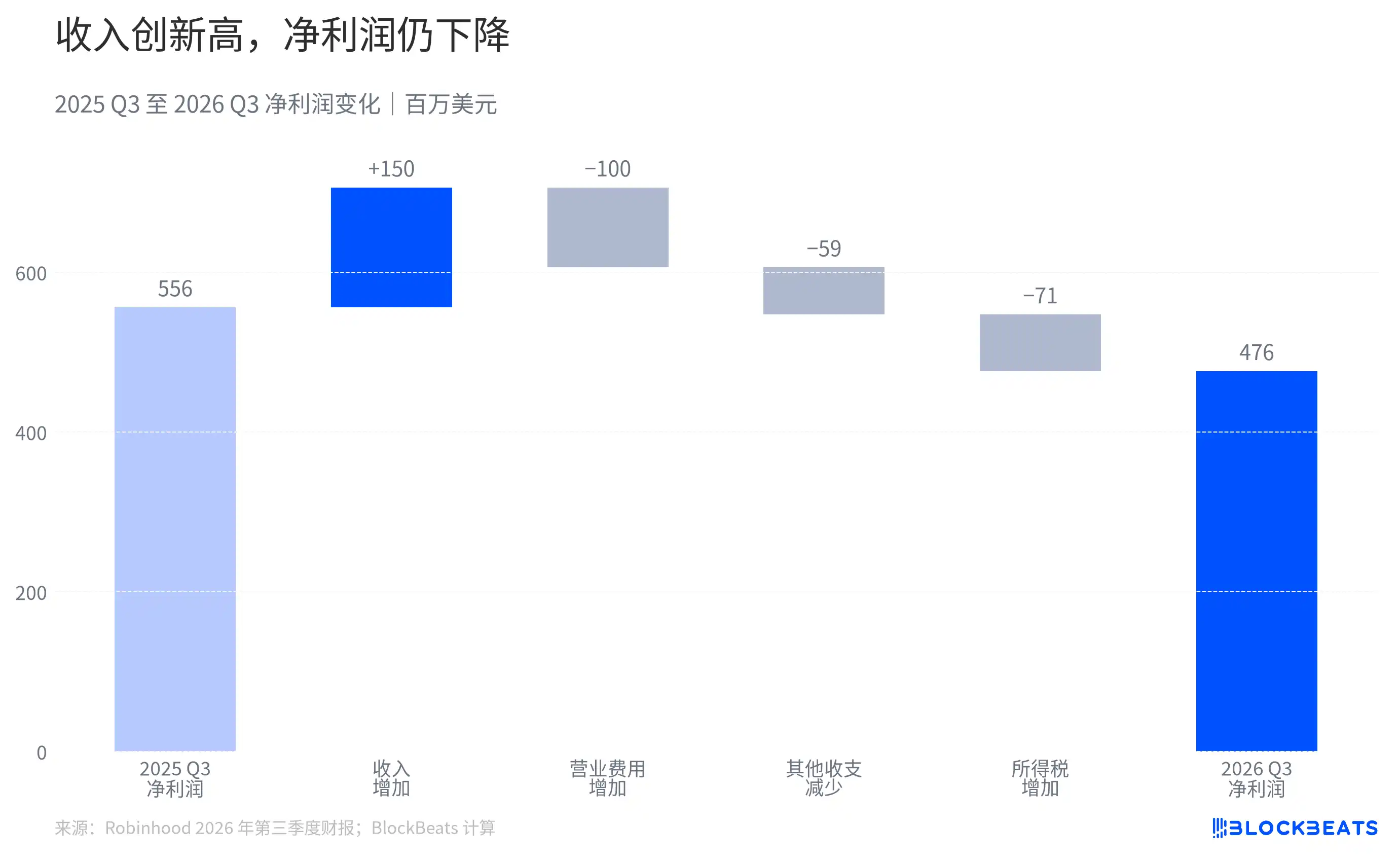
Robinhood Net Profit Year-over-Year Change Breakdown
Higher operating expenses were one factor. According to the company, increased credit loss provisions from the expansion of its credit card lending business, along with Trump accounts, Rothera-related expenses and growth investments, all pushed up operating expenses. These items serve different purposes and should not be lumped together as the cost of a single product.
Another change came from outside operating expenses. Robinhood said third-quarter net profit included $67 million in unrealized losses, mainly related to mark-to-market valuation of Robinhood Ventures Fund I. This affects profit for the period but does not mean the company paid out an equivalent amount of cash in that quarter.
Income tax expense also rose significantly. On the income statement, pre-tax profit edged lower, yet income tax expense climbed from $78 million in the year-ago period to $149 million. The waterfall breakdown in the chart shows the accounting contribution of each item to the change in net profit and cannot on its own prove the reasons behind each tax change.
To present profitability excluding certain items, Robinhood began disclosing adjusted net profit this quarter. That metric fell 3% year over year, a smaller decline than net profit calculated under U.S. generally accepted accounting principles. The two measures use different bases, and the adjusted figure cannot replace the official income statement.
Robinhood's revenue growth this quarter came from a relay of multiple trading businesses. As crypto trading cooled, options and event contracts continued to generate revenue, while investment valuation, expenses and taxes together determined how much profit was ultimately left.
Welcome to join the official BlockBeats community:
Telegram Subscription Group: https://t.me/theblockbeats
Telegram Discussion Group: https://t.me/BlockBeats_App
Official Twitter Account: https://twitter.com/BlockBeatsAsia
 Related Articles