IOSG Ventures: Can Lido continue to dominate the Ethereum staking market?

Original Title: "IOSG Weekly Brief | Can Lido Continue to Dominate the Ethereum Staking Market? #156"
Original Author: Momir
Original Source: IOSG Ventures
Market Opportunities
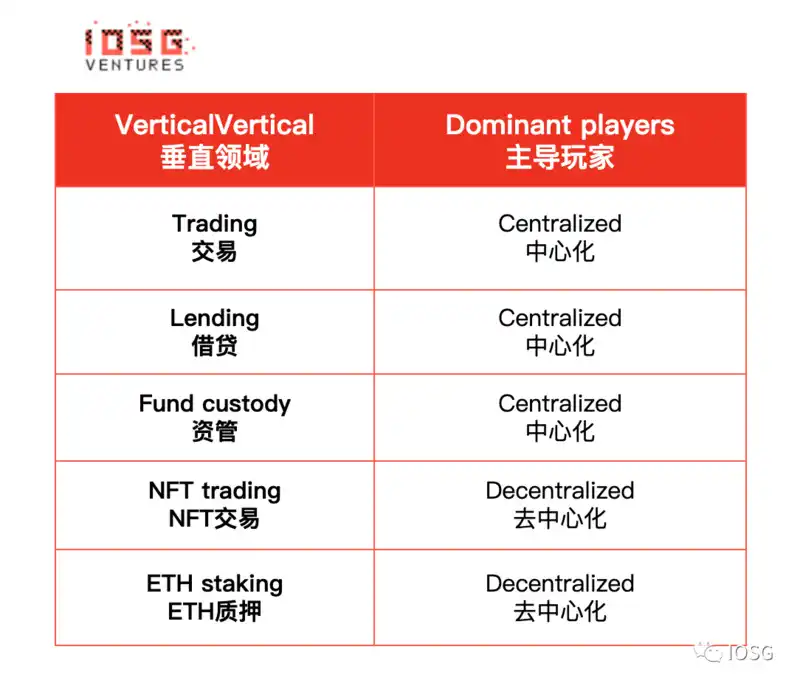
Is liquidity mining a winner-takes-all market?
If centralized trading platforms dominate the ETH staking market, it will go against the goal of building a decentralized network for Ethereum. As shown in the following figure, Lido is the leading project in the ETH staking field, occupying approximately 30% of the market share.
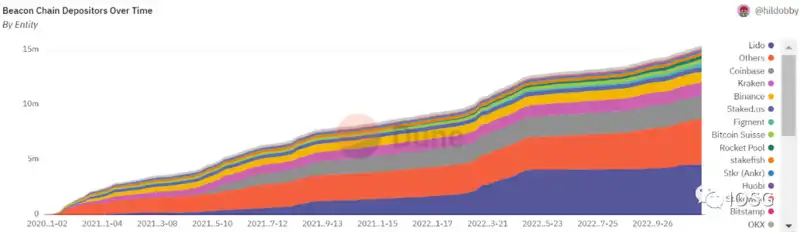
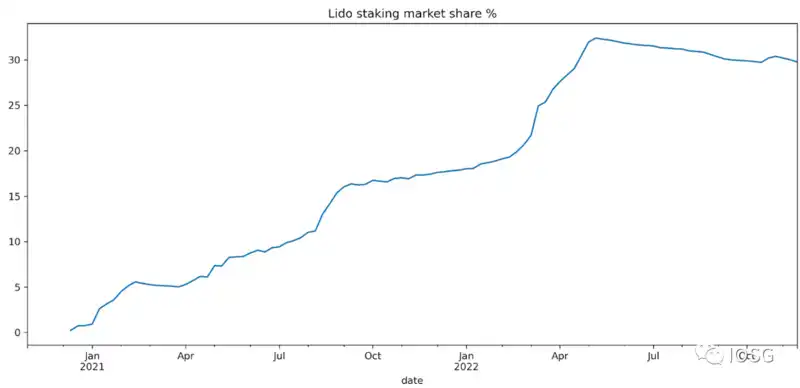
Despite this, there are still some voices in the community that restrict Lido's market share. For example, Vitalik believes that staking projects (both centralized and decentralized) should self-limit the amount of staking they control, and he suggests 15% as their upper threshold.
If there are no ideological (decentralized) concerns, due to liquidity, composability, network effects, specialization, and profit maximization, this may be a winner-takes-all market type.
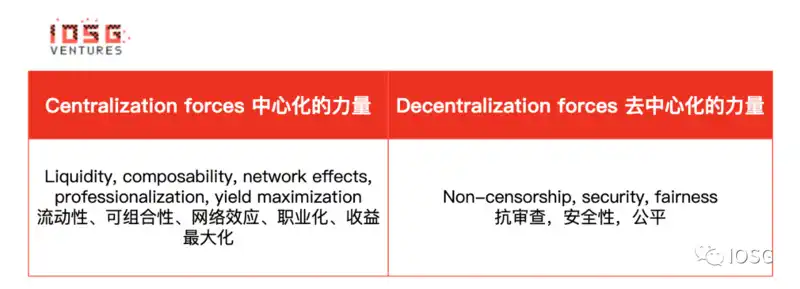
Lido can occupy how much market share?
The main arguments for and against limiting the market share of individual projects are summarized as follows:
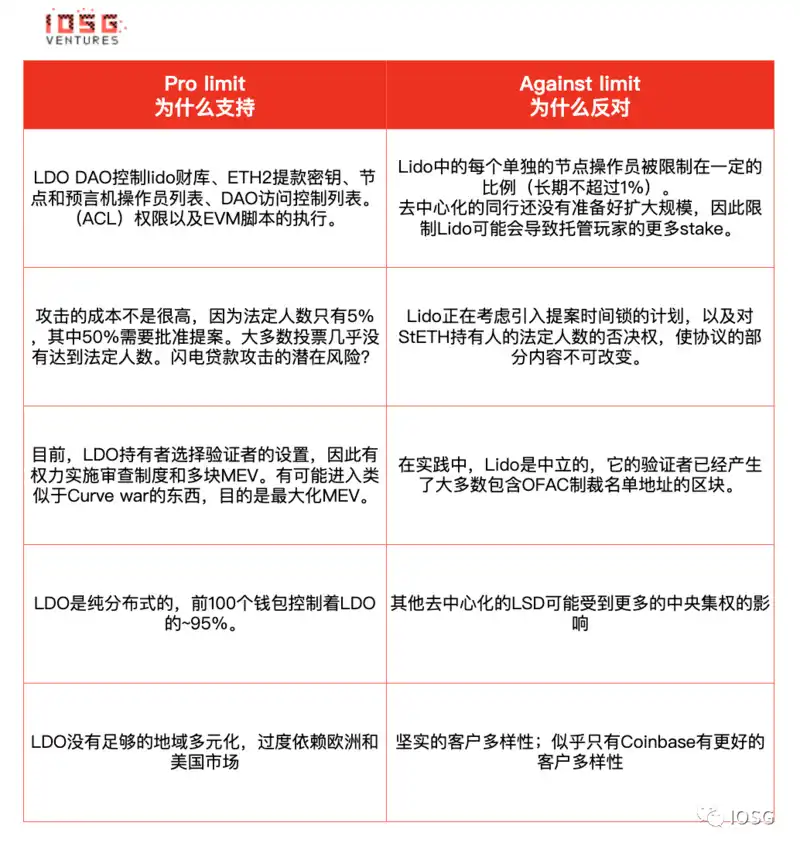
Summary:
1: Lido will not impose any self-restriction measures.
2: IMO believes that the Lido fork is inevitable, but it is difficult to predict how much market share such a fork can capture, which depends on many factors. For example, LDO's governance actions, timing, governance innovations from the fork, and so on.
3: Due to competition from decentralized and centralized players, as well as pressure from the community, it is expected that Lido will be able to capture 50% of the staking market at best.
4: The most realistic situation is that Lido maintains its current market share of approximately 30%. Many Lido depositors choose Lido partly for mining rewards, and there may also be a significant portion of ETH locked in leverage. These two types of users may have priority in withdrawals once the withdrawal function is enabled.
5: Meanwhile, as the withdrawal function is enabled, we also expect new depositors to come in. The reason is that in this case, the trading of ETH LSD (liquidity staking derivatives) should be closer to the anchored value, and concerns about the market liquidity of LSD will also be reduced, as users can convert back to ETH within 27 hours.
Therefore, the withdrawal function will:
- Allow speculators (yield farmers, leveraged users) to withdraw their deposits while increasing overall market confidence and making staking more attractive.
- The dominant LSD solution will lose some advantages compared to other solutions due to the lower opportunity cost of staking.
- CEX may offer products that allow for instant withdrawals (without waiting for 27 hours), which can win over users in terms of convenience.
Using the following formula, we can roughly calculate the market's implied expectations.
*(1/aave_earn * stETH_discount) 365
stETH's current pricing indicates that withdrawals will not be enabled for approximately 460 days.
飞速增长的市场
translates to
Rapidly Growing Market
Among the various POS chains, Ethereum currently has the lowest staking rate. This is likely due to the following reasons:
- Unable to directly pledge at the protocol level, users need to accept additional risks brought by smart contract or custody solutions.
- The pledged Ethereum cannot be redeemed.
- Ethereum is a more mainstream asset with a more decentralized community than any other POS Token, but it is also more focused on speculation from investors such as hedge funds.
With the passage of time, as new smart contracts are tested in practice and the certainty of withdrawals increases, we can expect a larger share of ETH to be staked. However, if more than 50% of ETH is staked, I would be surprised.
The decision-making process for ETH holders is as follows: Should I invest? If so, should I use a validator node pool? If so, should I choose the decentralized version? If so, should I choose Lido?
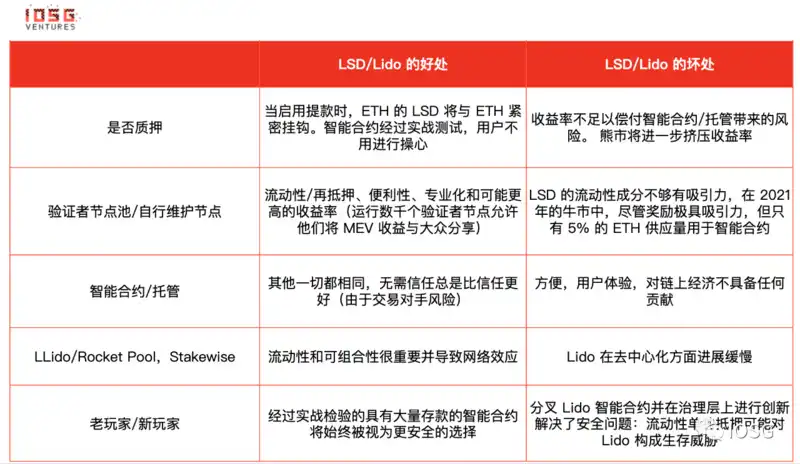
LSD Liquidity Importance
Some people point out that the network effects generated by the integration of the most liquid collateralized derivative, stETH, with major DeFi protocols may allow Lido to win the entire market.
For example, if you want to obtain liquidity collateralized derivatives, you may choose:
With the best market liquidity and convenient exit
The deepest liquidity makes LSD a collateral in many DeFi protocols, providing more use cases for its holders.
More use cases will make this type of Token more liquid.
As mentioned earlier, due to the high opportunity cost, liquidity is even more important at times when withdrawals are currently unavailable.
But overall, how interested are users in participating in re-staking? Or to put it more simply, are users interested in using ETH in on-chain applications?
We have experienced a major bull market driven by DeFi, NFT, and gaming projects, which have distributed a large number of incentives to attract new users. However, despite all these use cases and incentives, only a small portion of ETH is used for smart contracts.
According to Nansen, in October 2021, the usage was approximately 4.5 million wETH (users must Wrap their ETH to participate in on-chain economy), which is less than 4% of the total supply of ETH.
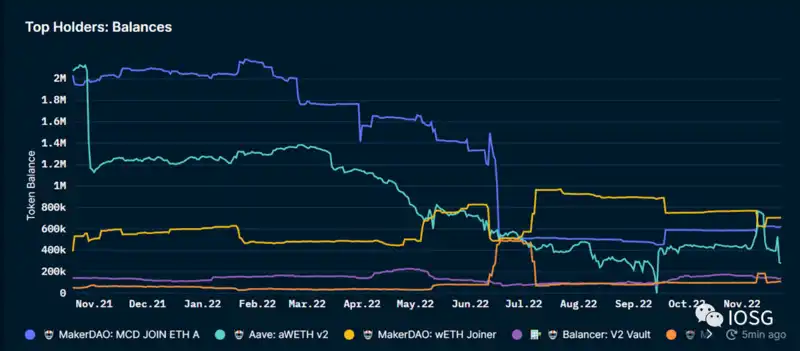
Another thing that is worth mentioning, although not so worrying, is that not all DeFi protocols support rebase Tokens. This is why Lido essentially has two standards: stETH and wrapped stETH (the latter is usually priced higher because it generates rewards that can be unlocked when unwrapped).
The following chart shows that some of the largest DeFi protocols do not support the stETH standard, which is why we can see Wrap's stETH being used in MakerDAO, Balancer, Euler, etc. Although Wrap and Unwrap are not a major obstacle, it does affect the user experience.
On the other hand, most stETH Tokens are on AAVE and Curve.fi.
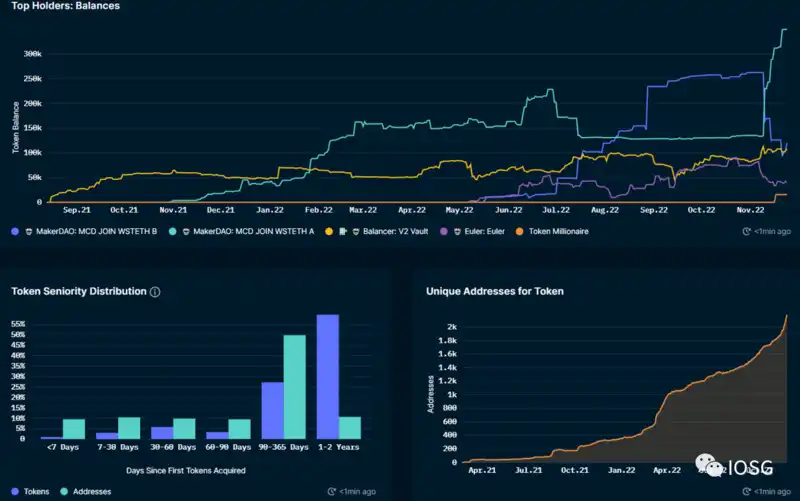
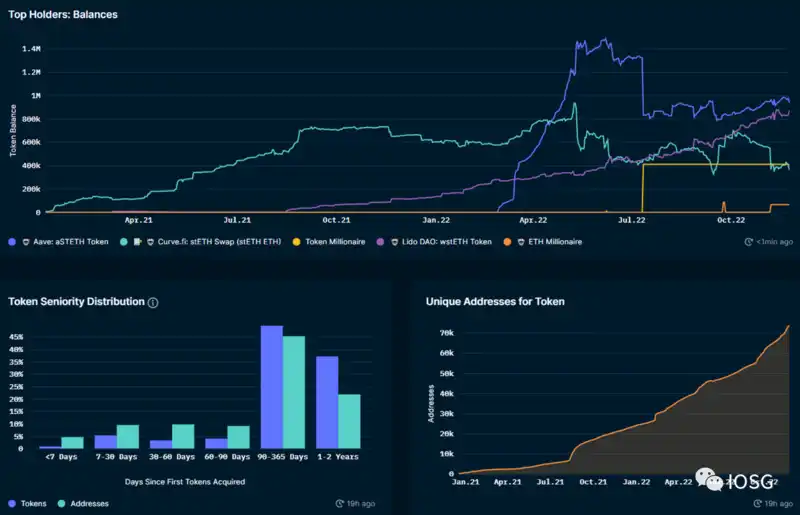
Using stETH
LDO vs ETH
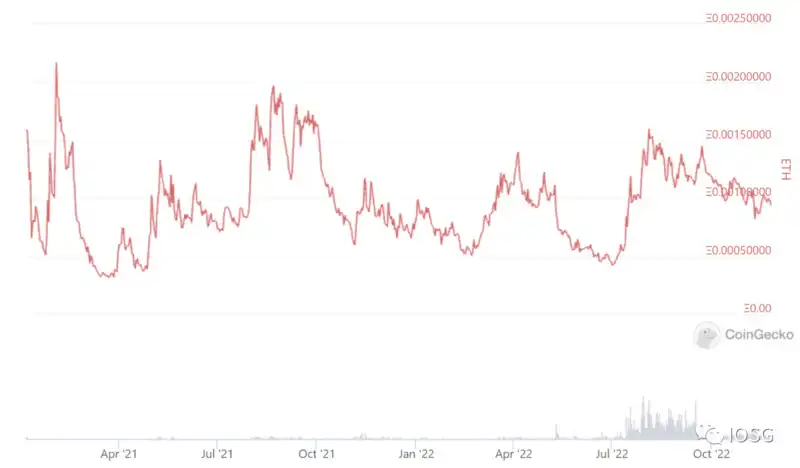
To a large extent, LDO prices are influenced by Ethereum activity and ETH prices.
Ethereum is the target market for Lido. Over 99% of Lido's locked assets are on Ethereum.
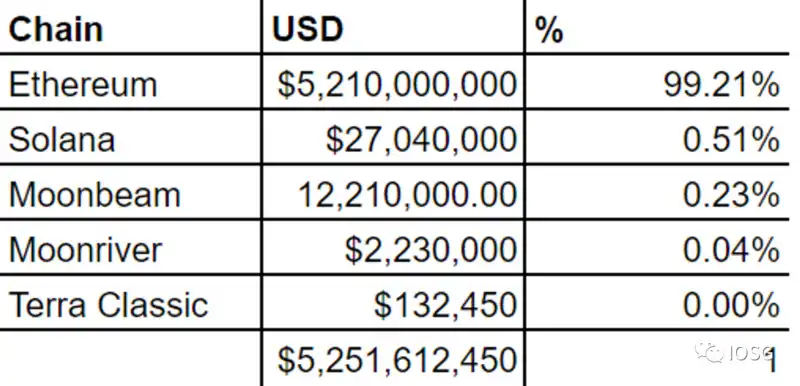
Lido's fees come from Ethereum's inflation rewards and transaction fees (Priority Fees).
Lido revenue equals 5% of the total staking rewards collected on Lido (90% allocated to stETH providers and 5% allocated to node operators).
Ethereum allocates 1700 ETH as a staking reward every day (approximately 0.5% of the ETH supply), of which approximately 30% goes to Lido (assuming other conditions are the same based on their market share).
Although Lido is highly dependent on the fundamentals of Ethereum, we can see that even with ETH supporting its value, Lido has experienced significant fluctuations. This may be due to the market re-evaluating Lido's position in the Ethereum ecosystem and estimating the market size of the LSD vertical market.
Ethereum Inflation Rewards
Due to the fact that ETH inflation typically accounts for a large portion of Lido's revenue, it is important to understand its dynamics.
Using data points from https://ultrasound.money/, we estimate that TVL has increased by 1%, and the base reward APY has decreased by 0.41%.
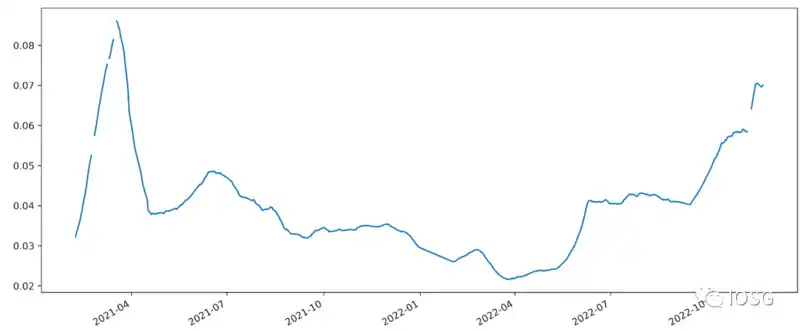
Lido 30-day staking reward APY %
对标竞争对手
translates to
Competitive Benchmarking
Quantitative comparison: In order to have a more mature competitor as a benchmark, we also added MakerDAO to the table, because LSD is essentially most similar to synthetic assets, among which stETH is a synthetic asset. If one day Lido decides to support the minting of synthetic stablecoins backed by staked ETH, I would not be surprised.
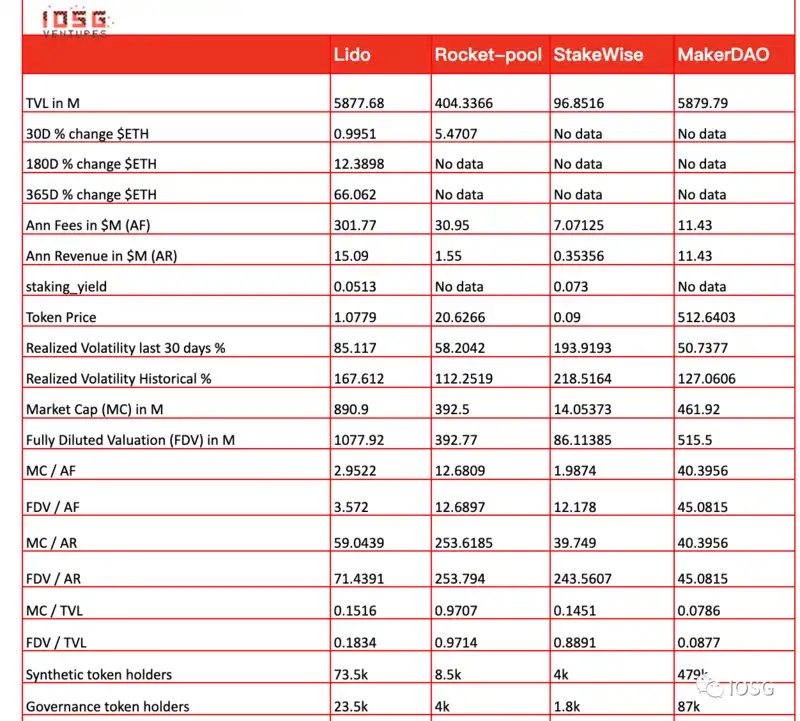
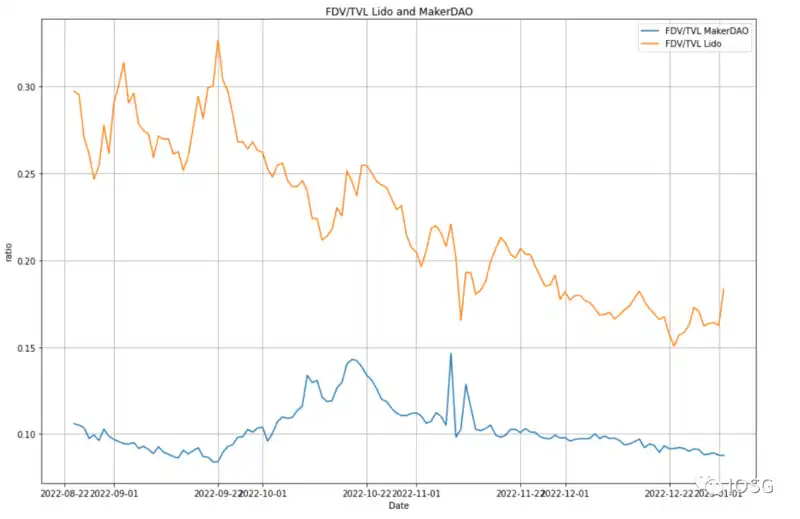
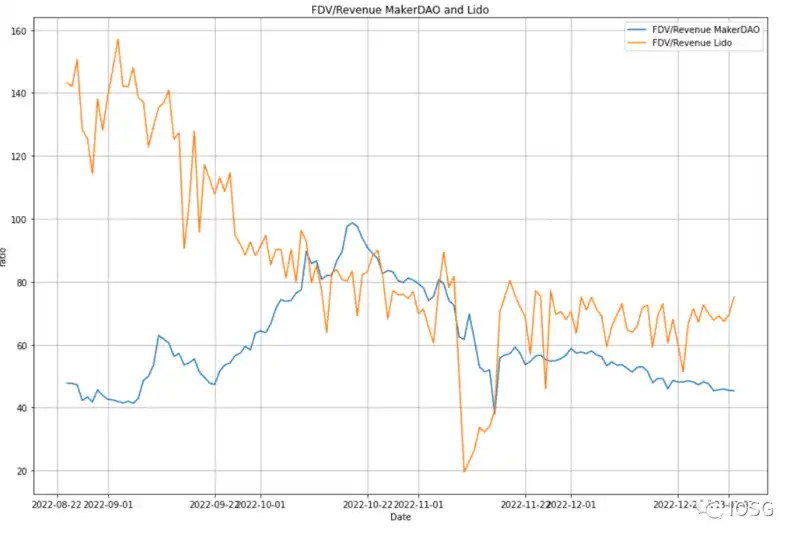
Token Health (Behavioral Finance/Market Psychology)
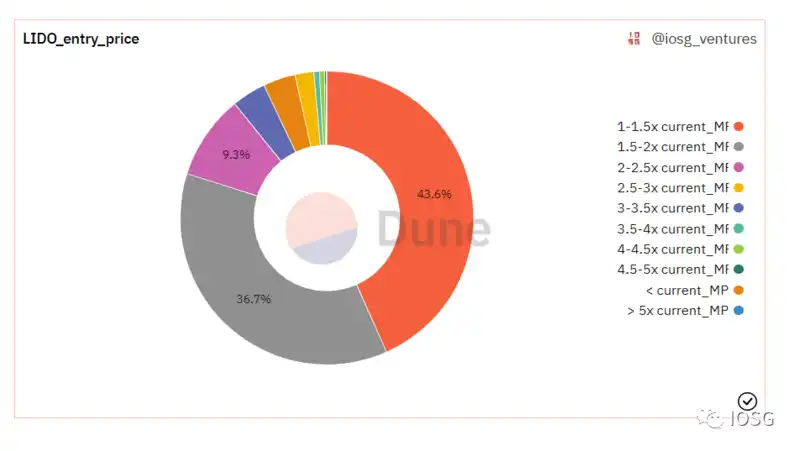
Attention: This data lacks insights into the usage of LDO Token on centralized trading platforms.
How to interpret these data?
Honest answer: I don't know.
Possible intuition - disposition effect refers to the phenomenon where investors tend to sell profitable tokens too early and hold onto losing tokens for the long term.
Directional Comparison
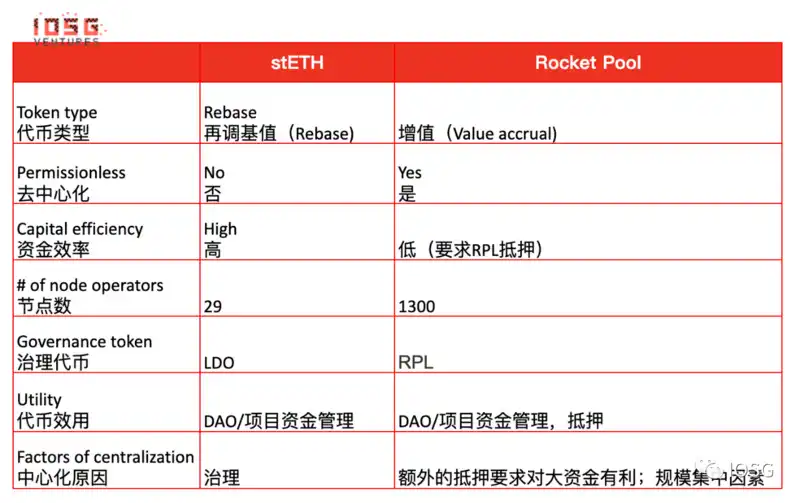
Summary
We estimate that the pledged ETH will account for up to 50% of the total ETH.
Due to challenges from the community and the emergence of competitors, we reasonably estimate that the market share of Lido's liquidity staking will be around 35%.
After the open flow withdrawal at Lido, we estimate that leveraged traders and mining participants will withdraw ETH, although the withdrawal should create an environment that boosts staking interest. Smooth withdrawals will also reduce the value proposition of LSD.
Open withdrawals may occur one year from now.
Lido Advantage
ETH liquidity staking is the top project, with first-mover advantage and a solid moat.
Compared to competitors, Lido has security, liquidity, composability, network effects, and professional/efficiency advantages. Lido is likely to maintain its position as the main decentralized liquidity staking platform.
There has never been a record of censorship.
Public and transparent roadmap, records of implementation and development according to the roadmap.
Lido Disadvantages
If Lido does not introduce certain restrictions, the cost of governance attacks will not be high.
There is a risk of manipulating the reward sharing mechanism in the LDO Token war by validators who pass the participation.
LDO Token is not decentralized enough.
The prolonged bear market will lead to low staking yields and a small portion of staked ETH.
The significance of liquidity may be overestimated: many ETH holders are simply not interested in re-mortgaging and using on-chain assets; once withdrawals are enabled, LSD will lose some of its value proposition.
Lido fork is inevitable, and it is currently uncertain how big the threat is.
The target market size of Lido is largely determined by the market value of ETH. Lido indirectly bets on ETH, however, on a risk-adjusted basis, ETH may be a better investment choice than Lido.
Original article link
Welcome to join the official BlockBeats community:
Telegram Subscription Group: https://t.me/theblockbeats
Telegram Discussion Group: https://t.me/BlockBeats_App
Official Twitter Account: https://twitter.com/BlockBeatsAsia

 Related Articles