IOSG: Why is the decentralized staking protocol an important piece of the puzzle for Eth2.0?

Original title: "IOSG Weekly Brief | Why decentralized staking protocols are an important piece of the ETH2.0 puzzle #112"
Original source: IOSG
1 How big is the Ethereum 2.0 staking market?
1.1 Ethereum Market Cap Forecast
Here we estimate the future changes in Ethereum market cap based on Ethereum market cap performance over the past four years:
ETH Related data sources: Coingeckco, CMC
Here are two historical data that will serve as the basis for future predictions:
The CAGR of Ethereum market cap from 2017 to 2021 is 55.64%, and Ethereum market cap will continue to grow at this rate in the future
The average inflation rate of Ethereum Token from 2017 to 2021 is 7.65%, and it is expected that the inflation rate of Ethereum will decrease year by year in the future, and will drop to 2% in 2025
1.2 ETH2.0 Staking market size forecast
Based on historical data, we predict the future market value of Ethereum and the growth of Ethereum's staking rate. We can see that the service market size of Staking third-party services will reach 2.3 billion to 4.6 billion US dollars in 2025.
(Note: JP Morgan previously predicted that ETH2 staking will reach 40 billion US dollars in 2025, which is the income of the entire network. If multiplied by the average handling fee of third-party service providers of 10%, it is also nearly 4 billion US dollars https://cointelegraph.com/news/jpmorgan-report-eth2-could-kick-start-40b-staking-industry-by-2025)

(Note: The number of ETH2.0 staked tokens is estimated based on the annual growth rate of 1.27x based on historical data; third-party StaaS service providers currently account for about 50%, so the actual third-party Staking service market size in 2025 is estimated to be 2.3 billion to 4.6 billion US dollars)
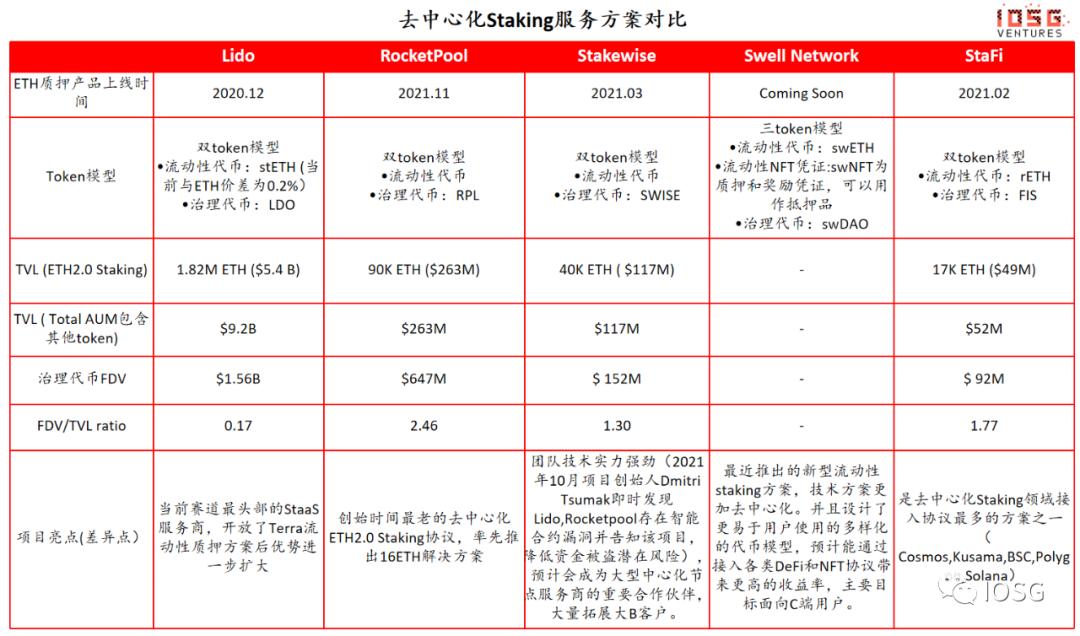
2 Comparison of decentralized staking service providers
The staking service market is roughly divided into two types of service providers: centralized StaaS service providers (such as Infstone, Staked, etc. and the staking services launched by major centralized trading platforms such as Binance and Kraken), and decentralized StaaS service providers (such as Lido, Stakewise, Rocketpool, Swell Network, etc.).
Decentralized service providers can be further divided into: permission validator (Lido) and permissionless validator (Rocket Pool, Swell Network).

Source: https://beaconcha.in/validator/217392
Rocket Pool halved the node’s 32ETH stake to 16ETH within two months of its launch
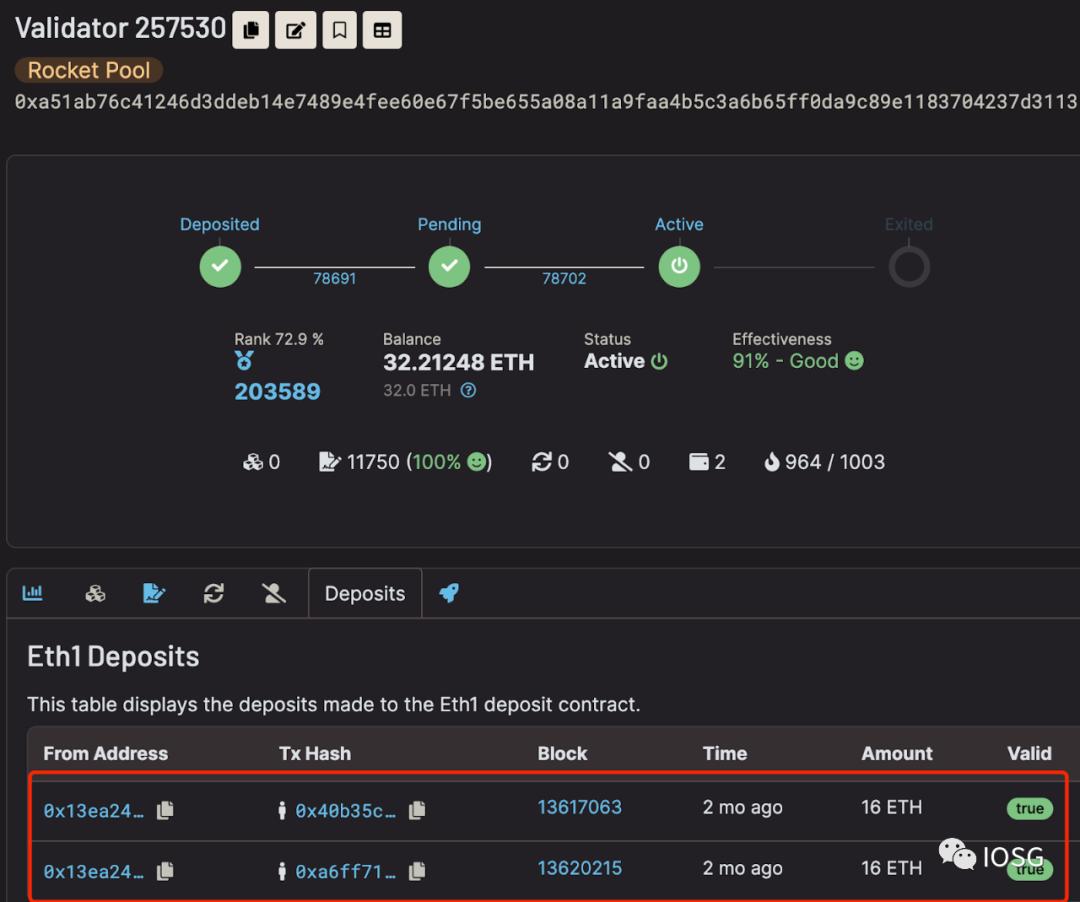
Source: https://beaconcha.in/validator/257530
The first version of the soon-to-be-launched Swell Network successfully achieved full non-custody and reduced the node’s 32ETH stake to 1ETH through atomic transactions.
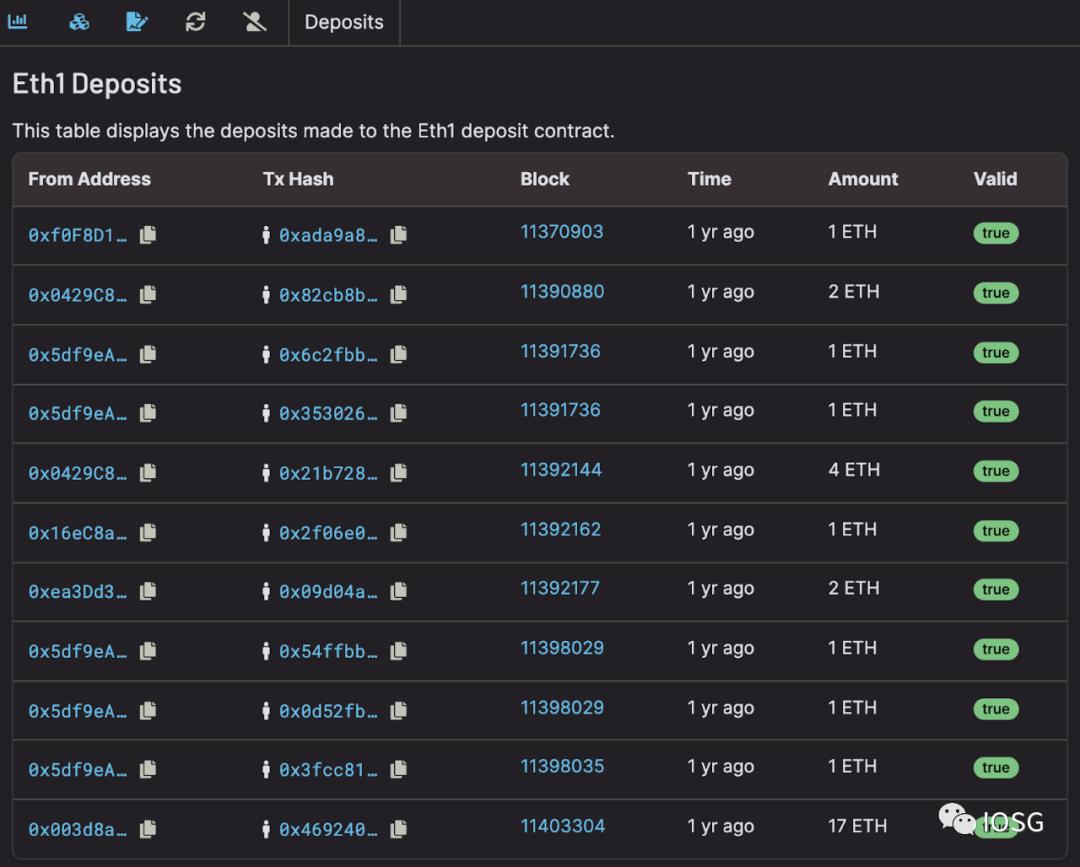
Source: https://beaconcha.in/
Among staking service providers, we believe that decentralized solutions have greater market growth space and application scenario growth potential. The main reasons are: 1. Most centralized service providers are restricted by compliance requirements and cannot promote liquidity tokens. 2. The liquidity solutions promoted by decentralized service providers can be applied to DeFi, NFT and other scenarios, which greatly solves the pain points of a large number of users for liquidity.
3 Opportunities
3.1 A large number of small user markets have not been liberated
On the one hand, from the perspective of market participation, although the number of ETH stakes has grown well in the past year, less than 10% of ETH is currently involved in ETH2.0 staking, which still has huge room for growth from the 50% staking rate of the entire network.
On the other hand, when we observe the current market structure of staking service providers, we can find that nearly 40% of ETH is staked in non-third-party service provider nodes (most of which may be operated by individuals), indicating that there is still huge room for growth in liquidity staking solutions. As the combination of liquidity staking and DeFi applications becomes more mature, we believe that more small users will flow into the liquidity staking market.
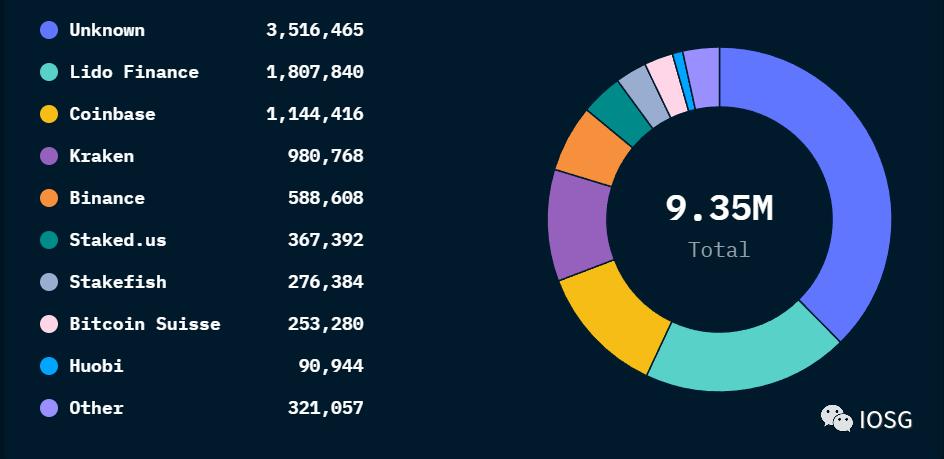
Source: https://pro.nansen.ai/eth2-deposit-contract
3.2 The Token mechanism is designed to be fully integrated with DeFi and NFT markets
The most prominent problem at this stage is that the business scope of pledged tokens needs to be expanded. Lido's stETH is temporarily ahead of other competitors in this ecological expansion. At present, the AUM of the stETH/ETH pool on Curve.fi has reached 3.5 billion US dollars, and MakerDAO and AAVE also use stETH as collateral for lending. However, there are still a large number of application scenarios worth exploring for C-end users. For example, Swell Network recently launched an innovative product that makes the assets deposited by users into NFT certificates, further opening up more interesting products such as NFT lending to bring more attractive yields.
3.3 Security Upgrade
In terms of staking business security, major staking projects are stepping up cooperation.
In terms of smart contract security, in October 2021, the founder of Stakewise acted as a white hat and discovered that there were security vulnerabilities in the smart contracts of Lido and Rocket Pool that allowed malicious staking nodes to withdraw part of the funds from the fund pool (see: https://medium.com/immunefi/rocketpool-lido-frontrunning-bug-fix-postmortem-e701f26d7971).
In terms of underlying infrastructure, major staking protocols are also stepping up cooperation with the SSV technology development team (Obol Network and SSV Network) to make ETH2.0's validator nodes more decentralized and more secure.
In general, regarding the staking market, we believe that:
1. The entire third-party staking service market will still have a market size growth of at least 3-4 times in the next 1-2 years
2. Decentralized staking service providers will have better growth opportunities, and they will also be differentiated into those that are more inclined to the B-end (such as: Stakewise) and those that are more inclined to the C-end (such as: RocketPool, Swell Network)
3. The space for the C-end market has not yet been opened up. The application of liquid tokens in more defi and NFT protocols and higher returns are the key to attracting small users. In this regard, we are currently more optimistic about solutions such as Swell Network
Original link
Welcome to join the official BlockBeats community:
Telegram Subscription Group: https://t.me/theblockbeats
Telegram Discussion Group: https://t.me/BlockBeats_App
Official Twitter Account: https://twitter.com/BlockBeatsAsia