Next time out: Web3 products need to be easy for the "average person" to get started
Original title: "Before the next Round: Web3 Products Need to be easy for 'ordinary' people to get Started"
Original article author: 0xjordy
Bai Ze Research Institute
You're watching Super Bowl 2022, and for the first time ever, you're seeing a Super Bowl AD from a crypto company.

The Los Angeles Lakers and Los Angeles Clippers, both professional NBA basketball teams, host Crypto_com Arena.

The cryptocurrency and NFT craze is finally breaking into the mainstream. With the rapid growth of the Web3 industry, the public is more aware of cryptocurrencies and blockchains than ever before.
But the industry faces a huge barrier to entry problem.
In the Web3 industry, we hear a lot about getting a billion users on board, but many might argue that the current Web3 infrastructure can't do that. Moreover, there are too many barriers to entry for ordinary consumers.
As stated in VISA's 2021 report, The Cryptocurrency Phenomenon: Consumer Attitudes and Usage:
"55% of non-crypto users cite the steep learning curve as the reason they haven't invested in cryptocurrencies."
In In Gemini's 2022 State of Encryption report, they identified education as the biggest barrier to entry into the crypto industry:
"Globally, respondents are nearly twice as likely to say that more educational resources about cryptocurrencies would help them start using cryptocurrencies ( 40% ) as to recommend them by a friend ( 22% ). More than half of respondents in Latin America (51% ) and Africa (56% ) said educational resources would make them more willing to buy cryptocurrencies. 44% of respondents in Asia and 42% in the United States said the same."
The huge barriers to cryptocurrency adoption lead me to believe that crypto products that extract complexity from blockchain technology and help new users more easily enter Web3 are the future.
This could include simplifying the wallet registration process, using the familiar Web2 login method, high-quality or code-free developer tools, interoperable layers, and blockchain infrastructure solutions that can lay the foundation for a seamless user experience. And centralized cryptocurrency trading platforms can also help aggregate complex utilities in one place into "super apps."
Here is a non-exhaustive list of some notable players in each of the verticals mentioned:
- Simple Wallet starter: Cupcake Protocol, Moonpay Hypermint, Paper.xyz
- Web2 login method: Web3auth, Crossmint, Moonpay, Reddit avatars, NBA Top Shot
- High quality/no code development tools: NiftyKit, ThirdWeb, Bueno
- Interoperability layer: Cosmos, Polkadot, Wormhole, LayerZero, Axelar
- Infrastructure solutions: Blockdaemon, Quicknode, Chainstack, Nodereal
- Trading platform/" Super App ": Coinbase, Binance, Blockbank, Mara, Trader Joe
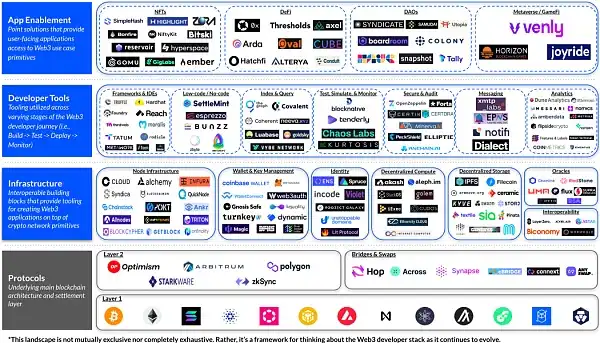
A broad overview of the current Web3 landscape -- Source: Coinbase
Reddit and Dapper Labs are good examples of using the Web2 login method (using only a username and password) to simplify the process of getting users to Web3.
In just four months, Reddit managed to become one of the largest NFT marketplaces in the world, attracting tens of thousands of new users to NFT. Most Reddit users don't even realize they're buying NFT with an encrypted wallet. Reddit replaces the crypto terms "NFT" and "wallet" with "digital collectibles" and "vault," and enables users to easily store their digital collectibles without memorizing mnemonics or having encryption knowledge.
Dapper Labs & Flow has had great success in the NFT with the NBA's Top Shot.
What are their advantages?
That is to give users access to high quality IP digital collections using an easier Web2 login.
This unique combination has generated a lot of interest from users, has low barriers to entry, and allows users to participate in the world of Web3 and cryptocurrencies using login methods that are familiar to all. If Reddit or Dapper Labs require users to set up their own encrypted wallets and manage their private keys, this could prevent user growth and lead to more complicated usage processes and security vulnerabilities.
We are also now starting to see startups staking their flag in the Web3 space by providing Web3 infrastructure solutions, gaining significant traction due to the value they provide to the rest of the Web3 industry in terms of node /RPC support. In layman's terms, this means they help Web3 decentralized products connect to the blockchain and let users run smoothly (Dapps, wallets, blockchain games). Node /RPC infrastructure providers can be thought of as opening up more lanes on the highway as well as exit points, thus providing easier traffic flow for those using the highway. Blockdaemon, Quicknode, Chainstack and Nodereal are some of the well-known companies that have contributed to this.
Nodereal is a notable player because they help Web2 companies and game studios build products on blockchain, providing customized app chains and other Web3 solutions for companies that may not be able to build on blockchain alone. One of the company's most important clients is Netmarble, the number one mobile game studio in South Korea. Netmarble has partnered with Nodereal to develop FNCY, a game app chain, which will become Netmarble's own blockchain game platform.
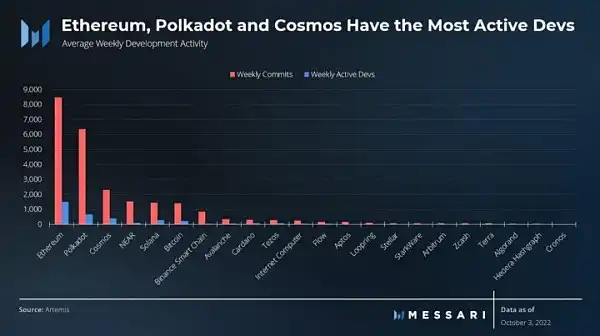
In terms of interoperability technology, as the Web3 ecosystem evolves and more blockchains are involved, we are seeing more interaction between the various actors, which makes the user experience more complex. Therefore, interoperability solutions are necessary. Currently, according to Messari, the two leading players in blockchain interoperability. Polkadot and Cosmos lead developer activity under Ethereum.
Innovation and products in the Web3 space have matured, but there is still a need to build a relaxed, simple infrastructure and focus on great UI/UX, all of which are very necessary priorities to drive adoption in the industry.
Web3 VC Wind
In the current bear market and gloomy macroeconomic environment, we are seeing less money in the Web3 space overall, with Crypto investments down 50% in the third quarter compared to the second quarter, according to Fortune Crypto. . Investment from the second half of 2022 to the first half of 2022 fell by more than 77 percent. Most of the money raised has gone to Web3 startups focused on user adoption and payment infrastructure and developer tools.
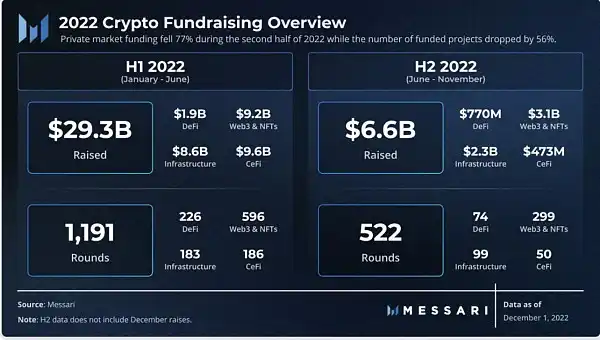
We're even now seeing a giant like BNB Chain launch a $10 million program for startups focused on growing active users and increasing user adoption. In the meantime, Coinbase Ventures gave their outlook on today's market:
"Coinbase Ventures made nine investments in the fourth quarter, the lowest quarterly total since the second quarter of 2020. In this slowing market environment, we took the opportunity to narrow our near-term focus areas. We also doubled down on our support for our existing portfolio companies."
In terms of payment infrastructure, we've seen some growth in the last few months. Ramp was raised in early November 2022 by A $70 million Series B round led by Mubadala Capital and Korelya Capital. Ramp provides a frictionless payment infrastructure designed to allow users in low-income areas to use more local payment methods to move in and out of cryptocurrencies. Ramp is working to help more people around the world, especially in Latin America and Asia, gain easy access to cryptocurrencies.
In addition to Ramp, we also see Sardines providing a payment infrastructure for real-time fraud prevention. Raised a $51.5 million Series B round led by a16z in late September.
We've also seen recent funding from tool-focused companies Stardust and Thirdweb. In late August 2022, Thirdweb raised $24 million in A Series A funding round led by Haun Ventures. Thirdweb has built a developer toolkit that makes it easy for startups to launch almost any type of platform in Web3.
Stardust, A company focused on blockchain game development tools, recently raised a $30 million Series A funding round led by Framework Ventures.
As for cryptocurrency ventures, CoinFund is hoping to raise $250 million for its new seed fund. BlockTower successfully raised $150 million to focus on investing in interoperability, credit and payments in Web3.
Longhash Ventures Ready to deploy $100 million in its Fund II to invest in Web3 infrastructure:
"Over the next five years, [Longhash Ventures] wants to double down on projects that deliver scaling solutions, cross-chain systems, and other tools that impact gaming, NFT, metacomes, and more."
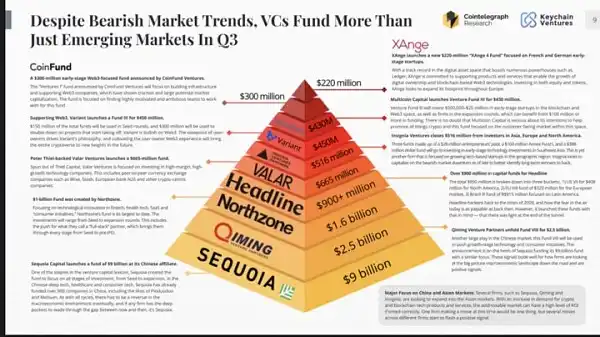
Even with the poor market conditions in the third quarter, we saw venture capital firms launch large funds focused on cryptocurrencies and Web3 startups. According to Ten venture capital firms have launched funds ranging from $220 million to $9 billion, the latter being Sequoia Capital, according to Cointelegraph Research.
Funding gaps that need to be filled
The funding gap to be filled is consumer-focused Web3 startups, but more specifically, infrastructure that allows users to easily and seamlessly enter Web3.
Venture capital is currently focused on developer infrastructure and tools, but if we want to achieve mass adoption, we also need to invest in how to do it effectively for consumers. Infrastructure is getting a lot of money, taking 20.1% of all cryptocurrency VC deals in the third quarter of 2022. .

Fundamentally, other gaps in the market that need to be filled are the consequences of the overhiring and rapid expansion that occurred during the recent cryptocurrency bull market, followed by the rapid contraction that has occurred during the current bear market cycle. Many echoes of hacks, ecosystem crashes (such as Terra/UST), trading platform bankruptcies (such as those experienced by FTX) are still present in the Web3 ecosystem even today.
Going into 2023, I believe project founders and crypto companies will place a greater emphasis on building secure, high-quality products with a focus on gaining real user, revenue traction. For founders who are currently considering raising money, there is traction, both in terms of actual revenue and actual users, that will set your company apart. This traction indicates that there is a demand for your product or service and shows the true value your company can provide to the market.
An interesting example of this is Pudgy Penguins, which have gained popularity by using Web2 platforms (e.g. Instagram is doubling down on cultural penetration by spreading well-made GIFs and ramping up brand exposure at full speed. What makes the marketing strategy unique is that the Web3 brand is trying to reach out culturally directly to non-encrypted users through viral Instagram posts and GIFs (Pudgy Penguin NFT is not a requirement to participate) that anyone can view, share and use.
At the time of writing, Pudgy Penguins have amassed 237 on Instagram. 000 followers, as well as. One billion GIF views.
A start-up that lets users easily get started with Web3
The following four startups are new players in the space, focusing on building seamless and breaking down barriers to entry for consumers.
One of the most innovative use cases for wallet creation is linking physical goods to digital assets through the Cupcake Protocol. Custom NFC tags for physical goods, coupled with Web3 mechanisms such as token drops and wallet creation, bring the physical world into Web3.
Next to any physical item with Cupcake's NFC label, users simply tap on their phone and enter their phone number to instantly cast their first NFT on their new encrypted wallet. (You don't need an encrypted wallet or any encryption knowledge to participate in this experience). Within seconds, Web3 is accessible to anyone with a smartphone. The possibilities are endless, as Cupcakes can be used as a powerful tool for any brand to adopt Web3 technology.
Another notable startup in the Web3 entry space is Web3Auth, formerly known as Torus Wallet. Web3Auth Raised $13 million in A Series A funding round led by Sequoia Capital, Union Square Ventures and Multicoin.
Web3Auth is building a very critical wallet that allows users to use all the cool applications, and it removes the complexity of the private key by letting users log in using a method they're familiar with. All they need is an email address and password, making the login process familiar, simple, and easy for anyone to understand.
Using the Web2 login method also makes it more secure, because Web3Auth users won't use their valuable private keys for insecure operations, such as taking screenshots of them into albums, or keeping their private keys in keylogs for convenience, where they can be stolen by bad actors.
Decaf is building a full-featured point-of-sale platform to help merchants accept crypto payments in USDC or Bitcoin. Decaf There is also an NFT gating feature that allows merchants to airdrop NFTS for customers, with perks for holding them. They are also fully integrated with Block (formerly Square), a payments company, to make it easier for merchants to manage inventory and manage taxes. Decaf also has a one-click wallet creation feature similar to the Cupcake Protocol.
Bueno is NFT Artists and Creators offers a code-free development kit. Users can create their own customized smart contracts. Bueno has also created Microverse, a toolkit for the NFT community to build their own 2D virtual worlds.
summarize
Overall, there is a great need for infrastructure in the Web3 space to help more users easily enter Web3 and gain mass adoption. It's important for founders and funds to allocate resources now to build a solid foundation focused on making it easier for users to use. The focus should be on generating revenue or getting real users, or at least strong plans. This way, when the next bull market in cryptocurrencies and global macroeconomics arrives, and the world's attention turns again to Web3, the entire industry will be ready to attract millions or even tens of millions of users with lower barriers to entry.
Original link
Welcome to join the official BlockBeats community:
Telegram Subscription Group: https://t.me/theblockbeats
Telegram Discussion Group: https://t.me/BlockBeats_App
Official Twitter Account: https://twitter.com/BlockBeatsAsia
 Related Articles