Besides Shibuya, which is invested by Terry Tsai, what other Web3 creator economies are worth paying attention to?
Original Title: "Exploration of Creator Economy 4.0"
Original Author: PingFeng (@byobu4)
In early 2022, I first came across the concept of Creator Economy 4.0 through episode 10 of the CSS Podcast, "Co-creating the 'Owner Economy' - LiJin".
Li Jin describes the evolution of the creator economy in four different stages. Here are brief descriptions of each stage:
Creator Economy 1.0: With the birth of the Internet, individuals can become creators.
Creator Economy 2.0: Creators leverage their influence on platforms to generate revenue through advertising and brand sponsorships.
Creator Economy 3.0: Creators become independent businesses and directly profit from their fans. Main topics include: Passion Economy, building a creator middle class, 100 true fans, and the role of cryptocurrency.
Creator Economy 4.0: Creators and their fans collaboratively create and accumulate wealth. This is a glimpse into the future of the creator economy.
Regarding how to embody the "economic" attribute and "business model", I have made a simple personal understanding and summary:
1.0: Unclear profit model for one-way output.
2.0: Rely on accumulating traffic to earn advertising fees and receive fan rewards.
3.0: Operating personal brand, fans pay directly for content;
4.0: Based on Web3, forming a community DAO around individual creators to create and own together.
The key point of Creator Economy 4.0 lies in the community. In the Web3 field, NFT projects also heavily rely on communities. This intersection seems to have found an answer to a frequently raised question: besides buying and selling small images, what are the application scenarios of NFTs?
除了老生常谈的游戏道具,pass 卡门票(alpha 社区、共创项目准入)、票据凭证(DeFi 场景)、e-mail 邮票、纪念奖章(参加活动、众筹募捐)……创作者经济 4.0 的表现形式之——Web3 内容共创场景也许是可以探索的方向。
Except for the clichéd game props, pass card tickets (alpha community, co-creation project access), ticket vouchers (DeFi scenarios), e-mail stamps, commemorative medals (participation in activities, crowdfunding) ... the Web3 content co-creation scene, which is a manifestation of the creator economy 4.0, may be an exploratory direction.Of course, as LiJin said, creators and their fans can create and profit together. This is just a glimpse of the future creator economy, and there are many ways to express it. However, just the aspect of co-creation and co-profit is enough for us to explore and imagine. Here are some fragments of initial exploration:
Two projects that take us down the rabbit hole
Shibuya
Following the question that is asked every now and then, let's talk about Shibuya. In an episode of Bankless interview video Alpha Leak | Shibuya Disrupts Hollywood Studios, pplpleasr, co-founder of the decentralized video distribution platform Shibuya, said that they are exploring the use cases of NFTs beyond PFP. The first self-produced animation on Shibuya, "White Rabbit," is divided into 7 chapters, and is currently in its second chapter. For each chapter, the project team will issue a producer NFT (ERC1155), and community members can vote on the direction of the next plot using the NFT they hold after watching the story (the official account says that there will be surprises if you collect all 7 NFTs).

Chapter One's plot selection screen
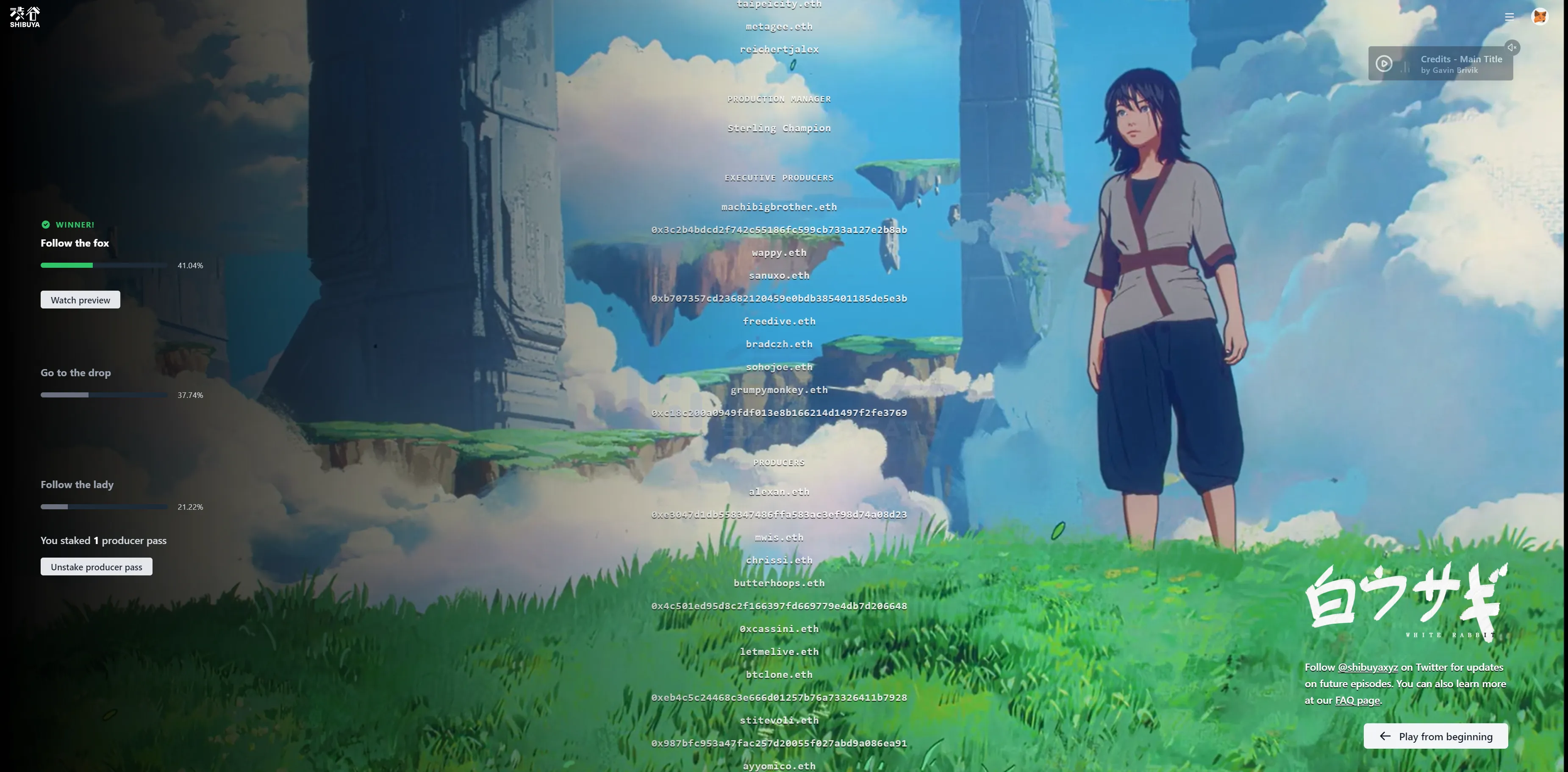
At the end of the film, the producer credits display an Ethereum address or ENS.
In addition to affecting the plot, these producers' NFTs can also determine how much ownership of the fragmented animation is given to community members: after the voting results are tallied, community members who unlock the NFT can receive WRAB Token rewards, and the earlier they vote and the higher the number of votes for the plot direction, the more rewards they can receive. Finally, after the entire animation is produced, WRAB will be converted into fragmented NFTs. The future development of the work, such as whether to sell it to other streaming platforms, will be decided by community voting.
As a new attempt, besides Token incentives and the expectation of jointly owning a work, what methods does Shibuya use to enhance community participation? The treasure hunt Easter egg is one of them. The Easter egg in the first chapter is the mnemonic phrase of an address containing 4 NFTs (all created by Shibuya team members), which is distributed in text and graphic form in different parts of the video for the audience to collect. In the second chapter, simply choose the gift in the middle of the airdrop to receive the airdropped NFT "Something Cooking". The purpose of this NFT is not yet clear, will it be useful in later stages?

助记词寻宝答案,第 1、2 个单词在第一章剧情选择画面的两扇门上方
The answer to the mnemonic word treasure hunt, the first and second words are located above the two doors in the first chapter's plot selection screen.
Speaking of interactive videos, you may think of "Black Mirror - Bandersnatch", which is also a gimmick of interactive videos. However, this kind of interaction is a way to peek at the whole picture from a God's perspective, and all the plot choices are actually preset by the production company Netflix. In the final analysis, the production company writes everything, and the audience is the passive recipient of the content. Of course, "Black Mirror" also has interesting Easter egg sections. I wonder if "White Rabbit" was inspired by this?

From Zhihu: "Black Mirror - Bandersnatch" Plot Summary
For more White Rabbit film reviews, check out this article "White Rabbit - Web 3's Hackers' Empire Has No Top Player".
BlockBeats Note: On December 8th, Shibuya, a Web3 video platform launched by digital artist Emily Yang, announced the completion of a $6.9 million financing round, led by a16z Crypto and Variant, with participation from celebrities such as Paris Hilton and NBA star Kevin Durant, Alibaba co-founder Joe Tsai, and DeFi trading platform Aave founder Stani Kulechov. The platform's valuation reached $50 million in this round of financing. Shibuya aims to help filmmakers raise funds and distribute films through fans using Web3 services, rather than relying on the Hollywood production system.
Mad Realities
Community/content consumers/audiences participate in content creation. Another example is the Web3 dating show Proof of Love, whose platform Mad Realities received a $6 million investment from Paradigm in April this year. In the Shibuya scenario, the audience only votes and does not truly embody the word "creation". Proof of Love, on the other hand, gives the audience greater creative space and participation. Proof of Love released three rose NFTs as participation tickets, priced at 0.1ETH, 0.5ETH, and 1ETH, respectively. NFT holders can participate in casting, from male and female guests to hosts, all of which are generated through voting. They can also participate in script planning, filming process, and some plot interventions (such as sending drinks to a favored couple). The highest level NFT holder can even attend the filming on site. After each episode is produced, it will be cast into a 1/1 NFT and auctioned on the ZORA platform. 30% of the auction proceeds will be awarded as a grand prize to the successful couple at the end of the season, 10% will be awarded as a reward for the next episode (if the chosen guest does not want to hold hands, they can win the prize money), 40% will go into the DAO treasury, and 15% will be decided by the auction winner. Without considering Web3 and crypto elements, this can be viewed as a comedy show.

Three levels of NFT Pass for participating in Love Proof, raised a total of 172.71 ETH, with 390 holders
At first, I followed these two examples because of their Easter eggs, funny and interesting content, and briefly wrote about the gameplay on social media and mentioned some details in the Web3 Random Door podcast. Later, some listeners recommended and shared with me Web3 content co-creation projects they discovered, and I consciously collected and tried to map out this type of project, feeling that it may soon be everywhere, and perhaps it already is... This recommendation and sharing process that helps us discover more co-creation projects seems to be a form of co-creation in itself.
Web3 Co-creation Mapping

Image source: Web3 Portal Community Compilation
Why is storytelling at the core of this mapping? Because according to incomplete project statistics, it is found that most of them revolve around creating a story, in various forms such as text, graphics, audio, video, and even various forms of composition, such as creating a decentralized Hollywood through a Story DAO. There are also some collaborative projects whose main focus is not on creating stories, and these projects are outside the storytelling circle.
Currently, there are still two co-creation categories with numerous project quantities that have not been included. One is the secondary creation based on PFP NFT, represented only by Jenkins the Valet, which has a high degree of creativity and is a butler story created based on BAYC. The field of future creation (secondary creation) may be more vigorous in projects with cc0 properties (Web3 Arbitrary Door Podcast uses Nouns, one of the cc0 pioneers, as an example to discuss the idea that cc0 may bring economic prosperity to creators in creating cultural symbols. A separate article will be written to explore this further); In addition, defining "content creation" in a broader sense, brand creativity can also be considered as a category of Web3 content co-creation, reflected in Web3+ consumption, with related projects such as GMGN supply, which intends to create a Web3 version of Nestle, and the "Web3+ consumption" incubator CPG.
The above mapping is a relatively narrow Web3 content co-creation. In these examples, there is an important role - NFT. NFT is the carrier, element or character of the story itself, as well as the admission pass card for participating in the creation.
Podcast
ReHash Podcast is a "community-driven Web3 podcast" initiated by Diana Chen on Mirror. Community members who hold ReHash NFTs can nominate and vote for their favorite guests, topics, and other aspects to create the podcast together. ReHash originally planned to raise 10 ETH, but eventually raised 29.53 ETH. Before launching ReHash, Diana Chen hosted two podcasts full-time, The Unstoppable Podcast and DAOn the Rabbit Hole, with a total of over 200 episodes, 150 of which were related to Web3.

Image source: ReHash discord Governance Channel
On the governance channel of ReHash's Discord, you can see that ReHash wants to do more than just a co-creation podcast program. It hopes to gather community power in the form of a DAO and develop an education center, knowledge hub, support group, media publications, podcast incubator, etc. ReHash calls it "the possibilities are endless". ReHash Podcast is the first project of Rehash DAO, similar to Mad Realities' variety show video, but it's just the beginning.
Why do interactive podcasts matter? ReHash expresses their values: if we want more diverse groups to benefit from Web3, we need to express different viewpoints as much as possible. This requires nominating podcast guests from minority backgrounds with diverse experiences, listening to their voices with respect and empathy. The world (including Web3) is not black and white, and there are nuances in the gray areas that are worth discussing, rather than simply labeling things.
What differences does community participation bring? ReHash's podcast is divided into 12 episodes per season. The first episode was produced before the launch of the co-creation plan, and the topics were niche and diverse (in my personal opinion, or it may be due to my limited range of knowledge), such as NFT projects that help ex-convicts stay on the right track and avoid returning to prison, interviews with DeFi educators/interns, etc. In the second season, guests nominated and confirmed by the community mostly come from well-known Web3 projects, such as Gitcoin, DAO Haus, Kernel, AAVE, Zora, etc.
Translated: ReHashDAO's extension of thought: As a DAO wanderer, I believe that co-creation of content may be one of the development directions for small and beautiful DAOs.
Currently, we can see large and comprehensive DAOs, such as BanklessDAO, as well as small and beautiful DAOs that have found their niche, such as Twoplus, which aims to promote the mental health of Web3 practitioners, and many small groups with clear creative goals. In large and comprehensive DAOs, talents gather in the same place to do irregular "Brownian motion" and see what opportunities can be collided with, with random strong attributes. Small and beautiful DAOs have a more focused project at the beginning, first creating products or works, thereby attracting more participants and expanding the community. We will not explore the advantages and disadvantages of these two methods. We have found that DAO considerations are included in the roadmap or positioning of Web3 creative small projects. There are many types of small and beautiful DAOs, and interactive creative projects may be one of the promising types. In fact, Shibuya has also mentioned this idea in official tweets: a movie is a DAO.

Image source: BanklessDAO
Music
SongCamp has held three camp activities (music creation hackathons): Genesis, Elektra, and Chaos. The third session, Chaos, focuses on the concept of "headless band". The term "headless" is borrowed from the term "headless brand" first proposed by the research institution Other Internet in October 2019. The values, beliefs, narratives, and symbols of a "headless brand" are determined by supporters in a distributed and permissionless manner, rather than being defined or reinforced from top to bottom like a traditional brand. A typical example of a "headless brand" is Bitcoin.
 The content you provided is:
Image source: SongCamp
Strictly speaking, Chaos is not the same type of co-creation as the team+community mentioned above. Chaos brings together 77 creators without a cooperative foundation, including 45 musicians, 9 visual artists, 7 operators, 6 engineers, 5 radio producers, 3 economists, and 2 copywriting masters, to create 45 pieces of music and 21,000 album covers (combined from over 1,000 visual layers that alternate and change).
These 77 professional creators are more like a professional team's co-creation, that is, these 77 people are regarded as a team and have not opened up creative space to the community or NFT buyers. This is most evident in the rights of NFT. The above 45 music pieces combined with covers form 21,000 NFTs, of which 20,000 are used for external sales, and the remaining 1,000 are distributed to the 77 creators in proportion (the proportion is determined by the CHAOS Token held by each person, and the number of CHAOS Tokens is determined by the scores of "self-evaluation + peer evaluation + adjustment" of the members. 30% of the CHAOS Tokens enter the songcamp treasury). Any income generated by future works can only be enjoyed by the holders of those 1,000 NFTs. Therefore, even if it is "co-ownership", it is only co-owned by the 77 creators.
The music NFT research organization Water&Music pointed out that the innovation significance of co-creation in the form of CHAOS lies in embracing a mindset that elevates the importance of finance to the same level as creativity. Financial innovation itself is also part of creation, and it has created a blueprint for Web3 music creation. Here, finance, in my personal understanding, refers to coordinating people to collaborate, discussing the financial value of artworks in the early stages of creation, and (in collaboration with the 0xSplit protocol) designing a system based on NFTs to automatically split revenue.

According to the report compiled by water&music
As for why the example of SongCamp is also included in the storytelling circle? Chaos does not tell a concrete story, but in terms of setting, it is to create music around an abstract story line: Act One, Order; Act Two, Chaos; Act Three, Entropy; Act Four, Rebirth. Why create a story? Henry, who translated the water&music report led by SeeDAO, shared the following views and information: Projects that always start with a story when making music will later develop some gameplay around this core, such as comic books and live concerts. As for how far it will go, it depends on willingness and funding.
Video
Video (including animation) projects typically involve the project team setting the basic framework and worldview, with the audience contributing content and voting to determine the plot. In addition to Proof of Love and White Rabbit mentioned above, there is also the animated series Stoner Cats, as well as the wrestling co-creation story The Gimmick, which is based on the Stoner Cats gameplay and is issued on the Solana chain. Unlike White Rabbit, Stoner Cats requires the purchase of NFTs to view the animated content.
Although NFT holders will be able to vote and collaborate on some of these stories in these projects, as someone who is easily distracted by too many projects and not bursting with creativity like me, I really can't offer much in terms of ideas (covers face)...
Earlier, an article discussing community bottom-up creative storytelling was published, which also listed more collaborative projects involving videos and written content. Interested individuals can explore these projects.
Shibuya once tweeted jokingly that they were upgrading their brand to NFTFLIX (did you read it as NETFLIX at first glance? Are they challenging NFTFLIX?), introducing interactive and collaborative elements. What differences can it bring to traditional content creation platforms? Is Web3 content collaboration just a temporary trend or a potential direction for Web3 development? These questions may still require us to observe and find answers as we go.

Image source: Shibuya Twitter
Text
Jenkins The Valet is a typical decentralized text creation project. Members, who go by the pseudonym Jenkins, bought the 1798th Bored Ape on May 22, 2021 and named it Jenkins the Valet. They then attempted to create decentralized creative writing around its story. The day after buying the Bored Ape, Jenkins wrote a simple 5/600-word story about a poor monkey who got a job as a valet and worked diligently in a yacht club where he could interact with wealthy apes. His mother was moved to tears by this. The story was quickly spread and Jenkins posted a form on Twitter hoping to create stories for each ape. He received many private messages and story submissions from Bored Ape owners. Jenkins then quickly wrote more than a dozen stories. At the time, Jenkins also had a full-time job as a product manager in the real world. After work, he tirelessly wrote stories and had a desire to scale the storytelling process. This is the origin of Tally Labs' entrepreneurial story, which raised $12 million in funding led by A16Z in May 2022. (For more details on this story, please refer to the podcast "Bored Ape Creative Story Community: Jenkins' "Author's Home"" and the Tally Labs entrepreneurial story.)

无聊猿 #1798
Bored Ape #1798
After 3 months, Jenkins launched Writer's Room (founded by a team of 3, formerly known as Tally Labs) and released 6942 Author's Home Pass NFTs (4 levels: WAGMI Yacht, Yacht Key, Jenkin's Key, Valet Ticket). The holders of the pass NFTs will be able to provide creative ideas for the story content, vote on the direction of the story development, and be marked as the author/creator in each piece of work produced. The NFTs were sold out within 6 minutes of their release.
Starting from a seed of desire created by a story, we witnessed the rise of the Writer's Home, and later on, Jenkins became the first NFT character to sign with the Creative Artists Agency (CAA), collaborating with more "celebrities" such as best-selling author Neil Strauss, Murda Beatz, and MBSJQ. The entrepreneurial story itself is fascinating enough!
According to the Roadmap of Writer's Home, in the future, their story creation will not be limited to Bored Ape Yacht Club, but will also expand to other avatar-based projects. The stories may bring vivid souls to these PFPs.
Images/Comics
The Space Wutubang is an NFT pixel art graffiti wall that applies radical market theory. Each pixel on the canvas is a tradable NFT, and these NFTs can be traded. Holders can color the pixels, and the patterns on the canvas are the results of social experiments. In these social experiments, holders must pay a Hamburger tax for the pixel NFTs, and a portion of the tax revenue is distributed as UBI to all creators, allowing everyone involved to profit.

Image source: The Space
Web3 Content Co-creation Spectrum
In the podcast conversation with "Tangying Jun" before, we tried to explore along a spectrum of co-creation of content in the past Web2/traditional field. One end of the spectrum is the team (or individual who initiates the work), and the other end is the community. In fact, every co-creative project is led by a certain proportion of the team/initiator, and then leaves some space for community members to participate, play creativity, and contribute content.

Image source: Vibe Squad&Web3 Portal
Why propose such a seemingly rigid framework? Does it have any practical significance? I believe this is a cognitive tool, because when chatting with colleagues who are relatively unfamiliar with this field, their first reaction is often, co-creation? A group of unprofessional and thoughtless people can create anything? It's better for professionals to do professional things.
Actually, people's understanding of co-creation is often pushed to the far right end of the spectrum, or viewed as an idealized state of "completely decentralized, bottom-up community creation". In reality, most co-creation projects start from the top-down and require a strong founding team. Similar to the progressive decentralization of DAOs, there is a process to test where on the spectrum a project should be placed, in order to ensure sustainable development and create infinite game-like stories, while also providing space for the community to freely participate and motivate co-creation. Here is more information on creating infinite game-like stories.
Some Optimistic Perspectives
Web3 content co-creation has brought us to the edge of the creator economy 4.0. What does it mean for the entire Web3 field? One of the criticisms of the Web3 field is that it is all speculation and unrealistic toys. The current situation is that the first stop for ordinary people to onboard Web3 is to speculate on coins and participate in airdrops. At least content co-creation provides a container for newcomers. In the future, many creative workers may come to Web3 to build and create. But then, will what they create still be toys? At this point, SolarPunk advocates may jump out and say that being positive and optimistic is the way to go, and we should believe that we can create a high-tech and high-quality future. I'm not sure if Professor Wang Chao believes in the SolarPunk ideology, but his tweet makes sense and reflects the meaning of being positive and optimistic: link.

Image source: Twitter
I believe that optimism is not blind or baseless. People who hold a positive attitude towards Web3, DAO, and creator economy to some extent acknowledge the ideas presented in The Sovereign Individual. They believe that taking personal responsibility is the path to freedom and wealth. By actively seeking and filtering information, breaking out of standardized life circles, creating their own rules of the game, and establishing leverage, they can achieve a life of both wealth and happiness. The influx of one billion digital nomads/sovereign individuals, as well as the capital's favor - A16Z announced that one of its support directions is decentralized creation, all allow us to glimpse the vast development space and promising future of the creator economy.
Regarding the belief and recognition of DAO, the recognition of individual creative potential, and the power of sovereign individuals, I recall a friend saying, "I don't have faith in DAO like you do, I just want to make money." Rather than saying that I have faith in DAO, it's more accurate to say that I just want to do my best to push myself and experience the dangers, depths, sharpness, turbulence, and recklessness of new fields. I believe in myself and my abilities.
If you don't believe in the power of individual sovereignty, then it's more of a speculative market perspective. This is a neutral meaning, and speculators can also reap great rewards. From the perspective of ecological diversity, speculators also play an extremely important role. "I thought you were talking about some projects, some so-called interactions that would have airdrops, but it turns out that being a good person on the chain is just a performance of being a leek." Okay, I am a leek. What I mean by doing good things on the chain actually refers to building on-chain assets, the digital assets carried in the NFT container. My naive and immature idea is that DeFi is developing first now, which is actually the financial world of the chain leading the way. "Entities" need a large number of creators to create works to catch up. At that time, DeFi will no longer be criticized as "spinning a bunch of air coins", but as "real" digital assets that can enrich personal spiritual life.
Critical Thinking
Despite being optimistic, we may still need to engage in some critical thinking.
Limitations
Looking back at the cases mentioned in the article, the initiators of these projects all have excellent backgrounds: Shibuya's co-founder, pplpleasr, is a well-known artist in the Web3 field, creating promotional videos for many top DeFi protocols and creating NFT covers for Fortune magazine. Another artist, maciej_kuciara, is a Hollywood animation producer. Diana Chen from ReHash has rich experience in the Web3 podcast field.
We can't help but think that creators/initiators who can leverage community power to participate in creation seem to have some "head creator" attributes or are already strong influencers. In other words, they can achieve direct content monetization in the mode of creator economy 3.0 without building communities, issuing NFTs, or designing community participation gameplay. In the podcast Web3 Anonymous Talk "The Core of Web3 is Collaborative Spirit", the guest pointed out that only 1% of creators may be able to achieve direct content payment based on blockchain-based Web3 creator economy, so how can the other 99% of creators benefit? This is a problem of allocating public resources such as "attention", and the solution points to the Haberger tax and radical markets. The gameplay of Web3 collaboration has its limitations in terms of scope and object, and for niche creators in non-head areas who are not influencers, they may need to explore some new ideas.
Coordination is more difficult than creation itself
Collaboration means that creators not only focus on creating, but also spend a lot of energy designing collaborative mechanisms and processes, including important copyright issues. Some DAO tools will play an important role in coordinating collaboration within organizations, and we have also seen more and more tools appearing to solve collaboration problems. It is always difficult to promote some innovative mechanisms, and we need to give more patience to these experimental projects.
In the future, there is still a lot of work to be done in exploring the creator economy. Fortunately, LiJin has opened an online course for free. Let's take the course together, think and build: https://creatoreconomycourse.xyz/
Finally, thanks to Wang Chao, Joel, Henry, Tangle Jun, and the Web3 Portal audience for their material contributions, inspiration, and support.
Original Link
Welcome to join the official BlockBeats community:
Telegram Subscription Group: https://t.me/theblockbeats
Telegram Discussion Group: https://t.me/BlockBeats_App
Official Twitter Account: https://twitter.com/BlockBeatsAsia

 Related Articles