The Chronicles of Pop Music - How the Creator Economy Made the Greatest Works
Original title: "IOSG Weekly Brief|Pop Music Chronicle-How does the creator economy make the greatest works? "
Original source: IOSG
Part.1 Insight
The Chronicles of Pop Music - How the Creator Economy Made the Greatest Works
A brief analysis of Web2.0 pain points and Web3.0 prospects from the music industry
Author: Kerou, IOSG Ventures
Editor: Elaine, IOSG Ventures
This article is the original content of IOSG , is only used for industry learning and exchange, and does not constitute any investment reference. If you need to cite, please indicate the source. For reprinting, please contact the IOSG team for authorization and reprinting instructions.
On July 15, 2022, Jay Chou finally released his new album "The Greatest Work" after six years. It has been a month since the album was released. Although Douban has not yet opened, the market's feedback on this new album has already set the tone. Compared with the old albums of more than ten years ago, the greatest works are not great. And half of the 12 works are old songs, lack of sincerity, which disappointed many fans. For Jay Chou, the youth of a generation, the audience did not buy it, and other singers and artists were even more difficult to escape. The word "ugly" is often listed on Weibo's hot search list, reminding us over and over again that the golden age of Chinese music is over. we go away.

Image source: weibo.com
As a carrier of civilization earlier than writing, music not only carries human spiritual emotions, social ideals and artistic pursuits, but is also in turn shaped by social economy and modern technology. As a kind of spiritual wealth, music is constantly being materialized and valued. With the evolution of communication media, music has gradually formed a complete form from the oldest word of mouth, to the prosperity of the physical record industry brought about by the popularization of recording technology in the last century, and to today's digital music disseminated on the basis of Internet technology. Commercialization path and industrial chain.
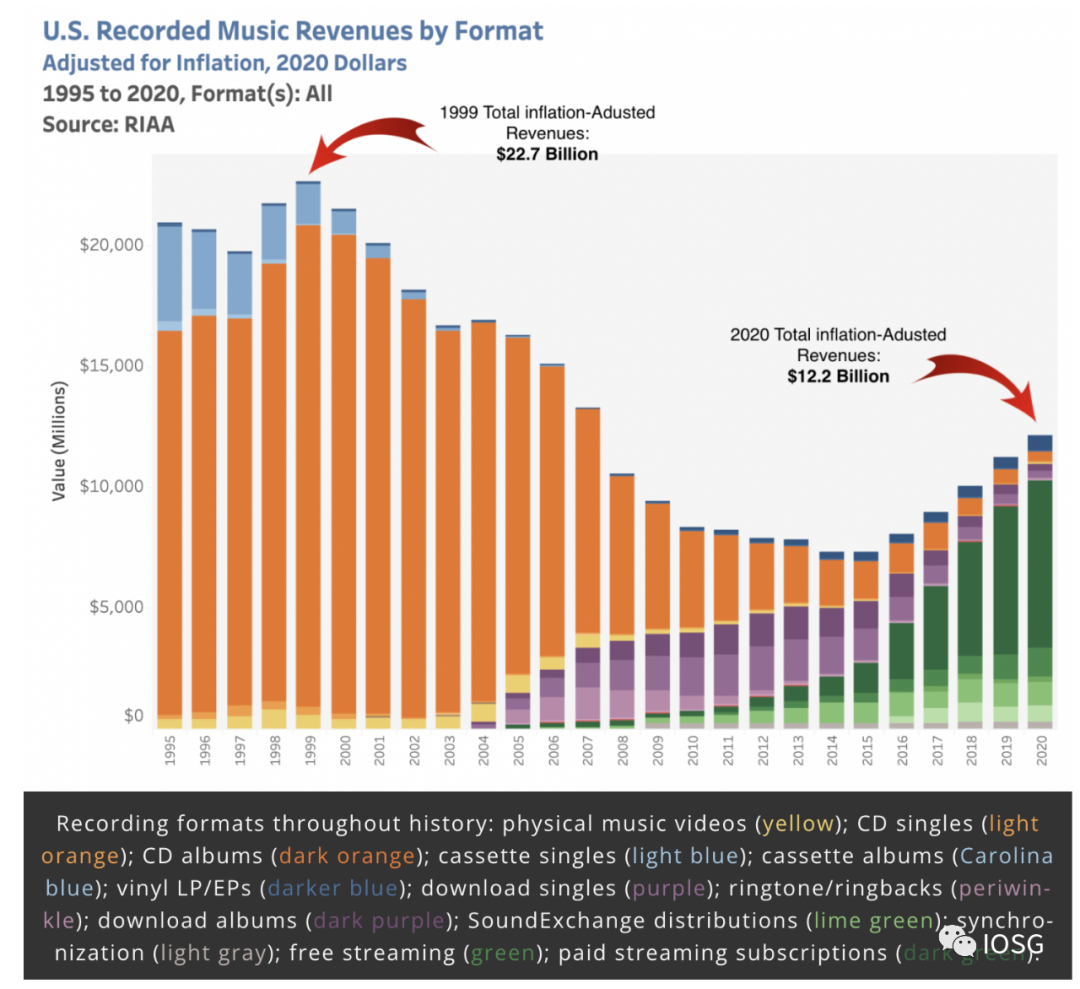
Image source: https://www.digitalmusicnews.com /2021/06/15/us-recorded-music-revenues-46-percent-lower/
1984 was an important point in the history of the music industry , Sony introduced the CD player. Due to the advantages of portability, high storage, and music quality preservation, CDs have been widely used in the music field, pushing the music industry into a golden age. Using the U.S. music industry as a global microcosm, physical CD sales and the overall size of the music industry reached an all-time high in 1999. In 2001, however, the American music industry faced an inflection point. At that time, Apple launched the iPod series of products, and the digital music industry was on the rise.
Under Internet technology, piracy and free downloads have become very easy, making the industry enter a three-year period of standing still. 2003 is another important node. Apple launched the iTunes paid download service, and the paid download of digital music and the sales of mobile phone ringtones are on the rise. However, these two business types are not enough to make up for the gap left by the rapid shrinkage of CD sales. The decline is difficult to reverse, and the scale of the music industry continues to decline. In 2008, the music streaming platform Spotify was officially launched in Stockholm, opening a subscription model for digital music. So far, the two modes of free listening and subscription listening have quickly crowded out the paid download market, while physical albums are already facing extinction.

image source : https://medium.com/cuepoint/4th-broadway-when-tower-records-was-church-65f15d7af2f7
The music industry today is hard to recover To the glory days before the millennium. At that time, Tower Records' brick-and-mortar record stores were popping up all over the world. Every night, musicians, critics, and music lovers from all over the world gather to communicate and share. The record store clerks who have been immersed in a strong artistic atmosphere for a long time may be the group of people who understand music the most in the world. They continue to recommend excellent works to customers who come and go, and the customer flow spreads them all over the world. Musicians at that time didn't have to worry too much about making a living, they didn't need many listeners. Because the pricing power of the physical album is still in their own hands, as long as they can find a hundred fans who really appreciate their music and are willing to pay for it, they can survive on the income of the physical album and continue to pursue their favorite career .
In 2001, with the release of the iPod and the popularity of iTunes, people gradually abandoned bulky CDs and CD players, and digital music became the preferred choice for consumers. good heart. A 99-cent piece of digital music is a bargain for music consumers compared to CDs, but a nightmare for musicians. The number of people willing to buy CDs has plummeted, and in 2016 Tower Records declared bankruptcy. In order to survive, musicians are forced to surrender their pricing power and sell their hard work at extremely low prices in accordance with the industry rules set by iTunes.
The emergence of Spotify can be said to have drained all the producer surplus from creators. From then on, consumers only need to watch advertisements, and consumers can listen to a large number of music for free without paying a penny, or pay a monthly subscription fee to unlock all the music libraries, and music has since become a cheap public good. The quality of music has become unimportant, and art and culture have been relegated to ancillary means of selling other products. As the CEO of Liquid Audio puts it: “Music is free, but the content of the music can be condoms, or any other crappy thing they want to sell you, as long as the business is happy. "
This subscription model is the final product of the entertainment industry in the era of attention economy. In order to seize the limited attention and disposable time of users, various The big entertainment industry has used its pricing power to exploit creators, lowering prices and striving to provide users with the most "cost-effective" products, and finally evolved into a subscription of "only 15 yuan per month, unlimited listening, viewing and playing of all content" model. This kind of competition does not only occur between industries, but also within each industry.
Back in the music industry, for each listener, his time is zero-sum. When all creators are gathered in the same pool to compete for limited attention, if a listener chooses to listen to the work of this musician, it means that he will give up another musician at the same time. So the composition of the audience is actually a cannibalism between the creators. This serious involution will lead to two serious consequences:
1) Matthew Effect,
2) Content discovery mechanism failure.
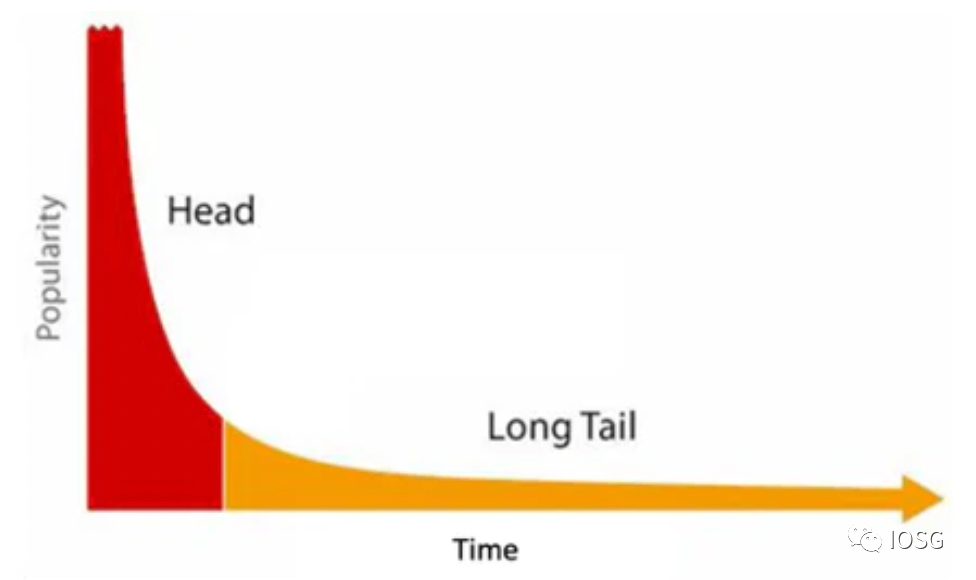
Image source: https://blog.csdn.net /zdg/article/details/1416659
The Matthew Effect is simply the imagination that the strong get stronger and the weak get weaker. Only by becoming the top few percent of creators can you make enough money. Once you fall into the group of long-tail creators, meager income can hardly support the output of high-quality content, so the gap with the head is getting wider and further leading to a sharp drop in income. This phenomenon is already extremely pronounced on Spotify, where the top 43,000 musicians, roughly 1.4% of total creators, receive 90% of the royalties, averaging $22,395 per artist per quarter. The remaining 3 million creators, or 98.6% of artists, only earn $36 per quarter.
The failure of the content discovery mechanism is another fatal problem. The infinite supply side and the huge demand side are all concentrated on the same platform. Creators, Especially for niche creators, it is even more difficult to find their target audience—100 fans who are willing to pay for themselves. Popular aesthetics and fashion trends, to a certain extent, are also a fig leaf for inefficient market allocation. However, streaming media platforms tend to conservatively use algorithms and recommendation systems to tilt traffic to popular creators who have been verified by the market. It further led to the failure of the Matthew effect and the discovery mechanism.
Under the subscription model, the living environment for long-tail creators is too difficult, causing many people to leave the industry. Just like social structure, the middle class plays an extremely important role in social stability and economic development. A large loss of creators at the waist and tail will lead to the decline of the entire industry. A direct reason is that non-head creators account for the vast majority of the total number of people, and they will put forward demands on the links in the industry chain in the process of producing content. Once they leave the industry, the demand of the entire industry chain will drop sharply, and the practitioners in the industry chain will also leave. Eventually, the industry will decline, and the top creators who remain in the industry will also be affected by the industry recession.
Although the total revenue of the US music industry has been on the rise after 2015 with the promotion of the subscription model, due to the aforementioned subscription model The sustainability of this upward trend is doubtful. In fact, we can already observe the negative impact of the subscription model on music creation under the attention economy. For example, creators reduce the length of songs, because on streaming platforms, the shorter the song, the more times it is played within the same period of time, and the more users’ attention is grabbed by a unit song, the more income it will get. The average length of the Billboard Top 100 in 2000 was around four minutes, with no song shorter than two and a half minutes. In 2019, the average song length was 3 minutes and 30 seconds, and songs under two and a half minutes grew by 8%. Other negative effects are also reflected in the early hook of the song and the spread of a large number of brainwashing melodies.
It is not difficult to find that in just a few decades, as the music medium changes, the pricing power also transitions. From distribution companies, to iTunes, to Spotify, with every transition, creators’ right to speak is constantly being cut, and pricing power is constantly being lost. The music industry is only a microcosm of the entire entertainment industry. Whether it is social networking, games or even the fashion industry, there are obvious signs of cultural decline. The root cause is the loss of creators’ pricing power caused by the economic model of the attention economy.
In order to prevent this trend of cultural decline and empower the creator economy, both the supply side and the demand side need to make changes together. For creators, regaining pricing power is the goal. The more difficult challenge lies on the demand side. We first need to change our cultural concepts and realize our spiritual wealth-it should never happen that cultural products are so cheap. And change consumption habits, willing to pay more for cultural products. Just like iTunes’ paid downloads and Spotify’s subscription model, Web3 is essentially an opportunity to reshuffle the cards, seize pricing power and reshape cultural concepts and consumption habits. Web3 is a good cultural soil, and the medium of NFT already exists on this soil. People advocate ownership, encourage owning and collecting, pay for JPEGs. Creators have already earned considerable income through NFT.
We have seen many new attempts in the Web3.0 music NFT track. From the perspective of the supply side, one possible way is to start with the music distribution platform Reforms passed on backwards. The first is that the music platform changes the economic model of subscription, which alleviates the Matthew effect and income difficulties faced by copyright companies to a certain extent. Perhaps copyright companies will not pass the excessive income pressure to their contracted artists, and use extremely harsh tax contracts. To squeeze the value of long-tail artists to increase revenue, the living environment and creative conditions of musicians can be improved. We have already seen the emergence of many Web3.0 music distribution platforms, such as Pianity, MintSongs and FanTiger invested by IOSG. Copyright is an extremely complex issue involving many parties, and it is difficult to break through the traditional framework for innovation in the short term. However, copyright company giants including Sony, Warner and Universal have already invested or tried in the field of music NFT. In the future, the development and growth of music NFT will definitely involve the distribution of royalties, legal framework and infrastructure.

image source : https://www.ledgerinsights.com/sony-universal-music-partner-with-snowcrash-nft-platform-plans-bob-dylan-nfts/
Part.2 Investment and financing event

MetaverseGo completes USD 4.2 million seed round financing
*blockchain mobile game platform
MetaverseGo Closes $4.2M Seed Round Led by Galaxy Digital’s Galaxy Interactive Division, Delphi Digital, Dragonfly Capital, Mechanism Capital, Infinity Ventures Crypto , YGG and others participated in the investment, and the funds raised will be used for software development, strategic recruitment and securing partnerships with telecom suppliers. According to the introduction, MetaverseGo was co-founded by Ash Mandhyan, Jake San Diego, and JC Velasquez, aiming to solve the problem of high entry barriers to blockchain games (such as using encrypted wallets, purchasing encrypted currencies, etc.), and users only need a mobile phone number to enter. Playing games such as Axie Infinity and Cyball, players can also obtain digital assets provided by game guilds such as YGG. Any proceeds from the game will be provided to players as MetaverseGo points, which can be used to pay for data and utility bills. Players can also use Earnings transferred to own wallet.
Gunzilla Games Closes $46M Funding Led by Republic Capital
*Games
Gunzilla Games announces completion of 46 million USD financing led by Republic Capital, Griffin Gaming Partners, Animoca Brands, Jump Crypto, Raptor Group, CoinFund, Shima Capital, Dominance Ventures, GSR, KuCoin Labs, Spartan Investment Group, AlphaCrypto Capital, Blizzard, Digital Strategies, Morningstar Ventures, Gamegroove Capital, NGG, Huobi Group, and Twitch co-founder Justin Kan also participated. Gunzilla said that the new financing will be used to build a new platform, GunZ, by adopting the "in-game item transaction" mechanism, which allows players to create game props such as game characters, weapons, and clothing and trade them with each other, giving players full ownership of game properties.
Pinata Closes $21.5M Financing
*Web3 Infrastructure
Pinata announced the completion of $21.5 million in financing, co-led by Greylock, Pantera, and Offline Ventures, with participation from Volt Capital, Opensea, and Alchemy. Funds raised will be used to continue investing in technology infrastructure and expanding the team. Additionally, Pinata will launch a new website with a better pricing model. According to the introduction, Pinata was launched in 2018 to provide Web3 creators with various functions to help creators create, manage and distribute content without restrictions. Recently launched features include Dedicated Gateway and Submarining, and currently has over 240,000 users worldwide.
RISC Zero completes $12 million financing led by Bain Capital Crypto
*Zero Knowledge Proofs
RISC Zero announced Completed $12 million in financing, led by Bain Capital Crypto, with participation from Geometry, D1 Ventures and Cota Capital, as well as Jinglan Wang, co-founder and CEO of Optimism, and Meltem Demirors, chief strategy officer of Coinshares. It is reported that RISC Zero is further planning to use zero-knowledge proof technology and its virtual machine to build a scalable blockchain. According to the introduction, RISC Zero launched a zero-knowledge proof virtual machine in March this year, through which developers can use various programming oracles to build and execute zero-knowledge proofs on any modern computer. Previously, RISC Zero had completed a $2 million financing led by Geometry Research and Ramez Naam Ventures in March this year.
Lysto completes $12 million financing , Square Peg, Beenext and Hashed lead round
*Game
CreatorDAO completes $20 million financing , led by a16z and Initialized Capital
*Decentralized Autonomous Organization
CreatorDAO completed $20 million in financing, led by a16z and Initialized Capital, with participation from Paris Hilton and musician The Chainsmokers. According to the introduction, CreatorDAO is a decentralized autonomous organization that provides capital and operational support for creators, and aims to invest in creators in exchange for some future earnings.
Satellite IM completes USD 10.5 million financing, co-led by Framework Ventures and Multicoin Capital
b>
*Decentralized communication platform
Satellite IM announced the completion of $10.5 million in funding, co-led by Framework Ventures and Multicoin Capital, with participation from Solana Ventures, IDEO CoLab, Hashed, and Pioneer Square Labs Ventures. It is reported that Satellite IM plans to provide early access to its desktop application this summer. The application is built on the Interplanetary File System and will support 4K video chat and file sharing of up to 4GB. Satellite IM also plans to launch its mobile native program, UpLink, in the fall. According to the introduction, Satellite IM was founded by Christopher Hogan and Thomas McArdle in 2020. It is a decentralized communication platform that enables peer-to-peer private messaging, and the protocol is compatible with the Ethereum Virtual Machine.
Jito Labs Closes $10M Funding, co-led by Multicoin Capital and Framework Ventures
*MEV Infrastructure Developer
Jito Labs Announces $10M Series A Funding, Co-led by Multicoin Capital and Framework Ventures, Alameda Research, Solana Ventures, Delphi Digital, MGNR, Robot Ventures and 18decimal and Angel Investors Anatoly Yakovenko, Brian Long, Armani Ferrante, Austin Federa, Edgar Pavlovsky and Nitesh Nath participated in the investment. The round, which brings its total raised to $12.1 million, will be used to recruit and develop an open-source tool suite to strengthen the Solana network, Jito Labs said.
Cashmere Closes $3M Seed Round, Coinbase Ventures Waiting to participate
*Enterprise Wallet Management
Cashmere completed a $3 million seed round of financing, with participation from Coinbase Ventures, FBG Capital, Y Combinator, etc., with a valuation of $30 million. The funds raised will be used to expand engineer recruitment and launch for institutions later this year product.
Cashmere aims to help companies securely store their crypto assets, and allows companies to collectively control themselves using multi-signature wallet, which in turn eliminates a single point of failure, allowing for more secure self-custody.
Fair.xyz completed 4.5 million US dollar financing, led by Eden Block, participated by OpenSea and others
*NFT Foundry Platform
Fair.xyz completed a $4.5 million financing round led by Eden Block, with participation from OpenSea, NFX and First Minute Capital. Fair.xyz said the post-money valuation of this round of financing was $33 million. Fair.xyz allows creators to launch NFT collectibles in minutes through its no-code solution. Fair.xyz founders Isaac Kamlish, Isaac Bentata Chocron and Nathan Cohen are former engineers at Meta and Goldman Sachs.
Nerdystar, a division of Line Games, completed a $5.8 million seed round financing< br>
*Web3 Games
Japanese social media giant LINE sub Nerdystar, the Web3 game division of the company Line Games, announced the completion of a US$5.8 million seed round of financing, led by South Korean investment firm Blocore, with participation from Bitkraft Ventures, FTX Ventures, GuildFi, Formless Capital, VistaLabs, Seum and SBXG. The round brings Nerdystar’s total funding to nearly $11 million.
Injective Closes $40M Funding , Jump Crypto led the investment
*decentralized smart contract platform
Injective, a Cosmos-based decentralized smart contract platform, has completed $40 million in financing, led by Jump Crypto and participated by BH Digital, the digital asset division of hedge fund company Brevan Howard. Injective said it will use the funds to increase the utility of the INJ token, provide liquidity for existing decentralized applications built on Injective, and support new decentralized applications on Injective. Eric Chen, CEO of Injective Labs, said that Jump is a major force in the crypto ecosystem, and this partnership will focus on expanding Injective's network and further providing shared liquidity across the Injective ecosystem.
Datawisp Closes $3.6 Million Financing
*Web3 Codeless Data Platform
Datawisp announced the completion of a US$3.6 million seed round of financing, led by CoinFund, with participation from Spartan Capital, Mirana Ventures, Dweb3 Capital, and Play Ventures. This round of financing will be used to grow the team, improve Datawisp's platform offerings, and expand infrastructure. Datawisp allows users to use an easy-to-use visual language instead of code to build complex queries and dashboards. It is currently integrated with Solana and supports multiple Web2 data sources.
Bitrise Capital Launches $10M Ecological investment fund, used to support the construction of PoW public chains such as ETHPOW, ETC and iPolloverse
*Fund financing
Bitrise Capital announced the launch of a $10 million ecological investment fund, which will be used to support the ecological development of PoW public chains such as ETHPOW, ETC and iPolloverse. Bitrise Capital stated that if the Ethereum hard fork is successful, Bitrise Capital will actively support the development and exploration of ETHPOW main network ecological applications, enrich and promote the overall development of ETHPOW network, and provide more support to ecological developers. In addition, Bitrise Capital said that with the conversion of ETH to PoS, part of the computing power will also flow into ETC. iPolloverse is a blockchain-based distributed GPU computing power network developed by Nano Labs (NASDAQ: NA), a Nasdaq-listed company. It also provides more options for ETH GPU computing power.
Original text link
Welcome to join the official BlockBeats community:
Telegram Subscription Group: https://t.me/theblockbeats
Telegram Discussion Group: https://t.me/BlockBeats_App
Official Twitter Account: https://twitter.com/BlockBeatsAsia
 Related Articles