Selected financing projects for the 51st week of 2022: Shibuya and DeFi derivatives.

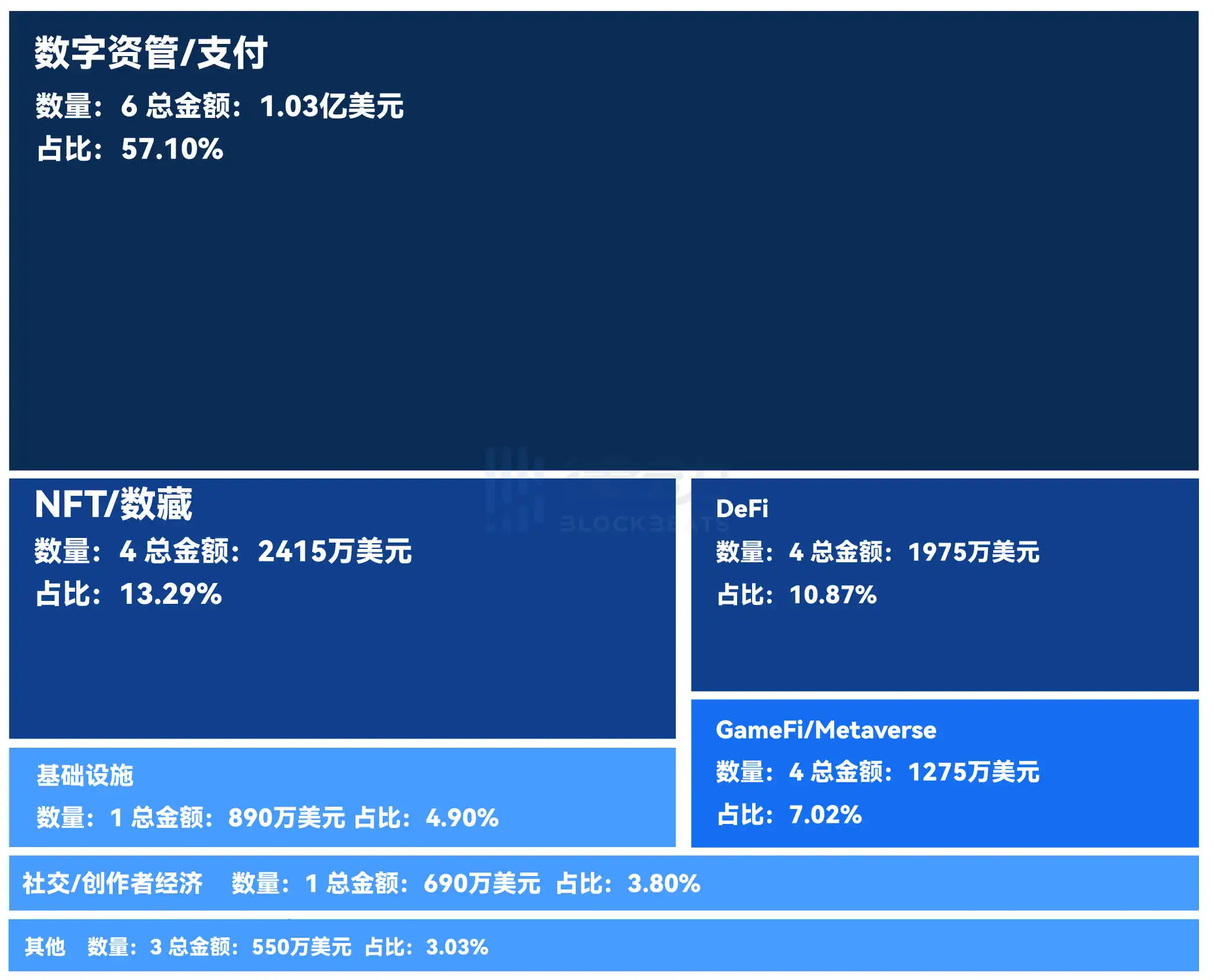
According to BlockBeats statistics, there were a total of 23 financings last week, covering GameFi, NFT, DeFi, social and other fields, with a total amount exceeding 180 million US dollars and an average financing amount of 5.26 million US dollars. The overall financing scale and frequency are still relatively low. Among them, digital asset management/payment is still the main target of institutional financing, while social and infrastructure sectors have less financing. The following chart shows the financing proportion of each sector last week:
Metaverse/GameFi
In the Metaverse/GameFi field, there were a total of 4 financing deals with a total amount of over 12.75 million US dollars, accounting for 7.02% of the total financing amount last week. Notable projects include:
Earn Alliance
Reasons for Attention: The team has rich experience and an impressive financing lineup. Recently, in addition to game studios, game platforms have also become a new trend in capital investment in the gaming industry.
BlockBeats News, on December 8th, Web3 gaming community platform Earn Alliance announced the completion of a $4.75 million seed round of financing, led by CoinFund and Fabric Ventures, with participation from Blockchain Coinvestors, MAD World Ventures, and angel investors.
Earn Alliance was founded by Joseph Cooper, and the team includes top game companies and crypto institutions such as Blizzard, Binance, Huobi, and Sandbox VR. The goal is to create a comprehensive game infrastructure platform and community to meet the needs of blockchain game players, communities, and developers. The Earn Alliance Alpha version will be launched on December 15th, with features including Web3 games, game intelligence news briefs, soul badges and task systems, and articles.
Earn Alliance will automatically import several important player statistics into the platform's games and bind them to players in the form of SBT badges to showcase their skills and achievements. Badges are the core of Earn Alliance's incentive model, and the more communities supported by players, the more badges they hold, and the more rewards they receive.
Additionally, Earn Alliance also encourages the creation and sharing of high-quality content. The platform's native token ECT is planned to be released in Q2 2023, with most ECT and tokens/NFTs from partner games being used to incentivize users to create content and engage with the gaming community. The platform will also insert planned game directories into announcements, blogs, Twitter, etc. so that players can stay up-to-date on the latest developments in Web3 gaming. Players can discover the latest Web3 games on Earn Alliance, view tutorials on how to play games, and watch gameplay videos from popular blockchain gamers.
Currently, Earn Alliance is working with action-adventure game Apeiron to develop blockchain automation processes for its game NFTs, allowing players and guilds to effectively cultivate their in-game assets. The team hopes to create a set of standard process interfaces in the future, where developers can automatically integrate their developed games into Earn Alliance's ecosystem, sharing payment, asset allocation, scholar access control, community game API, and other functions.
The Mirror
Reasons for attention: Innovative vision and great potential for application scenarios. In the future, individual developers and small studios will still be the main force in the blockchain gaming industry, and mature developer tools may become a hard requirement.

BlockBeats News, on December 8th, The Mirror, a development platform that allows independent developers to create virtual world games, completed a $2.3 million Pre-Seed round of financing, led by Founders Found, with participation from Konvoy Ventures, Florida Funders, and Palm Tree Crew.
The Mirror currently has a team of 15 people and is an integrated gaming and game development platform aimed at providing developers and 3D creators with unlimited experiences and creativity. The Mirror is supported by the Godot engine and provides tools for creating 3D multiplayer games set in virtual worlds, including real-time collaboration applications.
The team's vision is to create a real-time game development platform where any content created by users can interact with other mirror spaces. Developers can build game props in Blender and then publish the final game in The Mirror, and can migrate the props to other games, all through the use of Mirror Assets.
The Mirror allows developers to build games and internal assets together with colleagues in a 3D space. It also provides a ready-to-use multiplayer game built-in network that can expand the game from 10 people to thousands of people in the same space. In addition, the platform provides rich physical sandboxes for developers at all levels, from gravity, collision to physical control space, and allows developers to import their own built 3D models and artworks from other platforms.
The team also proposed the Build To Earn model, where developers can buy and sell their own or others' created games and models on the platform, and enjoy all the assets in the Mirror games and experiences on one platform. Currently, The Mirror is still in the invited experience development phase.
NFT
In the NFT/digital fashion field, there were a total of 4 financing deals with a total amount of 24.15 million US dollars, accounting for 13.29% of the total financing amount last week. Notable projects include:
Metagood
Reason for attention: Animoca Brands participation.
BlockBeats News, on December 8th, NFT startup company Metagood completed a $5 million Pre-Seed round of financing, with participation from Animoca Brands, Morgan Creek Capital founder and CEO Mark Yusko, and Virgin Group investment manager Freddie Andrewes, among others.
The concept behind Metagood is to use NFTs as a means of expression, tokenizing good deeds and incentivizing everyone to do more good for each other. The Metagood team believes that Web3 can be a positive force for driving the "economy of kindness," and has launched its flagship NFT series, OnChainMonkey, with the hope of combining charitable donations with the price of OnChainMonkey NFTs.
Additionally, its DAO organization has raised over 2,000 ETH in the past year. The team hopes that community members will have the opportunity to promote the development of social welfare projects through the support of the DAO. In the first 10 weeks of its first season, 70 ETH in funding has been distributed to 42 projects.
NF3
Reasons for attention: Impressive financing team, focusing on the hot topic of NFT liquidity.
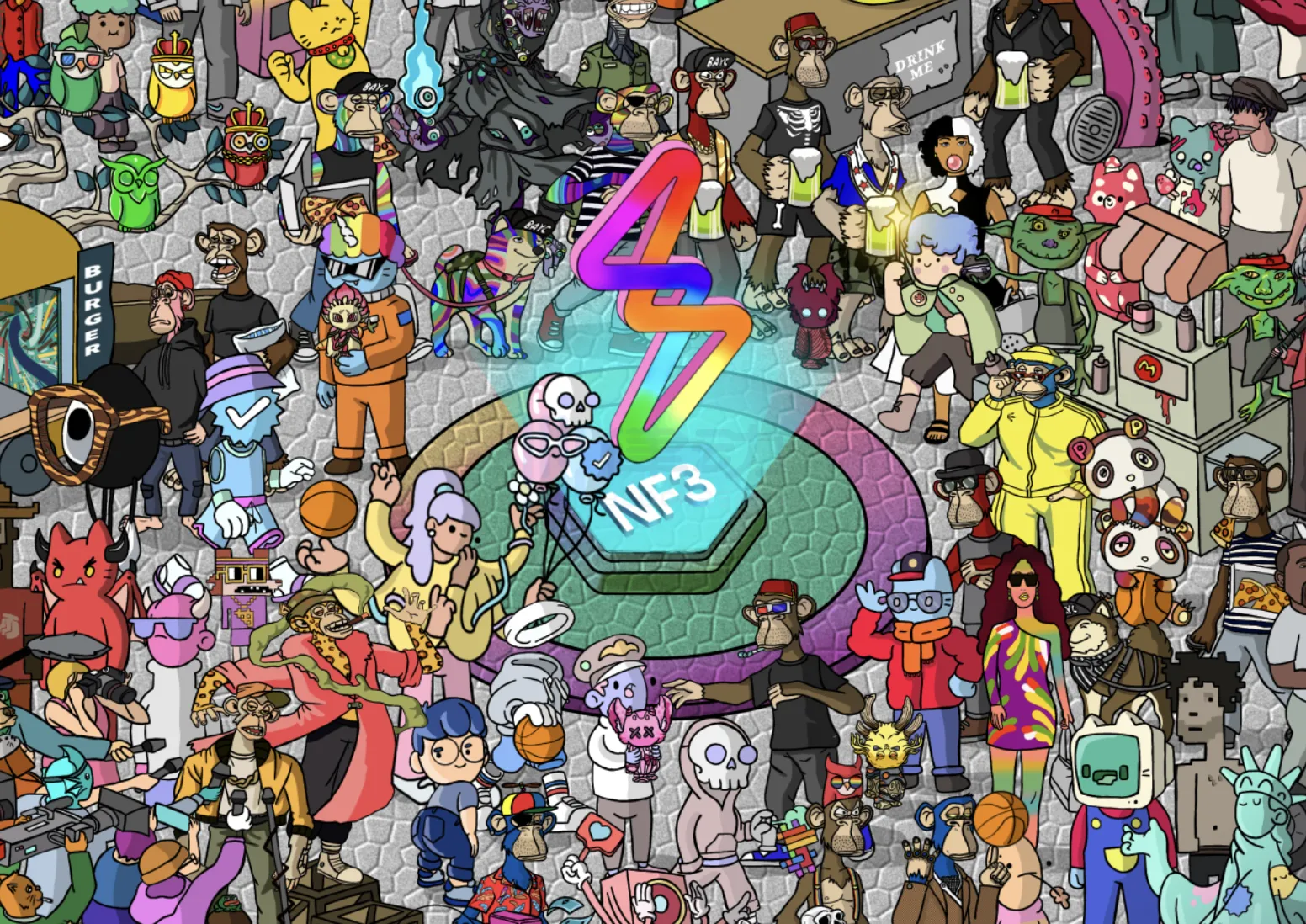
BlockBeats News, on December 9th, according to The Block, NFT trading platform NF3 completed a $1.65 million seed round of financing, led by Infinity Ventures Crypto and Spartan Group, with participation from DWF Labs, Saison Capital, Bitmex founder Arthur Hayes, David Chreng (LeadBlock Partner), and Neil Gomes, Head of Financial Technology at SoftBank EMEA.
NF3 aims to bring fun back into the activities of collecting and trading NFTs, rather than just collectors buying and selling NFTs for profit. NF3 addresses these issues by providing derivative solutions, including allowing collectors to trade NFTs through swap transactions and offering options with a "buy now, pay later" structure.
NF3 currently mainly offers swap and options services, but the team hopes it will become a one-stop-shop for Web3. The team recently partnered with Solidity.io to launch the ApeCoin staking platform to address some of the geographic restrictions faced by BAYC holders when trying to use their ApeCoin. This service will enter a closed testing phase in the coming weeks.
NF3 is currently built on Ethereum and will expand to other active NFT communities in the future, including Solana, Polygon, Tezos, etc., allowing people to exchange assets between different blockchains. According to reports, the funds raised in this round of financing will be used for recruitment and smart contract auditing.
DeFi
In the DeFi field, a total of 4 financings were completed with a total amount of 19.75 million US dollars, accounting for 10.87% of the total financing amount last week. Notable projects include:
Perennial
Reasons to pay attention: The financing team is impressive, and the decentralized derivatives market remains a blue ocean that has yet to be fully explored in the DeFi field.
BlockBeats News, on December 7th, DeFi derivative protocol Perennial completed a $12 million seed round of financing, led by Polychain Capital and Variant, with participation from Coinbase Ventures, Scalar Capital, Robot Ventures, and others.
Perennial was co-founded by Kevin Britz and Arjun Rao. The two previously co-founded Astro Wallet in 2017, which was acquired by Coinbase in 2019. They currently work as advisors for Coinbase. Perennial is a derivative protocol built on DeFi primitives, aimed at empowering market participants to take control of market structure and design decisions. The core features of the initial version include peer-to-peer AMM, zero price slippage, cash settlement, and bilateral leverage.
Perennial uses a native DeFi trading model that allows for no order book, permissionless leverage, and composable positions. In the team's view, Perennial is not just a single protocol, but a foundation for various DeFi activities and protocols, and many customized derivative trading experiences or products can be built on this foundation. The core protocol of Perennial aims to provide powerful and efficient services for advanced users, while tools built on top of the protocol can simplify and automate retail user participation.
Additionally, Perennial can also serve as an AMM derivative of spot pools, providing counterparties for any trader position taken directly at the oracle price, in exchange for floating interest rates based on the utilization rate of the liquidity pool. Traders deposit collateral to gain leveraged exposure to varying price supplies, while liquidity providers pool funds within the protocol to earn fees for holding counterpart positions.
Panoptic
Reasons to pay attention: The financing team is impressive, and the decentralized derivatives market remains a blue ocean that has yet to be fully explored in the DeFi field.
BlockBeats News, on December 6th, Panoptic, a DeFi protocol based on Uniswap, completed a $4.5 million seed round of financing, led by Gumi Cryptos Capital, with participation from Uniswap Labs Ventures, Coinbase Ventures, Jane Street, SevenX Ventures, and Avalanche Foundation's Blizzard Fund. The funds will be used to expand the team, build the protocol, and conduct code audits.
Panoptic was founded in July this year by Jesper Kristensen, former head of research at Advanced Blockchain AG, and Guillaume Lambert, a professor of applied physics at Cornell University. Panoptic is a perpetual option DeFi protocol designed to overcome the problems of on-chain options in terms of trading costs, speed, and liquidity by managing LP positions on Uniswap V3 to replicate the returns of single or multi-sided options. Its first version is based on Uniswap's AMM and is planned to be launched in the first quarter of next year.
Panoptic allows users to simulate multi-party options by combining different call or put options. Option sellers can also sell options with insufficient collateral, which means that on-chain markets can be as complex and capital-efficient as traditional financial markets. The pricing of perpetual contracts is done through a streaming premium model, where the price increases over time based on the pricing formula.
In addition to buyers and sellers, Panoptic also introduces liquidity providers. Option buyers and sellers can greatly improve capital efficiency by borrowing a small commission from liquidity providers on Panoptic. Since liquidity providers provide liquidity to the Panoptic pool, rather than the Uniswap pool itself, they do not need to actively manage their LP positions to generate income. Instead, more income will come from the commissions paid by active trading of option buyers and sellers, greatly reducing slippage losses and capital risks. In addition, Panoptic also allows call options and put options to be stacked together to create multi-party options.
Social/Creative Economy
In the social field, a total of 1 financing was completed with a total amount of 6.9 million US dollars, accounting for 3.8% of the total financing amount last week. Projects worth paying attention to include:
Shibuya
Reasons for attention: With a strong financing team and a significant project in the Web3 creator economy, this project has garnered sustained attention from the community.

BlockBeats News, on December 8th, Shibuya, a Web3 video platform launched by digital artist Emily Yang, announced the completion of a $6.9 million financing round, led by a16z Crypto and Variant, with participation from celebrities such as Paris Hilton and NBA star Kevin Durant, Alibaba co-founder Joe Tsai, and DeFi trading platform Aave founder Stani Kulechov. The platform's valuation reached $50 million in this round of financing.
Shibuya is a web3 content studio and creator platform named after the intersection in Tokyo, which means a place where culture and ideas intersect. It aims to use Web3 services to help filmmakers raise funds and distribute films through fans, rather than relying on the Hollywood production system. As an excellent example of the Web3 creator economy, Shibuya has been highly regarded in the past and for more information, please read "When creators meet Crypto: a new paradigm for the creator economy".
Infrastructure
There were a total of 1 financing in the infrastructure field, with a total amount of 8.9 million US dollars, accounting for 4.9% of the total financing last week. Notable projects include:
Tea
Reasons for attention: The founder has rich development experience and integrating Web3 concepts into traditional development is an interesting approach.
BlockBeats News, on December 6th, Tea, an on-chain open source software building platform, announced the completion of an $8.9 million seed extension round of financing, led by Acuitas Group Holdings, with participation from Betaworks Ventures, Percival VC, Round 13 Digital Assets Fund, StrongBlock, and Wax Blockchain. According to previous reports by BlockBeats, on March 23rd, Tea completed an $8 million seed round of financing, led by Binance Labs, with participation from Coral DeFi, SVK Crypto, and MAKE Group.
Tea was founded by Homebrew creator Max Howell and Timothy Lewis in November of last year. It is an open-source unified package manager for software developers. The proposed protocol will provide package maintainers with an NFT upon completion of package submission, which will be used to prove their work and guide Tea rewards.
The team hopes to break out of the blockchain through a new Web3 protocol to help open source software creators and maintainers receive economic incentives and rewards. Tea will allow protocol package maintainers to receive an NFT upon completion of package submission, which serves as proof of their work and guides the distribution of rewards on the Tea platform. Currently, the team is still focused on the first version of its product, which aims to challenge established players in the package management field, such as GitHub's NPM and Homebrew itself.
Additionally, according to the official whitepaper of the project, Tea will not only be a simple package manager, but also a "universal" package manager, a universal interpreter, and a virtual environment manager with flexibility. Developers and companies can customize things according to their own needs. For more information about Tea, please refer to "Tea.xyz: A Decentralized Protocol for Incentivizing Open Source Ecosystems".
数字资产管理/支付&其他
translates to
Digital Asset Management/Payment & Others
In the field of digital asset management/payment, there were a total of 7 financing deals with a total amount of over 154 million US dollars, accounting for 44.08% of the total financing amount last week. Worth noting are:
Bitcoin.com
BlockBeats News, on December 8th, Bitcoin.com, a digital ecosystem and self-hosted platform, announced the completion of its pre-sale of VERSE Tokens for rewards and utility, raising $50 million. The VERSE sold in this pre-sale accounts for 16% of the total supply, and other strategic buyers include Digital Strategies, Blockchain.com, Kucoin Ventures, Redwood City Ventures, Boostx Ventures, and Poly Network. Bitcoin.com will launch VERSE trading on the decentralized exchange platform Verse DEX.
In addition, Bitcoin.com has launched the Verse Development Fund, which will begin accepting funding applications from developers and other ecosystem participants in the first quarter of 2023. 34% of the VERSE Token supply will be allocated to the Verse Development Fund, and the Token will be linearly released to the fund over 7 years.
It is reported that VERSE is a reward and utility token designed for contributors and participants in the Bitcoin.com ecosystem, with EVM compatibility. On May 5th, Bitcoin.com announced the completion of a $33.6 million private placement of VERSE tokens, with participation from Digital Strategies, KuCoin Ventures, Blockchain.com, ViaBTC Capital, Redwood City Ventures, 4SV, BoostX Ventures, Roger Ver, Jihan Wu, David Wachsman, and others.
Tapline
BlockBeats News, on December 8th, SaaS digital financial platform Tapline announced the completion of a €31.7 million pre-seed round of financing. Web3 venture capital firm Fasanara Capital led the round, which consisted of both equity and debt financing. Fasanara Capital provided $30 million in debt financing, while the remaining €1.7 million in equity financing was contributed by Czech venture capital firm V-Sharp Venture Studio, Antler, Black Pearls VC, 365 fintech, Depo Ventures, Impetus Capital, and others. It is reported that Tapline aims to provide digital financial solutions for enterprises, helping digital small and medium-sized enterprises to obtain funds more conveniently to accelerate growth.
Bitwave
BlockBeats News, on December 6th, Bitwave, a cryptocurrency accounting and compliance platform, announced the completion of a $15 million Series A financing round, led by Hack VC and Blockchain Capital, with participation from SignalFire. As previously reported by BlockBeats, in August 2021, Bitwave announced the completion of a $7.25 million seed round of financing, led by Blockchain Capital, with participation from Nascent, Nima Capital, and Arca.
Other Financing
Other financing totaled 3 transactions, with a total amount of 5.5 million US dollars, accounting for 3.03% of the total financing amount last week. Including:
On December 9th, decentralized recruitment platform Outdefine completed a $2.5 million financing round, with Jump Crypto and TCG Crypto leading the investment. Other participants included Big Brain Holdings, Formless Capital, and Blocore. Outdefine is built on Solana and uses token economics to promote a more fair and transparent relationship between recruitment companies and talent.
On December 9th, Liquid Access, a Web3 digital asset software-as-a-service (SaaS) platform, announced the completion of a $3 million seed round of financing led by Flintera. Liquid Access' SaaS platform will help brands and organizations create and manage Web3 digital assets, integrate them into their own business, and help institutions transfer existing loyalty programs to the chain.
On December 9th, Fingerlabs, a blockchain company under FSN, a South Korean digital marketing giant, announced the completion of a strategic financing round. Innocus Global Group, the parent company of Singapore's Web3 entertainment ecosystem Fellaz, participated in the funding, but the specific amount has not been disclosed. It is reported that Fellaz will enter the South Korean blockchain industry through Fingerlabs and explore NFT use cases, such as membership qualifications and concert tickets, using the Favorlet blockchain wallet developed by Fingerlabs.
Welcome to join the official BlockBeats community:
Telegram Subscription Group: https://t.me/theblockbeats
Telegram Discussion Group: https://t.me/BlockBeats_App
Official Twitter Account: https://twitter.com/BlockBeatsAsia

 Related Articles