What centralized issues does MEV bring to Ethereum? How can they be improved?
Original Title: "What Centralization Problems Does MEV Bring to Ethereum? How to Improve?"
Original Author: Simon Brown
Original Translation: 0x11, Foresight News
How does MEV become a centralizing force for PoS Ethereum? This article is the second part of the discussion on this issue. The first part was written before the merge, speculating on how Ethereum would become more centralized due to the impact of MEV. The second part is written after the merge, focusing on what has actually happened in the months since the merge, the current state of the ecosystem, and future development directions.
The quotes in the article are all collected from public information by a group of smart, hardworking, and honest people. If you are interested in this topic, please feel free to check out the various data sources I have cited.
Validator Centralization
Recall that the original basic principle behind MEV-Boost was an attempt to mitigate the scale effect of large staking pools on MEV extraction, which would inevitably lead to centralization. MEV-Boost aims to allow any validator to obtain as much MEV as possible from their proposed blocks, which means that independent stakers have the same opportunity to obtain MEV as large staking pools, thus maintaining a fair competitive environment.
Despite the alleviating effect of MEV-Boost, validators still face significant centralization issues. The following is a validator set snapshot obtained from Etherscan on November 25th:
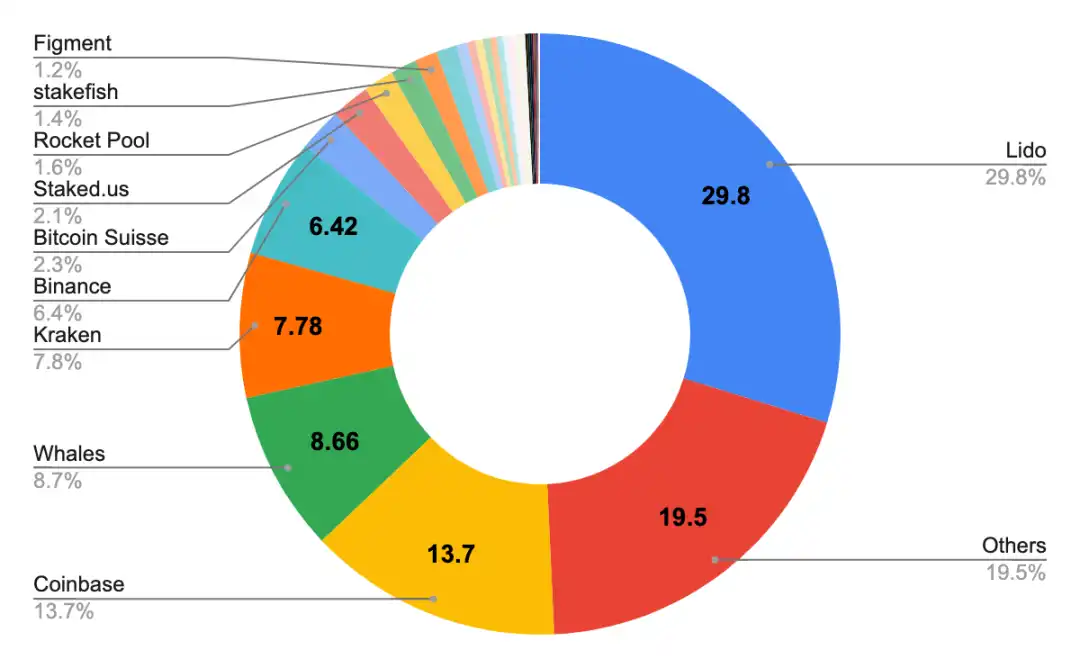
Lido occupies 29.8% of the staking share, which is close to the consensus threshold, which is worrying.
However, there is also a misunderstanding because Lido itself is a DAO, which means it is decentralized by definition. Lido has developed transparent policies around its node operators' distribution, and you can read more about decentralization in their posts on the topic.
If we break down Lido into its node operators instead of just viewing it as a single entity, the composition of the validator set appears to be different:
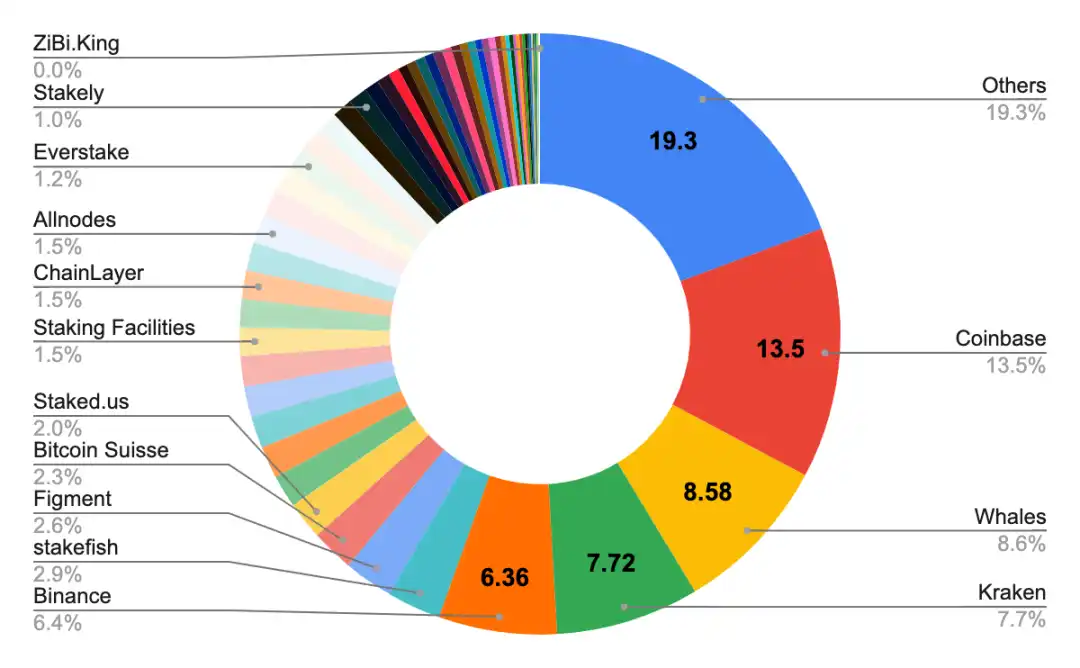
The situation is still not optimistic, especially considering that Coinbase and Kraken (two US registered companies) together hold over 21% of the staking shares. In addition, Danny Ryan believes that any liquidity staking derivative protocol carries risks, even if the protocol itself is decentralized, there is a risk of obtaining a stake of validators exceeding the consensus threshold. You can read more information in his article The Risks of LSD—HackMD.
However, how much of this centralization is driven by MEV? Given that MEV-Boost provides all validators with fair access to all MEV, this centralization must be attributed to other factors. Remember, the more validators you have, the higher the frequency of choosing validators as proposers. Currently, the probability of being selected as a proposer at least once a week is 10%.
slots_per_week = seconds_per_week / seconds_per_slot = (60*60*24*7) / 12
(1 / number_validators) * slots_per_week = (1 / 479652) * 50400 = 0.1
For a staking pool with 30% validators, this probability will increase to 315%, which means you can get at least three proposal blocks per week and have three times the chance of getting an intermittent high-value MEV block. You can check out Flashbots' analysis of this phenomenon here.
Given that validators do not access MEV until they are able to receive execution layer rewards (i.e. post-merge), we assume that if MEV is the driving force behind validator centralization, we would see an increase in centralization post-merge. However, this does not seem to be the case based on actual data. While the overall amount of ETH staked has been increasing over time, there has not been a significant change in the relative share of participation among major players since the merge.
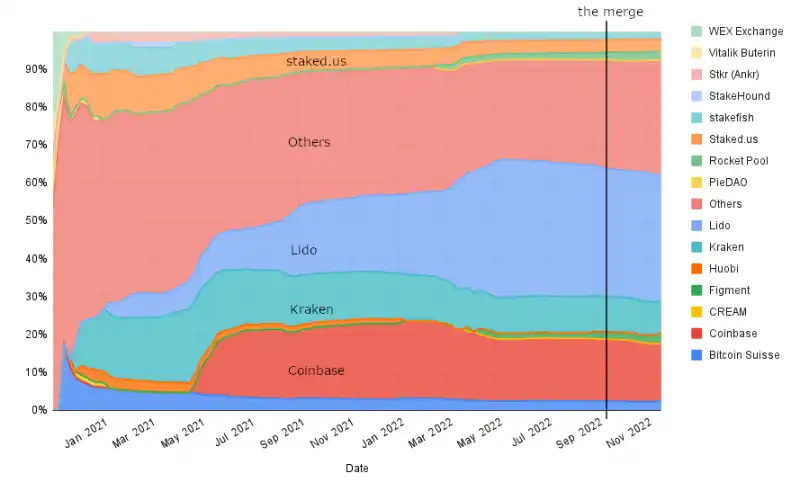
This indicates that MEV-Boost is at work and distributing MEV evenly among all validators in the pool. Of course, one could argue that the lack of change in validator share since the merge may be due to low adoption of MEV-Boost or simply a small amount of MEV being paid out to validators. However, a closer examination of these two metrics reveals that neither of these are the reasons.
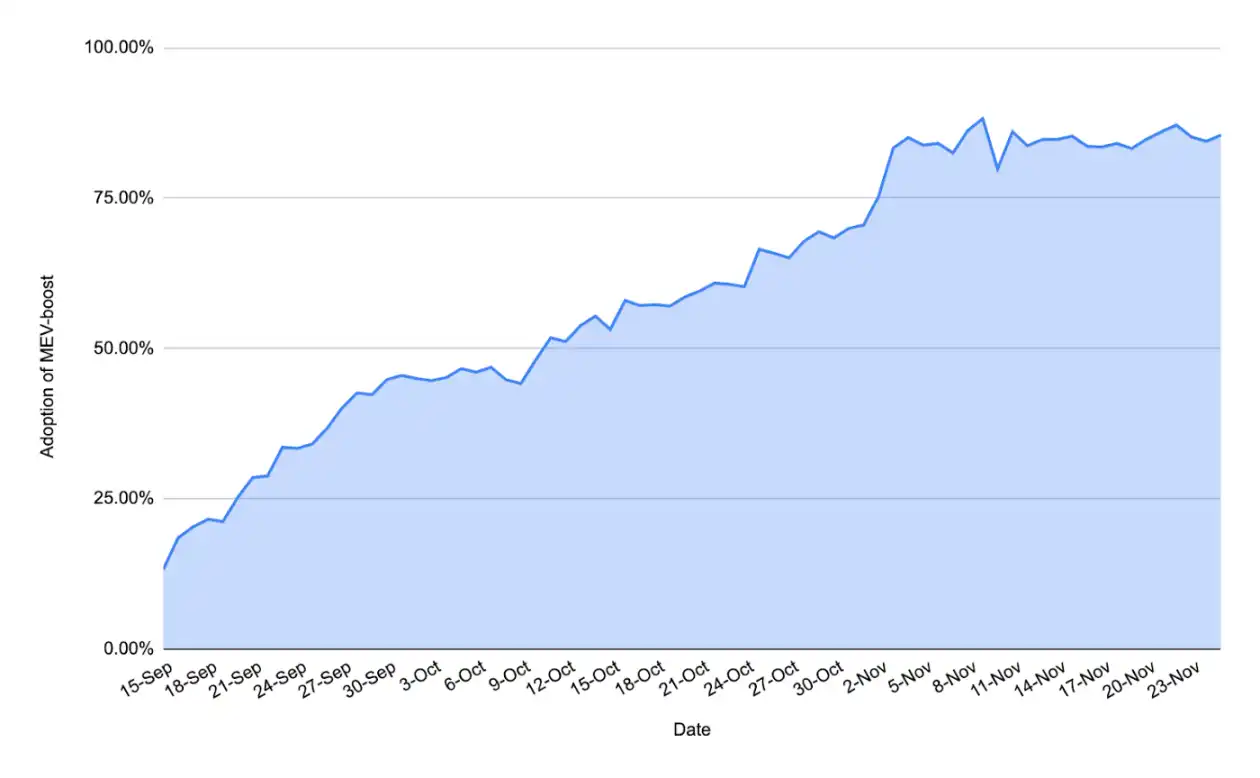
First of all, the adoption of MEV-Boost has grown significantly over time, with approximately 90% of validator sets having installed MEV-Boost and registered one or more relays. This indicates that the share of the staking pool remains almost unchanged after the merger, not because the adoption rate of MEV-Boost is low.
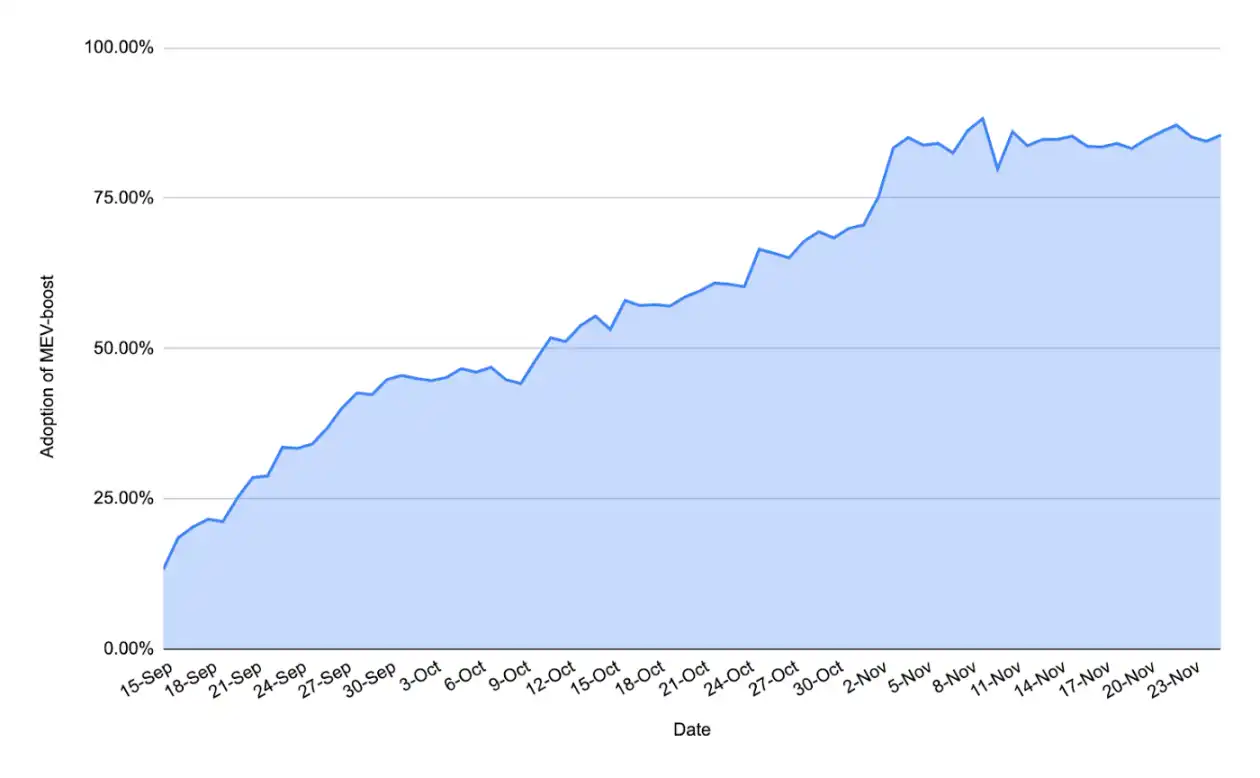
MEV-Boost adoption rate changes, source: https://dune.com/queries/1279670/2192739
Next, we can look at the changes in rewards for validators over time in the execution layer. The following chart shows the total rewards paid to validators in the execution layer, including MEV. This data is taken from Chainsight Analytics' MEV-Boost Dashboard.
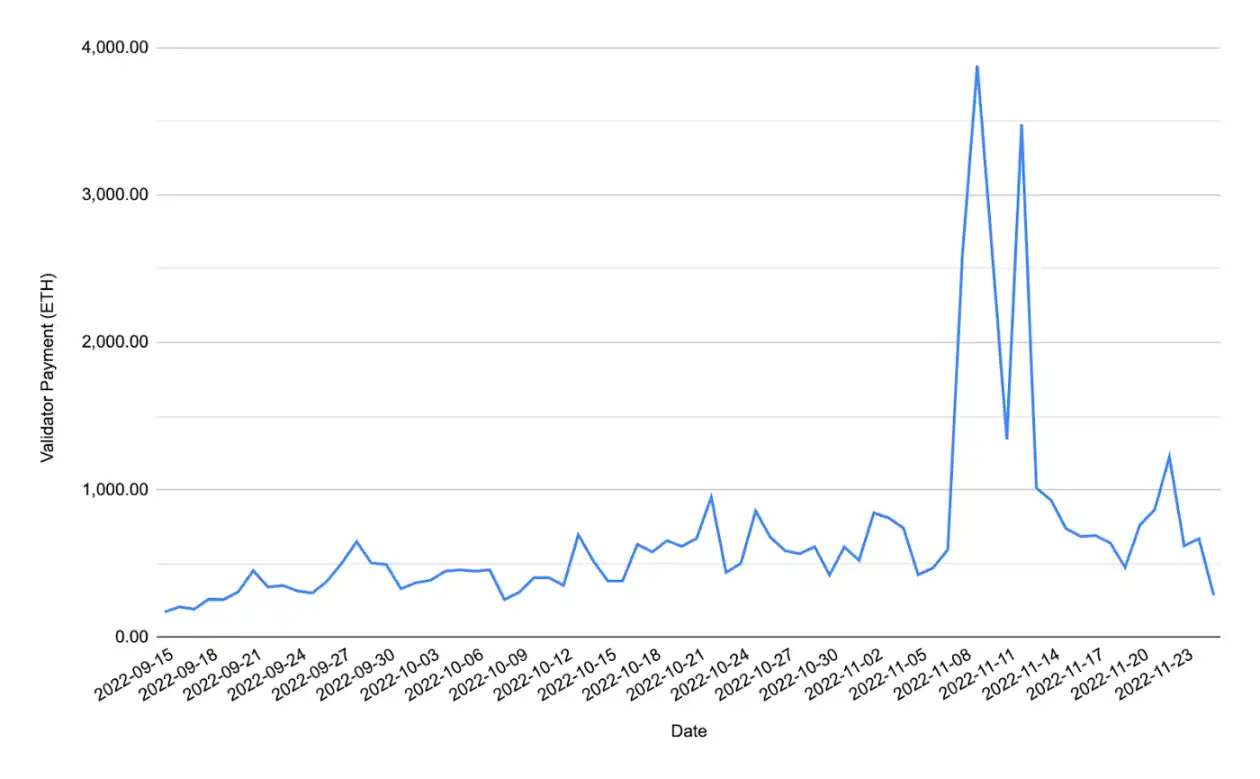
The reward paid to validators, source: https://dune.com/queries/1279670/2192739
Of course, the execution layer rewards include the priority fees of all transactions in the block and any MEV captured on top of that. To determine whether the lack of concentration of validators after the merger is due to less MEV, we need to separate MEV from priority fees. Fortunately, our friends at Flashbots have already done so. Their data analysis shows that MEV accounts for 73% of all payment rewards for validators.
Putting all these metrics together paints a picture of MEV being fairly evenly distributed across the entire validator set, which mitigates centralization.
How will withdrawals affect the allocation of collateral?
This is an interesting question. Will we see stakers move from one staking provider to another? Currently, all stakers are locked in. Once withdrawals are enabled, competition between staking pools will intensify. At this point, we may see a spontaneous redistribution of staking shares.
Whether this will happen and how it will happen is just speculation, but we may see many people simply transferring funds based on APR, or we may see more market share attracted by liquidity collateralized derivative agreements. When withdrawals are enabled on Ethereum, we may see distributed validator technology launched and running, please refer to Obol or SSV network.
Relay Centralization
As of November 23, 2022, Flashbots' relays have processed approximately 80% of MEV-Boost blocks, while BloXroute's relays have processed approximately 14% of blocks.
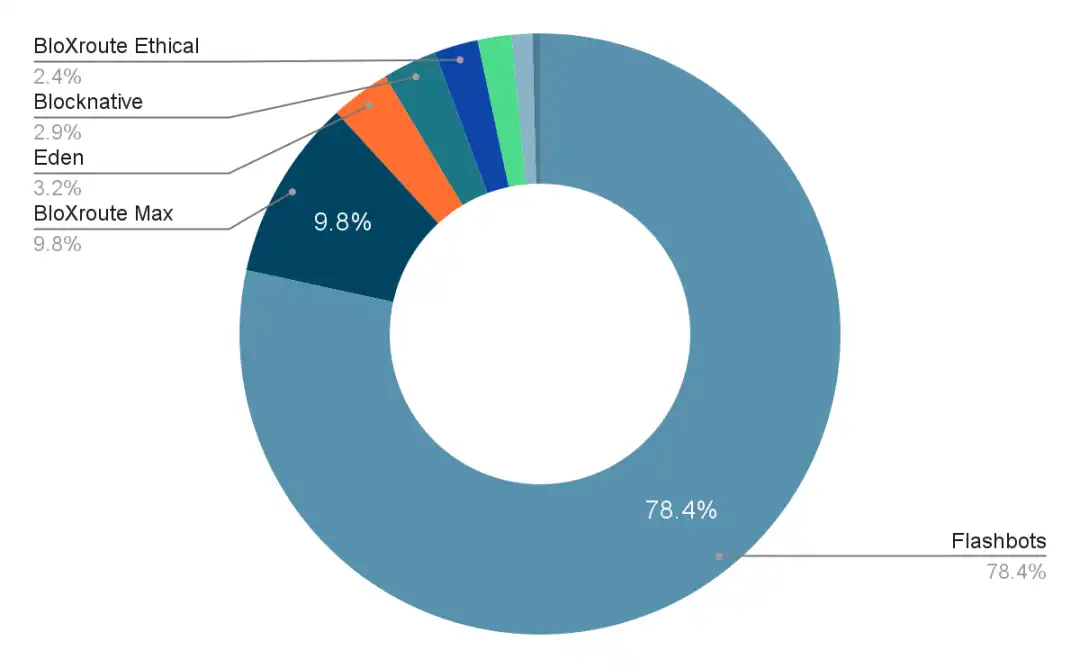
Block distribution processed by the relay, source: https://www.mevboost.org
This clearly indicates a high degree of centralization of a very critical component in the Ethereum infrastructure. This is not ideal, as the potential issues with this level of centralization became a focus of attention when Tornado Cash was sanctioned by the US Treasury Department (especially OFAC) in August. They added a large number of smart contract addresses related to Tornado Cash to their SDN list. This created a ripple effect and led to many organizations removing the UI, GitHub code repository, and of course, RPC endpoint providers reviewing any transactions sent to Tornado Cash.
It is currently unclear whether OFAC is aware that they cannot actually prevent access to Tornado Cash (spoiler alert: it is still actively being used), but placing these contract addresses on the SDN list has had the expected chilling effect. Many MEV-Boost relays have started scrutinizing Tornado transactions (rather than risking imprisonment or paying hefty fines), including one relay from Flashbots. This means that at the time of writing, 75% of all blocks on Ethereum are being scrutinized.
It is important to note that this censorship system will not prevent access to Tornado Cash (or any other contract that happens to be censored), it will only delay routing to Tornado Cash by a few blocks. Justin Drake refers to this as "weak censorship" in contrast to "strong censorship" which completely blocks access. However, the real issue is not currently using Tornado Cash, but rather if Ethereum enforces authoritarian government laws, it cannot claim to be a reliable neutral platform. This makes the centralization of MEV-Boost relays a problem.
So what causes the centralization of MEV-Boost relays?
Recall in Part 1, I described the phenomenon of MEV-hiding and how it could lead to trust issues between staking pools and relays. Staking pools typically prefer their node operators to connect to specific relays so they can track the amount of MEV paid to their validators. This is to identify any potential payments to node operators that were not passed on to the validators. This, of course, is a contributing factor to the centralization of relays, as it is easier to use established and trusted relays once valuable blocks are produced by builders.
Block Builder Centralization
Surprisingly, the block distribution proposed by third-party block builders to the network is actually quite even. I had predicted that network effects would only push for the emergence of a few major block builders, and in fact, I did not completely rule out the possibility of a single block builder emerging.
On the contrary, what we see is the emergence of a large number of block builders. There is still some centralization, as 50% of MEV-Boost blocks are created by two builders: Flashbots and 0x69. There are approximately 8 or 9 active block builders, as well as dozens of smaller long-tail builders, all of whom have less than 2% share.
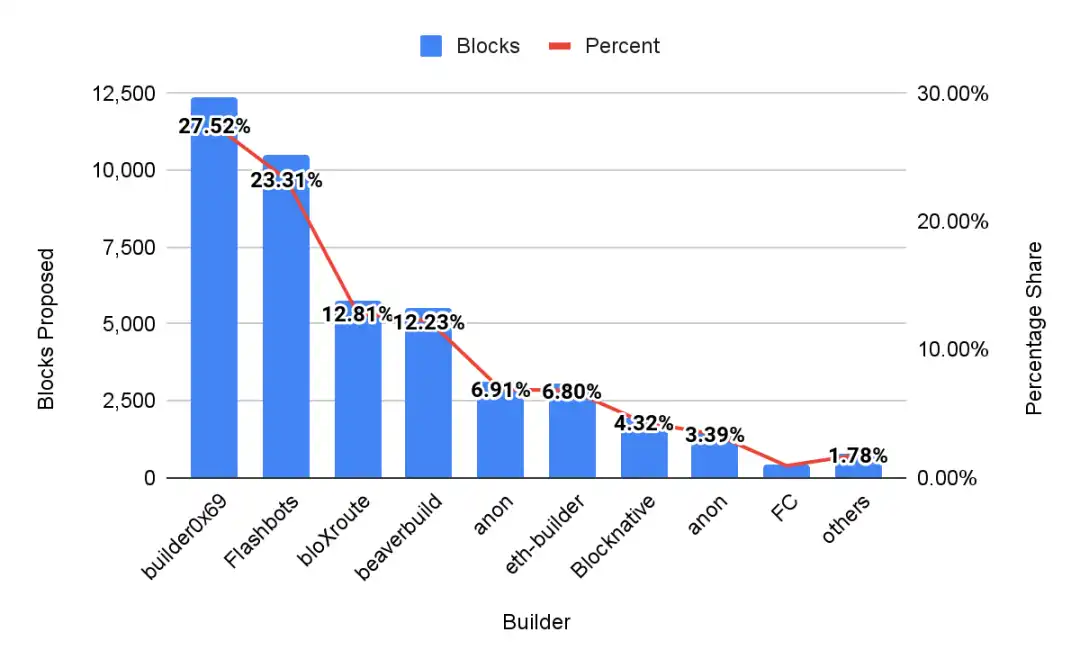
Block builder distribution as of November 21 to 28. Source: https://www.relayscan.io/
This can still be improved, but it is not much worse than the centralization of PoW. In PoW, two major mining pool operators produce most of the blocks.
Interestingly, during the initial period after the merger, as predicted by myself and others, a single dominant block builder emerged. However, over time, this situation changed. The following graph shows the distribution of block proposals from different builders over time.
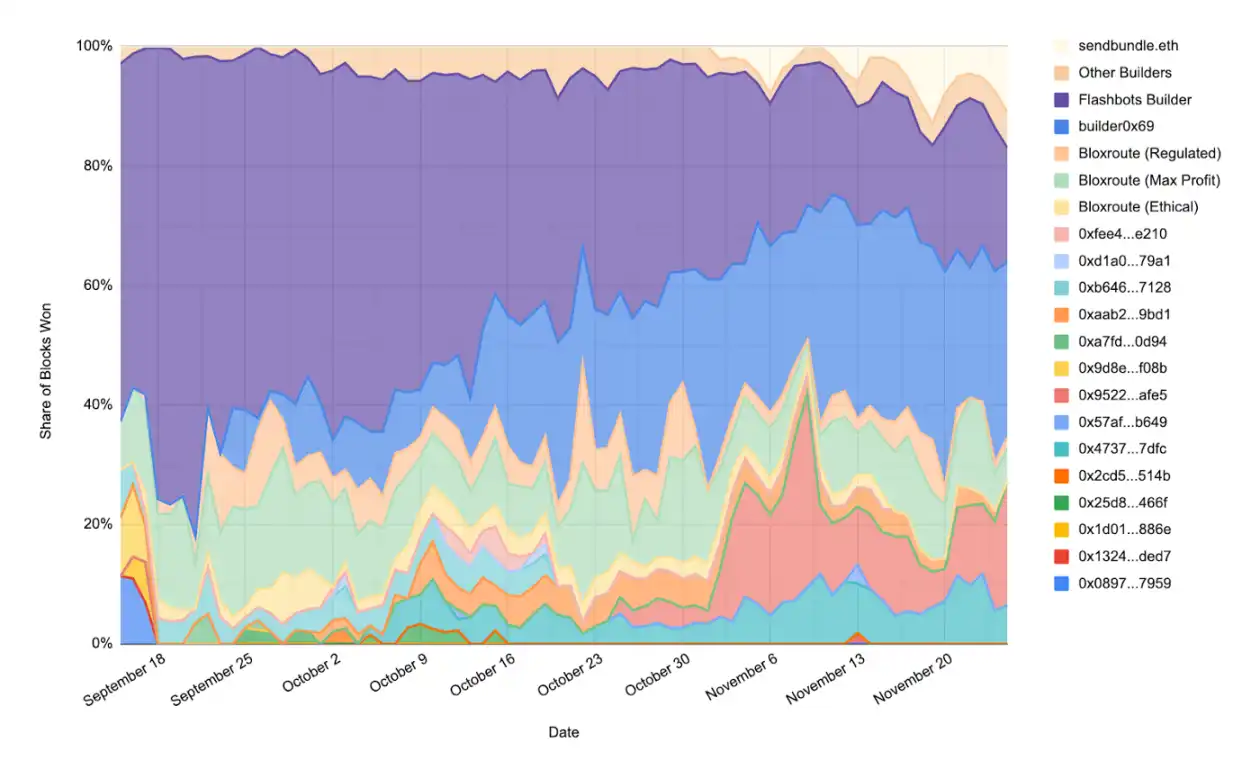
Proposal on the distribution of block shares on the network, source: https://dune.com/queries/1306635/2237247
As you can see, Flashbots once built over 60% of MEV-Boost blocks. If you combine these numbers with the total adoption rate of MEV-Boost by validators, you can see that at one point, Flashbots generated about 30% of blocks on Ethereum. This was somewhat expected, but also concerning because at that time, this trend seemed to continue.
The following image shows the percentage share of MEV-Boost blocks proposed to the network by Flashbots, represented by the blue line. The red line represents the overall adoption of MEV-Boost by the validator set, while the yellow line represents the percentage of MEV-Boost blocks built by Flashbots out of the total adoption.
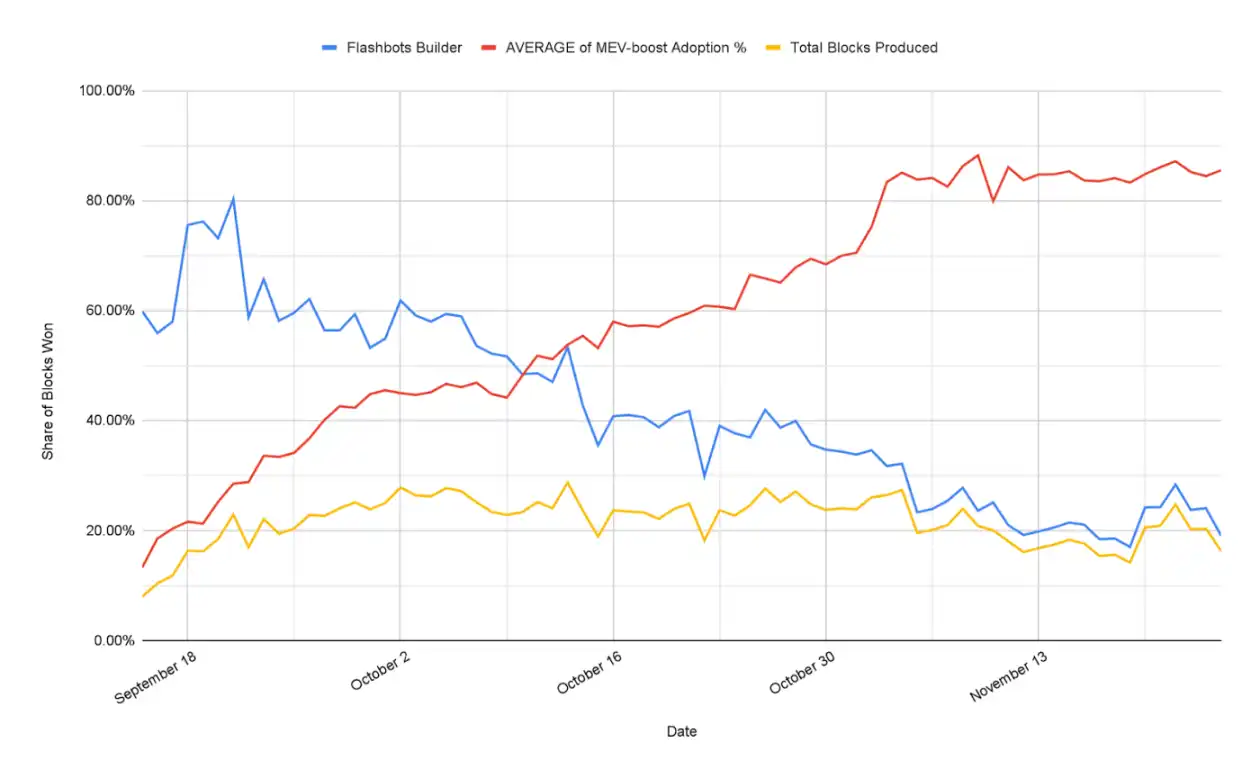
Comparison of Flashbots' share in MEV-Boost blocks with overall MEV-Boost adoption rate.
Source: https://dune.com/queries/1306635/2237247
The trend of builders hoping to accelerate their entry into the field and win more proposal block shares continues to develop over time. It is commendable that Flashbots has decided to encourage this practice by open-sourcing their block builders, which should make it easier for block builders to compete.
The number of block builders changes, source: mevboost.org
The future of Ethereum?
Obviously, MEV-Boost is not just a software, it is a critical part of the Ethereum infrastructure. What Flashbots has created fundamentally changes the design philosophy of the network. Looking ahead, Flashbots hopes that the management and governance of MEV-Boost will be handled by the community.
In early October, Flashbots called for more community participation and received a positive response. Many organizations have stepped forward to contribute to the ongoing management and development of MEV-Boost.
In the future, decisions will be made around how to implement partial block auctions, trading lists, new transaction types, etc. We hope to see more people participate and contribute to this process.
There are many innovations in this field aimed at mitigating the risk of MEV as a centralizing force in Ethereum, many of which are expected to be quite successful. In fact, MEV mitigation measures have their own lane on the Ethereum roadmap, labeled as a "natural disaster". The center of this lane on the roadmap is "Protocol-level Backstop Syndication (PBS)".

Ethereum roadmap, source: https://twitter.com/vitalikbuterin/status/1588669782471368704
Protocol-based Separation (PBS) in the Agreement
PBS is a design concept, and there are multiple methods to implement PBS. There are also various reasons for researching it.
PBS was originally proposed as a way to mitigate the centralizing effects of MEV. Our idea was that if we outsourced MEV extraction to experienced professionals and allowed equal access to the outsourcing service for each validator, this would prevent staking pools from benefiting from economies of scale to the point where they gain a larger share of the growing set of validators.
PBS also has an impact on scalability - namely danksharding. Not all validators can create a danksharding large block. Without PBS, the number of validators on the network may significantly decrease, making PBS a key factor in enabling danksharding.
MEV-Boost can be considered as a "proto-PBS" or a PBS that exists outside of the protocol. To some extent, it can be seen as a good test for this idea. However, the problem with this approach is that it places the MEV-Boost relayer in a trusted position, trusted by block builders and proposers. Without some form of protected PBS, there is no way for proposers to be confident that the builder's block will be released and they will receive payment, and there is no way for builders to be confident that the MEV in their block has not been stolen without trustless means.
Therefore, PBS seems likely to be incorporated into the agreement in some way, but it is unclear at this time how this will happen, as there are many proposals to do so.
For more information on how to implement PBS in protocols, please refer to the ideas described in these threads:
Proposer / Block Builder Separation Friendly Fee Market Designs
Two-Slot Proposer/Builder Separation
Single-slot PBS using attesters as distributed availability oracle
Other directions: Partial block auction
As we can see, outsourcing the construction of the entire content of a block to third-party block builders may lead to inconsistent preferences for the content of the block. For example, builders may try to avoid any potential issues with the US government and therefore review certain transactions.
The solution seems to be to only outsource the construction of certain block contents, a concept commonly known as partial block auction.
There are many ways to solve this problem, but they all seem to revolve around one idea: the proposer creates a block prefix or suffix containing the transaction, while the rest of the transactions in the block come from the block builder. Currently, we have not seen any proposals that allow multiple block builders to contribute transactions to a single block.
Eigenlayer has proposed a seemingly increasingly popular method, in which they use a re-collateralization mechanism.
Through re-mortgaging for partial block auction
The idea of re-collateralization is very simple. When validators register in the protocol, they deposit 32 ETH into the deposit contract and provide their withdrawal credentials, specifying an address for withdrawal in case the validator wants to cancel their stake.
Re-mortgaging is based on the idea of providing a smart contract address as the withdrawal address. Once validators cancel their pledge, they will withdraw their balance to this re-mortgaged smart contract, and must exit the smart contract to receive their pledge and validator rewards.
This allows smart contracts to impose additional penalties on validators, so in order to get their stake and the full reward of validators, they will need to fulfill the commitments they made as validators. In fact, Eigenlayer allows for the creation of various re-staking contracts, which are called "middleware". In this way, Eigenlayer can be considered a "programmable slashing protocol".
An example of a commitment that validators can sign is partial block auctions, where validators can create a portion of the block themselves and allow another portion to be created by the block builder. Validators can allow the block builder to create any size portion of the block and propose the remaining portion themselves.
In this setting, the MEV-Boost relay storage builder section of the transaction is configured to forward the Merkle root of the transaction to the validator. The described setting still relies on a central trusted relay, but the validator maintains a backup block in case of any issues, which they can propose. Additionally, Eigenlayer can use another middleware to completely eliminate the trusted relay, which is designed as a data availability layer.
By using this data availability middleware, builders send their block portions to the "data availability arbitrator". They do this by secretly sharing their blocks with nodes in the DA arbitration, so that no node can access any information about the block. The arbitration nodes sign the secret blocks they receive and return them to the builder, who then creates a "certificate" in the form of an aggregated signature and includes it in their bid to the proposer. The proposer selects the highest bid among all bids with valid certificates and signs the block header included in that bid. The proposer then sends the signed block header to the DA arbitrator, who publishes their respective secret blocks to the proposer, who can now reassemble the builder's portion of the block.
This method is very interesting for two reasons: it means that the proposer can build part of the block themselves, which will help alleviate the censorship system issues currently affecting Ethereum, and it will also help decentralize the MEV-Boost infrastructure and eliminate reliance on centralized relays.
Through PEPC to conduct partial block auctions
Please note that Barnab Monnot has also conducted an exploration that reflects the form of re-staking at the protocol level. This will allow validators to make general commitments with any third party and have the proof committee enforce this commitment at the protocol level without the need for Eigenlayers to re-stake contracts/middleware. This idea is called Protocol Enforced Proposer Commitments, or "PEPC". The main reason behind this approach is, as Barnab said, that when the protocol no longer knows how many validators are effectively in danger, it may ultimately undermine the stability of consensus (although I believe Eigenlayer has another idea to mitigate this situation, including programmatically triggering validator exits).
PEPC's method of promoting partial block auctions is similar to re-pledging, but it allows the protocol to track which validators are being reduced and to what extent. Of course, this assumes that the proposal, if enforced by the protocol, promises to be more attractive to validators and third parties than the re-pledging smart contract.
Protocol-level Partial Block Auction
Part of the block auction in this form has been proposed as an alternative to crLists (anti-censorship lists) in PBS, and I will delve into it later. In this scheme, the partial block auction will be facilitated by the protocol itself. With this idea, proposers can provide prefixes or suffixes, which basically means that the builder will provide part of the block, while the proposer will provide the rest. Vitalik discussed the trade-offs between the two approaches, such as the additional burden it brings to proposers, which may hinder the progress towards a fully stateless system.
Transaction contains list /crLists/ mixed PBS
The transaction includes a list, and crLists is a method to reduce the burden of transaction review for block builders, without requiring the proposer to actually provide any part of the block.
At a high level, this idea allows proposers to create a list of valid transactions they observe in the public memory pool (i.e. valid random numbers, signatures, balances, maxFeePerGas, etc.), which should be included in a block based on Gas Price.
This is not as simple as it seems, and there are various different variations of this method. All variations of the crLists method seem to center around one central principle, which is that the protocol will force builders to generate a complete block, or a block that includes a list of proposers.
The reason for doing this is that if a builder creates a block that does not use all available block space, even though there are transactions that can be included in the memory pool, can we assume that the rational builder is reviewing the transactions for some reason, because not including all available transactions is unreasonable. If the block builder generates a block that does not use all available space, then there is no reason for the block they generate not to include transactions in the crList.
Under this scheme, in order to avoid scrutiny of transactions from crList, builders need to fill a block to the gas limit so that their block is accepted by proposers and the network. To do this, they need to fill the block with random transactions themselves. This may be economically feasible for one or two blocks, but remember: under EIP-1559, once the block limit is reached, the base fee will increase, which means builders will need to pay more gas for transactions to avoid having to include crLists. Over time, the increase in base fees will mean that most normal transactions will not be able to be included in blocks, which in turn will require builders to "fill" even larger amounts of space.
The more likely scenario is that block builders will refrain from generating blocks until crLists no longer contain sanctioned transactions. This should rebalance the landscape for block builders to support non-censoring builders.
This method seems to rely on altruism. The various designs of crLists ensure that the cost of creating crLists for proposers is not high, so theoretically it will not cost them any fees, but there is no clear motivation for them to create crLists.
If the proposer of the current time slot is responsible for creating the crList for that time slot, there is a motivation to create an empty list, as this will ensure that the block builder continues to build the most profitable block. This is especially true when the primary block builders (who typically build the highest value blocks) are reviewing.
Therefore, it is proposed to create a crList for future time slots. For example, the proposer of the current time slot 2n creates a crList for 2n+2. This is called a "forward inclusion list". In this way, the proposer of the current time slot will not incur financial risks by creating a crList. This also has good properties compatible with single secret leader election or SSLE, as proposers will not deceive themselves by publishing crLists before their positions.
This document outlines a non-exhaustive list of variants for the design of the crLists scheme.
Open Question
All the ideas listed above are under active discussion, and I find some of them very promising. However, I have some questions: Why don't validators outsource 100% of the blocks to builders? Are we relying solely on altruism? What motivates proposers to do any work to provide partial blocks? Why do validators spend energy creating crLists? If it's because Ethereum clients default to doing so, can validators choose to disable it? I can imagine that some node operators of staking pools would be unwilling to publish crLists or block prefixes/suffixes containing sanctioned transactions.
What should be done if the incentive measures are misaligned? If the proposer provides a part of the block, will this take away valuable block space that the builder can use to derive MEV? Even if there are not enough transactions to fill a block, the proposer needs to carefully choose transactions that will not conflict with the builder's bundle.
As far as crLists are concerned, what happens if the proposer does not publish the crList on the P2P network? Can this be enforced through consensus? This has a strong synchronization assumption and will increase complexity, as mentioned in some of the source materials I have linked to.
In addition, how does crLists work together with partial block auctions (i.e. block prefixes/suffixes)? For example, what happens when many validators participate in re-staking for registering partial block auctions during the implementation of crLists?
Conclusion
The above are just a few questions I thought of when writing this article, and there are more challenging questions raised by people who are smarter than me. Therefore, as you can see, there are still many unresolved issues and potential concerns that need to be addressed before determining any specific direction or method. In this regard, it may take several years before effective solutions emerge, and by then the entire MEV landscape may be very different.
Through studying this article, my main conclusion is that since the merger, I am more optimistic about Ethereum because I have seen a lot of innovative ideas emerging to solve the newly generated centralization problems. Additionally, some of these ideas are clearly having an impact. We have seen a trend of decentralization in various key parts of the ecosystem, and these trends seem to continue, which will put Ethereum in a stronger and more robust position in the future, giving confidence and encouragement to those who are building tools to improve people's lives.
Original source
Welcome to join the official BlockBeats community:
Telegram Subscription Group: https://t.me/theblockbeats
Telegram Discussion Group: https://t.me/BlockBeats_App
Official Twitter Account: https://twitter.com/BlockBeatsAsia
 Related Articles