SBT: Unlock the future key of DeSoc

Original title: SBT: Key to the Future of DeSoc
Original article by Huobi Research
Abstract
SBT 由 Vitalik 受游戏《魔兽世界》启发后在论文中提出,是一种公开可见、不可转让,但可以被撤回的Token类型。绑定这些 SBT 的账户就是灵魂,灵魂可以对应个人、机构、组织等等,且一个灵魂可以拥有多个 SBT。SBT 将用户的特征和成就在链上以 Token 形式进行标记,并且附带可验证的信息。SBT 可以帮助用户在 web3.0 世界中构筑原生数字身份,最终实现去中心化社会的愿景。SBT 与 DID 的概念有重合的地方,从功能上讲,它们都是希望通过证书或标识符的形式来描述用户的特征,进而构建出一个数字身份。SBT 是从下而上的解决方案,是实现去中心化身份的一种手段。
At present, there are three main categories of SBT based projects, which are certificate, identity and semi-credit. Certificate projects issue certificates in the form of SBT for a user's on-chain actions, representing the user's experience or qualifications. Projects that work with them can rely on certificates owned by users to more precisely locate and filter users for other activities or business. An identity project can be regarded as a high-level project that aggregates multiple certificates issued by itself, directly uses SBT as the certificate of identity, and can contain other certificates such as KYC information. Semi-credit lending projects measure the credit risk of users by describing user credit SBT, and provide more capital efficient services for users with good credit.
SBT circuit is still in its early stage, and it is mainly faced with the problem that there is no unified technical standard, it is difficult to balance privacy protection and verifiability, and there are loopholes in some application scenarios. After it has accumulated a certain foundation, there may be some new use cases, such as cross-platform SBT to allow users to operate more freely, refined SBT to make marketing more accurate and SBT based credit lending.
今年夏天 Vitalik 提出了一个听起来新奇的名词」灵魂绑定 Token 「,并畅想了它的使用场景。受到他的启发,一批 SBT 概念项目如雨后春笋般纷纷出现。可惜由于加密市场整体趋于下行,SBT 的热度很快就被淹没。10 月,Vitalik 铸造了可用于兑换帕劳共和国数字身份(SBT)的 NFT;近日 Huobi Global 宣布支持帕劳共和国 ID 进行 KYC 身份验证。SBT 这个神奇的名字再一次引起了人们的兴趣。那么 SBT 到底是什么,它仅仅是天才不切实际的突发奇想,是一个博人眼球的概念,还是能推动加密行业开创新领域的智慧火花。本文旨在带领读者认识 SBT,探寻它的含义、发展现状和价值。
1. Origin: the past and present lives of SBT
1.1 Etymology and meaning
Soulbound, a term derived from World of Warcraft, is an underlying mechanism implemented by the game to define the ownership of some powerful equipment. The player is rewarded for completing copies or certain missions with in-game equipment. Once picked up, these equipment items are uniquely bound to the player and cannot be transferred or sold. It is this special design that gives players a unique experience and has helped World of Warcraft to become popular around the world for decades.
With the popularity of the NFT market, NFT has been widely used in determining the rights of scarce digital assets by virtue of its unique and inseparable characteristics, and the form is also quite consistent with in-game scarce items. Not only that, but it also serves other purposes, such as as proof of a certain ability, qualification or social status. However, because NFT can be transferred freely, especially in the past two years there have been a lot of rich stories about NFT, leading people to focus too much on its trading nature. At this point, if the NFT is still a badge or a token of ability, it is impossible to tell whether the holder really has the merit or just has enough wealth. Therefore, Vitalik took inspiration from soul binding and tried to combine the two to explore some new applications.
在《Decentralized Society: Finding Web3』s Soul》一文中,Vitalik 将他的构想做出了详细阐述,并对灵魂绑定 Token (SBT,soulbound token)给出明确定义。SBT 是公开可见、不可转让,但可以被撤回的 NFT。这个 NFT 代表了用户在链上有过某种行为或经历。由于这些行为发生在区块链上,它们天然地可追溯。绑定这些 SBT 的相关账户就是灵魂,灵魂可以对应个人、机构、组织等等,且一个灵魂可以拥有多个 SBT。不仅如此,SBT 通常被用来构成 web3 世界中社会关系的承诺、证书或是从属关系,其作用就像一份可扩展的简历,将对应灵魂的特征和成就在区块链上以 Token 的形式进行标记,并且附带可验证的信息。由此,SBT 可以帮助用户在 web3.0 世界中构筑一个与现实社会映射的原生数字身份,通过建立并不断扩大这种社会关系网络,最终实现去中心化社会的愿景。
1.2 New solutions for decentralized identity
Careful readers may already have doubts that the SBT seems to be very similar to the existing DID circuit, thinking that the SBT is a copy of the DID. To be sure, the two tracks have a lot to do with each other, and there is a lot of crossover between concepts. Therefore, it is necessary for us to clarify the difference between the two and explain their respective values and development paths.
The full name of DID is Decentralized Identifier (Decentralized Identifier), which emphasizes decentralization and hopes that users can have full control of their own identity, rather than the large centralized platform controlling user identity data in the world of web2. This has been the core narrative of previous DID projects.
As for "ID", people have different understandings, with the dual meanings of "symbol" and "identity". The standard concept of DID was proposed and elaborated by the W3C in a draft working paper on DID published in 2019. This was followed in 2021 by the publication of the Recommended Standards for Publishing Decentralized Identifiers (DIDs) Version 1.0 Proposal, which explained the meaning of DID in detail. It says that "entities are identified by decentralized identifiers and can be authenticated by proof (e.g., digital signatures, privacy-protecting biometric protocols, etc.)." From here, you can see that DID is a symbol used to identify an entity. What this symbol can be used to identify is not specified in the standard.
The emergence of DID is intended to change the current status quo of digital identity controlled by central institutions. It aims to build a global digital identity while returning the ownership of digital identity data to the user. Just like a real-life ID number, which each person has only one and cannot be transferred, any other certificate can be associated with it. Therefore, some people tend to interpret DID as a Decentralized Identity, a global identity that includes various characteristics of users.
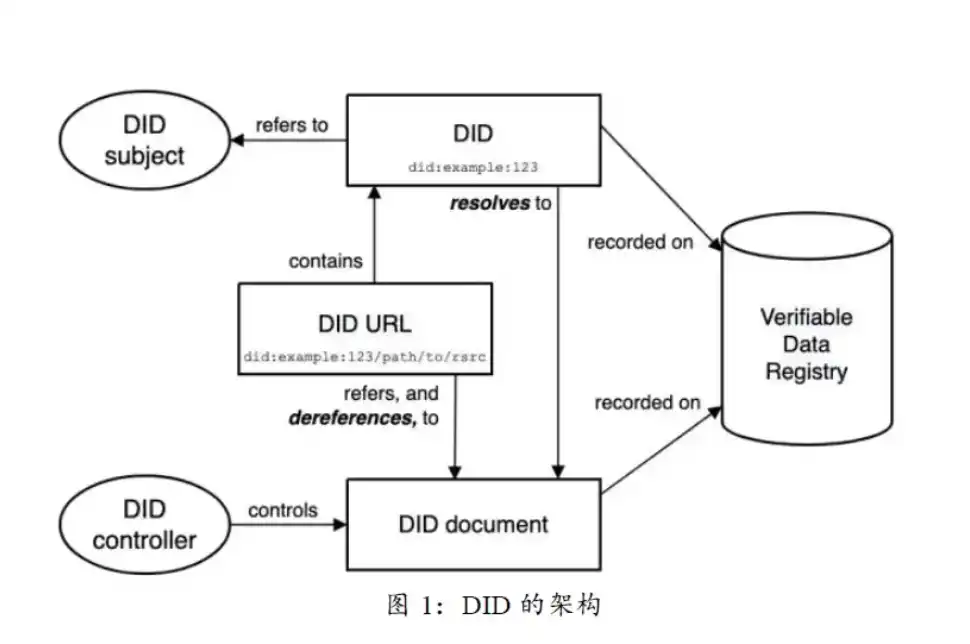
Architecturally, the DID system roughly includes decentralized identifiers and DID documents, DID parsers, verifiable credentials (VC), verifiable data registry and other components.
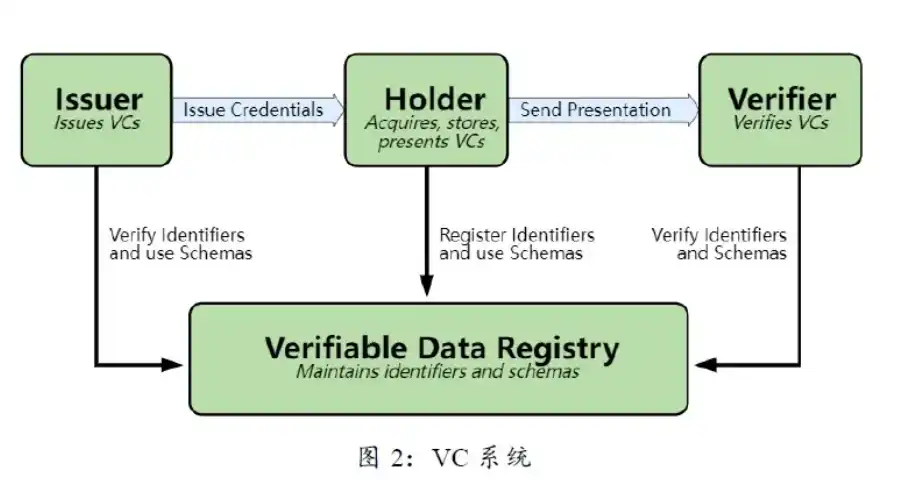
Among the W3C's list of recommendations, DID uses verifiable credentials (VC) as a verification method. The VC is generated by a third party (Issuer) to certify that the user has certain attributes. To protect privacy, the Issuer has the right to access the user's identity information stored below the chain, generate a zero-knowledge certificate and upload it to the chain. This would prove the identity of the user without compromising privacy. Users can store VC in a wallet and reuse it, just like any other crypto asset.
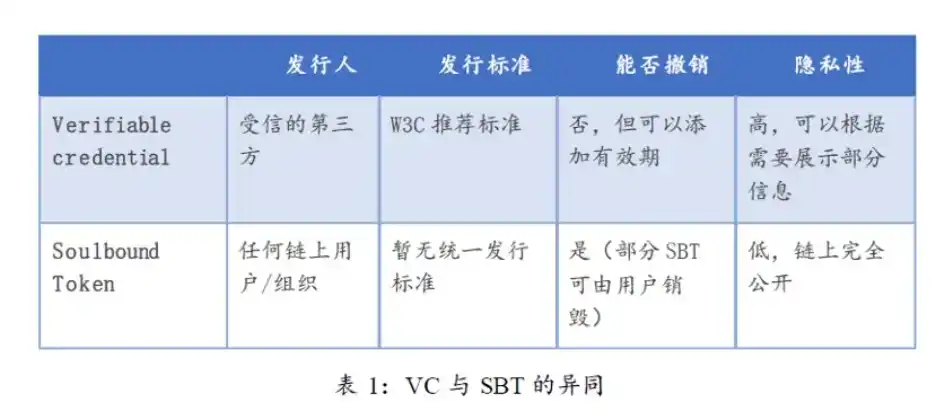
In this way, although VC and SBT are both solutions to DID, they are slightly different. The following table summarizes the characteristics of VC and SBT.
I believe that everyone will understand here, easy to cause confusion is that DID has a double meaning. The DID project implements the same functionality as SBT when it represents a generic certificate with some sort of identifier, especially if the certificate is not transferable. And when DID is used to represent identities, it is itself the Soul Bound by Tokens with SBT.
In summary, we summarize the main differences between SBT and DID: (1) SBT is a bottom-up solution and a means to achieve identity. It focuses more on what kind of certificates are issued and what kind of abilities and qualifications are embodied in the form of non-transferable NFT. And DID is the result of identity on the chain. It focuses on aggregating multiple tags, multiple addresses and even multi-chain addresses to form a global identity. (2) The identity of SBT construction is a solution in the unit of address, while DID hopes to realize a solution in the unit of address collection to some extent.
In the future, a possible ideal scenario would be for each user to have a unique, decentralized identity with a number of non-transferable credentials representing their experience, skills, and qualifications in different areas. This identity can be a single address or a collection of addresses.
As a result, the competitive landscape of credentials and identities is clear. Any organization can issue credentials to users. The threshold for this business is low, but it takes several large, influential organizations to aggregate the credentials into a common identity across multiple applications or even multiple networks. This business is valuable and the threshold is relatively high.
2. Typical SBT-based applications
Vitalik's paper lists eight use cases based on SBTS, such as reputation offering, SBT community restoration, soul airdrop, soul governance, and soul lending. So I won't go into the details of this article, but I'll just categorize his ideas here:
1. Use SBT as certificate to establish identity;
2. Use the identity established based on SBT to achieve more advanced functions, such as credit lending, more democratic governance, community recovery key, etc.;
3. Use SBT as the carrier of non-transferable special assets.
With the first two types of applications already on the market, let's take a look at SBT and its role based on identity in the context of typical projects.
2.1 Certificates
Because of the non-transferable nature of SBT, it is well suited to represent certain abilities and qualifications of the holder that are acquired by their own actions, rather than by assets. At present, certificate projects account for the largest number of applications based on SBT. Such projects are represented by POAP, Project Galaxy, and RabbitHole. In common, they issue certificates in the form of SBT for users' on-chain/off-chain actions. This certificate represents the user's experience or qualifications. Projects that work with them can rely on certificates owned by users to more precisely locate and filter users for other activities or business. RabbitHole is used as an example to illustrate a typical running pattern for this type of project. (Individual project certificates are transferable NFT, but the design idea is the same.)
RabbitHole 是一个有奖的新手课堂。它通过发布有奖任务来吸引用户,让用户学习并使用特定的 Web3 应用之后领取奖励。奖励包括活动定制的 NFT 和由项目方提供的 Token 奖励。
In order to be eligible to participate in the event, users first need to complete the basic Skills study and certification at the Skills training camp at RabbitHole to obtain a skills certificate in the form of SBT. For example, in order to obtain an Intro to L2 certificate, the user needs to complete three small tasks, namely transferring ETH to a network of Optimism using a Hop cross-chain bridge, converting ETH to an OP on Uniswap, and casting an NFT on Quix.

获得了技能证书后,用户就能以此为前提条件,参与更多的有奖任务。比如之前 Uniswap 曾与 RabbitHole 合作,发布了 Learn L2s with Uniswap 任务 Quest。完成这个任务的前提条件是要拥有 Bright ID 认证(真人认证)和由 RabbitHole 自己颁发的 Intro to DeFi 证书(当时还没有 Intro to L2 证书)。Quest 分为 4 个小任务 tasks,本别是在部署在 Arbitrum 和 Optimism 上的 Uniswap 里提供流动性和交易。完成了这 4 个小任务后,用户可以获得 2 枚 UNI Token 奖励和一个 NFT。
Certificate projects are sort of like on-chain data service providers. Cooperative projects can directly query the certificates they issue, rather than having to personally read the user interaction history. This saves time and economic costs in processing data for collaborative projects. Their revenue model is to charge a fee for the project.
Using RabbitHole as an example, they will run the whole event in conjunction with the partner project, including event start and end times, mission setting, rewards and expected number of participants, community and media outreach, tutorials, etc. RabbitHole will charge the partner 20% of the reward amount as a service fee and lock up the warehouse for one year. In this way, the service fee is more like an operating fee, of which the data usage fee is only a part.
The key to certificate-type projects is to have partners recognize their certificates and conduct activities based on them. On the one hand, their income is more dependent on the overall activity of the market, when the market is active and various projects can come up with customer financing, their income is guaranteed. And when the market is quiet, they don't have much business to do. On the other hand, their revenues depend on their market power. If a project has been running for a long time, has a large and active community, and can attract users, their credentials are more likely to be recognized and make a real difference.
2.2 Identity Class
Sbt-based identity class projects use SBT directly as user identity credentials. In this system, SBT realizes the function of DID. The identity category is represented by BAB and the Palau Digital Identity card mentioned at the beginning.
BAB 是交易平台 Binance 于 2022 年 9 月推出的基于 BNB Chain 的首个灵魂绑定 Token ,它是 SBT 概念在身份证明赛道上的具体落地。BAB 与币安账户绑定,遵循 ERC-721 标准,只有在该交易平台进行过 KYC 的用户才能申请,且单个账户 ID 只可铸造一枚,铸造费为 1BUSD。铸造完成后,BAB 不可转让,只可以撤销。
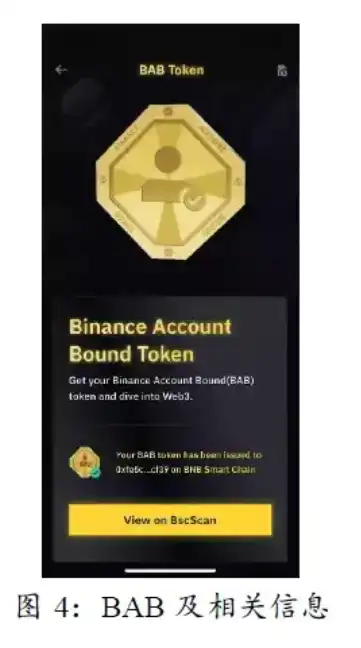
BAB is young, but its arrival has brought some predictable opportunities.
(1) For the holding user, although BAB's non-transferable nature prevents it from having direct financial and wealth value, it represents the on-chain behavior credentials corresponding to the address and can be verified by others. The user simply has to hold it to prove that he has successfully passed Binance's KYC process, effectively preventing him from being added to the bot account and missing out on potential airdrop rewards.
(2) For Binance, it can not only earn a certain amount of on-chain revenue by providing channels for the casting of BAB, but also verify the time of the casting of BAB by the user to determine the degree of loyalty of the user, and even provide precise services by analyzing the owner's on-chain behavior in the future.
(3) For the ecological project side, it will be of great help to its community construction and project development if it can quickly integrate its ecology with BAB and take over this part of real users, no matter by air drop or other incentive methods. With this purpose in mind, within less than a week of BAB's launch, 14 eco-projects within the BNB Chain have pledged rewards for BAB holders.
Palau's digital identity card is also an identity class SBT. Application for rental (US$248 for one year) This SBT needs to go through KYC procedures, including uploading ID photo, profile picture, filling in height and weight, etc. Its planned use cases include address verification, KYC verification, access to digital banking, legally verified chain signatures, digital company registration services, and other potential products such as asset ownership and insurance. Officials also specify that it can be used in any application that requires a government-issued ID.
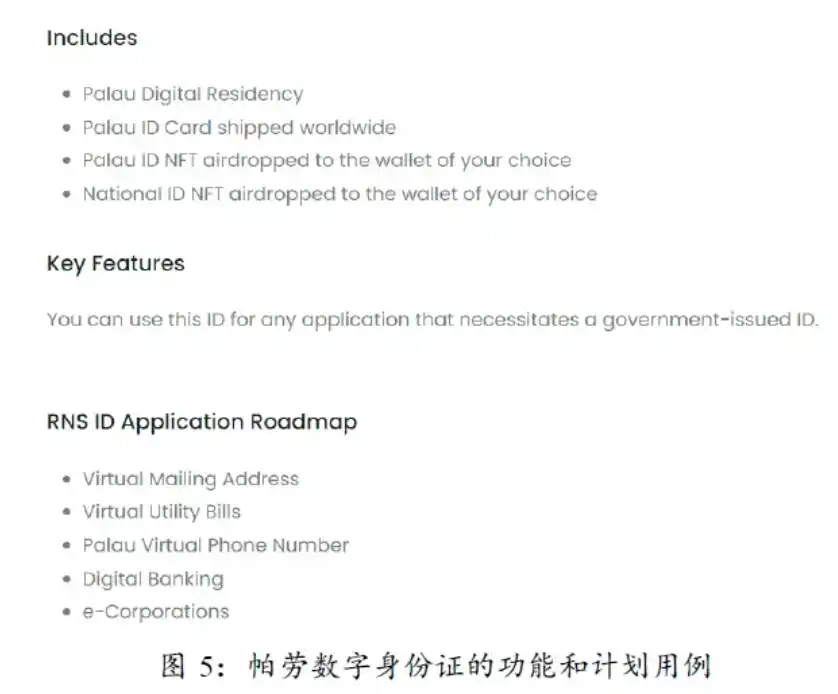
An identity project can be thought of as a high-level project that aggregates multiple certificates issued by itself. BAB is an identity in itself, containing a user's Binance KYC "certificate", and in the future may contain more information such as interactions and position information on the BNB Chain. The KYC certificate is the link between real users and the cyber world. Ordinary blockchain projects cannot issue it to users, but only trading platforms and asset management companies can issue it. Established trading platforms have a significant traffic advantage, so they are the first choice to launch SBT-based identities.
In the future, there may be several large trading platforms combined with their own closely related public chains, their own identity in the issuance chain. This will effectively reduce the interference of robot users to the encryption application, so that ordinary users can get a more comfortable on-chain experience. If the on-chain identity issued by a trading platform can obtain a large-scale consensus, even across several public chains, this SBT will attract incremental users and investment for the trading platform, and achieve feedback.
2.3 Semi-credit lending
Lending programs have grown rapidly since DeFi Summer 2020, but the vast majority are mortgage programs. Mortgage lending conforms to the characteristics of the crypto world with no license and no threshold, but there are inherent deficiencies in the efficiency of capital utilization. Credit lending projects such as TrueFi, Goldfinch, and Maple have since emerged, providing credit loans to crypto companies that have gone through off-chain KYC, expanding the market size of lending, and improving the efficiency of funds used by institutional traders and crypto companies. But it is still harder for the average user to get a loan on credit. One reason is the lack of identity and credit verification on the chain, making it difficult for lenders to measure the credit risk of borrowers. Therefore, Vitalik put forward the concept of "soul lending" in the paper, hoping that SBT could be used as a credit history record to prove that users have a good reputation, so as to directly obtain loans without collateral.
At present, the industry has not completely based on SBT to provide credit loans to general users. However, there is a semi-credit loan project that judges the credit risk level of the user according to his behavior and adjusts his maximum loan-to-value (LTV) based on it. We classify this type of project as the second category of SBT-based application scenarios. The following takes ARCx as a typical representative to introduce how SBT promotes the operation of such projects.
First of all, it should be noted that the word "SBT" does not clearly appear in the official documents of ARCx, but its practice is similar to SBT, so this paper regards it as an SBT project.
ARCx launched a Credit Score similar to SBT's DeFi Credit Score. It scores users based on their behavior on ARCx and other lending platforms, on a scale of 0 to 999. This score reflects the user's risk appetite, risk management ability and knowledge of lending products and market conditions. ARCx sets a borrowing pool of three levels. The higher the user's credit score, the higher the maximum LTV, that is, the mortgage of assets of the same value, the more money can be lent.
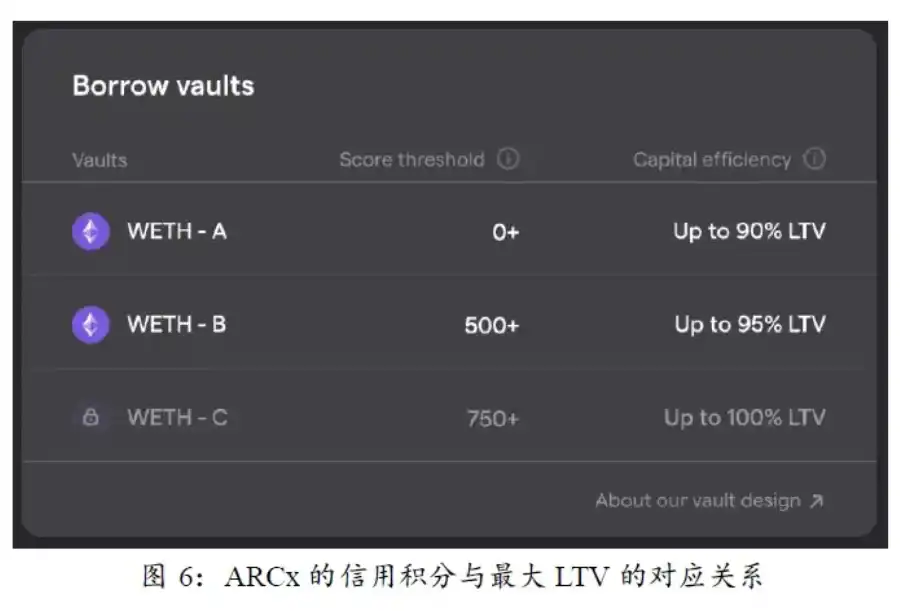
ARCx's credit score is calculated based on the user's address on the chain (Polygon and Ethereum) and the loan protocol interaction record, the calculation formula is fully public. The credit score consists of three major items, namely, daily score reward, survival score reward and liquidation score penalty. Daily score reward is to reward users who use the ARCx platform within 120 days, and the reward coefficient is calculated according to the user loan utilization rate (the proportion of actual loan LTV to the maximum LTV). According to the survey of Compound, ARCx found that the most experienced and capable users had a borrowing rate of about 60%, and they would get the maximum reasonable efficiency of using funds on the basis of controlling risks.
So when ARCx users have a loan utilization rate of 60%, they will get more points, and if they deviate from this ratio, the score growth rate will decrease regardless of whether it is higher or lower. Both the survival score reward and the liquidation score penalty measure how much a user is at risk of liquidation, and both look at the user's performance in all loan agreements. If a large number of liquidation events occur in the lending market, but the user avoids being liquidated, this indicates that the user has outstanding risk control ability and should be given a higher score. If the market is smooth, the average user will not be liquidated, then the score will not be very high. The penalty is easier to understand. If the user has been liquidated within 120 days, he will lose 250 points. With a total score of only 999, the pool that has been liquidated once in a short period of time will not be able to use ARCx's highest utilization pool.
Semi-credit programs like ARCx still operate within the safety of mortgage lending. They measure the user's credit risk by describing the user's credit SBT, and thus provide more capital efficient services for users with good credit. So far, this design is in line with the status quo of the crypto industry and is an effective complement to traditional excess mortgage lending.
3. Development problems of the current SBT track
Although various SBT projects have sprung up since Vitalik published his paper, they still have some difficulties in development, preventing them from gaining further market recognition.
3.1 There is no unified technical standard
在以太坊上发行 token,本质上是通过在某地址下建立一个新的智能合约账本来实现的,其上记录了所有用户与其交互的全部交易记录。这种发行方法已形成几个统一的标准,例如 ERC-20,ERC-721,开发者只需按照规则按部就班,即可构造出对应类型的新加密 Token 。
SBT 向 web3 世界展现了一种新的 token 类型,但现有的 SBT 大多是在 ERC-721 的基础上进行略微修改,其概念中不可交易、可撤销及验证的特性在现有的 API 中尚不存在专门的技术接口。没有正式定义的接口,不仅加大了合约代码部署前的安全审计工作,还可能在运行时引发意料之外的攻击事件。另一方面,不同 Token 标准的 SBT 会为集成它们的其他项目带来额外工作量,不利于它们获得更大范围的采用与认同。
The solution to this problem is relatively easy. We need a unified SBT technical standard with public consensus, so as to lay a good foundation for the application of SBT.
In addition, SBT is also programmable, and it is very promising to combine with dynamic NFT in the future to introduce predictive machine for dynamic updating of attributes. Of course this needs to be included in its unified technical standards.
3.2 Privacy protection and verifiability are difficult to balance
For SBT, it is difficult to balance privacy and verifiability. On the one hand, the SBT is generated based on the on-chain behavior of the user and is inherently verifiable. It is because it is verifiable that it has credibility. But on the one hand, SBT is equivalent to a summary of the user's originally relatively scattered behavior, and put a label on it. This increases the risk of exposing users' privacy. On-chain analysis tools can easily learn users' behaviors and habits.
In particular, those projects requiring KYC authentication will face a dilemma. If users' KYC information cannot be verified by a third party, their SBT will more or less lack credibility, thus limiting the scope of use. However, if the KYC information of users is verified by other entities, it will inevitably cause information leakage, such as the information of users in real life, and cause unnecessary troubles. Of course, this will also cause damage to the brand reputation of this project and the SBT released by it.
Therefore, it is a great challenge for every SBT project to obtain as much real user data as possible and build credentials with high consensus on the premise of ensuring user privacy. In the future, technologies such as zero-knowledge proof and multi-party secure computing (MPC) may be used to achieve a balance between privacy and authentication to solve this problem.
3.3 Vulnerabilities Exist in some application scenarios
以将 SBT 用于更民主的治理为例,当前 DAO 依赖的 Token 投票机制往往会遇到女巫攻击和操纵选票的问题。SBT 的出现可以帮助社区有效的筛选出虚假的机器人账户和社区外成员,缓解 DAO 治理时投票不公平的问题。但是,现实生活中投票存在的问题映射在区块链世界里也同样奏效,例如贿赂。有了 SBT 后,那些拥有投票权重高的灵魂更容易被有心之人发现,一旦贿赂事件发生,显然与 SBT 想要帮助实现社区公平治理的初衷相违背。这一点较难解决,它已经超出了计算机科学的范畴,进入了社会学的领域。
4. Outlook: Potential use cases for SBT
It's early days for SBT and the on-chain identity circuit, and more projects are looking at how to launch SBT. Assuming we have more uniform technical standards that make the most of information while protecting privacy, SBT's role will extend beyond soul drops and governance.
4.1 SBT across platforms allows users to operate more freely
At present, Internet applications can log in across multiple applications based on Google, Facebook, wechat and other accounts. However, if users use some of the same types of apps, they will still be required to fill in the same registration information, or they need to go through a process to prove their proficiency. From this perspective, SBT is generated on the blockchain, and the information is publicly available, which is conducive to sharing across applications and platforms. However, the application scope of SBT is still limited to a certain platform. If SBT can realize interconnection in the future, user experience will be greatly improved. For example, A shooting game user wants to choose a favorite game to play for a long time. He can directly compete with the "sharpshooter" SBT sent to him by game A in game B, avoiding the repeated process of upgrading and accumulation of ranking levels. If he gives up A and chooses B, Game B pays A certain fee to Game A.
4.2 Refined SBT makes marketing more accurate
The current SBT measures the user's behavior in a relatively small and shallow dimension, which mainly includes information such as interaction with an application and obtaining an airdrop. Some projects have already recorded and analyzed user behavior at a deeper level, and we need to refine the information of SBT, including the amount of user operation, risk preference, time period, use time and other aspects of information. Especially when combined with the information of the trading platform, such as trading frequency and strategy preference, and what news users follow on the media, the soul depicted by SBT will be closer to the real appearance of users. Based on more detailed user profiles, various projects will carry out more accurate marketing activities to find the most suitable potential users at a lower cost.
4.3 The more widely used SBT helps realize credit lending
The realization of credit loan in reality mainly depends on the imposition of various restrictions on the trust-breakers. If the borrower defaults, his credit is damaged and he will lose many convenient services. For example, the consumption restrictions on the trust-breaking person can not take the plane, train soft sleeper, ship second-class class or above, can not be in star hotels, hotels, nightclubs, golf courses and other places for high consumption, can not buy real estate or new, expansion, high-end decoration of houses, can not rent high-end office buildings, hotels, apartments and other places of office. In accordance with relevant regulations, it will also inform relevant government departments, financial and regulatory agencies, industry associations, etc., for relevant units to implement joint credit punishment in accordance with laws, regulations and relevant provisions, and adopt more restrictions on economic activities. The types of restrictions include: Government procurement, administrative examination and approval, bidding and tendering, government support, financing and credit, qualification recognition, market access, corporate matters, bond issuance, serving as directors and supervisors.
If we learn from the practice in real life, try to flag the dishonest person and limit his on-chain behavior, it is not impossible to achieve credit lending. If some lending agreements form an alliance and issue credit SBT with the consensus of the whole industry, and other agreements and trading platforms cooperate with each other, they will jointly restrict the behaviors of trust-breakers, such as refusing to serve them, and the trust-breakers will face high default costs. If some compliant trading platforms can synchronize users' on-chain default records to traditional financial institutions such as banks and take joint actions, ordinary users will not dare to break their trust easily, and complete credit lending is likely to be realized.
This article is based on contributions and does not represent the views of BlockBeats.
Welcome to join the official BlockBeats community:
Telegram Subscription Group: https://t.me/theblockbeats
Telegram Discussion Group: https://t.me/BlockBeats_App
Official Twitter Account: https://twitter.com/BlockBeatsAsia