Reinventing connections: An Analysis of the Decentralized Social Network Panorama
Original title: Rebuilding Connections
Original article by STEVEN SHI
Kxp, Blockbeats
Earlier this year, Twitter abruptly shut down third-party apps. A few weeks later, it dropped free API access, and its cheapest plan now costs $42,000 a month.
Now, most users have adapted to this reality. Our most important social media apps, from Facebook and TikTok to wechat and Grab, are centralized platforms. While often docile, these platforms occasionally wield power in wayward ways that highlight centralized authority, such as censoring and banning users based on vague content policies or arbitrarily elevating certain users.
These platforms are essential to our daily lives. As a result, users are frustrated with the status quo but don't have much choice. Therefore, in the Web3 movement, decentralized social media is a key direction. Since the Crypto industry runs on Twitter, building a "decentralized Twitter" is more attractive to Web3 founders, who are well aware of Twitter's pain points.
This report explores the decentralized Social (DeSoc) protocol. We reviewed various DeSoc designs and focused on interesting projects. We also analyzed the pros and cons of each protocol's approach and outlined our view of the entire vertical.
The value of the social graph
Since its founding, Twitter has raised $4.4 billion in capital in 19 rounds of funding. When it went public, it had accumulated losses of nearly $1 billion. Yet the products themselves have changed little in the past five years.
However, Twitter is still very valuable, with a valuation of at least several billion dollars. If it were auctioned today, there would no doubt be plenty of buyers willing to bid on Twitter's revenues at a generous valuation.
The key value of Twitter and any social media platform is primarily its social graph. Features as goods (see: Clubhouse Spaces, Snapchat Stories, TikTok/Douyin short videos). But a unique and differentiated social graph is extremely valuable, which is what allows niche platforms to grow and maintain share in the face of intense competition (e.g. Bilibili, GitHub, LinkedIn, Twitch). Conversely, a weak social graph can frustrate users and lead them into a death spiral (e.g., Clubhouse, MySpace, Friendster, Vine, Renren, YY, Digg).
Established platforms noticed this early on and captured value by locking in users. As a result, most users are stuck with their existing platforms, with few viable opt-out options.
Decentralized social networks promise to return the value derived from the social graph to users. The overall argument is that this approach eliminates rent-seeking behavior and promotes more competition for products and features, ultimately creating value for users.
The promise of a decentralized social network
Resist censorship and ownership
One of the most obvious benefits of building the DeSoc protocol is guaranteed open access. A decentralized social network should allow two users to find each other and communicate with each other, even if all other users want to block that communication. These networks should also allow users to post content and find what they want.
This is not to say that centralized filters cannot be applied to them. We can learn from Gmail's relationship with decentralized email protocols (SMTP, POP3, IMAP) to imagine what a powerful decentralized social network might look like. Although Gmail is a centralized application, users can choose other clients or have their own domain name, giving them more control over their data, privacy and communication preferences. Substitution costs are negligible.
Most DeSoc protocols have a similar architecture. As a result, users truly own their social graph and are free to opt out of any app.
Composability leads to innovation
Open access to decentralized social protocols is likely to lead to faster and more significant innovation between applications based on them. This is consistent with the previous point -- if the opt-out cost is low, the application must compete to provide the best user experience.
In fact, Twitter had a similar innovation cycle when its API was relatively open. Many Twitter inventions originate from outside developers. Twitterrific created the Twitter Bluebird logo and the word "tweet"; Another third-party client Tweetie created the pull-down refresh gesture; The widely used TweetDeck first emerged as a third-party platform for managing multiple accounts and Posting content. Similarly, when Facebook opened up access, it had a major innovation cycle, allowing apps like Zynga, Buzzfeed, Pinterest, and others to distribute using Facebook's social graph and feed.
But as user growth approaches saturation, the Web2 platform often shifts from collaboration to competition with its partners. Over time, entrepreneurs have learned not to build on centralized platforms, limiting innovation.
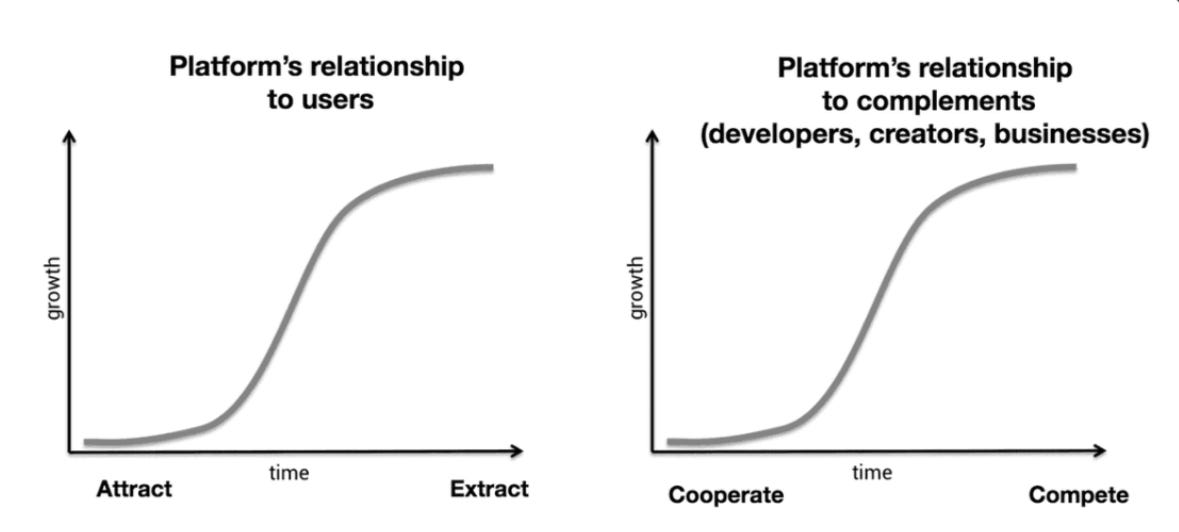
In contrast, decentralized social networks assure users that access remains open and permissionless. With that guarantee, they are more likely to attract smart founders and build a strong, positive-sum ecosystem.
Native Crypto primitive
With an emphasis on decentralization, the Crypto and DeSoc protocols are often, but not necessarily, related to each other. For example, profiles in the social graph protocols CyberConnect and Lens are stored on the L1 blockchain, while Farcaster ID is published on Ethereum.
withIn contrast to existing social media platforms, this connection to native digital ownership creates a large space for design. Crypto can be used as a simple financial primitive to transfer value across a network. For example, Nostr integrates with the Lightning network to enable low-cost Bitcoin tipping.
The Crypto primitive can also enhance the quality of interaction. Spam and bots plague all social media platforms, but since most Crypto operations carry financial weight (even in the form of paltry Gas fees), the history of Crypto addresses can serve as an effective filtering mechanism. Some early experiments included building higher-quality feeds or address-based NFT collection portal communities.
Challenges and open-ended questions in DeSoc
Cause and effect are hard to determine
The most obvious challenge for any platform/network founder is to trigger initial network effects. The value of a network increases with the number of people using it. So this suggests that the value of the new network is small. For early adopters, attracting and retaining them is often the biggest hurdle because of their low value. Even after gaining a niche community, expanding into the mainstream market can be very challenging.
This is especially true today. In contrast to Twitter, which achieved widespread popularity with little competition, social media platforms now have to compete with established platforms with strong barriers and lots of capital. Since users have already established their social networks and status on existing platforms, it is not feasible to rebuild social capital on completely new platforms.
BitClout is trying to clout that problem by crawling and importing an existing social graph from Twitter into its platform. At launch, BitClout had pre-loaded the profiles of thousands of high-profile Twitter users, including Elon Musk, Katy Perry and Barack Obama. Although the campaign served as an effective marketing strategy, the application lacked differentiation and organic community and failed to keep users engaged, resulting in rapid user loss.
Still, as with the recent rise of relatively new TikTok, starting from scratch can be overcome. Therefore, finding an actual use case that truly provides utility and a differentiated experience will be key. Moreover, some DeSoc protocols may not aim to capture maximum market share, choosing instead to focus, as Linux does, on serving an audience that values open source, control, or privacy over universal adoption.
Infrastructure and UX differences
Most DeSoc protocols use public and private keys to give the user ownership. Examples include Nostr, Farcaster, Lens, and CyberConnect. But setting up private keys is often more confusing than traditional login methods, at least for now.
There are also challenges with using private keys. What happens if the user loses the private key? Some protocols, such as Farcaster, have recovery processes, but they are complex. Other protocols, such as Damus, do not have a recovery option. Without proper design to mitigate the impact of private key leaks, users may need to completely rebuild their social graph. Self-trusteeship will be a double-edged sword.
Other obstacles include the private key signature and transaction fees required for on-chain operations, which are significant demotions to the user experience compared to the Web2 platform. One can easily feel the difference between an effortless experience like Tiktok and the stress of using any of the DeSoc apps we'll cover below.
Over time, these problems will be solved. Multi-party computing (MPC) and smart contract wallets can help set up social recovery features and reduce Gas costs. But for now, wallet, custody, and recovery capabilities are key barriers to adoption.
Realization -- An Open Question
With almost all existing social media platforms monetising through AD spending, generating revenue through other means remains an open question.
The DeSoc protocol is trying to generate revenue using a seigniorage fee (a one-time fee for a unique ID), a subscription model (such as paying a unique username or privileged relay), and a royalty model (a percentage of the money that is recycled on the platform). While these business models make sense in theory, there is little evidence so far that they are practical on a large scale, with users preferring to get them for free.
Other open-ended questions:
· Wen token? Does the DeSoc protocol require tokens for decentralized governance (e.g. ENS, Uniswap), or can it remain decentralized without tokens like Linux, Android?
· Should DeSoc developers see the equity /Token class of the protocol go up? And if they do, does that create a bad incentive? If they don't, how can developers be sufficiently incentivized and given the resources to build and scale a platform that can compete with the existing Web2 platform?
· How should developers consider raising capital accordingly? Some try to maximize credible neutrality by rejecting outside capital. Others argue that they can't compete adequately with the dominant Web2 player without enough huge sums of money.
Industry map and where we are in the adoption cycle
Occasionally, a decentralized social application will suddenly see a large number of users sign up due to external controversy or hype. The Mastodon social network grew nearly fivefold after Elon Musk fired thousands of employees, changed verification policies and arbitrarily added/removed accounts. Recently, Damus has suddenly gained a large number of Chinese users, making it one of the top 21 social apps in China.
But users tend to drop off very quickly and return to the existing platform. (To be fair, Damus was ordered to be removed from the app store by the Cyberspace Administration of China)

A brief hype cycle
Overall, DeSoc protocols and applications are still arguably in the innovator phase of the adoption curve.
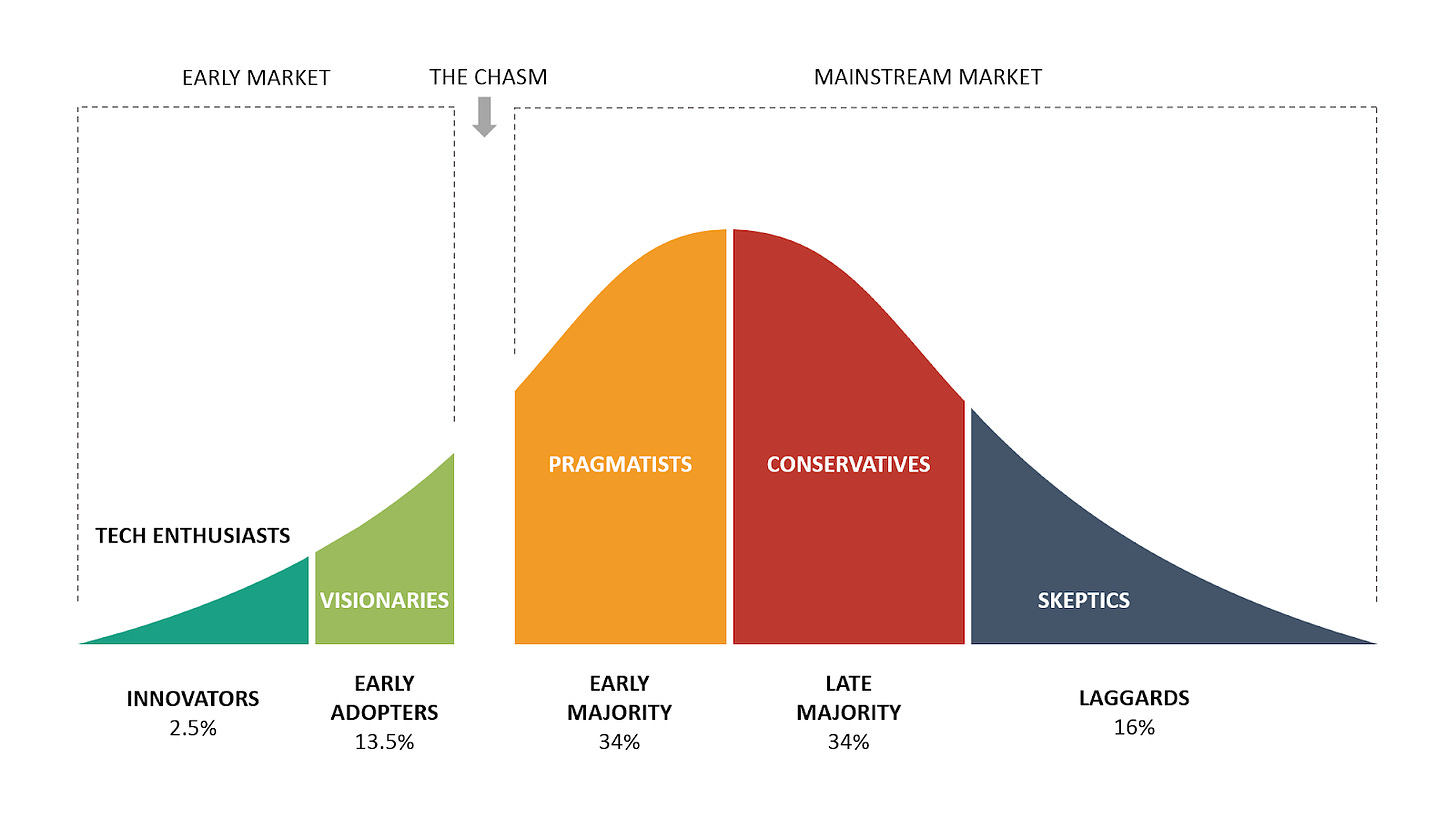
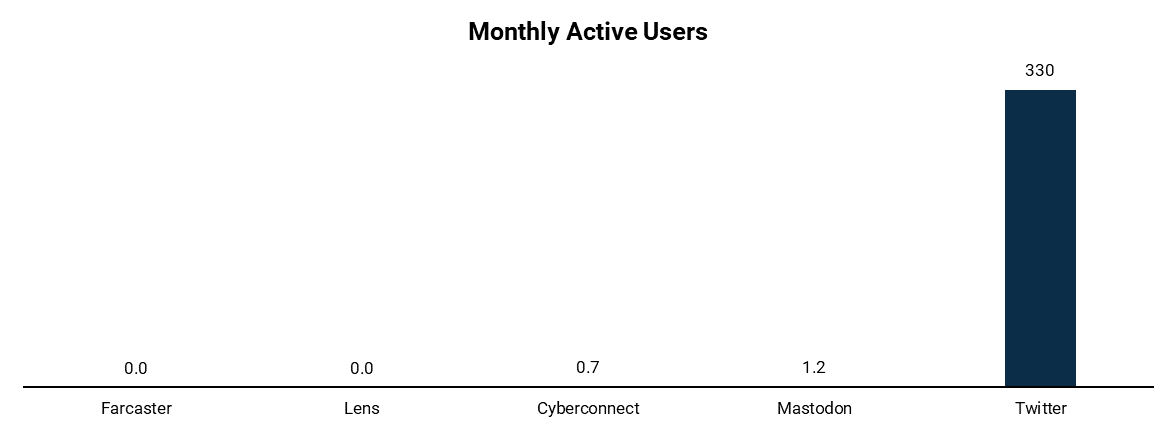
On all metrics, DeSoc's adoption rate is several orders of magnitude lower than existing platforms. Total active users on Mastodon and Damus (two relatively popular DeSoc platforms) are still a fraction of Twitter's monthly active users (MAUs). No DeSoc network is the clear winner -- the team is still experimenting with the right architecture to provide a great user experience while maintaining decentralization.
We'll focus on a few more interesting items below. We focus on the high-level design of the agreement, measure its strengths and challenges, and provide some commentary based on our analysis. We will not delve into the technical implementation of each protocol within the scope of this report.
Mastodon -- Step into Fediverse
Mastodon has emerged as an alternative to Twitter, especially after its recent controversies.
Mastodon is built on instances on a network of independent managed servers. Each instance is managed by its own administrators, who set the rules and policies for its particular community. Administrators can ban, censor, or encourage content as they like, although many of the servers we visited tried to be neutral. Therefore, Mastodon encourages users to choose the instance that best matches their values and preferences or to host the instance themselves.
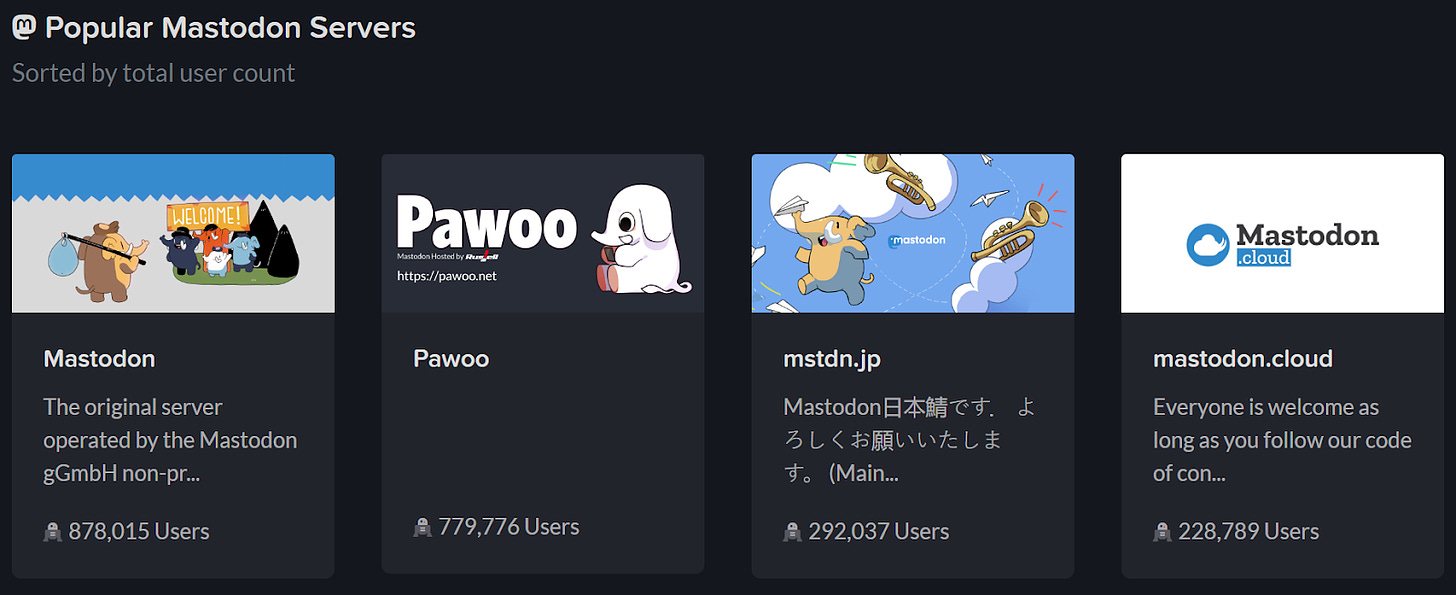
Mastodon uses ActivityPub, a standardized open source protocol for social networks. It is part of the Fediverse or Federal Universe, a term used for all platforms that can communicate with each other using the ActivityPub protocol.
Mastodon's development was collectively funded through Patreon and OpenCollective, with no VC involved.
Advantages:
· All the advantages of the DeSoc platform - open source, ability to own and control data and social graph and free exit from one client to another.
· Use ActivityPub, an open and decentralized protocol for social networking that dramatically improves interoperability and decentralization.
· Emphasis on community: Many users appreciate Mastodon's community-driven nature, where smaller instances foster a more intimate and supportive environment.
Challenges:
· Instances are mostly run by individuals or groups with fewer resources than the Web2 leader. Most servers are managed by volunteers who take responsibility for running their own instances. This includes maintenance costs (e.g. licensing, hardware, electricity bills) and content management risks (e.g. undesirable/unwanted content, copyright infringement, extremist content, etc.). The server may be down, and the search capabilities are weak compared to the Web2 platform. Inconsistent administration between different servers can lead to a frustrating experience.
· While Twitter is like a "cauldron" of different interests, topics, and languages, Mastodon's server architecture tends to vertical topics. This can lead to fragmentation of the user base, fewer use cases and less chance of serendipity.
· Difficult to get started: Twitter can already be intimidating for new users. Mastodon complicates the entry process by requiring users to be found and followed on different servers, which can add to the user burden.
Other key points:
· Mastodon does not directly integrate features or technologies from Crypto/ blockchain. Any such integration would be third-party development built on top of Mastodon.
· Different ways to monetize: Some servers are run entirely by volunteers and ask for donations to maintain the server, while others run ads.
Our view
Mastodon's philosophy and design goals are admirable. It gives users the option to create, curate, and choose their own social networking experience. Because of its open source and community-driven development, it could be an important part of decentralized social media for a long time to come.
However, several obstacles may prevent it from reaching the mainstream. Splitting the user base by server fragmentation reduces its ability to achieve network effects and wider applications. For example, while breaking news tends to spread first on Twitter, it is hard to see something similar happening on Mastodon. In addition, the current user experience is poor, which may explain the low user retention rate after the influx of new users from the Twitter event.

Still, Mastodon is a strong alternative for users seeking a close community of shared interests. In the future, developers will likely continue to build on Mastodon, creating third-party applications with seamless navigation and an improved user experience.
Farcaster - sufficiently decentralized protocol
Farcaster is a decentralized enough social network built on top of Ethereum. The Farcaster team coined the term "sufficiently decentralized," which means that even if the entire network wants to prevent two users from finding and communicating with each other, they can still find and communicate with each other.
Although Farcaster utilizes Ethereum on a portion of its technology stack, it does not host the entire social network on the blockchain. Instead, the Farcaster ID is registered on Ethereum, while its social graph and content is hosted on a network of nodes called Hubs. These Hubs ensure consistency across the network because they replicate all data and signed messages. The Farcaster protocol also trims messages, making Hubs lighter and making the protocol more decentralized.
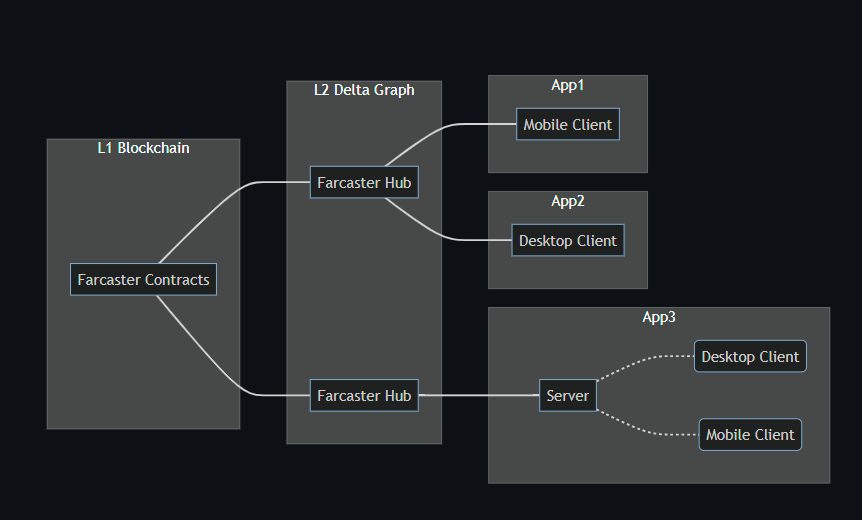
Farcaster architecture
Farcaster drives competition at the application and client levels. The team believes that good applications should evolve from this architecture. Since user distribution occurs at the protocol level, apps with killer features should theoretically be able to leverage the underlying distribution of the protocol to gain market share. It's like Clubhouse using the social graph of Twitter/Instagram users when it launched.
Farcaster is currently invitation-only and has a total of about 11,000 users. The Farcaster protocol was developed by Merkle Manufactory, which raised $30 million last summer in a funding round led by a16z. Merkle Manufactory is also building a mobile/desktop client called Warpcast on top of Farcaster.
Advantages:
· Protocol and first client application developed by Merkle, which can test and release new features at a speed similar to Web2 competitors. Over the past few months, Warpcast has implemented significant improvements, including the launch of a desktop client, QR login, mobile apps in the App Store, and more.
· Even in its early stages, Warpcast's introductory experience is very familiar to Twitter users.
· Reliable ID and thoughtful design for account recovery
--ID: Although the primary namespace is completely decentralized, a second namespace can be managed. So if you register on Farcaster, no one can take it from you. Take your unique ID (for example, @918392), but if you fake register a handle to @jeffbezos, the second namespace has the option of taking it away.
-- Recovery: Built-in recovery system in case of private key loss/attack, with a 7-day time window to prevent malicious takeover of accounts.
· Since Farcaster's ID exists on Ethereum L1, it is easier to integrate other Crypto elements in the client. For example, Warpcast incorporates NFT authentication and discoverability into its client.
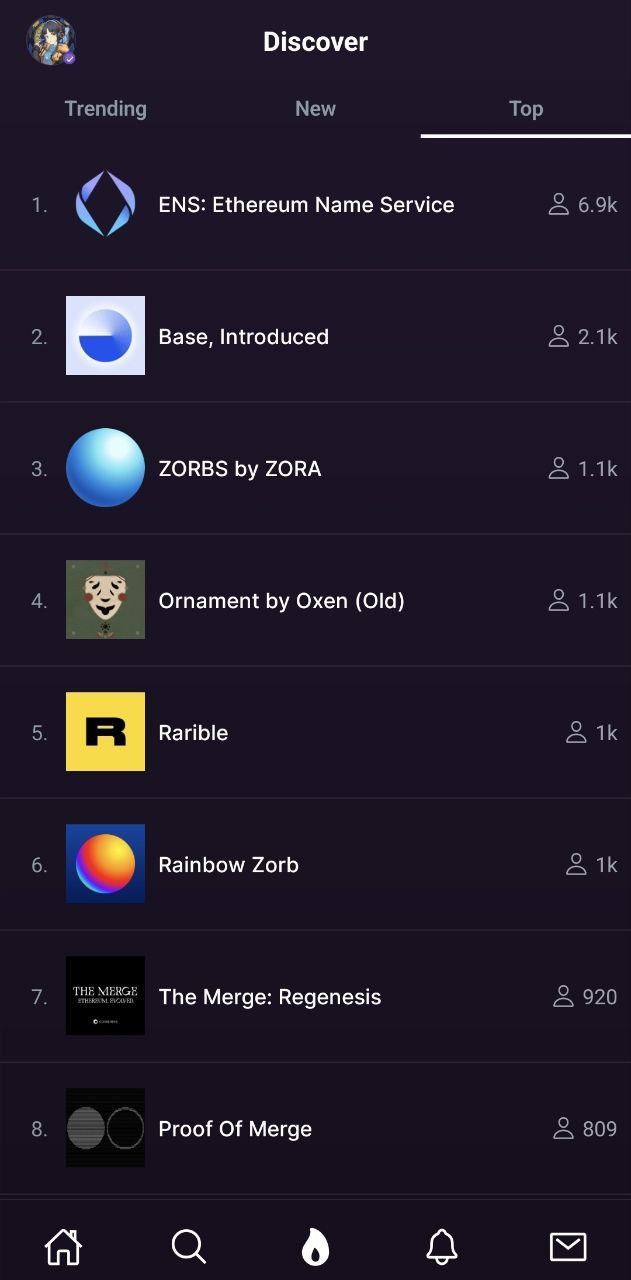
NFT found on Warpcast
Challenge:
· Merkle must demonstrate credible neutrality over time, as the protocol and de facto client have been developed by centralized teams to date. VC support may impede credible claims of neutrality.
· Accordingly, Merkle's default client may crowd out third-party clients because it has the first mover advantage and is the first to understand new protocol developments.
Other key points:
· Money could be made by paying a fee for the unique Farcaster name (e.g. @elonmusk), although this has not been implemented or determined.
· GTM seems to be planning a Western oriented technology community, including people working on Web2, Web3, VC, etc.

Our view:
Farcaster's current, more centralized structure enables it to be more responsive to user feedback, iterate quickly, and achieve product market fit. The architecture is well designed and should easily scale to accommodate millions of users. In addition, Merkle's VC support provides Farcaster with the financial and network resources to grow.
We are optimistic that the team will be able to expand beyond the current user base. The initial marketing strategy for technology enthusiasts is smart because these users are often early adopters of new platforms and are more likely to contribute to open source protocols. There is already a vibrant developer community, and there are a variety of applications that leverage Farcaster's social graph. Similar dynamics to what Instagram and Vine created for Twitter feeds a decade ago could work similarly in Farcaster's ecosystem.
We've focused on how Farcaster has decentralized over time. This can only be resolved with time, as the Farcaster team shows they can slowly let go, making Hubs easier for developers to run and allowing third-party developers to compete with Warpcast on a level playing field.
Lens -- Own your digital roots.
Lens Protocol, developed by the Aave team, is a smart contract social networking platform based on Polygon. Almost all important social interactions are recorded on the chain. Users' profiles and followers are represented by NFT. Mirroring and favorites (similar to retweets and favorites) are also on-chain operations that create NFT. The content itself is stored down the chain to save Gas costs and becomes NFT only when it is collected. The platform is designed to be modular, allowing developers to create new features through modules.
Like Farcaster, Lens is designed to be a neutral base layer and to encourage competition at the application/client level.
Lens raised outside capital from FTX Ventures last year.
Advantages:
· Lens offers unique and innovative features through Crypto technology. For example, the Collect module allows creators to sell their posts directly to followers. Artists can create "rare collections" that allow followers to collect their art for a limited time. Followers can also mirror these posts and receive referral fees. Since all these operations take place on the blockchain, the balance is debited and credited immediately, with no middle man.
· Unlike Farcaster, Lens can hitch a ride on other nodes that have already verified the Polygon blockchain. As a result, Lens is as decentralized and permissionless as the Polygon network itself.
· Modular architecture allows others to create new social fundamentals.
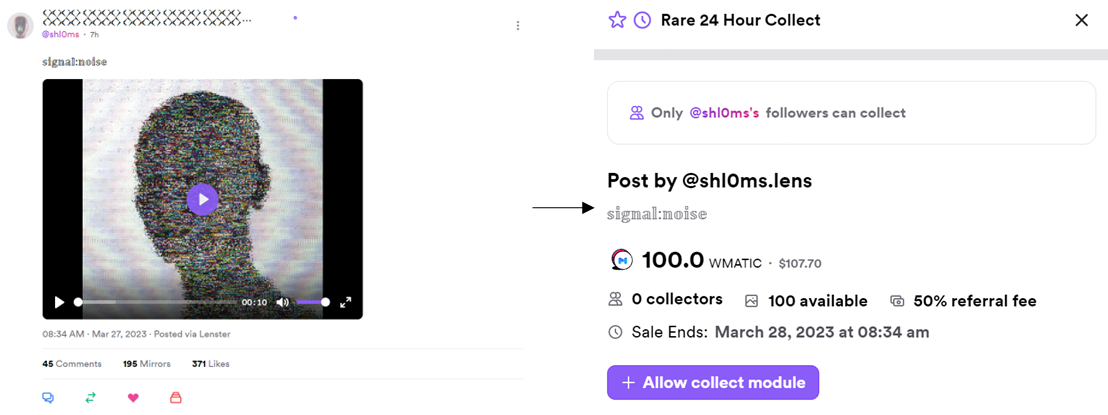
Examples of creators using collection module to realize artwork realization
Challenge:
· Since many user operations are read/write operations on Polygon smart contracts, latency and throughput can be an issue, especially if the blockchain is experiencing high usage or network instability.
· Unclear GTM: Current users seem to be made up of Crypto natives, creators, developers, and people who are actually airdrop farmers. As a result, the overlap of common interests may be smaller, which may reduce user engagement. This is supported by a relatively low DAU/MAU ratio.
· Spam, mainly from Sybil and airdrop farmers, makes it difficult to parse signals and noise.
· Posts are reportedly unlikely to gain traction unless one of the Lens team members mirrors/re-shares them.
Other key points:
· Use the third-party protocol XMTP to build a secure direct message, Crypto channel, and Lit protocol to create gated publications.
Our view:
Lens is one of the most innovative and exciting DeSoc protocols. It provides features and tools not seen on Web2 or other Web3 platforms and shows what Crypto-enabled social networks can unlock for creators and fans. Ideally, these features will kick off a powerful flywheel for creators to start using Lens to build more direct relationships with their fans, draw users to the platform, attract more creators, and more. We also like Lens's modular architecture, which creates a broad design space for new social fundamentals.
To be sure, the platform still has room for improvement. Popular apps built on top of Lens lack a sophisticated user experience, and given its current architecture, we have some concerns about Lens's scalability. But these problems can be solved gradually. We look forward to seeing applications built on Lens by third-party developers.
CyberConnect -- Extensible and Context-Rich Social Graph
On the surface, CyberConnect is very similar to Lens Protocol. Both are decentralized social networks that utilize smart contracts on generalized blockchains. Like Lens, CyberConnect publishes NFTS for profiles, followers, and content. Creators can monetize through NFT or token gated portions of the community. Again, both have modular architectures that allow developers to develop and reuse modules as they see fit.
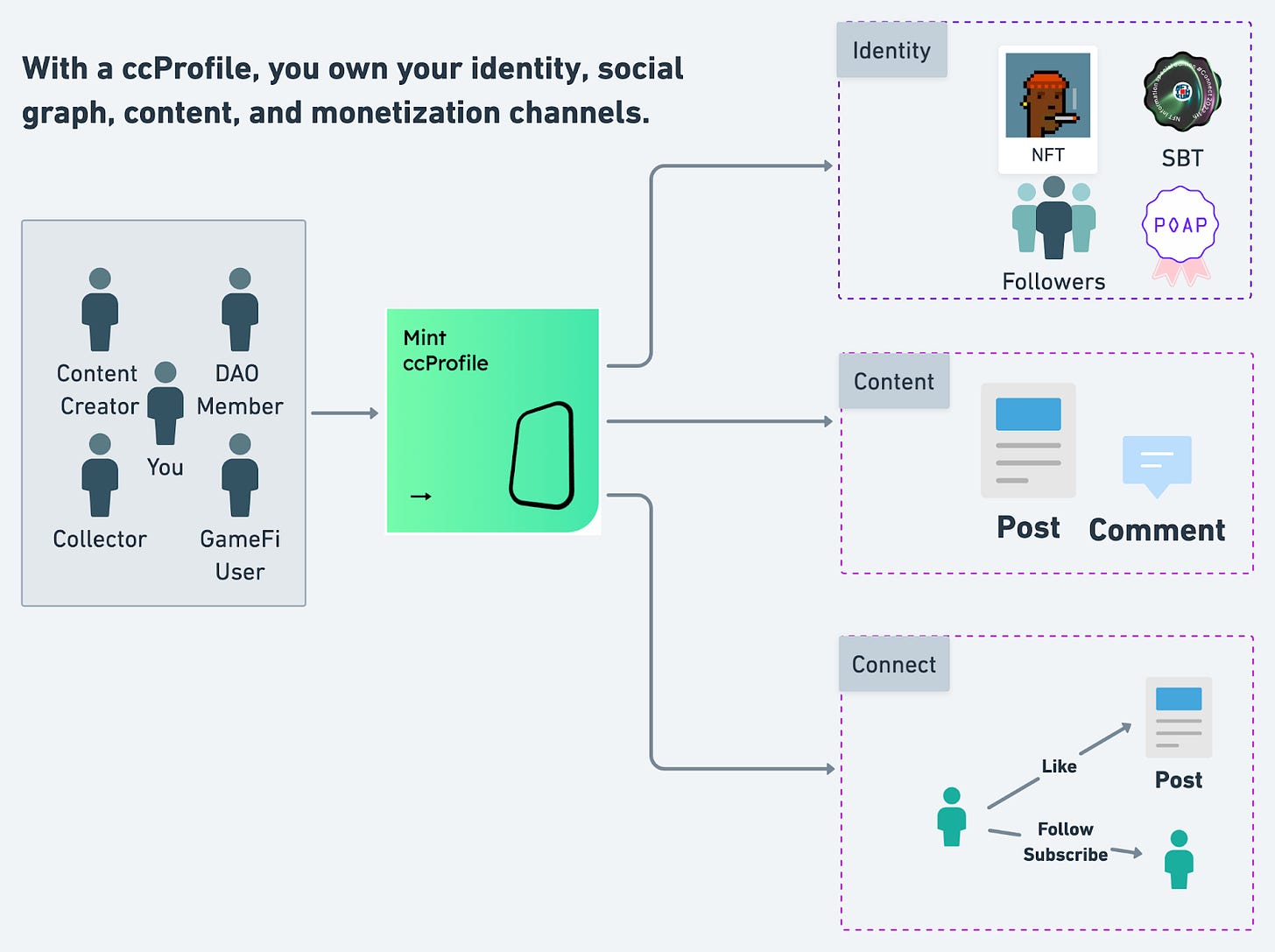
However, CyberConnect uses a combination of multiple blockchains and distributed networks, including Ethereum, Polygon, BNB Chain, IPFS, and Arweave. CyberConnect also enables users to manipulate caching and batch processing, which is then uploaded to a decentralized storage like Arweave to improve scalability while maintaining data integrity and censorship resistance.
CyberConnect sets itself apart through its initial and diverse curation of use cases and the social graph. The first use case for other protocols like Farcaster and Lens is usually "decentralized Twitter." Instead, CyberConnect offers a variety of other products and features:
· ccProfile: An on-chain identity standard for individuals/groups, including on-chain operations.
· Link3: Similar to Linktree and Eventbrite, Link3 helps Web3 users find other profiles and discover/attend events, leveraging the social graph of ccProfiles and CyberConnect.
· W3ST (Web3 Status Token) : A more general proof of attendance concept that covers endorsements, roles, certificates, and participation.
· FanClub: A loyalty and community game that identifies and rewards user contributions to the company and DAO, similar to Galxe and Crew3.
· Posts: Publishing tools similar to Mirror.xyz (decentralized Substack) store content permanently on the chain and allow followers to collect posts.
CyberConnect also has a thriving dApps ecosystem that covers multiple use cases beyond the capabilities of Twitter. Its recent hackathon, "#Connected2023," specifically enhanced its ecosystem.
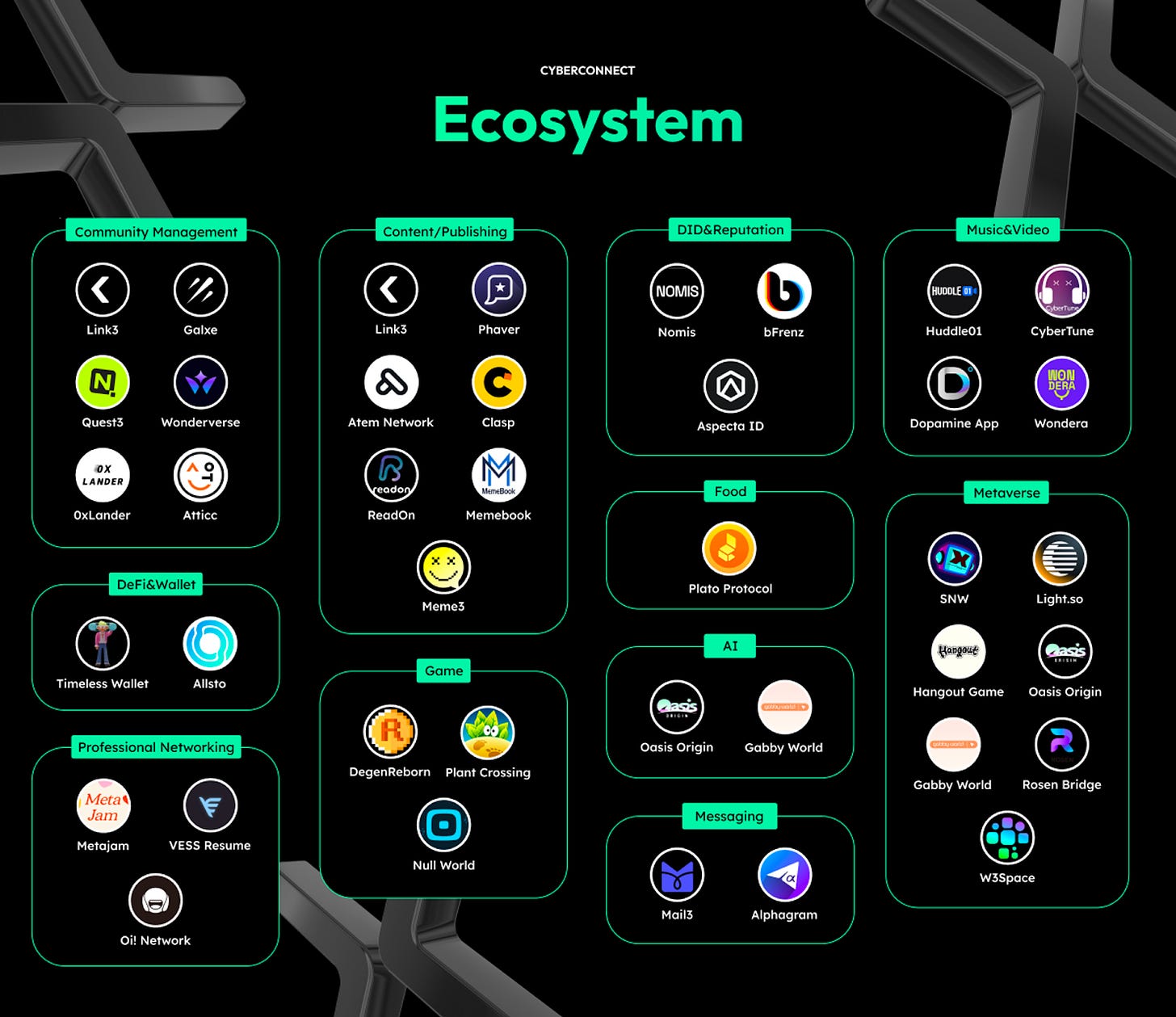
Select projects within the CyberConnect ecosystem
CyberConnect raised $15 million in Series A funding in May 2022, co-led by Animoca Brands and Sky9 Capital [Disclaimer: Amber Group also participated in CyberConnect's Series A round].
Advantages:
· No need to sign minimal private keys for a seamless user experience.
· Multi-link support and proprietary data indexers enhance scalability, flexibility and social graph connectivity. Based on our conversations with other developers, this also improves the developer experience.
· The social graph may be richer, including individuals, groups, activities, and various on-chain interactions.
· Various products for Web2 users: Link3< > LinkTree, Post < > Substack, activity < > Eventbrite, Phaver < > Twitter, Huddle01 < > Zoom, etc.
· Modular architecture allows others to create new social primitives.
Challenges:
· CyberConnect uses centralized Repeaters to improve scalability. Although no plans have been announced yet, decentralization is likely in the future.
· Some of Cyberconnect's early features (e.g., events, status tokens, FanClub) were low-engagement products.
· Similar to Lens, it is difficult to parse the signal from the noise because most of it is Sybil and garbage activities such as airdrop mining.
Other key points:
· Since the original GTM was use cases like activity and FanClubs, as well as other use cases beyond Twitter, CyberConnect's social chart average quality is somewhat different from Farcaster or Lens.
· CyberConnect is also expected to attract more mass users to Web3 by leveraging more use cases than just the Crypto native community.
· Powerful B2B starter for use with numerous Web3 organizations, with numerous Link3 profiles.
· Received 278E and 401BNB (approximately $603,000) from profile casting fees since February this year.
Our view
CyberConnect does a great job of building radically different social graphs and providing the broad range of applications common in Web2. Its original GTM targeted both Crypto native and Crypto adjacent communities, helping to increase immediate adoption rates. It has the potential to become a decentralized one-stop shopping mall for social media and content for the Crypto industry, replacing Linktree, Medium, Eventbrite and other Web2 tools used by Crypto users/companies today.
However, the validity of all experiments with different use cases remains to be seen. If decentralized social platforms are to achieve strong adoption rates and high engagement, there needs to be a killer feature that drives growth.
Despite this, the CyberConnect team continues to deliver stylish and innovative products. We look forward to seeing what new content the team and other developers will build on top of the protocol.
conclusion
Decentralized social protocols and platforms face daunting challenges in pursuing mainstream adoption. Behind the success of the founders are thousands of similar failed attempts.
However, we remain hopeful. Decentralized social networks have a unique opportunity to introduce entirely new social primitives and return the value of the social graph to the user.
Social media is on the verge of change. While we are still in the early stages, the possibilities are truly endless in reshaping how we connect, share and interact online, opening the door to a much brighter, inclusive and robust digital landscape.
Original link
Welcome to join the official BlockBeats community:
Telegram Subscription Group: https://t.me/theblockbeats
Telegram Discussion Group: https://t.me/BlockBeats_App
Official Twitter Account: https://twitter.com/BlockBeatsAsia