Crypto Revenue Sources Analysis: Not All Benefits Are Created Equal
Original title: "Crypto Yield Sources: Not all Yield is Created Equal"
Original author: Mikey, founder of Block49 Capital
Original compilation: Block unicorn < /blockquote>
One of the main advantages of decentralized finance, or DeFi, is that it is open to anyone, anyone, to participate anytime, anywhere. With that comes the opportunity to earn benefits as a DeFi participant that would otherwise be difficult or impossible to obtain in traditional finance.
The permissionless and open-source nature of encryption has turned DeFi into an industry that is both broad and profound. This is evidenced by the complex ecosystem of Bitcoin, the endless design of protocol mechanisms, and the more than 2,000 protocols that exist today. Therefore, discovering the types of yields that exist and making potential trade-offs between them is a daunting task.
This article will cover the following:
Main use cases in DeFi
Definitions of the main principal and return categories and relevant considerations for each< /p>
·Comprehensive map of revenue sources
·Considering the ongoing "real revenue" narrative
In DeFi What are the main use cases?
There are currently 8 main use cases in DeFi:
· Liquidity: Access to liquidity of crypto assets in a permissionless and instant manner
· Exchange: Efficient and a seamless way to buy and sell Token
· Directional trading: Execute transactions based on specific views on the market or asset price direction, whether it is bullish or short
· Borrowing and leveraged trading: with Borrow funds instantly at an effective rate to increase exposure to a specific asset or market
· Liquidity Mining: Passively or productively deploy assets to earn returns
· Staking: Delegate funds to a project or validator and expect to receive a portion of the generated revenue
Deposit Funds: Deposit funds into the protocol and/or pool for liquidity (or counterparty liquidity) Provider or Lender Identity Generates Return
Storage: Safely store crypto assets without sacrificing custody
In order to serve these required use cases, funding, infrastructure and various services. In return, these suppliers will be rewarded.
What is the rate of return?
Yield is the percentage return earned on deploying capital into a particular strategy. There are two key parts to defining the rate of return: the principal invested and the income earned. Generally speaking, there are two types of principal assets and income.
· Principal: the funds invested at the beginning of the investment period, also known as initial investment. For example, deposit $1,000 of USDC into AAVE.
· Yield: Return earned over a period of time. For example, earn $15 (1.5% APR) in USDC in one year.
· Total income: principal net profit and loss + realized rate of return.
What are the different types of principal?
There are two main types of principal in DeFi: price stable and price volatile.
Price Stable Principal:
·Definition: A principal whose value generally does not fluctuate, so there is no price risk and dilution pressure.
· For example: Stablecoin; USDC, DAI, USDT.
Impact: The primary consideration is the opportunity cost of holding and deploying price-stable principal, not the loss of principal value, especially during a bull market. Worst case, the total return is low, e.g. USDC deposited in AAVE only earns 0.5% in one year. At best, returns are low double-digit percentages.
Principal amount for price fluctuations:
· Definition: A principal whose value fluctuates significantly and therefore involves price risk. The impact of token price fluctuations varies widely by category and specific project.
For example:
one layer (L1): ETH, SOL, MATIC, AVAX
Application: SUSHI, CRV, GMX, SNX
Web3 Basics Facilities: LPT, AR, POKT, FIL
Governance: UNI, FF
Memes: DOGE, SHIBA
Impact: All principals with price fluctuations have price risk. In the worst case, yields are low and prices of major tokens drop significantly. The best case scenario is that the rate of return remains unchanged and the price of Token appreciates substantially. There are several DeFi projects with significant cash flows, while others have pure equity mechanisms that rely on dilution or inflation. Many projects rely on a mix of cash flow and inflation, especially in the middleware category. Many Tier 1 projects have relatively stable mid to high single digit yields.
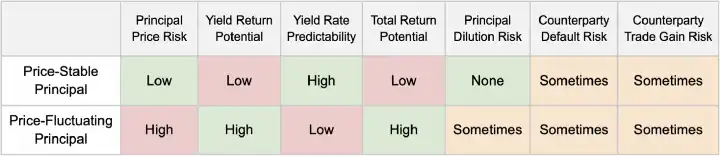
< p>The table below compares the relative trade-offs between the two types of principal and associated definitions:
·Principal price risk - The value of the principal may decrease due to the price drop of Token sex. Price-stabilized principal-protected total returns that do not decrease due to price changes.
· Potential for Income Return - The degree of income that can be achieved by using the principal. In general, tokens with volatile prices have a much higher potential for yield returns, especially in the early stages of dilutive token distributions.
· Yield Predictability - The degree to which the level of yield can be predicted. Predicting the rate of return of a price-stable principal token is simpler because there are fewer variables to consider and there is an inherent upper bound on the rate of return.
· Total Return Potential - The overall degree of profitability when factoring in changes in principal value. The principal token whose price fluctuates can obtain higher returns, because the principal can appreciate. But this is also a double-edged sword, because in theory the principal value can also be close to zero.
· Risk of Principal Dilution - As the circulating supply increases over time, a Token The value of has the possibility of being diluted. One consequence is that the market believes that each token is overvalued, so there is higher than normal selling pressure. For example, a DEX has a low supply of initial circulating tokens and allocates a large portion of tokens to liquidity mining. Over time, more users will receive these tokens, some decide to stake to earn transaction fees, while others sell them on the market and never use the DEX again. The former dilutes the value of each Token, while the latter also reduces the total value of the stakers in the first place.
· Risk of Counterparty Default - The possibility that the counterparty will not be able to repay the loan. On undercollateralized lending platforms, if the borrower fails to repay the loan, the lender may lose some or all of the principal originally deposited. Alameda is likely to default on several undersecured loans due next month, while Gemini earns withdrawals that were recently suspended due to Genesis liquidity problems.
·Risk arising from the correct trade by the counterparty - the probability that the counterparty trades correctly, which in turn It will reduce the returns of liquidity providers. For example, if all GMX traders were shorting ETH at the top, GLP's liquidity providers would need to pay out of the pool and take the loss. GLP's liquidity providers will act as direct counterparties to GMX traders.
What are the different types of yield?
When investing the principal Token, there are usually two types of yields that can be obtained in DeFi Earning yield: Token-agnostic yield and Token-specific yield.
The unknowable rate of return of Token has nothing to do with whether the Token is a project Token, because between parties There is an organic and direct exchange of value. One party gives up value upfront to gain access to a specific use case, while the other earns value by providing funds or services. Similar to cash flow in Web2.
Token-specific yields must be issued directly from the project treasury. The exact structure, whether it be the initial supply, inflation, or burning mechanism, is determined by the holders or founders. Token-specific yields contribute to a continuous circulating supply and dilute holders. Without the token, it is impossible to control and distribute the output of a particular token. Similar to marketing and/or customer acquisition costs in Web2.
Below is a deeper view of the flow of the two main yield categories.
Token is not allowed Known rate of return
There are 4 main types of Token unknown rate of return:
Network pledge fee: Delegate Token to a blockchain middleware And ensure safe and moderate verifiers, including blockchain and Web3 infrastructure
· Borrowing: Provide Token and allow others to borrow.
· Liquidity supply: Provide Token and allow others to trade/use it.
· Counterparty liquidity: The party that takes "trading", such as doing swings, and earns or loses principal based on the results.
Liquidity supply has higher principal price risk , as impermanent losses magnify potential principal losses. Furthermore, there is an upper bound on the total return potential of liquidity provisioning, given that liquidity providers buy cheaper assets when the price of another asset rises. Loans tend to have the lowest yield caps, but are more predictable. At the same time, lenders are also vulnerable to default by borrowers. By becoming a liquidity provider or acting as a counterparty's liquidity, arbitrageurs or profitable counterparties will gain exposure to a portion of their deposited principal.
Rate of Return Attribute:Rate of return is determined by demand and supply. The more users want to access the use case, the higher the usage rate for capital contributors. There is nothing unique about the reward mechanism, for example, the benefit of overcollateralization is earned in roughly the same way and distributed across the various platforms in an almost consistent manner. At the same time, the yields of each platform are roughly similar.
Token's agnostic rate of return is passed through events (such as transactions) or epochs (such as blocks ) and can be accessed directly as a capital investor or as a project token that holds protocol cash flow.
Example of Token Unknowable Yield
Token agnostic rate of return based on the principle of price stability
· Loans: Deposit USDC into AAVE and earn variable interest rates from borrowers.
· Liquidity supply: Provide USDC-DAI liquidity to Uniswap and earn transaction fees.
· Counterparty liquidity: Deposit USDC into Ribbon and sell ETH put options, or sell external derivatives to market makers in Cega
Token agnostic rate of return based on price fluctuation principle
· Network pledge: pledge ETH to the validator, earn network fees through basic fees and rewards, or entrust LPT to pass The coordinator of the transcoding service earns fees and is rewarded with ETH.
· Loans: Lend BTC or ETH to Euler and earn a floating rate from the borrower.
· Liquidity supply: Provide ETH/UNI liquidity to Uniswap.
· Counterparty liquidity: Purchase GLP and earn transaction fees, while acting as counterparty liquidity
Achieving Token-agnostic rate of return through protocol revenue distribution
While not directly tied to DeFi use cases, distributing fees to token holders also provides an opportunity for revenue:
< p>
· Pledge SUSHI to earn platform transaction fees
· Convert BTRFLY to rlBTRFLY and earn ETH income from platform fees
p>
· Pledge GMX to earn platform transaction fees and esGMX rewards
A specific case of Token unknowable rate of return
· Failure Case: User deposits 1 ETH worth $1,000 into a decentralized option vault . The user is advertised to have an APR of 52% over the course of a week. The user earned 0.01 ETH because the option expired, but the price of ETH fell by 25% during this time. In dollar terms, users' portfolios are now down 24.3% in value. Token-agnostic yields remain vulnerable to negative total returns. In this case, price risk becomes a reality.
· Failure Case: User lends $500 USDC to borrower who pledges their $1,000 worth of NFT as collateral . At the end of the loan, the borrower refuses to repay the loan because the NFT is now only worth $250. Although not affected by currency price risk, it is still possible to lose money. In this case, the risk of counterparty default becomes a reality.
· Success Story: A user deposits USDC into AAVE's lending pool and earns from their $1,000 deposit 5%. The effective rate of return at the end of the year is 5%.
· Success Story: A user provided $1,000 of liquidity in DAI-USDC on Uniswap using the Arbitrum network. The effective rate of return at the end of the year is 5%.
Token-specific rate of return
There are three main token-specific yields:
· Token Holder Rewards: Provide benefits to those who hold the same Token (usually DeFi or governance-based projects).
· Participation Rewards: Provide benefits to users who use the project.
Network pledge release: Provides blockchain middleware ( L1 or Web3 infrastructure projects) functioning validators and/or delegators.
Revenue attribute:Token-specific yield depends on a specific project, so the realized return may vary greatly. Accumulated earnings over time are entirely hypothetical and denominated in the project’s token price. Gains can only be realized by selling from one party to another. Therefore, realizing yields has underlying assumptions, such as the ability to sell in the open market, zero price changes, and the proper functioning of the underlying mechanisms. Occasionally, token-specific yields dilute the value of tokens due to mass releases, or act as an inflation mechanism for the structure of failed projects, leading to project failure. Other times, project-specific yields help guide actual demand, which ultimately leads to a network that thrives.
Token-specific yield example
Specific Token Yield Based on Price Stability Principle
Participatory Rewards: Deposit stable currency into Compound and earn COMP, or deposit stable currency pair liquidity into a new DEX and earn COMP Earn its native Token, or earn airdrops for early participation in the network.
Specific Token Yield Based on Price Fluctuation Principle
· Token holder rewards: lock CRV to get more energy and rewards, or pledge APE To earn more APE Token.
Participation rewards: Join the network in advance to earn airdrops, or deposit wBTC/renBTC into Curve and earn CRV rewards.
Specific cases
·Failure Case: A user purchased 100 USD MOON and started earning 50% annualized rate of return (moon-based) within one year. The user now has $150 MOON. However, at the beginning of the year, the price of MOON was $1, and by the end of the year it had dropped to $0.5. The user's portfolio value has dropped from $100 to $75. In order to realize the cash, the user sold all Tokens to the market with a 10% difference, and received $67.5. While the advertised yield was 50%, the actual total return was -32.5%. In theory, if the price of the Moon remains the same and the user sells with zero slippage, the user's return should be 50%. Risks are misunderstood because of advertised rates of return. In this case, price risk and liquidity risk become a reality.
·Success Stories:Users deposit funds into AAVE’s lending pool in Optimism and earn OP. Users earn 5% APY on OP by the end of the year and sell it on the market for a 5% return on top of regular lending yields.
· Successful case: A user pledged 1,000 USD in UP (imaginary Token worth 1 USD) and earned 20% output. At the end of the year, UP’s token price appreciated 500% as the project gained strong traction and was distributing strong revenue. The user now owns 1,200 UP, worth $6,000, and the income reaches 6 times.
In summary, the chart below compares the two main types of yields and their deeper Impact:
Token-agnostic yields are usually easier to predict, but Return potential is always low: it's much easier to sell a shovel in a gold rush than to pick a metal that appreciates 1,000 times. The risk of misunderstanding is greatest for token-specific yields, as exemplified by Bancor and dual-pool liquidity mining in general. Bancor makes yield attractive when the mechanism works, but has catastrophic consequences when it doesn't - volatility prior to covering impermanent losses from aggressively minted BNT. Token-specific yields are the equivalent of discovering metals in a gold rush and realizing gains by selling those metals on the open market. These gains are only possible if another party is willing to become a buyer, and there is downward pressure on unit prices as more of the same metal is discovered.
What about liquidity mining?
Liquidity mining is an act of maximizing returns relative to risks, mainly through the market Inefficiency.
The strategy implemented by revenue aggregators like Yearn Finance is to mine the Token of specific projects To maximize value for depositors, which in turn will harm the interests of Token holders of these projects. Yearn’s USDC vault has a special strategy of depositing USD into Stargate, putting in STG to provide liquidity, and selling STG to the market to return returns to depositors in the vault. This is also known as the dilution pressure problem for STG holders. This process can be described as rate maximization.
There is also a new revenue aggregator, focusing on different types of liquidity mining operations, These categories can be grouped into three broad categories:
· Interest rate arbitrage - Borrow an asset at x rate and lend it elsewhere to earn more than x rate. Alternatively, hold spot amount x and short the equivalent to earn a funding spread.
· Leveraged Yield - Borrow one asset, convert it to another Increase productivity, thereby improving overall profitability.
·Delta-neutral strategy - Hedging the price risk of the underlying asset in order to obtain the return rate itself the only exposure.
Example of Liquidity Mining
Interest rate arbitrage
· Mortgage an asset, borrow USDC at an interest rate of 2% on AAVE, and then deposit it in an under-collateralized lending platform, such as Ribbon/Maple/TrueFi, and earn 10%+.
· Borrow DAI on AAVE, deposit it in dAMM, and then earn surplus through dAMM’s native Token-specific rewards.
· A cash-and-carry treasury, do long spot and short perpetual to obtain funding rate.
Leveraged pledge
· Deposit BTC, borrow Avax to get sAVAX, and repeat.
· Increase the yield of stETH through recursive ETH borrowing and de-staking through Index Coop.
Delta-neutral strategy
· The liquidity aggregation layer on GMX accepts USDC unilateral deposits.
· A vault that hedges its exposure to GLP prices by short selling.
Generally speaking, both interest rate arbitrage and leveraged pledge yields contain relatively high liquidation risks. For example, when stETH breaks away from its theoretical peg, many users will be liquidated. The yield of cross-platform interest rate arbitrage may contain very high smart contract risk, because new yields often come from new and untested platforms. In terms of Delta-neutral strategies, there is no guarantee that the hedging mechanism will perfectly offset the price exposure (risks include liquidations, deviations of derivative prices from spot prices).
Given a better understanding of the yield outlook, what are some things to consider?
A particular inspiration for this post came from the ongoing "Real Yield" on Twitter Narrative (example posts: Defi Edge, Miles Deutscher). Most "real yields" can be categorized as token-agnostic yields earned by offering either of the two main tokens. While it’s encouraging to see projects generating fees based on real user activity, and there are some examples of quite profitable cash flows, “real yield” is a dangerous term to talk about. Because of general reflexivity, the advertised APR may change very quickly. If protocol usage is low, not only will yields fall, but negative public perception could lead to selling pressure, so total returns could turn negative.
Another interesting and thought-provoking question is whether the protocol should distribute the proceeds in the first place. As is often the case, revenue earned in the early stages of a project should be reinvested in growth. Because very few protocols (if any) have reached maturity. Also, in crypto, anything related to yield effectively attracts users, so it's easy to create short-term price gains that are optimized for hype rather than long-term fundamentals. While this can be challenging, understanding the founders' motivations and intentions can better indicate whether a project is future-focused.
Explorable revenue opportunities
Lending to NFT holders (principal with stable or fluctuating prices, Token agnostic yield): Given its relatively volatile nature, the yield on lending to borrowers can be very lucrative. The annual interest rate on the monthly average loan fluctuates in the range of 30%-50%, and can be three times higher during periods of high borrowing demand.
Lenders can find offers priced in both DAI or ETH. The main risks are the risk of borrower default due to falling collateral prices, and the risk of illiquidity if the collateral is acquired. The higher APR can compensate for the higher NFT risk.
NFT liquidity supply (principal of price fluctuations, Token unknown rate of return): For For users seeking risk-return, if the price of NFT remains unchanged, it is relatively profitable to provide liquidity for NFT. There are currently two main platforms to explore: NFTX and Sudoswap.
NFTX allows users to have unilateral exposure to NFT while providing bilateral liquidity. Several notable collectibles had double-digit Liquidity Supply APRs as of November 21, including Mooncats, Miladies, Squiggles, and Forgotten Runes. Sudoswap, on the other hand, allows users to set their own curves and fees.
Other opportunities
· Undercollateralized loans to Goldfinch (central for non-crypto borrowers) or Maple (native crypto institution).
· Provide stable currency pair liquidity on the new EVM chain to earn transaction fees from bridgers, miners and experimenters.
· Earn Token through platform deposits and borrowing on the new lending platform.
· Tokens such as GLP and Gains Network's DAI treasury are used as the liquidity of the counterparty to earn transaction fees.
· Hedging or monetizing the premium from the steady cash flow of blockspace through Alkimiya.
· Earn income by swinging and depositing funds into Opyn's Squeeth Crab vault.
In crypto, risk appetite is directly related to the potential for yield and total return. The bigger the upside, the bigger the downside. The most important aspect is giving users choice, and we expect more diverse revenue streams to continue to grow as more original products and opportunities emerge on-chain. If you are building something in the DeFi space, please don't hesitate to reach out.
Disclaimer: Neither the author of this article nor investment fund 1K(X) are financial advisors. This article and its contents should not be construed as investment advice.
Many thanks to Dmitry Berenson for his many feedback on this article.
Original link
Welcome to join the official BlockBeats community:
Telegram Subscription Group: https://t.me/theblockbeats
Telegram Discussion Group: https://t.me/BlockBeats_App
Official Twitter Account: https://twitter.com/BlockBeatsAsia


 Related Articles