Five Dimensions of crypto Market
Title: The "Five-dimensional Investment Law" of Crypto Market
Original source: King Bitlear
A. & have spent Three elements of investment decision
Investment methods are complicated and complicated, but all changes are inseparable. The factors that affect the final return cannot be separated from three aspects: winning rate, odds and position. Generally speaking,
Win rate: What are the odds of winning on this investment? How sure is it to make a profit rather than a loss? The winning rate determines how likely an investment is to end up making money.
Odds: If you can make money, how high can you get? How many times can you make? The odds determine the yield.
Position: How much money do you need to invest in this investment? Positioning largely determines the size of the ultimate absolute return.
Most people who are keen on short-term speculation will only focus on high odds and one-sided obsession with the chance to hit a hundred times. However, high odds often mean high risk (i.e. low win rate, small chance of winning), and high risk often means that investors are afraid to invest heavily in their positions. The final result is that even if they bet on the chance of high odds, the absolute return is still limited (unless the odds are high enough, but the probability of grasping this opportunity is even lower). And it's certainly a question of whether they'll get a hundred times as much.
A good investment strategy, therefore, is to seek a combination of sufficiently high winning rates, moderately high odds, and sufficiently heavy positions.
So how do you improve your winning rate of investment decisions?
How do you find an upper-medium odds chance?
How to put into the appropriate position to buy?
Based on the recent round of bull and bear gains and losses and continuous reflection, I have summarized a set of crypto market "five dimensions of investment."
The five dimensions are:
1. The track
2. cycle
3. competition
4. The price
5. strategy
And from these five dimensions, after repeated practice, summed up a set of system executable methods.
2. & have spent Five Dimensions of crypto Market
The so-called "five-dimensional investment method" is to explore and evaluate an investment opportunity from the five dimensions of track, cycle, competition, price and strategy, systematically improve the winning rate and odds of investment decisions, and on this basis, better evaluate how much position should be invested in an investment, so as to obtain a higher absolute return. The "Five-dimensional Investment Law" can be specifically distilled into the following five steps of investment decision-making.
1. Track Selection (track dimension)
As a game of probability, investing is like fishing.
How to catch more fish? How to catch more big fish? The first is not to have better fishing skills, but to:
Go where the fish are, and where the big fish are.
In a river ditch, even with the best fishing skills, it is impossible to catch big fish -- big water makes big fish, so you must first find a big enough river, or jump straight into the sea, and then talk about the skills of catching big fish.
The same goes for investment. If you want to find a big enough and good enough opportunity, you first need to find a good enough track, because it is impossible to run a thousand-li horse on a barren and narrow track.
What makes a good track? What kind of track can run out of the horse? It can be evaluated from the following dimensions:
1) The thickness of the track The thickness of the track, that is, the lucrative degree of the track.
Only on deep snow is it possible to roll big enough snowballs, and only on a profitable track can it be possible to run horses and unicorns.
On the website Crypto Fees, you can see the ranking of the fee income of the agreement on the chain. The top 10 projects are basically divided by the projects of the two tracks:The DEX circuit (a decentralized exchange that includes spot trading and derivatives trading) and the lending circuit.
The reason is that these two tracks cover the essential infrastructure for a blockchain ecosystem to thrive: Trading and lending. Trading solves the problem of free flow of assets in a blockchain ecosystem, while lending solves the problem of capital utilization, thus building the basic application components of the Internet of value. Therefore, these two tracks can capture most of the value in a blockchain ecosystem.
Similarly, if the two tracks are compared to each other, there are also advantages and disadvantages. The DEX track faces more common and high-frequency user trading demand, so the profit of DEX track is thicker than that of loan track. According to the data of Crypto Fees, among the top 10 projects in fees, DEX accounts for 7 (UNI, GMX, SUSHI, CRV, SNX, Trader Joe, SpookySwap). The lending category only occupies 3 (Aave, COMP, MKR), which confirms this point.
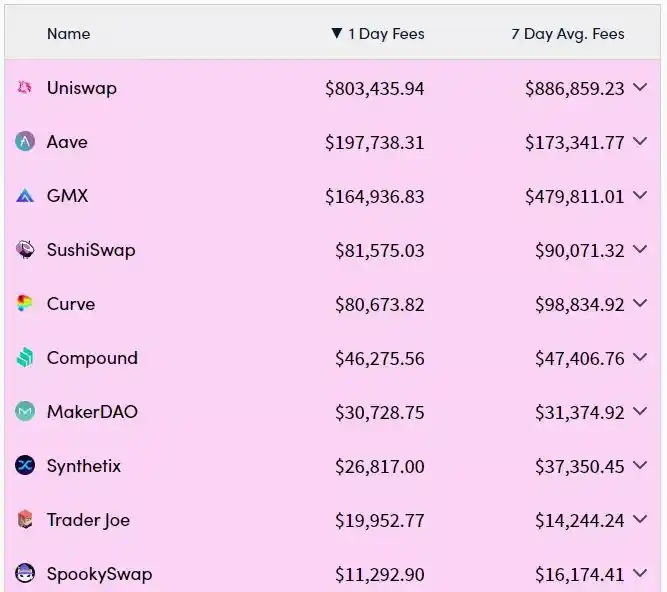
In "DeFi Summer", DEX app Uniswap and loan app AAVE eventually became the top streams of DeFi. The reason is that DEX and loan are the most profitable tracks in DeFi. Even if UNI and AAVE did not run, these two tracks could not run. - there will also be other items running as DeFi top stream, because only fat water can produce fat fish.
2) The width of the track The width of the track refers to the ductility of the track and the strength of the network effects.
The more malleable a track is, it means that the track has a large enough width and more profit extension space.
The stronger the network effects at a track, the stronger the Matthew effect, the more likely it is to grow into a winner-takes-all behemoth.
For example, also look at the DEX track, which is much wider than the loan track. In terms of asset categories traded, DEX can be expanded from FT trading to NFT trading, which can be seen from the recent launch of Uniswap's NFT trading platform; In terms of trading types, DEX can also be extended from spot trading to rich derivatives trading, and with the increasing demand for leverage in trading, DEX can easily be extended to the lending market. On the contrary, loan track is not as good as DEX track in terms of track ductility.
In terms of network effects, DEX track naturally has network effects. The accumulation of assets and trading demand will lead to better trading depth, which in turn will attract more users, and eventually create a strong enough Matthew effect that there is a high probability of a mega project, while the loan track has a much worse network effect than the DEX track, and these differences will eventually be reflected in the overall project market capitalization.
3) The length of a track The length of a track is the length of a track's growth cycle.
Only in a track with a long enough growth cycle, it is more likely to obtain excess returns through long-term holding strategy, and at the same time reduce the potential opportunity selection cost (some tracks have a short growth cycle, resulting in investors will frequently switch investment tracks, thus increasing the potential opportunity selection cost).
Some tracks are staged or even short-term.
An example from a non-crypto industry: In the traditional mobile Internet industry, the track of third-party mobile phone system tools is phased, because the early Android system is not perfect, to create a share of the opportunity for third-party developers, but with the continuous improvement of Android system, mobile phone developers also directly built-in many system tools, making these mobile phone system tools track quietly decline. However, the e-commerce circuit is a long enough circuit, since the birth of the Internet, there has been a simple e-commerce model, and until now, the development of the e-commerce circuit is still in full swing.
In the crypto world, there are countless examples of various short-term concept hyped track life and death.
4) The core of the track The so-called core of the track mainly depends on two dimensions:
a. In terms of technical application, does the track take advantage of the core technical advantages of blockchain
People tend to exaggerate the potential of a technology. For example, before the bursting of the Internet bubble in 2000, people once imagined that the Internet could solve most of the practical problems, and made many attempts to transcend The Times and even go beyond the limits. However, these attempts all proved that the Internet was not omnipresent.
Any technology has its core advantages, play its core advantages and find the market convergence point, you can go to any disadvantage. Deviating from its core advantages and exaggerating or generalizing the potential of a technology can create a heap of pure conceptual hype.
For blockchain, its core advantage is the advantage of de-trust brought by decentralization, as well as other attributes associated with decentralization, such as no access, immutable, open and transparent, composability, anonymity, anti-censorship, globalization and other distinct features. These core characteristics are the core advantages of blockchain.
Some tracks are highly consistent with the core advantages of blockchain, such as the typical DeFi track and NFT track (NFT is a kind of financial asset in essence), but some tracks, at most, are just a shell of blockchain, and do not give full play to the core advantages of blockchain. Typical projects related to the Internet of things, such as the concept of track is very big. However, it does not fit well with the advantages of blockchain technology itself, or there is no highly suitable point at present. For this kind of track, the core degree of the track is very low, which is not a good track for the crypto world.
b. Does the track solve the core problems of the industry in terms of the problems it solves
Currently, the blockchain industry is facing many core issues, such as the expansion of the bottom layer, privacy issues, infrastructure problems in the middle layer, lack of infrastructure in the application layer, poor usability, and so on. Here are just a few of them listed. Some tracks close to these core issues mean there are huge opportunities; While some other tracks solve some marginal, optional problems, the track core degree will be relatively low, the track corresponding investment value is relatively small.
2. Cycle judgment (cycle dimension) After the race track is selected, it is further necessary to judge the current cycle stage.
Cycle stage has two levels, one is the stage of the specific track cycle, the other is the stage of the macro cycle of the crypto market. First, look at the track cycle stage. Every track has a certain track cycle during its development. I divide a track development cycle into four stages, which are:
1) Trial and error exploration period
2) Rapid growth period
3) Stable growth period
4) Maturity plateau
In the first stage), the potential growth rate of the track is very high, but because the track has not yet developed a relatively formed model, there will be great trial and error costs for a single project, and the investment decision will be faced with great uncertainty. If you are not careful, you will invest in the Martyr project.
In stage 3) and 4), the certainty of the development of the track project becomes higher, which means that the winning rate of investment in the track project will be higher, but the potential return rate will also decrease.
Therefore, if you want to find an investment opportunity with both high winning rate and high odds in a track, you should choose to enter the track when it is in stage 2), that is, when it is in the rapid growth stage. How do you determine if the track is in a growth phase? There are three criteria:
a. Within the circuit, there are already projects that have reached the PMF (product and market matching) stage. For example, if some projects show a continuous and organic trend of rapid user growth, and many other projects continue to follow the trend of imitation, there is a high probability that the track is about to enter or already in a period of rapid growth.
b. Within the racetrack, there are already projects exploring effective business models.With a relatively predictable profit model, with a certain degree of sustainability. This is a supplement to the first, because even if a track has reached the PMF stage, it does not necessarily mean that the track has found a sustainable monetization model.
c. The Matthew effect is starting to show whether there is a competitor with 30 or even more than 40 per cent of the market.Of course, this is provided that the project market share growth must be organic, and not simply through various economic incentives to create false market growth.
If the above three criteria are met, it can be concluded that the track has entered the rapid growth period.
Second, look at the crypto market macro cycle.
In terms of macro cycle, it mainly refers to the crypto market industry cycle around the BTC halving cycle.
The small cycle must be subject to the big cycle, that is, the judgment of the specific track cycle must be considered in combination with the macro cycle of the crypto market. The simple principle is that, even if the track is in the rapid growth stage, do not invest in the macro cycle of the crypto market is in the frenzied stage (short risk speculation is another topic, because this is more speculation than investment category), because any small cycle change of a track, relative to the macro cycle of the crypto market, is insignificant.
Therefore, when the macro cycle of the crypto market is at a low stage, and the specific track cycle is at a rapid growth stage, enter the track to look for opportunities. Typical examples are the DeFi circuit in late 2019, early 2020.
The current phase to the next 18 months will be an excellent investment phase in the crypto market macro cycle. Betting on a core project that is already on the fast growth track will be highly likely to generate excess returns in the next bull market.
3. Fixed head (competitive dimension)
After the first two steps, we have selected the track with potential, and through long-term observation and research, determined the time to cut into the track, thus narrowing the scope of time and space to look for high-quality investment opportunities. What kind of analysis is needed to determine the final investment project?
The answer is: more evidence, backed up by proper analysis.
Limited information can only lead to limited conclusions.
Rather than conduct limited collection and analysis and rely on investors' own limited logic and judgment of the project, it is better to believe in the horse-racing mechanism of the market, because in a long time scale, the market is truly an all-knowing God, a mule or a horse, and the final result of the horse race will be known. How to get a better look at horse racing? We only need to focus on the key indicators that are relevant to the nature of the track. It is a project of Qianli horse, and sooner or later, we will definitely highlight the core indicators. On this basis, if you look at the team, product, and business model in a comprehensive way, it's easy to see which is better. At the end of the day, just focus on the top three.
At this point, the specific investment target has been narrowed down to a very small range. The same goes for watching the game of horse racing'Vanity indicators' and' false prosperity 'to watch out for. For example, for some racetrack projects, some common business indicators, such as TVL, may not have much reference significance, and may simply be a "vanity indicator". There are also projects that maintain "false prosperity" through aggressive token incentives, creating the illusion of market leadership, and these need to be vigilant.
4. Look at price (price dimension)
After the previous three steps, we only solve one problem, that is: keep narrowing down the scope, find a good project.
However, a good project is not necessarily a good investment opportunity.
ETH is definitely a good project by all means, but buyers with more than $4000 May be overwhelmed. While this may not be a problem in the long run, the time cost is also a cost. A good project, a good price -- only when both conditions are met, will it be a good investment opportunity.
What is the right price? For the crypto market such a new area, speculation is rife, most of the so-called valuation methods, but the blind man fortune telling, but there is a rule that cannot be broken: that is, in the panic, the price is likely to be cheap. Therefore, after selecting a good project, it is usually a good time to pick up a bargain in the following two situations:
1) At the low point of the crypto macro cycle.
The macro cycle of the crypto market is highly correlated with the halving cycle of bitcoin. At the trough of the industry cycle, with all kinds of negative news constantly, panic everywhere, and persistent low mood in the whole industry, this time is a good chance to pick up bargains.
2) When there is a black swan that is hard to meet.
For example, the project itself appears black swans, but some "black swans" will only lead to the psychological panic of investors, but will not affect the core value of the project, this is the best time to pick up bargains.
In these two cases, it is the perfect time to sell. Like the cheetah, it doesn't usually go hunting very often, most of the time it's just boring watching, lurking and waiting, and then waiting for the once-in-a-lifetime opportunity to strike quickly and kill with one blow.
5. Long hold (strategic dimension)
After the previous four steps:
1. Track selection; 2. Judgment period; 3, fixed head; 4, look at the price, you can basically determine the ideal investment target, and find the right opportunity to buy.
What about after you buy it? In conclusion, the first four steps solve two problems as a whole: how to find a good deal and how to get a good price. It is not easy to seize an investment opportunity that meets both of these conditions, so the best strategy after buying is to hold it firmly, hold it for a long time (at least for one cycle), and keep a constant eye on the project. Great projects usually generate outperformance for long enough. The above is the preliminary framework of the "Five-dimensional investment method". The specific methods and steps are sorted out from five dimensions respectively, namely:
1) Track Selection (track)
2) Judgment period (period)
3) Set the head (competition)
4) Look at the price (price)
5) Long hold (strategy)
This is a systematic framework, but in the actual investment process, there are still some limitations, and another level of supplement is needed.
3. & have spent Limitations and Improvements
Looking at the five steps of the "Five-dimensional Investment Method" as a whole, it can be seen that it is a complete top-down analysis framework, that is, to first stand at an altitude of 10,000 meters, then look down on the overall situation from top to bottom, constantly narrow the observation and research scope, and finally locate the target.
However, as a decentralized global market, many new things emerge from the bottom up in this ecosystem. If only top-down observation and research is effective for the track with clear outline, but for some new disruptive innovation projects, it is necessary to combine top-down and bottom-up methods. The way to do this is to believe that:
Phenomena are laws.
The so-called phenomenon is the law, there are two levels of significance:
1) Be sensitive to any phenomenon. Be highly sensitive to any seemingly random hot spots and phenomena, and avoid any kind of blind eye, dismissive, "that's all," "I get it" mentality.
2) Believe that whatever happens must happen. We should firmly believe that behind all accidental phenomena, more or less, there must be some great inevitability, and behind all seemingly random hot phenomena, there must be some great law revealed.
These two points are the bottom-up approach, from the phenomenon to the rule -- when you perceive some big rules from the phenomenon, you can start from the top-down "five-dimensional investment method", and then look at the phenomenon from the rule, so that you can have a clearer framework and background vision of the phenomenon, which is a process from micro to macro, and then from macro to micro.
The above is the overall framework of the "Five-dimensional Investment Law", which is neither simple top-down nor bottom-up, but a dynamic combination of top-down and bottom-up.
4. & have spent conclusion
To go back to the beginning of the question, the five-dimensional approach is ultimately about finding opportunities that have a high enough winning rate to be moderately overweighted.
With the help of the "five-dimensional investment method" overall method, select a good track, and in the right cycle to select the head of the project, and then buy at a cheap enough price and hold for a long time, basically can ensure a high winning rate, medium odds. Then, on this basis, we dare to achieve the third point mentioned at the beginning of the article: a sufficiently high position.
At this point, the perfect combination of three factors of investment decision is realized: high win rate, medium and upper odds, and high position. In this way, the absolute return of sufficient high probability can be obtained at last.
This is the core framework of my Five-dimensional Investment Approach, which is based on a continuous review, reflection and summary of the recent bull and bear experience. Method is important, also is not important, because everything is not easy to know, it is difficult to do, only adhere to the unity of knowledge and practice, in order to remain invincible.
Link to original article
Welcome to join the official BlockBeats community:
Telegram Subscription Group: https://t.me/theblockbeats
Telegram Discussion Group: https://t.me/BlockBeats_App
Official Twitter Account: https://twitter.com/BlockBeatsAsia

 Related Articles