Owocki: Sybil Attack Characteristics, Design Spaces, and Open Discussion
Original title: "Knowledge Transfer: Characterizing the Sybil Resistance Problem"
Original author: owocki
Original compilation: DAOctor@DAOrayaki.org< p>
In this post, owocki will attempt to shed light on his observations of the Gitcoin Grant over the past 2 years and a half, and present his views on the design of Sybil Resistance.
First of all, owocki makes the following definitions
Witch resistance is an important issue that needs to be addressed.
Witch Resistance is a confrontational game.
Witch Resistance is an iterative game.
Witch Resistance is an evolutionary game.
Witch Resistance is an iterative game of infinite evolution between various opponents.
What are the criteria for solving witch resistance?
Outline of this article
What is Sybil Attack?
Benefits of Solving This Problem
Meet the Adversary/Witch
Criteria for an Ideal Way to Solve this Problem
Criterion 0 : Large Society Complexity of the System
Criterion 1 : Privacy-Centric and Need for Sovereignty
Criterion 2 : Need to Avoid Plutocracy
Criterion 3 : Shared
Criterion 4 : The need to build system defenses
Criterion 5 : The need to build network effects
Criterion 6 : Through modularization and separability Forking enables innovation and prevents capture
Standard 7 : Fostering innovation and preventing capture through decentralization
Standard 8 : The evolutionary nature of the game
Looking forward
1. Sybil Attack
Many systems designed to democratically determine outcomes, Like Gitcoin Grants, it is assumed that each participant is unique.
This makes them vulnerable to Sybil attacks, where bad actors create large numbers of anonymous identities to undermine a service's reputation system and gain disproportionate influence.
Sybil attacks undermine the legitimacy of blockchain-based democratic pluralism processes
2. Benefits of solving this problem
Whether Grants DAO can achieve its core mission depends on the design of the mechanism, such as Gitcoin and DoraHacks. Quadratic Funding is a mechanism commonly used by Gitcoin and DoraHacks. The success of its funding, anti-Sybil attack is one of the important decisive factors.
Without Sybil resistance, Gitcoin Grant is a castle in the air. Anti-sybilism is the cornerstone of the Gitcoin Grant's legitimacy, and a lack of understanding of the issue is a constraint on its development.
Currently, the DAO ecosystem is built around the 1 token 1 vote or 1 person 1 vote scheme. If the sybil attacks are resolved, the ecosystem can move to more systems built on a one-person-one-vote basis and drive the DAO system towards scale.
Sybil attack solving can unlock use cases such as:
Quadratic Funding< /p>
Quadratic Voting
Gini Coefficient Measurement
Universal Basic Income
One Person One Vote DAO
Data Collection
Anti-witch airdrop
3. Common witches
Script Kiddie

Individual Witch
< br>

Rational economic actors
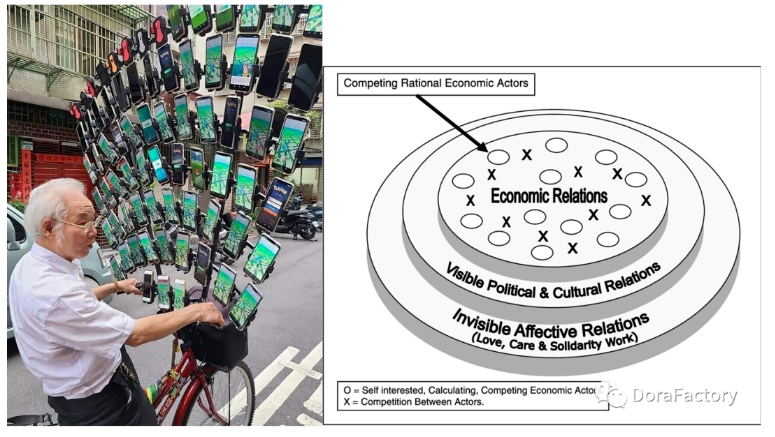


Organized witch activities

Fourth, the standard of the ideal method to solve this problem
Criterion 0 : the complexity of large social systems
Each attack type has a different level of sophistication. A script kiddie may lack the skills, organization, and conviction to launch a sophisticated attack, whereas an organized Sybil attack may have a near-limitless budget, skills, organization, and conviction to attack a system. More sophisticated adversaries will grow and evolve over time, requiring either ( 1 ) continued vigilance or ( 2 ) systemic antifragility on behalf of DAOs as digital identity providers.
Different opponents may try different attacks from each other. Some adversaries may pursue schemes that are invulnerable to biometric identity + government identity countermeasures but vulnerable to time attack countermeasures. Other adversaries may try something that is impotent to web-of-trust and presence-based countermeasures, but vulnerable to biometric countermeasures.
As there are different types of adversaries, the most comprehensive anti-fraud approach will aggregate different types of countermeasures to defend against Sybil/fraud.

Standard 1 : privacy-centric and sovereign needs
establish A challenge with a system that can address Sybil attacks is managing identity information. Identity information is critical to identifying Sybil attackers.
However, the need for identity also has counter-forces.
In a world where control over data is a liability, the designer of any of the above systems must avoid becoming a data honeypot.
Another requirement of a web 3 based DID system is user sovereignty (users can own/manage/delete their data) and privacy Protect. For example, when a dapp discovers whether a user is unique, they should not be able to discover more about the user without explicit consent.
Criterion 2 : Need to avoid plutocracy
Sybil resistance is a pedigree, From fending off script kiddies to fending off organized witches.
One management metric that has been kicked around is the idea of trust bonuses. Basically, you just amplify or suppress secondary matches based on some percentage. For example, a user with
100 % Trust Bonus + $100 hits will be able to assign $100 hits.
50 % Trust Bonus + 100 $ match will be able to allocate 50 $ match
150 % Trust Bonus + $100 match will be able to distribute 150 $match.
And so on......
The role of TrustBonuses in gitcoin has been obsolete. It is a legacy concept from the days of cGrants and only applies to QF products (other Sybil-resistant dapps will not have trust rewards because there is no quadratic matching).
One way we can move to a more manageable metric is personality score = falsification cost = dollar cost of falsifying a user's identity. For a system-wide KPI, this would make TCF = Total Cost of Forgery in the system, which is the ultimate KPI the DAO is pursuing to bootstrap an anti-Sybil economy.
As a passport's anthropomorphic score increases, it becomes more resistant to certain types of witches. Here's a rough estimate of personality scores by witch's level of sophistication.

Fake costs are created by linking multiple accounts. A very rudimentary example.
If a user connects to twitter (default 0.10 USD fraud cost)
Connect with a user to POH (default 00 USD fake cost)
A user connects to BrightID (default 10 USD fake cost)
The total forgery cost of this user's identity is then $110.10 $.
The cost of counterfeiting is how value is passed through the ecosystem of Passport users. If I'm designing a dapp, and I know this user's fake cost is 110.10 $, then I can reasonably reward this user with Sybil rewards worth up to 110.10 $.
So in the case of gitcoin it could give a match worth $110.10. Rabbithole (if it integrates with Passport) can offer rewards worth $110.10. POAP (if it integrates with Passport) can provide $110.10 worth of POAP Gas fees, etc.
The key insight behind the personality score is that in an adversarial world, the adversaries Gitcoin seeks to defend against vary in complexity. Instead of viewing Sybil Resistance as a binary (yes/no), we approach Sybil Resistance as a spectrum, making the problem more manageable.
Conceptually, you could use the current TrustBonus architecture to return PersonhoodScores, e.g. your trust bonus * your match amount = current risk amount.
IMO cGrants are structured in reverse. It makes more sense to start with a personality score + guide users to increase it or decrease their contribution by calculating their trust reward.

This brings me to a major problem with PersonhoodScores. It puts witch resistance in economic terms. If the designers of Witch Resistance games aren't careful, this could give the system a very dystopian quality.
If the TCF (Total Cost of Forgery) of the system is linked to the amount of funds in the system, then only the rich have status, that is a dystopia
If the average citizen has no way to reliably create a high enough personality score without money, it's a dystopia.
For this reason, it may be important to prioritize validation mechanisms that do not filter out citizens without wealth. It may be important to keep track of the number of monetary versus non-monetary identities active in the system. Examples of these systems are: BrightID, proof of character, biometric systems.

Standard 3 : Collusion
Assuming you have built the perfect witch resistance identity system.
Or a good enough system. A good enough IMO is a system where the TCF (Total Cost of Forgery) is greater than the amount of rewards a citizen of the system can take advantage of.
A good enough Sybil-resistant identity system is therefore one
has 3 , 000 , $000 in TCF and 2 , 999 , $999 matching pool.
Or, in a world where passports are implemented by multiple dApps, with a TCF of $3 , 000 , 000, all of these dapps The total economic opportunity is $2 , 999 , 999.
Or maybe the DAOI decides that it is willing to accept a 10 % risk of fraud, so when it has a TCF of $3 , 000 , 000 , which supports a total economic opportunity of $3 , 299 , 999 for all dapps in the Passport ecosystem.
In this case, you still have to deal with collusion attacks.
A really good enough system is one where TCB (Total Cost of Bribery) + TCF (Total Cost of Forgery) is greater than the amount of rewards that citizens of the system can exploit to exploit it.
Standard 4 : The need to build system defenses
About Proof of Stake and Proof of Work The way they are designed, one of the things I find most inspiring is that they work by acknowledging the presence of an adversary + essentially tilting the system design toward defensiveness and antifragility. PoW/Pow, they all come down to a simple principle, which is to make the cost of defense of the system much lower than the cost of attack.
In PoW, it is more profitable (and less risky) to use my mining hardware to mine the next block than to try to 51 % attack the network .
In PoS , it is more profitable to use my mining hardware to mine the next block than to try to 51 % attack the network (risky as well smaller).
This leads me to the following criteria: In Gitcoin Passport, it should be more profitable (and less risky) to legitimately participate in the network than to attack it.
Criterion 5 : Need to build network effects
If you build a perfect Sybil-resistant ecosystem, but no one is using it. This is known as the cold start problem in n-sided networks.
passport's flywheel can grow like this: the more users use Gitcoin Passport, the more Passport's TCF increases and the more dApps/stamps integrated with it , the more utility it provides, which leads to more users using it (and the cycle repeats).
How to cold start this network?
With the right configuration - as this flywheel spins, TCF should begin to grow exponentially as the network grows fundamentally exponentially.

Standard 6 : Enable innovation and prevent capture through modularity and forkability
Disagree with Gitcoin's (Stamp|Scoring Algorithm|Focus on Sybil Resistance), optional points. Over time, one could build a marketplace of stamping tools around the Gitcoin Passport scoring algorithm. Such a rich ecosystem is the foundation of decentralized social network effects.


A great devrel campaign could enable decentralized innovation on top of the Passport protocol. It invites contributions from around the world and turns Passport into a schelling point to address sybil resistance and create diverse collaborations across social distance, growing stronger over time.
A great devrel event that will serve as a meme schelling point for people who want to solve this problem + enable them to contribute their resources (coding skills, funding, anti-fraud data analysis, etc.) to solve this problem.
Criterion 7 : Fostering innovation and preventing capture through decentralization
With Gitcoin coming As time goes on and gradually decentralizes, I think it will change from centralized to decentralized and modular set of protocols based on the code base.
It will move from social software to trust software.
"Social software - a mechanism for creating assurance through interpersonal relationships, which incurs high social coordination costs"
“Trust software—a mechanism for creating guarantees through technology, resulting in lower social coordination costs”
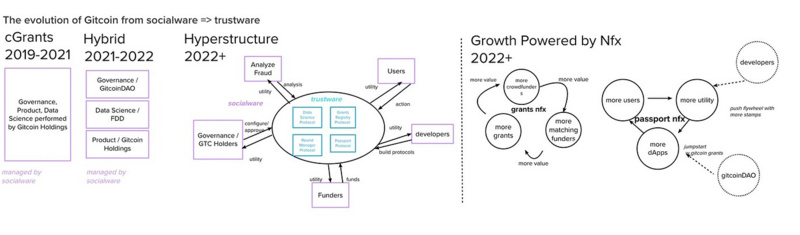
"By using blockchain as Our underlying assurance mechanisms codify organizational governance through code rather than purely documented principles that rely on human coordination. In doing so, we minimize trust in humans and maximize trust in technology , to build greater trust between all parties.”
Standard 8 : The Evolutionary Nature of the Game
< /p>
Gower's Law states that all efficient complex systems evolve from simpler efficient systems.
For Gitcoin Grants, the simple rule is quadratic funding. basically.
Funds are continuously raised into the matching pool and matched.


Gitcoin The main stated goal of Grants is to fund public goods. But if you look at it from a certain perspective, because Gitcoin Grants requires Sybil resistance, every round of Gitcoin Grants is actually a giant red team/blue team exercise, a battle to test digital native Sybil resistance technology.
Gitcoin's Sybil resistance will evolve as attackers evolve. It's important to think of this as an evolutionary game, and to recognize that the ecosystem is fluid, with opponents coming and going (and possibly becoming more advanced).
Five, what the future looks like
Imagination 69 round
The system is anti-vulnerable to many types of attacks.
Preserve privacy and respect user sovereignty
Avoid plutocracy/dystopian outcomes
Avoid collusion
An antifragile system , because the defense cost is lower than the attack cost.
Have network effects
Foster innovation
Prevent capture
Embrace the evolutionary nature of the problem
Original link
Welcome to join the official BlockBeats community:
Telegram Subscription Group: https://t.me/theblockbeats
Telegram Discussion Group: https://t.me/BlockBeats_App
Official Twitter Account: https://twitter.com/BlockBeatsAsia

 Related Articles