Other than Worldcoin, what other identity authentication systems should we be paying attention to?
Original Article Title: "Identity Authentication Systems You Must Know Besides Worldcoin"
Original Source: Biteye
As the airdrop army grows stronger, project teams have become more cautious about airdrop distribution, as seen in the recent popular project Worldcoin.
Despite first-tier exchanges like OKX and Binance announcing listings for its token $WLD, Worldcoin, as a project aiming to airdrop to all of humanity, faces a heavier anti-whale task, leading to much criticism of its iris authentication method.
In addition, the recent Linea testnet event introduced an identity authentication step to combat whale attacks. Users who complete identity authentication can receive an additional 2500 points.
The project teams' stance on whales is evident now, as completing account authentication has become a mandatory lesson for everyone interacting with projects. This article introduces several popular identity authentication and anti-whale projects.
01. World ID

Introduction
Worldcoin is a crypto project founded by Sam Altman, the founder of OpenAI, in 2020. The project aims to utilize blockchain technology to establish an open-source protocol for global financial equity and inclusivity.
With the rise of ChatGPT, this 2020 project has gradually gained recognition. However, in June of the same year, Worldcoin received a $250 million funding at a $1 billion valuation, with investments from Digital Currency Group, Coinbase Ventures, a16z, Multicoin Capital, LinkedIn founder Reid Hoffman, and FTX founder Sam Bankman-Fried.
By the end of March 2021, Worldcoin raised another $1 billion at a $30 billion valuation.
In many countries worldwide, there are still many people without legal identity. Worldcoin's aim is to provide these individuals with a unique digital identity.
Its goal is to create a digital economy that anyone can participate in, ultimately benefiting from this decentralized collective ownership.
To achieve this goal, the first step is to have enough people using its tokens, so conducting a token airdrop is an essential operation.
As mentioned at the beginning of the article, Worldcoin wants to carry out such a large-scale airdrop, facing a more burdensome Sybil attack task. Therefore, they directly launched a hardcore authentication process, confirming users' real identities through iris information.
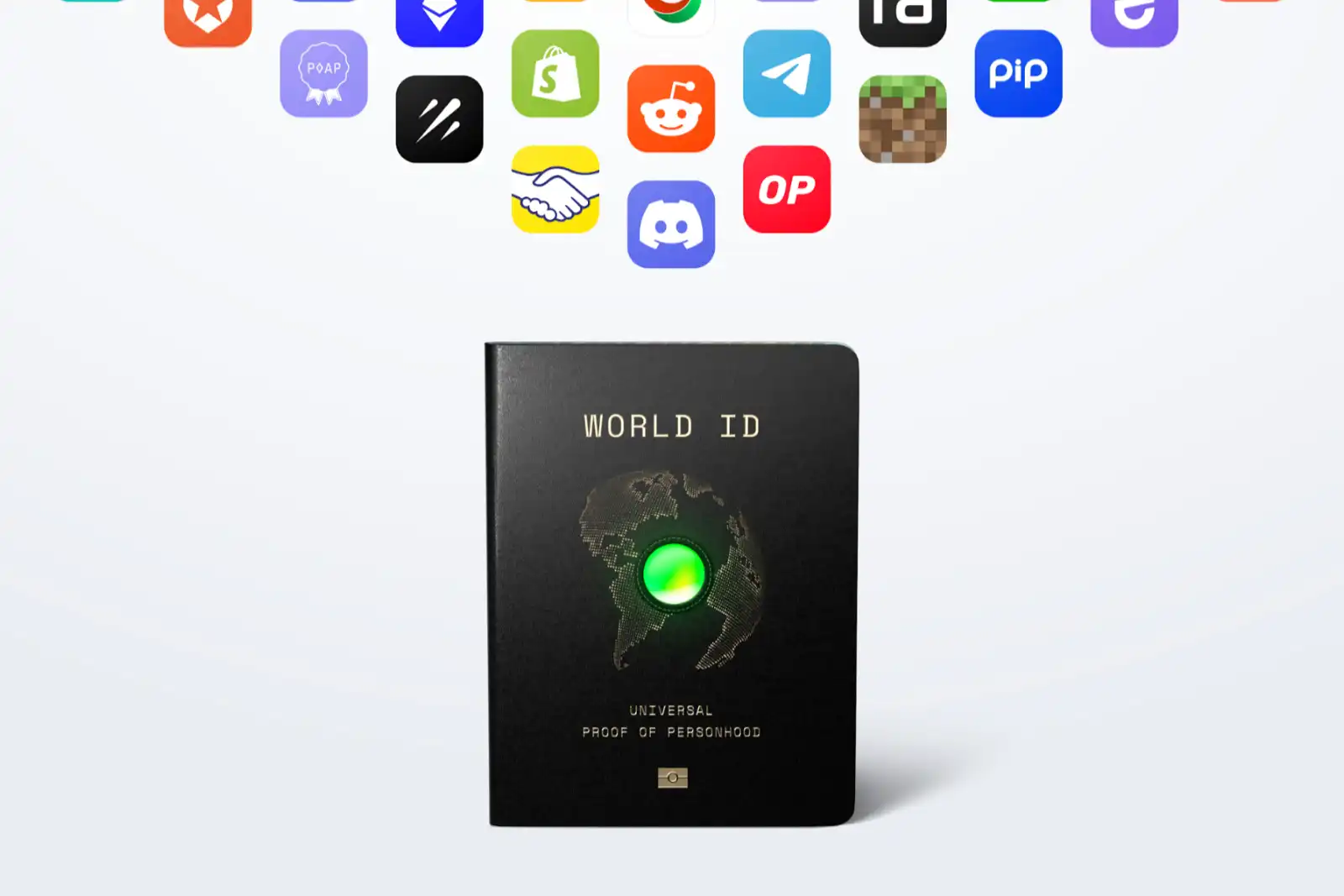
Worldcoin consists of three parts: the token, World ID (DID), and World APP (wallet). Users use World ID to verify their unique identity to prevent Sybil attacks and use World APP to receive the $WLD airdrop.
Currently, there are many methods of real person verification, such as facial recognition, fingerprints, genetics, and so on. Worldcoin uses iris verification, emphasizing its uniqueness and anti-fraudulence. In short, iris forgery is more difficult.
The promotion and operation of World ID are relatively simple. Worldcoin has introduced an iris detection device called Orb and then recruited local agents in various countries. After assessment and training, Orbs are distributed to these agents who carry out the iris collection tasks.

The more irises the agents collect, the more rewards they receive. Additionally, for each collected user iris, users receive small gifts and token rewards, making the overall offline promotion quite effective.
Due to its hardcore identity authentication, it is impossible to complete without an Orb. Furthermore, since collecting user biometric information is highly sensitive, many countries' laws prohibit institutions from collecting such information privately and taking it out of the country.
Therefore, the biggest obstacles to iris authentication currently are the quantity of Orbs and compliance restrictions of sovereign states.
Worldcoin plans to increase the number of Orbs to 1500 this summer and fall, and expand World ID to more countries and regions, such as the United States, Mexico, Hong Kong (China), Japan, Singapore, and others.
Projects Currently Using World ID
Worldcoin
https://twitter.com/worldcoin
Web3 Social Graph Lens Protocol
https://human.withlens.app/
Operation
Due to the authentication of World ID requiring cooperation with Orb for iris collection, if your country is not within Worldcoin's supported range, you still cannot obtain a World ID. Therefore, here we will only discuss the operational part and the basic principle of authentication.
First, users need to download their wallet World APP, which is currently available on major app stores.
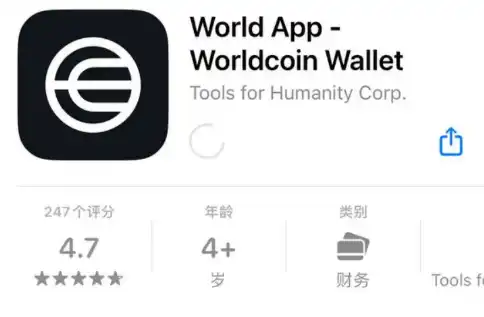
After the wallet is installed, it will prompt you to choose to create a new wallet or import an existing one. When creating a new wallet, it will also ask you to verify your phone number. Of course, you can choose to skip this and verify later.
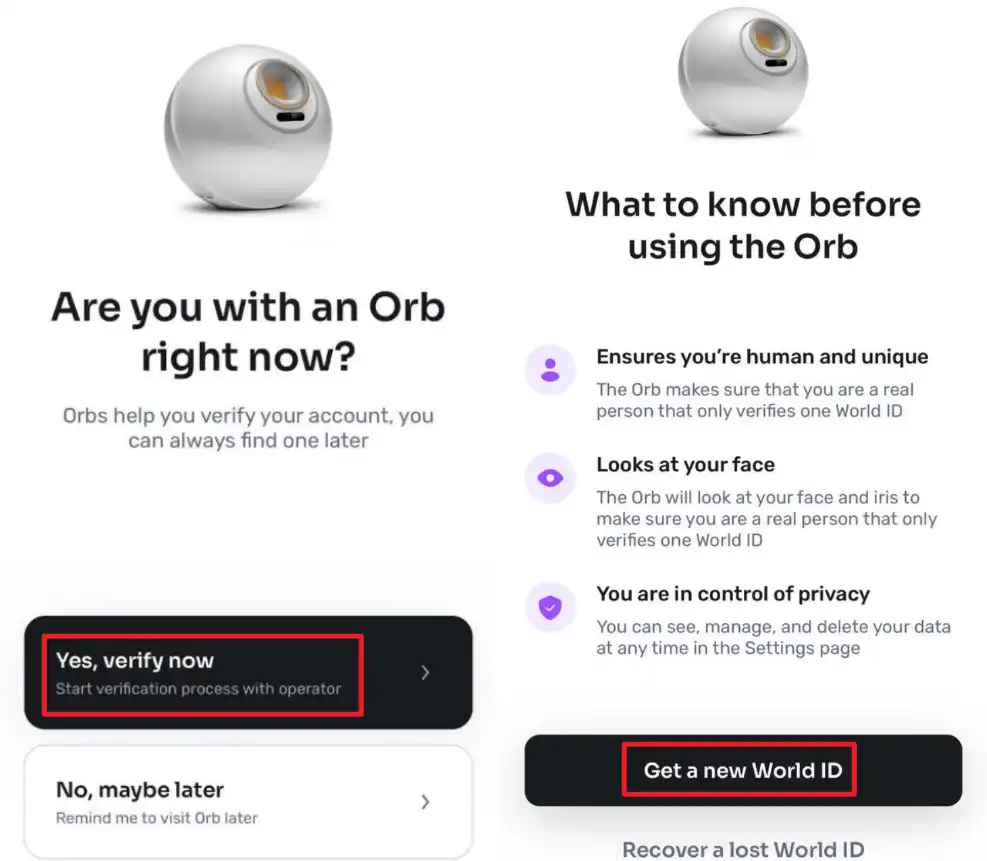
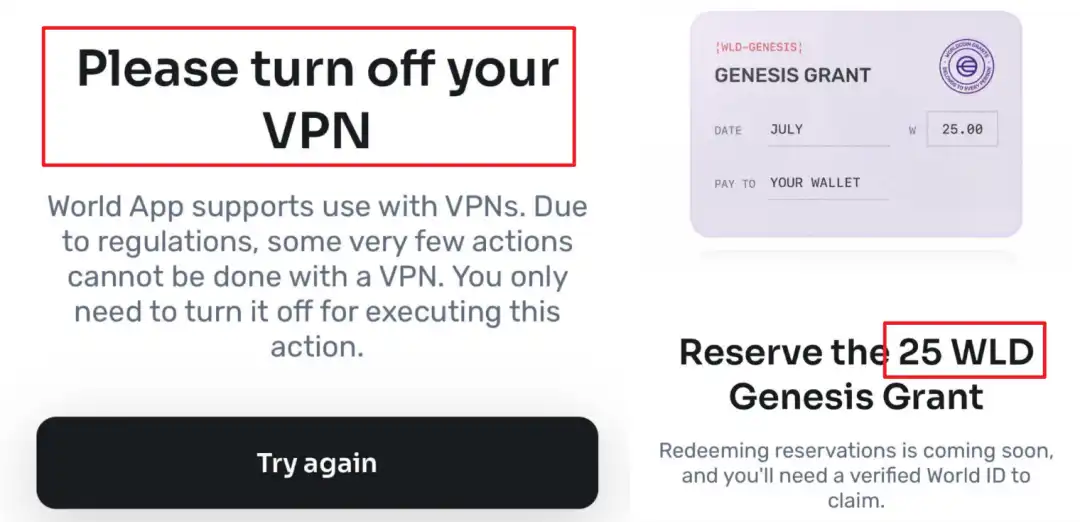
If you proceed with verification immediately here, you need to turn off your VPN. After verification, you will receive 25 $WLD tokens.
The basic principle of verification is that when creating a new wallet, you will obtain a key pair consisting of a private key and a public key. The user will provide the public key to the iris detection device Orb for detection. Orb will calculate a unique IrisHash identification based on the collected iris image through an algorithm.
When this IrisHash is not in the database, it means the user is registering for the first time. Only through such verification can the user successfully register a new World ID.
02. Gitcoin passport
Introduction
Gitcoin Passport should be the most well-known identity verification system for everyone. Gitcoin is an open-source donation project based on Ethereum, whose main purpose is to help raise funds for some open-source projects and build a communication bridge between projects and users.
Gitcoin was founded in 2017 by American engineer and entrepreneur Kevin Owocki. It then received a $11.3 million investment from Paradigm in April 2021 and another $500,000 raised by the Ethereum Foundation in November of the same year.
As a donation platform, Gitcoin has raised early-stage funding for many excellent projects, and these projects have also airdropped tokens to donating users, such as GTC, ENS, BrightID, and so on.
Due to the ease of receiving project airdrops through donations, there emerged a large number of users who donated solely for the airdrop. Therefore, Gitcoin Passport was born.
Gitcoin Passport is a Web3 identity verification aggregator designed to prevent Sybil attacks. It can collect verifiable credentials to prove user identity and credibility while protecting user privacy.
In Gitcoin's quadratic funding mechanism, there is a concept of matching donations. When users make a donation, Gitcoin's funding pool will additionally match a portion of the donation based on the number of donors to a project.
Only users with a Gitcoin Passport score exceeding 21.76 can qualify for donation matching.
With the increasing influence of Gitcoin, its Passport is gradually being accepted by other projects, such as the new public chain Linea mentioned above.
In the future, the operations of some projects will likely require a Gitcoin Passport score as a threshold. As users, it is also necessary for us to complete the corresponding verification tasks.
Projects Adopting Gitcoin Passport:
Donation Platform Gitcoin
https://twitter.com/gitcoin
Layer 2 Public Chain Linea
https://twitter.com/LineaBuild
Layer 2 Public Chain Taiko
https://twitter.com/taikoxyz
Decentralized Social Graph Protocol CyberConnect
https://twitter.com/CyberConnectHQ
Cryptocurrency Exchange Platform Shapeshift
https://twitter.com/ShapeShift
First DEX on Linea, EchoDEX
https://twitter.com/Echo_DEX
Operation
https://passport.gitcoin.co
The Gitcoin passport operation is relatively simple. When you open their website, you can clearly see all the tasks.
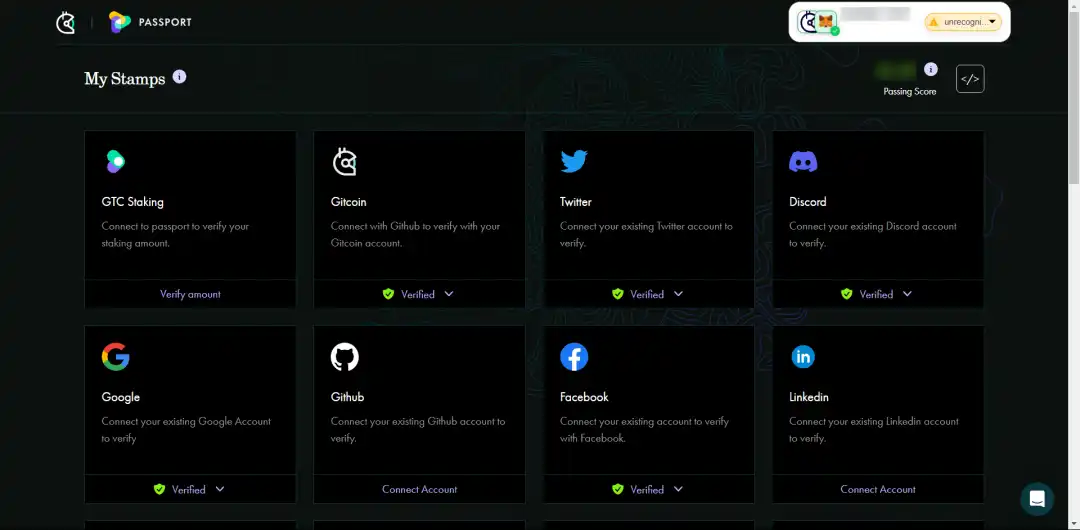
After completing each task, you will receive a corresponding score, such as binding your Google account, Facebook account, or Discord account.
Based on the completion status of these tasks, Gitcoin gives an overall rating of the user's authenticity. The higher the score, the more trustworthy your wallet address is considered to be.
If other projects adopt Gitcoin Passport scores, then the higher your score when interacting with this project, the lower the likelihood of being flagged as a witch.
For the specific score corresponding to each task and strategies on how to achieve a score of 20 or more at the lowest cost, you can refer to the mind map and guide previously released by Biteye.
《A Picture to Teach You How to Quickly Save Money and Increase Your Gitcoin Passport Score》
https://twitter.com/BiteyeCN/status/1673273955560599554?s=20
《Latest Verification Strategy for Gitcoin Passport》
https://mirror.xyz/0x30bF18409211FB048b8Abf44c27052c93cF329F2/J8KayQG2NOj-OZ_EMSgfHl3_cln1lCuUTNQuA_hOAcw
03. Nomis
Introduction
Nomis is a recent on-chain reputation project that has suddenly gained popularity. Launched by the Web3 credential data network Galxe, it aims to utilize the transparency of blockchain to establish an open Web3 on-chain data reputation system.
In airdrop events, witch users often profit in various ways, causing significant trouble for project teams and community members.
Despite the transparency of the blockchain, where these witch users can be seen transferring the same amount of tokens between multiple wallets, this information is useless without the right tools.
As such a tool, Nomis uses a custom wallet scoring model to assess address airdrop eligibility. The score is based on over 30 parameters, taking into account various types of wallet activities.
Through this model, project teams can customize parameters and weights to calculate a user's score, and once a user's score falls below a specific level, they can be explicitly flagged as a witch.
Nomis always believes that even if not all wallet holders are witches, utilizing tools like Nomis can significantly reduce the workload of manual review.
Likewise, although it may not change the minds of witch users, at least their operations can be rendered ineffective, which is what Nomis aims to do.
The reason this project gained traction is related to the current popular Layer 2 public chain zkSync. Just as everyone was interacting with zkSync, the zkSync team suddenly retweeted Nomis's tweet, causing widespread anxiety, with many people starting to worry that zkSync was also going to aggressively address witch accounts.
The Nomis team also published a related article, stating that they are the first identity protocol deployed on zkSync, which is significant for them.
But rather than worrying about project teams starting to target witches, it is wiser to prepare in advance, improve your score, which is the more prudent choice.
Projects Adopting Nomis:
Web3 credential data network Galxe
https://twitter.com/Galxe
Layer 2 public chain zkSync
https://twitter.com/zksync
https://nomis.cc/multichain
On the official website, you can see the multi-chain composite score of our linked wallet on the left side. Users with over 40 points can mint the Score SBT on the right, which comes at a cost. In other words, 40 points might be a passing score.
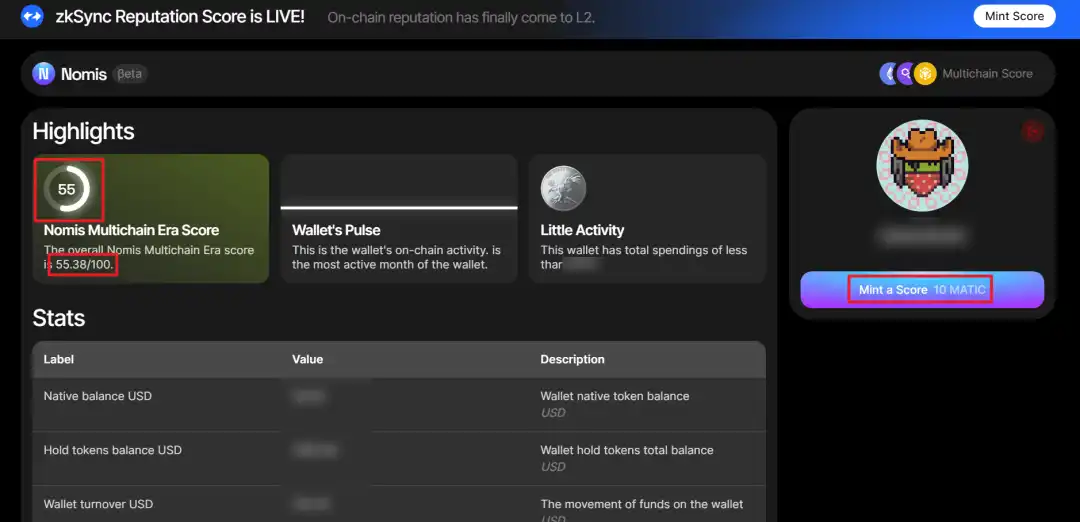
If you want to improve this score, you can see what parts make up the score under Stats below the score.
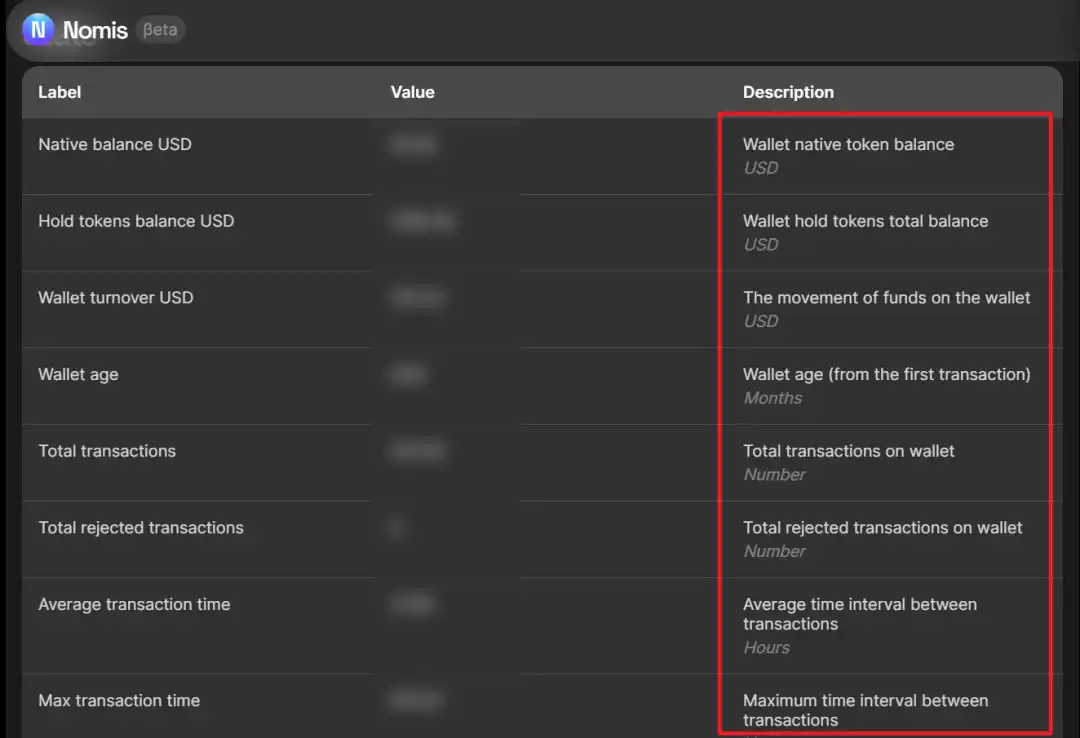
Based on the description on the right, we can basically summarize the following actions to improve the score:
Increase wallet funds
Increase transaction volume
Increase transaction frequency
Increase wallet NFT count
Increase total NFT value
https://mirror.xyz/0xnomis.eth/ne_vvBn04A0OmInI2ssirP4iMCwb_E0jNZcV8znQ9go
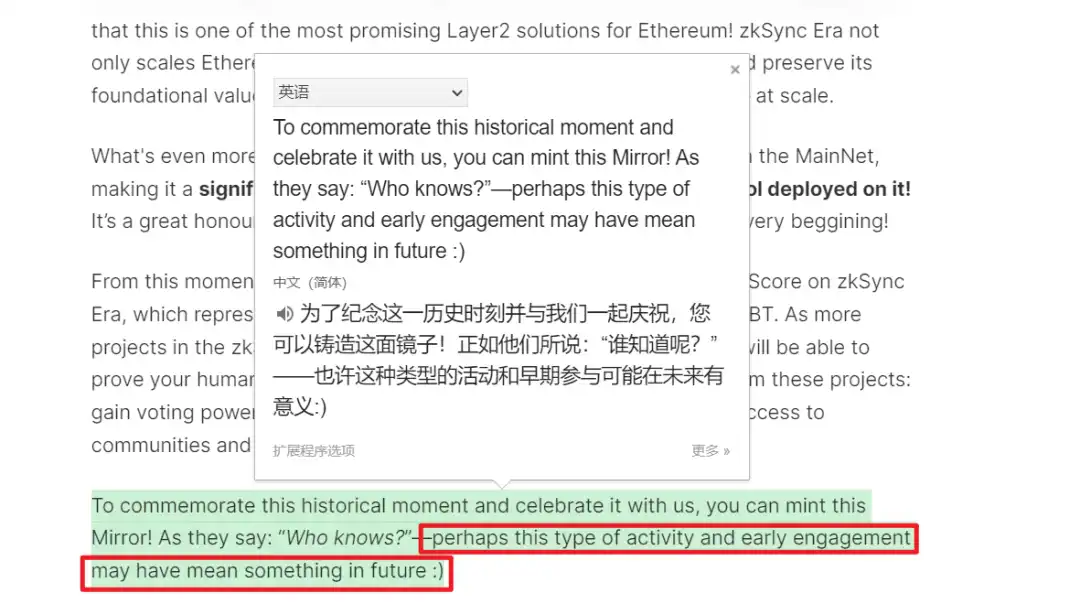
In addition to some of the project's own operations, the article mentioned above about the zkSync launch, officially published on Mirror, can also be minted to commemorate the moment. Optimism's fees are very cheap, around 0.1U, and currently only 28 people have Minted.
04. Degenscore

Introduction
Degenscore is a decentralized identity system based on on-chain behavior. Unlike Nomis mentioned above that supports multiple chains, Degenscore's score is entirely based on behavior on the Ethereum mainnet.
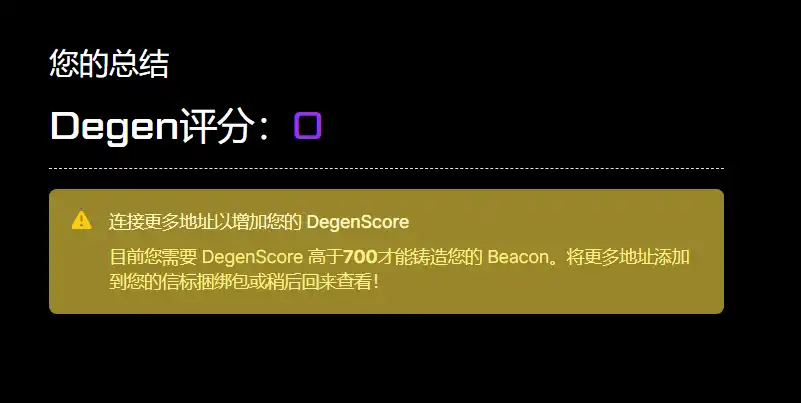
Users with a score of over 700 can mint a Degenscore Beacon SBT, but reaching 700 points is not easy.
Although the difficulty is high, once certified by Degenscore, there are many benefits.
Many projects will cooperate with Degenscore, providing users with whitelist benefits, and so on. The most well-known example is Lens's whitelist, with Lens peaking at around a value of 270U.
Projects Adopting Degenscore:
Web3 social graph Lens Protocol
https://twitter.com/LensProtocol
Web3 social APP Phaver based on Lens
https://twitter.com/phaverapp
Cross-Chain Bridge Via Protocol
https://twitter.com/via_protocol
On-Chain Identity Visualization Project PHI
https://twitter.com/phi_xyz
Wallet Project XDEFI Wallet
https://twitter.com/xdefi_wallet
And so on...
Degenscore has many collaborative projects, which can be viewed on the official website. Most of the projects listed in the Cafe have implemented Degenscore.
Operation
https://degenscore.com
Upon opening Degenscore's official website, you will see the Cafe interface. Here, you will find three sections: Opportunities, Abilities, and Jobs, which directly inform users of the benefits of holding Beacon.
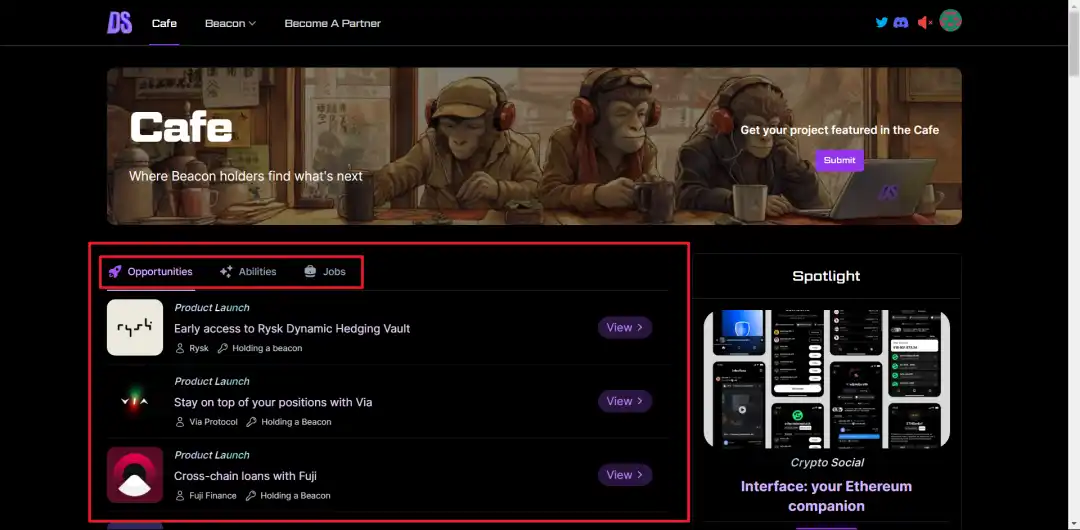
Opportunities: Beacon holders can get early access to the beta features of these collaborative projects
Abilities: Beacon holders have special rights within collaborative projects
Jobs: Beacon holders can gain priority employment opportunities in recommended projects and companies
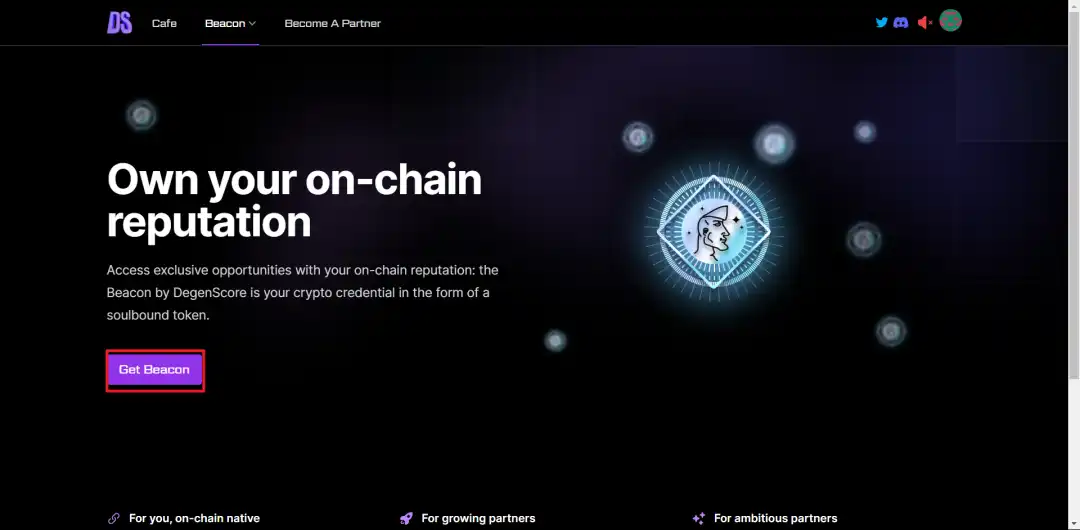
Click on Beacon in the top menu bar, select Overview, and you will see the application interface. The minting process is simple, with the only requirement being that the address must have over 700 points.
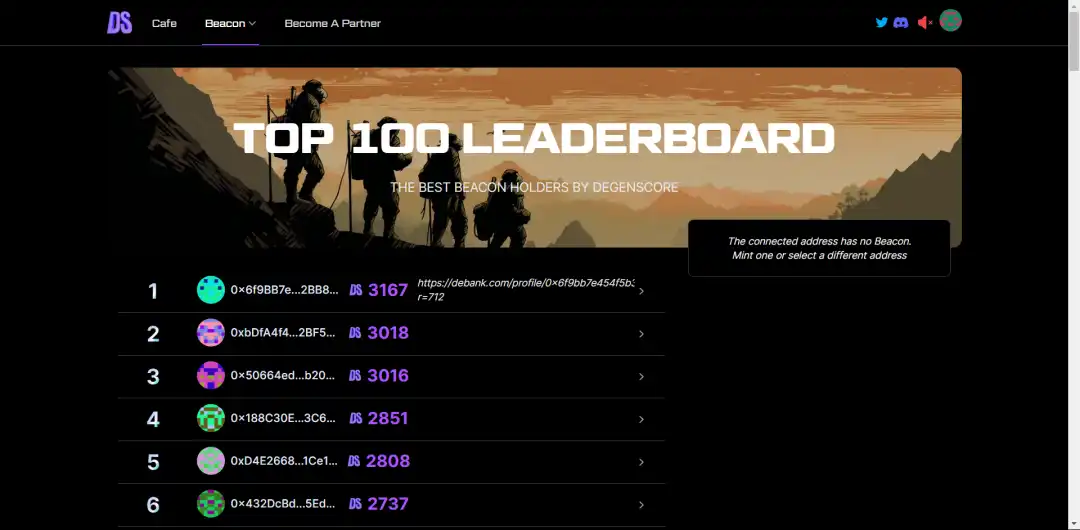
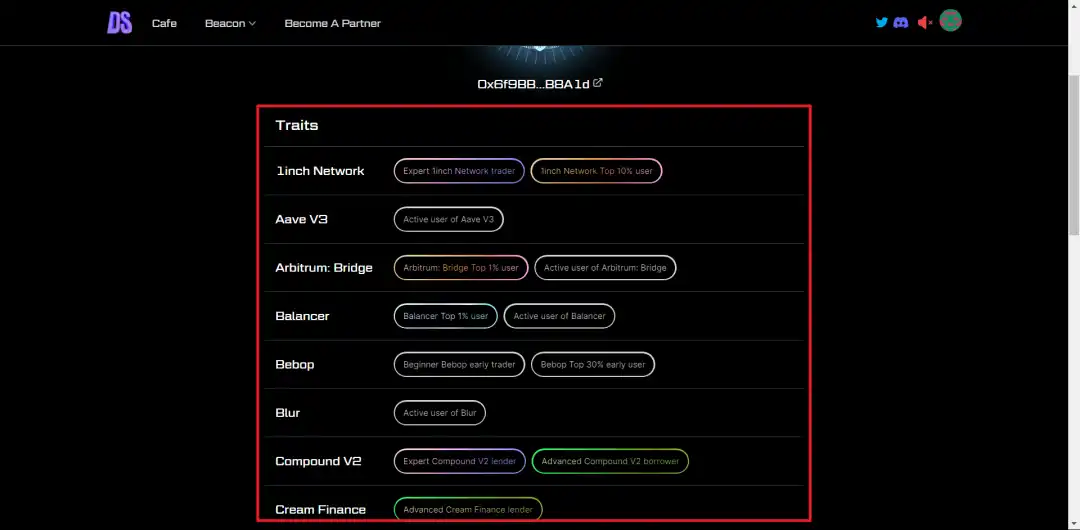
Boosting your score is simple; just go under the Beacon in the top menu bar and find Leadrboard, interact with the projects interacted with by the top hundred high-scoring users, and you're good to go.
As this is done on the mainnet, users need to have extra ETH prepared for gas fees.
05. Sismo
Introduction
Sismo is an on-chain reputation project based on zero-knowledge proof, reportedly founded by a former Aave employee. In December 2021, it raised a $10 million round of funding.
The investment lineup is quite strong, including Framework Ventures, Delphi Digital, Fabric Ventures, Global Coin Research, Seed Club Ventures, and more.
One of its key features is that users can prove ownership of an asset without revealing their wallet address.
This is very attractive to users who want to demonstrate their strength but are concerned about privacy leaks. For example, Ethereum's founder Vitalik has mentioned in his blog that he is very optimistic about the identity ecosystem and has cited Sismo as a specific project.
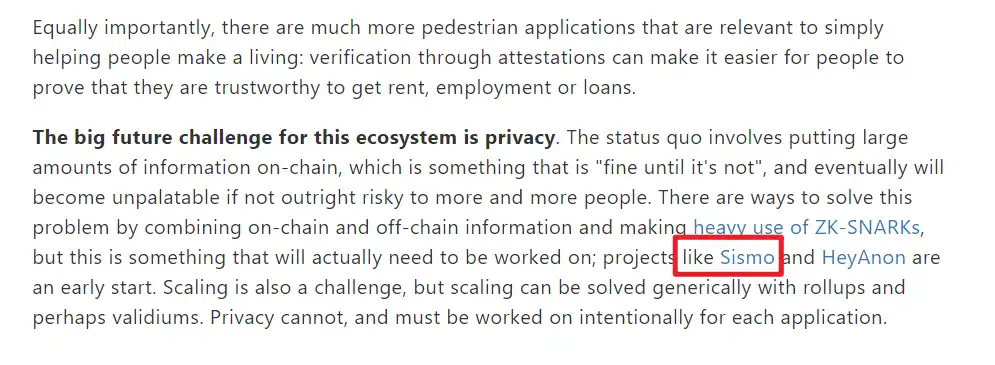
(Vitalik's Blog, https://vitalik.eth.limo/general/2022/12/05/excited.html)
So how does Sismo solve this problem? In the crypto world, many users do not have just one wallet. For example, if one wallet has 100 ETH and another wallet has 100 UNI, when I participate in a corresponding event, I need to prove ownership twice separately.
There are two main issues here: I need to disclose both of my addresses, compromising privacy, and I need to provide proof of ownership twice, which is cumbersome.
In Sismo's official introduction, the concept of single sign-on is mentioned. This means that a user only needs to log in once, and other places can be verified without logging in again. For example, once you log in to your Google account, services like Gmail, YouTube, Google Translate, Google Docs, etc., will automatically log you in without requiring you to repeatedly enter your account password.
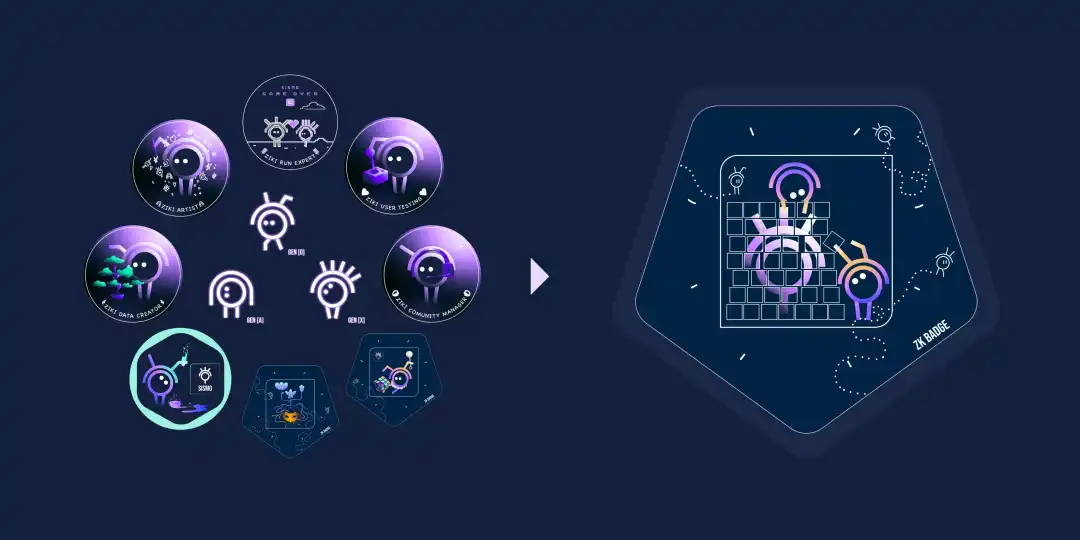
The badge of Sismo serves this purpose; a user only needs to undergo verification once to generate a badge. You can send this badge to a new address without any assets.
In this way, even if the new address does not hold this asset, having this badge can prove your on-chain identity. And since the badges are all on one address, users also do not need to use multiple wallets for multiple verifications.
Projects Adopting sismo:
Web3 Privacy Layer Aztec
https://twitter.com/aztecnetwork
Multi-chain DeFi Aggregator rhinofi
https://twitter.com/rhinofi
Operation
Sismo's current operation is to obtain badges. There are mainly two types of badges, one is the official badge, and the other is a badge issued by a third party, such as the badge that users who donated to G15 can claim.
https://app.sismo.io/
Open the above link, the first thing you will see is the G15 badge. If you cannot find it, you can search for keywords in the left-hand search box.
(Author's Note: The website app.sismo.io may become inactive in the future; you can use apps.sismo.io as an alternative.)
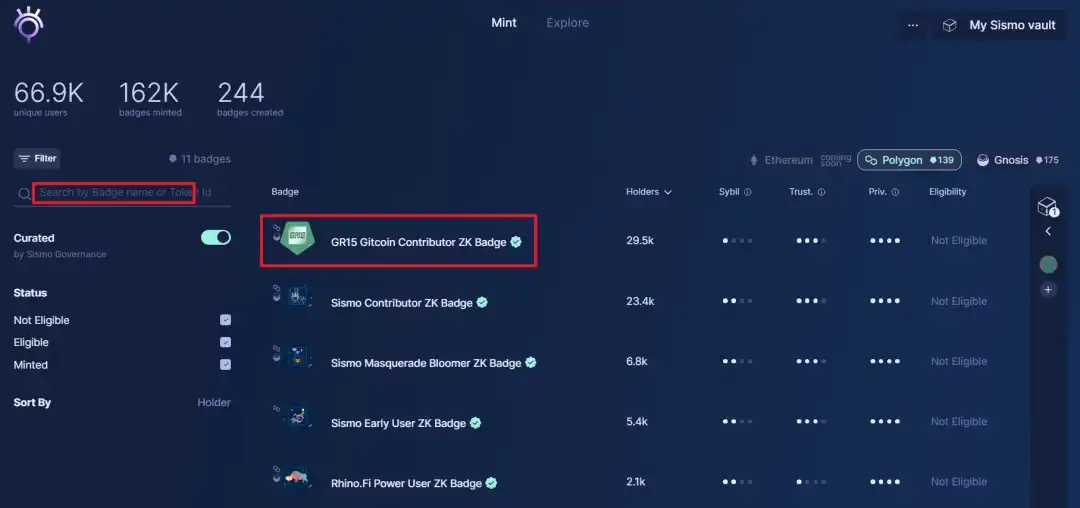
Go to the badge detail page and claim it directly. If your wallet is not eligible, it will ask you to switch to another wallet.
Currently, many badges have a time limit for claiming, so the number of badges that can be claimed is relatively small. After the Sismo update, the platform also provides the feature to create badges.
Open the website below, click on "Create a Data Group," and you can create your own badge. Although self-created badges may not carry much weight, consider it as an experience with the project.
https://factory.sismo.io/
06. Summary
The mentioned projects are just some of the more prominent and noteworthy projects in the identity verification field. There are still many other similar projects:
Binance Account Bound (BAB): Used for identity verification of Binance wallet accounts, completing KYC is sufficient, a requirement for Binance-related projects
Galxe Passport: A passport issued by Galxe, obtained by completing KYC, and serving as the entry requirement for certain projects on Galxe
Debank: A multi-chain DeFi wallet that recently introduced a badge feature and has its own WEB3 ID, but requires a $96 fee
Summary of the above five projects:
1. World ID is currently facing the most controversy. From the perspective of anti-whale measures, its iris authentication can filter out the majority of whales. However, due to the difficulty of verification, some genuine users have also been filtered out.
Collecting user biometric information is a highly sensitive operation. Although Worldcoin claims not to store users' iris images and will delete these images once the algorithm is optimized, the timing of optimization and the risk of leakage during the process of collection by local agents are factors that remain unknown to us.
Additionally, constrained by the number of Orbs, the efficiency of this off-chain validation is far lower than on-chain validation. Therefore, whether World ID is a reliable, effective, and secure identity authentication tool remains to be validated.
2. The most widely used should be Gitcoin Passport. It uses a large number of tasks to verify user identity, including both on-chain and off-chain methods. The evaluation of user identity is relatively comprehensive and reliable.
In the future, many projects are likely to adopt its verification as a means to filter out whales. Users who want to participate in airdrops should pay close attention to and improve their score on Gitcoin Passport.
3. The simplest and most cost-effective operation belongs to Nomis. Users do not need to complete various tasks; they only need to perform more on-chain operations, deposit more funds, and buy more NFTs to increase their overall score.
Moreover, it is a multi-chain composite score, allowing operations on Layer 2 chains, which not only saves costs but also diversifies user evaluations.
4. The most challenging and costly operation is likely Degenscore. It involves numerous tasks and requires on-chain operations on the mainnet, potentially demanding substantial transaction fees, leading to high costs.
Although the funding level can to some extent indicate the authenticity of an address, for a project, filtering out genuine users relies more on authenticity than solely on the amount of funds.
Using Degenscore as a witch judgment tool leads to heavily skewed results. In the author's opinion, Degenscore is more like a rich people's club, or as its name suggests, a Degen (Veteran, Heavy User) club, so regular users don't need to be too fixated on their score.
5. The final one is Sismo, which adopts zero-knowledge proofs and focuses on privacy as its advantage. However, Sismo is still in a relatively early stage, with few collaborative projects and a shifting technical roadmap, so there won't be much for users to get their hands on. For now, users can experience badge claiming or its badge creation feature, and stay tuned for its latest developments.
Original Article Link
Welcome to join the official BlockBeats community:
Telegram Subscription Group: https://t.me/theblockbeats
Telegram Discussion Group: https://t.me/BlockBeats_App
Official Twitter Account: https://twitter.com/BlockBeatsAsia

 Related Articles