Inventory of different types of zero-knowledge technology solutions and zero-knowledge proof projects
Original title: "Understanding Zero-Knowledge Proof Blockchain Project in One Article"
Original source: Chainlink
Zero-knowledge technology is a branch of cryptography that can solve scaling and privacy issues for many Layer 1 blockchain projects. Blockchain can use zero-knowledge proof technology to improve transaction throughput, protect user data privacy while verifying user identity, realize complex calculations, and allow enterprises to use blockchain technology while protecting their own intellectual property rights. In all the above application scenarios, zero-knowledge proof is an indispensable key technology.
What is a Zero Knowledge Proof (ZKP)? Zero-knowledge proofs allow users to prove that they know or possess information without revealing it. A "prover" uses information entered into a system to create a proof, while a "verifier" verifies the calculation of the proof, but does not know the specific content of the information. Most importantly, zero-knowledge proofs can verify the validity of a data set while protecting data privacy.
This article will explore the unique advantages of zero-knowledge proof solutions; Utilizing zero-knowledge proof technologies like zkSNARK and zkSTARK to help developers build advanced dApps that scale for Web3 while protecting user privacy; and how Chainlink's trust-minimized service helps these protocols improve decentralization, reliability, and security sex.
Why use zero-knowledge proof technology to build a network?
Zero-knowledge technology allows developers to take advantage of underlying blockchains such as Ethereum It can improve the transaction throughput and speed for dApp, and at the same time put the user's personal information off the chain to protect user privacy. Transactions will be packaged and uploaded to the chain to reduce the cost of use for end users. Ultimately, projects can leverage these capabilities to create advanced dApps that not only rival Web2 systems in performance, but also maintain the decentralization benefits of Web3.
Zero-knowledge proof scheme VS Optimistic Rollup
Optimistic rollup is a Layer 2 technology and is currently the mainstream expansion solution. According to statistics from the analysis website L2Beat, as of June 29, 2022, optimistic rollups accounted for 74.3% of the total locked positions of the Ethereum Layer 2 network, while zero-knowledge proof schemes accounted for 25.9%.
The biggest difference between the zero-knowledge scaling solution and optimistic rollup is the way of transaction verification. Optimistic rollup adopts fraud proof (fraud proof), which needs to be generated only when adjudicating a state change dispute on the Layer 1 blockchain; while the zero-knowledge technology solution is to publish a valid transaction when each batch of transactions is packaged and uploaded to the chain. Validity proof. That is to say, the protocol using zero-knowledge proof is always valid, and the cost is to spend more gas fees to verify the validity proof on the underlying blockchain.
However, combining zk-rollup with off-chain data can effectively optimize gas fees. This more efficient zero-knowledge technical solution includes "validium" and "volition". Such schemes can also prove state validity without revealing data privacy. This will help improve the application of public chains in enterprises, and enterprises can better protect user data and business secrets.
There is another difference between the zero-knowledge technology solution and optimistic rollup, and that is capital efficiency. In optimistic rollup, the standard time window for transaction finalization and withdrawal is one week; in zero-knowledge technology scheme, users can withdraw in about 10 minutes.
To learn more about the difference between optimistic rollup and zero-knowledge protocols, please watch the following video. In the video, leaders from Offchain Labs, Polygon Hermez, Matter Labs, Metis DAO, and Optimism discussed the future development of Ethereum Layer 2: https://youtu.be/t-SQQmLhepY
Different types of zero-knowledge technology solutions
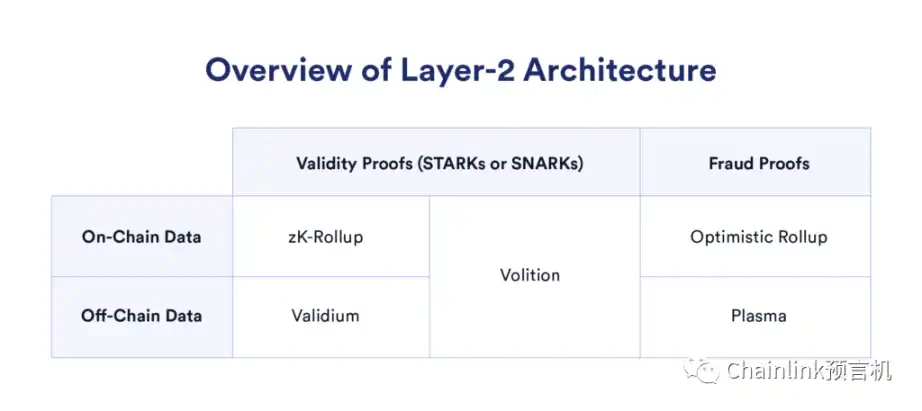
Layer 2 schemes can use validity proofs or fraud proofs, and can store data on-chain or off-chain
< /p>
Infrastructure
zk -Rollup
zk-rollup will pack multiple transactions in together, and publish it on the Layer1 blockchain, and at the same time issue a proof to verify the validity of the calculation. Proofs posted on-chain are also called "validity proofs". Validity proofs are divided into two categories: SNARKs and STARKs. Once these proofs are verified on the underlying blockchain, the state of the zk-rollup is updated.
Validium
Validium combines proof of validity and off-chain data storage to improve scalability. Validity proofs are published on the underlying blockchain, while data is stored off-chain. This will greatly increase throughput and reduce gas fees.
Although Validium is far superior to zk-rollup in terms of efficiency and scalability, it is Data may be unavailable due to an attack, or users may not be able to withdraw funds. However, this data availability problem can be solved through the PoS system, which uses an economic incentive mechanism to ensure that data is stored in each node and is available at any time. It is worth mentioning that although the attacker may suspend transactions, they cannot directly steal user funds.
Volition
Volition combines zk-rollup and validium, users can freely choose to use zk-rollup or validium scheme, these two schemes share the same state root. Even if validium is compromised, funds on zk-rollup are still safe.
Therefore, institutions are willing to pay higher fees in exchange for the security of zk-rollup , while individual users are more inclined to validium with lower transaction costs, and the two can seamlessly interact on volition. For example, market makers in DEX provide hundreds of millions of dollars in liquidity, so they will choose zk-rollup; while retail investors have relatively small positions, so they will choose validium.
Validity certificate
SNARK
The full name of SNARK is "zero-knowledge succinct non-interactive argument on knowledge" (Chinese is "succinct non-interactive zero-knowledge proof"). This is a cryptographic proof that the file is small and easily verifiable. It generates a cryptographic proof using an elliptic curve that assumes that the discrete logarithm of a random elliptic curve element cannot be found from a public base point. The calculation cost of elliptic curve is lower than STARK’s hash function, so the gas cost of SNARK protocol is lower.
STARK
< br>
STARK's full name is "zero-knowledge scalable transparent argument of knowledge" (Chinese is "zero-knowledge scalable, transparent knowledge proof" ). This cryptographic proof requires almost no interaction between the prover and verifier. The biggest advantage of STARKs over SNARKs is that the proof time is shorter and it is easier to expand. In addition, since STARKs use a hash function, they are also resistant to quantum attacks.
It is worth mentioning that the inventor of STARKs is Eli Ben-Sasson, the Ren is the co-founder of StarkWare, the team that also developed StarkEx and StarkNet.
Blockchain project using zero-knowledge technology
< br>

A blockchain project that adopts a zero-knowledge technology solution
Projects using zk-STARK
< b>StarkEx
StarkEx is Layer 2 expansion on Ethereum The scheme adopts STARK proof to verify self-hosted transactions, and develops transaction and payment applications on it. Projects based on StarkEx include DeversiFi, Sorare, and dYdX, which have completed hundreds of millions of transactions and achieved a transaction volume of hundreds of billions of dollars. However, StarkEx cannot support smart contract functions, so it cannot realize a fully functional dApp.
StarkNet
< br>
StarkNet is a general platform, developers can use StarkNet to deploy smart contracts on Ethereum's zk-rollup. Ethereum’s mainstream dApps Aave and Maker both plan to launch on StarkNet. It is worth noting that StarkEx’s zk-rollup can also be released on StarkNet to improve the scalability of the application.
In order to take full advantage of STARK's advantages in computing and scalability, StarkWare developed the Cairo language , an efficient and Turing-complete programming language designed specifically for creating STARK proofs. This means StarkWare needs development documentation, frameworks, and other tools to activate its developer ecosystem.
Immutable X
Immutable X is an NFT platform for minting and trading NFTs and tokens. The platform uses StarkEx to build its own zk-rollup. Millions of NFT minted and traded on the Immutable X platform, and costs can be kept low even during periods of Ethereum network congestion.
Immutable X will also be released on StarkNet. The validity proof will not be released directly to Ethereum, but to StarkNet first, and then released to Ethereum through StarkNet’s rollup. Immutable X can use StarkEx to publish application chains on StarkNet, providing a layer 3 expansion solution for projects.
Projects using zk-SNARK
< /p>
Zcash
Zcash was formerly known as ZeroCash. The "zero" in the name refers to the use of zero-knowledge proof technology to achieve private transactions. Zerocash was one of the early crypto projects that drove the adoption of zero-knowledge proof technology in the industry.
Loopring
Loopring is a DEX on Ethereum that supports order book transactions and does not host user assets. Loopring is connected to Chainlink Price Feeds, serving hundreds of thousands of users and billions of transactions.
zkSync 1.0
zkSync 1.0 is a rollup on Ethereum. Like StarkEx, it supports token transfer and exchange, but does not support smart contracts. The protocol was developed by Matter Labs.
zkSync 2.0
zkSync 2.0, like StarkNet, is also a Layer 2 expansion solution for Ethereum. The volition infrastructure is adopted to support smart contracts. zkSync uses zk-SNARK to verify transactions, and uses PoS system zkPorter to ensure data availability. The main difference between zkSync 2.0 and StarkNet is that the former is compatible with EVM besides validity proof. 1inch, Alchemix, and Curve are all scheduled to release on zkSync 2.0.
ZigZag
ZigZag is a decentralized trading platform that uses the order book model to trade ERC-20 tokens. In contrast, most DEXs use an automated market maker (AMM) model. ZigZag's order book mode benefits from the powerful scalability of zk-rollup. Any token in the zkSync registry can be traded in ZigZag. The protocol currently runs on zkSync 1.0, but plans to release it on zkSync 2.0 and StarkNet.
Mina
Mina is a lightweight blockchain that uses SNARKs to create blocks with a maximum capacity of 22kb. Projects can develop and deploy applications on Mina, and can realize all smart contract functions.
How can the zero-knowledge proof protocol improve the level of decentralization, reliability and security< /h3>
Zero-knowledge proof protocol can use Chainlink's decentralized oracle service to improve security and achieve automation . Protocols in the Web3 ecosystem can use Chainlink's trust-minimized services to access any external API and leverage secure off-chain computing to build more advanced applications.
The zero-knowledge proof protocol can use the following services to improve dApp performance:
Accurate market data——Chainlink Price Feeds escorts the DeFi economy and supports decentralized stablecoins, Various use cases such as lending protocols and trading platforms provide extremely reliable and accurate market data.
Verifiable random numbers - Chainlink VRF can create random numbers and cryptographic proofs, and upload them together to the chain for verification. NFT platforms can use random numbers to mint NFTs in a fair and verifiable way. Blockchain games can use random numbers to create an unpredictable gaming experience.
Smart Contract Automation - Chainlink Keepers is a decentralized transaction automation service that can automatically trigger key smart contract functions, such as settling limit order transactions , Execute liquidation and rebase pass, etc.
Proof of Reserves - Chainlink Proof of Reserves can automatically verify reserve assets based on cryptographic facts, reducing risk for zero-knowledge proof protocols, increasing transparency and avoiding DeFi systemic risk.
Cross-chain communication——Cross-chain Interoperability Protocol (CCIP) provides a common open standard for the protocol to create secure cross-chain applications, Transfer tokens, send messages and trigger interactions in a Web3 world.
Summary
The combination of zero-knowledge proof and the underlying blockchain and decentralized oracle network is bound to promote the transformation of the blockchain industry, and the project team will develop a scalable Highly cost-effective applications, while protecting user privacy.
Although other Layer 2 solutions may provide better infrastructure, but with the continuous development of the blockchain industry, zk-rollup, validium and volition are bound to gain the favor of more individual users and enterprises.
Original text link
Welcome to join the official BlockBeats community:
Telegram Subscription Group: https://t.me/theblockbeats
Telegram Discussion Group: https://t.me/BlockBeats_App
Official Twitter Account: https://twitter.com/BlockBeatsAsia

 Related Articles