Zero-knowledge proof network: a top-down approach.
Source: R3PO WeChat Official Account
Introduction
This article is not about the technical details of ZK technology, but about describing as many application directions of ZK as possible. The iteration of ZK technology is still ongoing, but the implementation of the technology requires applications to carry it. We will gradually delve into the bottom layer of EVM, L2, cross-chain bridges, and public chains from the application layer closest to the user.
Against the backdrop of social division of labor, technologies from different fields are like magic to outsiders. However, building with "usable things" can help us grasp the main thread of things and thus deduce the technical characteristics of ZK, which is also the most reasonable arrangement in line with human cognitive logic.
Development History in Brief
In 1985, Goldwasser, Micali, and Rackoff first proposed the Zero-Knowledge Proof model. To be precise, this is a "interactive zero-knowledge proof" model, which allows for verification of truth without revealing the information itself through specific techniques in multiple interactions between both parties.
In 1991, Manuel Blum, Alfredo Santis, Silvio Micali, and Giuseppe Persiano proposed "non-interactive zero-knowledge proofs", which is known to be a way of conducting non-interactive proofs, that is, verifying the authenticity of information between two parties with only one final verification.
The progress brought by non-interactive zero-knowledge proofs is enormous. Firstly, the number of interactions between the parties is reduced to a fixed number, which enables offline verification and public verification. The former lays the foundation for the effectiveness of Rollups, while the latter is coupled with the broadcasting mechanism of the blockchain, which can avoid the resource waste caused by multiple calculations.
The subsequent appearance of Zcash also marks the first large-scale use of SNARKs technology. As a standalone privacy coin, it serves as a bridge between people's understanding of ZK technology and blockchain.
In short, this improvement is focused on "succinctness". SNARKs aim to compress the size of the information itself, rather than just compressing the amount of data used for verification. In ZCash, the program circuit is hardcoded, fixed, and unchanging, so polynomial verification of it is also fixed.
ZK Technology Generalization: Starting from Private L2, but Will Eventually Shine Across the Entire Blockchain
The term "late bloomer" is a fitting description for zero-knowledge proof technology. This cryptographic algorithm, which originated in the 1980s, did not truly come into its own until 30 years later, with the emergence of first-generation privacy coins such as Zcash and Monero. As a result, ZK technology has become increasingly intertwined with blockchain technology.
At this time, Ethereum was struggling to survive, but scalability had already been a long-term planning idea. With the actual failure of the Plasma scheme, Ethereum began to turn to the Layer 2 Roll up scheme. ZK also went through more engineering iterations such as SNARK, PLONK, and STARK, and built the now thriving ZK Roll up family.
Privacy and scalability, Tornado Cash and L2, respectively become the usage and practical examples equivalent to these technical terms.
But this is just the tip of the iceberg in the story. Essentially, ZK is a means of verifying information between two parties, with the key point being that it does not involve the information itself, and is as cost-effective and efficient as possible. We can use Vitalik's concept of the blockchain trilemma to describe the technical features of ZK.
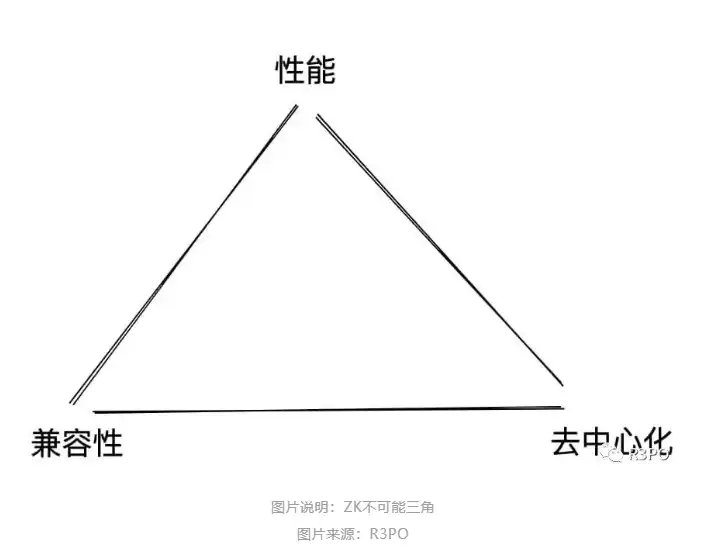
These three requirements conflict with each other. The better compatibility requires off-chain computation to improve performance. Pursuing decentralization requires as much on-chain verification as possible, which will reduce performance and increase the cost of improving compatibility. If the best compatibility is to be achieved, verification performance will be sacrificed.
However, ZK technology was born out of the exploration of the impossible triangle through iteration, and now has a rich range of uses. But first, we need to get rid of our existing understanding that ZK can only exist on Layer 2. In this article, we will gradually introduce the practical uses of five main areas: Dapp, L2, ZK-EVM, ZK Bridge, and ZK public chain.
ZK Dapp: The Dawn of the Dark Forest

In "The Three-Body Problem," Yun Tianming conveyed three survival rules in the Dark Forest to his fellow Earthlings through three fairy tales known to the Trisolarans:
Surrender, hide yourself, artificially lower the civilization level, which is equivalent to issuing a safety declaration to the hunters lurking in the forest;
跑路, developing curvature engine technology, breaking free from the mindset that Earth is home, wherever humans are is home;
Battle, develop interstellar civilization, and knock down the Trisolarans. If encountering a stronger civilization, then be strong and face it.
Transmitting this story under the surveillance of the Trisolarans is itself a workflow description of ZK technology. All three parties, the Trisolarans, Yun Tianming, and the people of Earth, know all the "information," but only Yun Tianming and the people of Earth understand the "knowledge" represented by the information.
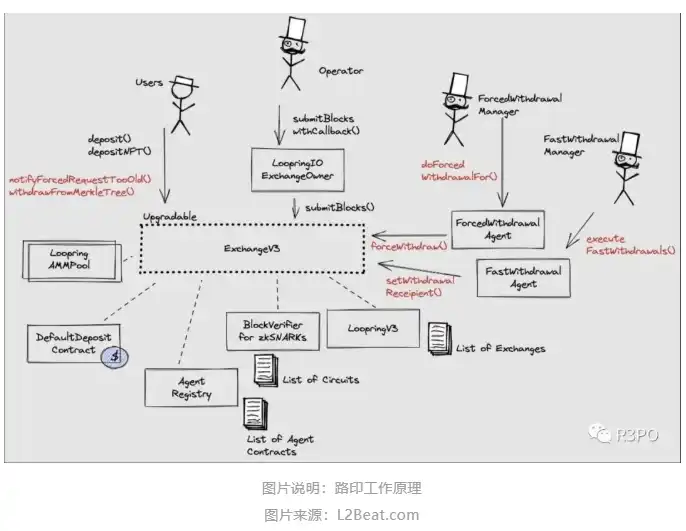
ZK's "information encapsulation of knowledge" feature is very suitable for use in inter-chain communication, cross-chain DEX, and other areas where knowledge requires encryption, but information transmission needs to be public.
Taking Loopring as an example, although it claims to be an L2 solution, it belongs to a specific type of L2 solution that focuses on trading and payments. The scheme it uses is zkSNARKs, and according to its official documentation, it puts more verification work off-chain and stores verification information on-chain as succinctly as possible.
To achieve the highest throughput, we only support off-chain balances. These are balances stored in a Merkle tree. Users can deposit and withdraw tokens to and from our smart contract, and their balances will be updated in the Merkle tree. This allows us to transfer tokens between users off-chain by updating the Merkle tree, without the need for expensive on-chain token transfers.
The benefit of doing this is to design a ZK scheme that can work in a specific field. Essentially, it uses ZK technology to turn Roll up into a single application solution. The true champion of this approach is dYdX, developed using StarkEx, which has become the leader in the derivatives race.
However, the problem with non-universal solutions is that they can lead to being stuck in a rut, and communication with the outside world is always an issue. Upgrading and maintaining internally while also considering the needs of both the Ethereum mainnet and their own applications is a difficult balancing act. Walking on a tightrope is not a sustainable solution in the long run. dYdX's decision to migrate to Cosmos, as well as the launch of the universal Rollup Taiko, also signifies that the competition in L2 is about universalization.
ZK Rollup: The Midpoint of Dreams
The starting point is in the abdomen, which is a typical feature of the ZK technology innovation. Earlier privacy coins such as ZCash and Tornado Cash in the race were discontinued due to regulatory reasons and did not carry the banner of ZK.
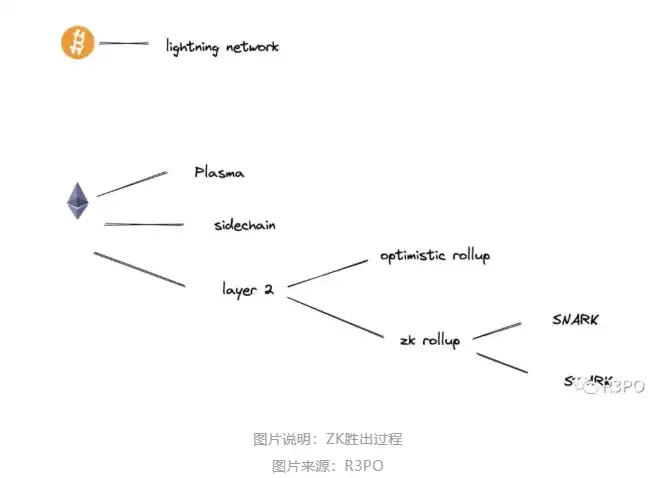
The L2 Rollup track is a very strange existence in the overall encryption pattern, which is neither a bottom-layer public chain nor an upper-layer application. Correspondingly, Ethereum is actually dominant, and the remaining public chains are essentially Ethereum's compatible chains.
L2 is not exclusive to Ethereum. In theory, Bitcoin's Lightning Network is also a type of L2, but only Ethereum's L2 can be called a track. Vertically speaking, it has gone through a long period of innovation and has experienced multiple routes such as Plasma, sidechains, Optimistic Rollup, ZK Rollup, etc. Horizontally speaking, the development of ZK Rollup alone has led to differences in directions such as ZK VM, ZK EVM, SNARK, and STARK, resulting in numerous projects and diverse opinions.
But fundamentally, Rollup is a sub-chain level basic narrative, and its own operation cannot directly generate profits. Instead, it relies on the ecological effects of the functions and applications built on top of it. For example, zkSync focuses on Gitcoin's transfer payments, and dYdX relies on the application chain built by StarkEx, both of which prove the public chain similarity of the Rollup narrative.
Currently, in the overall Layer 2 landscape, the main battle in terms of technical roadmap is between SNARK and STARK. Representative projects for the former include zkSync, while for the latter, there is StarkWare. The main difference between the two lies in the following:
zkSync: Towards an EVN-compatible ZK Snark Solution
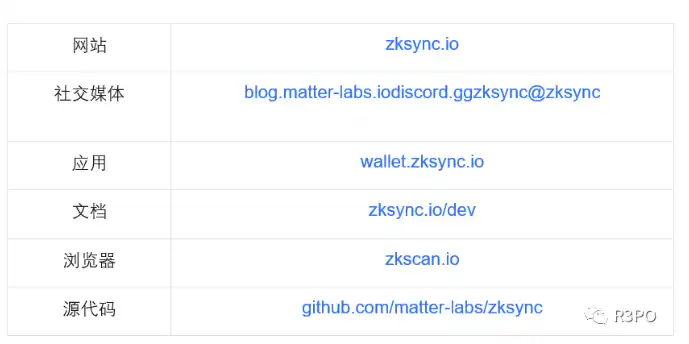
Basic Information:
2. 技术方案:zkSync,一种基于zkRollup的扩容方案,采用ZKS作为其代币。
3. STARK和zkSNARK是两种常用的零知识证明算法。
4. SCROLL是一种基于零知识证明的匿名通信协议。
1. Developer: Matter Labs
2. Technical solution: zkSync, a scaling solution based on zkRollup, which uses ZKS as its token.
3. STARK and zkSNARK are two commonly used zero-knowledge proof algorithms.
4. SCROLL is an anonymous communication protocol based on zero-knowledge proof.
2.TVL: 52M, 170M (maximum)
Translated:2.TVL: 52M, 170M (maximum)
3. Transfer fee: 0.1U
4. Technical Paradigm: ZK-SNARK
Team Information:
1. Alex Gluchowski is the co-founder and CEO of the company.
2. Danil Lugovskoi Senior Software Engineer
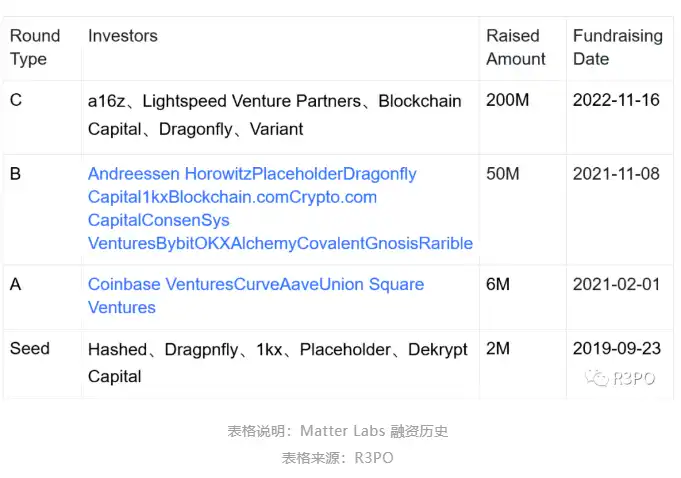
Funding History: As of November 2021, Matter Labs has raised a total of $58 million from a16z, Union Square Ventures, and Placeholder.

Ecological Overview: Currently, there are a total of 70+ applications. After the launch of 2.0, compatibility with EVM features may further increase the number of applications.
ZigZag: A zkSync-based order book DEX, is currently one of the earlier DeFi applications that supports zkSync.
· ZigZag is a decentralized non-custodial order book trading protocol. As part of the zkSync scaling solution based on the ZK Rollups architecture, it only transfers computation and state storage off-chain, giving it an advantage in simple payments, transactions, and other application-specific use cases. It can provide users with transaction services with fees close to zero. Additionally, ZigZag also offers services such as bridges and NFT markets (not yet online).
· ZigZag received a donation of $100,000 in October last year and launched three trading pairs, ETH/USDT, ETH/USDC, and USDC/USDT, on zkSync 1.0 in the same month. According to the Gitcoin donation page, ZigZag has also received a total of nearly $300,000 in donations and was one of the most popular projects in the 12th round of Gitcoin donations.
· ZigZag Bridge Service is another core product of the project, currently supporting asset exchange for Ethereum and zkSync, and also launching a cross-chain bridge from zkSync to Polygon.
· ZigZag previously launched an NFT marketplace on the zkSync mainnet.
· When ZigZag announced the launch of its token, it also established the ZigZag DAO, which will later decide on the use cases of the token and the possibility of profit sharing.
The current number of users is 310,000, the number of active accounts is 2216, and the number of new users is 504.
zkSync 1.0
· zkVM compatibility level, mainly used for payments and transfers, with the most successful use case being the support of 98% of Gitcoin donation channels.
· Stable operation for two years, reducing gas fees by 50 times, supporting 4 million transfers.
zkSync 2.0
zkSync 2.0 will fully support zkEVM. It will be launched on the mainnet within 100 days, and ZK proofs for EVM smart contracts in real production environments will be released in the fall.
· On October 29, 2022, the Ethereum Layer 2 scaling solution zkSync released version 2.0 of its mainnet Baby Alpha.
· On October 18, 2022, the Ethereum Layer 2 scaling solution zkSync completed "Milestone 3: Proof Merging" and released the zkSync end-to-end verifier on the testnet. With the integration of validity proofs, zkSync 2.0 is officially running zkEVM on the public testnet and will showcase a fully operational ZK-rollup 11 days before its release on the mainnet.
· On September 7th, 2022, the Ethereum Layer 2 scaling solution zkSync 2.0 opened project registration on the mainnet.
· On August 31, 2022, zkSync 2.0 testnet completed the dynamic fee upgrade. Currently, fees are estimated based on the expected system resources needed and charged based on actual usage. The dynamic fee upgrade includes a new fee model, abstract support for Paymasters accounts, EIP-1559 support, and other updates such as Vyper programming language support, zkEVM compatibility improvements, and binary file functionality for the Hardhat compiler plugin.
· On May 25th, 2022, Orbiter Finance, a Layer2 cross-rollup bridge in the encryption industry, added support for the Ethereum Layer2 solution zkSync 2.0 on its test network.
· On March 10, 2022, zkSync upgraded to version 2.0, which includes support for paying gas fees with any ERC20 token, not just ETH, and the addition of a block explorer. Users can apply for test tokens to try it out.
· On February 22, 2022, zkSync announced the launch of its 2.0 public testnet, which will release the first EVM-compatible ZK Rollup on the public testnet.
StarkNet: After dYdX left Cosmos, StarkNet developed ZK-EVM using Cairo
Basic Information:
2. 代币名称:STARK
3. 技术架构:ZK-STARK
4. 滚动函数协议:Scroll
1. Issuer: StarkWare 2. Token name: STARK 3. Technical architecture: ZK-STARK 4. Scroll function protocol: Scroll2.TVL: 1.26M, 1.5M (maximum)
3. Technical Paradigms: ZK-STARK, ZKVM mode, self-programming language Cairo is not compatible with Solidity, but optimized to produce ZK-EVM.
· StarkEx, a ToB service, provides specialized Rollup technology services for each application. It has been officially launched on the Ethereum mainnet since 2020 and is relatively mature. The most typical representative is dYdX.
· StarkNet, a universal L2 solution, can deploy any smart contract without the need for custom development for specific applications like StarkEx. StarkNet launched its testnet in June of last year and went live on the Ethereum mainnet in November of last year.
· StarkNet aims to create ZK universal circuits, while StarkEx develops circuits customized for each application. The complexity of the problems handled by StarkNet is much higher than that of StarkEx.


Team Information:
Co-founder and Chairman Eli Ben-Sasson received his Ph.D. in theoretical computer science from the Hebrew University in 2001, specializing in cryptography and zero-knowledge proofs. He is one of the inventors of the STARK proof system and has been involved in several encryption projects, including Zcash. Prior to co-founding StarkWare, Eli was a computer science professor at the Israel Institute of Technology.
Founder and CEO Uri Kolodny holds a Bachelor's degree in Computer Science from Hebrew University and an MBA from MIT Sloan. Uri is a serial entrepreneur who has co-founded several technology companies, including medical device company OmniGuide and big data visualization development tool Mondria. Prior to this, Uri served as an EIR (Entrepreneur in Residence) at two Israeli VC firms and worked as a McKinsey analyst.
Founder and Chief Architect Dr. Michael Riabzev is a doctoral student under Eli Ben-Sasson and a co-inventor of the ZK-STARK protocol.
The co-founder and chief scientist Alessandro Chiesa, and Eli Ben-Sasson co-founded Zcash, and teach at the UC Berkeley computer department.
Funding History: A total of $225 million in funding has been raised.

Summary evaluation:
STARK technology development is difficult, but has a broad prospect and is resistant to quantum attacks. This is the main reason for its low TVL but huge financing.
dYdX suffered a heavy blow from the departure, but MakerDAO and Aave will continue to deploy. In the long term, they are suitable for applications with unique security requirements.
StarkNet can handle large amounts of computation, which is very advantageous for developing games such as @LootRealms and @TheDopeWars, which are currently in preparation for launch.
Finally, StarkNet has written the first ZK-EVM, earlier than any L2 competitor compatible with Solidity. StarkWare will also open-source its programming language Cairo 1.0 in Q1 2022, with the first version of the Cairo 1.0 compiler planned to be released in the early first quarter of next year, with a focus on supporting all existing features of StarkNet in Cairo 1.0.
Ecological Development:
On November 29th, StarkNet announced that its Mainnet alpha has been upgraded to v0.10.2 and released a performance roadmap.
Major developments will include parallelization of sequencers, a new Rust implementation of Cairo-VM, and a reimplementation of sequencers in Rust. This roadmap aims to prepare for improving TPS.
Currently, there are 40+ ecological projects on StarkNet, including 13 and 14 projects in the infrastructure and DeFi categories respectively, and 11 projects in the NFT/game category.
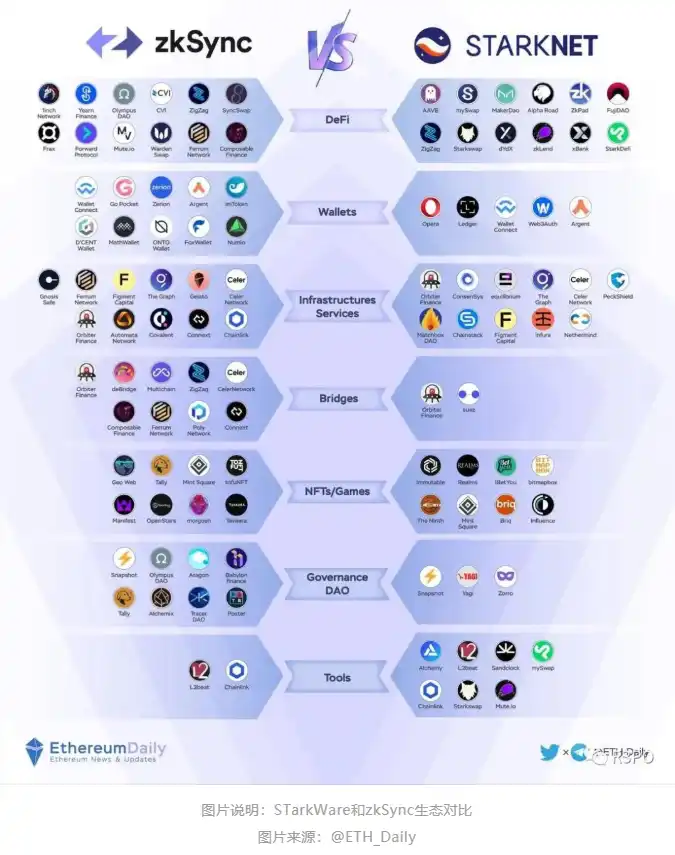
dYdX Runs Towards Application Chains
1. dYdX will develop a decentralized off-chain order book and matching engine, and migrate from Ethereum to a dYdX-specific application chain. The plan is to open source dYdX V4 by the end of this year.
2. Derivative trading protocol on Ethereum, currently implemented through StarkEx on StarkWare to achieve scalability and low cost requirements. However, in June 2022, dYdX announced its V4 plan to develop its own application chain using Cosmos SDK and Tendermint.
3. According to Messari's statistics, Uniswap and dYdX hold 44% and 38% of the DEX market share, respectively.
4. Regarding why dYdX left the Ethereum ecosystem, the team mentioned that they were not satisfied with the current transaction speed of 10 transactions per second and the order/cancellation performance of 1000 times per second. Scaling requires building a centralized off-chain order matching system, which does not align with dYdX's decentralized trading positioning. Therefore, in V4, dYdX will build a decentralized off-chain order system that balances performance and ideology.
5. Currently, dYdX's settings on StarkEx rely on a centralized sequencer. Like all current Rollups (Starkware hinted at plans for a decentralized sequencer in a recent article), the current sequencer standard is effective but creates significant centralization effects, as only one participant can submit block batches to the Ethereum mainnet. Therefore, Cosmos sets its own validator set, which theoretically can decentralize the protocol.
Immutable: L2 on L2
Immutable was founded in 2018 and has two subsidiaries: the NFT trading card game Gods Unchained and the NFT scaling solution ImmutableX (which uses the StarkWare solution) designed specifically for Web3 games. Immutable Studios, a game development studio focused on NFTs, is also advancing the development of the NFT world.
Immutable X adopts the Validium data storage solution, because transaction data is stored through an off-chain solution called the Data Availability Committee, rather than being fully stored on-chain.
Immutable X is an Ethereum-based scaling solution for NFTs that utilizes StarkWare's solution. Immutable X can be seen as both an NFT marketplace and a Layer 2 chain. Immutable X plans to deploy some projects on StarkEx to achieve complex DeFi interactions and composability.
When understanding Immutable X, it is important to distinguish between the relationship of the Immutable X platform, Immutable X marketplace, and Immutable X token. The Immutable X platform is the core infrastructure that allows users to deposit, withdraw, mint, and trade on Layer 2. The Immutable X marketplace allows users to mint and trade NFTs without gas fees, developed by Immutable and supported by the underlying technology of Immutable X. The Immutable X token (IMX) is an ERC-20 utility token for the Immutable X protocol, used to reward users for contributing to the platform.
The main trading of Immutable X comes from a collectible card game called Gods Unchained, which is also a previous product of the Immutable X team. By registering with an email, you can get free card packs. During the IMX release, it was airdropped to Gods Unchained users. According to CryptoSlam, the total number of NFT transactions in Gods Unchained is about 5.35 million, with a trading volume of about 45.21 million US dollars. The vast majority of transactions on Immutable X come from Gods Unchained.
Polygon Hermez
In strict sense, polygon and hermez together build an L2 solution. The following text will no longer strictly distinguish between the differences of polygon and ploygon Hermez.
Basic Information:
Producer: iden3 + polygon
TVL: 309k, 29M (maximum)
Technical paradigm: ZK-SNARK, which will soon launch zkEVM. After the acquisition by Polygon, it will be integrated to build a unified L2 solution.
Composition:
· On July 20th, Polygon Hermez announced the release and open sourcing of the first EVM-equivalent ZK L2 (ZKR).
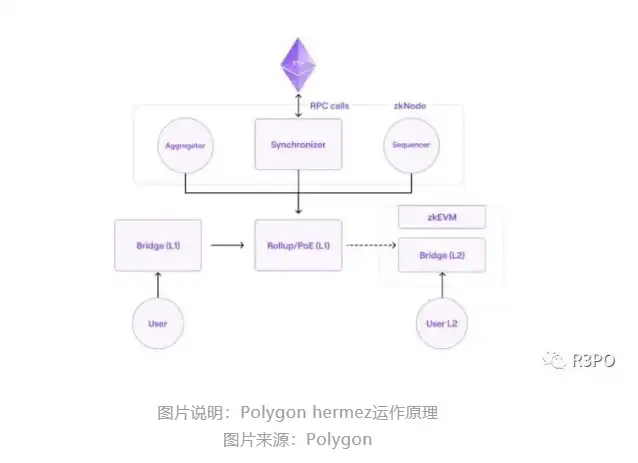
· The key components of Polygon zkEVM Rollup are: PoE consensus algorithm, zkNode, zkProver, STARK and SNARK Proof Builder, Rollup cross-chain bridge.
· PoE Consensus Algorithm: In order to improve security, efficiency, and decentralization, the PoE algorithm replaces the PoD algorithm of Hermez 1.0. PoE can be combined with PoS to ensure the decentralization and efficiency of Polygon zkEVM Rollup block production. Any miner running zkNode can become a Sequencer, while any miner running zkNode and zkProver can become an Aggregator. The gas fee for the block production rights of miners will be traded using MATIC.
· zkNode: zkNode is the software that any miner who wants to participate in the Polygon zkEVM Rollup network needs to run. zkNode will synchronize, sort, and verify transactions. In addition, if you only want to understand the network's operating status and not participate, you only need to run a read-only node, and there is no need to run zkNode.
· zkProver: zkProver is the software that any miner who wants to participate as an Aggregator role in the Polygon zkEVM Rollup network needs to run. As the name suggests, zkProver is a prover that generates zk proofs. Essentially, zkEVM is a state transition under polynomial representation, and zkProver contains a Main SM Executor and multiple Secondary State Machines to achieve proof of state transition.
· STARK and SNARK Proof Builder: Two proof builders will generate two types of proofs, STARK and SNARK. STARK (PIL STARK) generates proofs that satisfy polynomial constraints for state transition batches, while SNARK (SnarkJS) constructs constant size proofs for STARK proofs, allowing for lower cost publication on the chain.
· Rollup Cross-Chain Bridge: In addition to being a traditional Burn/Mint cross-chain bridge, Polygon zkEVM Rollup can also serve as a bridge for cross-chain transactions with other L2 solutions.
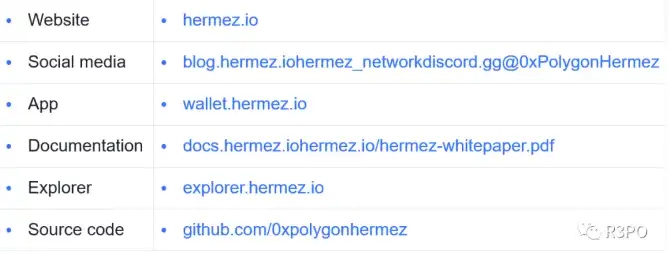
Funding History: In August 2021, Polygon acquired Hermez Network, an Ethereum ZK Rollup scaling solution developed by iden3, for $250 million. The project was renamed Polygon Hermez and integrated into the Polygon ecosystem.
Summary evaluation:
This is the first time that one blockchain network has merged with another blockchain network, demonstrating the technical capabilities of both teams.
Balancing performance and efficiency, through models such as POE, we aim to improve compatibility without adding burden to developers.
Three ZK teams can directly collaborate and help each other on technical solutions and architecture. Polygon Hermez, Polygon Zero, Polygon Miden, and Polygon Nightfall. For example, Polygon Hermez adopted Polygon Zero's suggestion of using a 64-bit small field for STARK proof generation.
Aztec: Privacy+DeFi+L2 Triple Convergence
Basic Information:
1. Issuer: Aztec
2.TVL: 3M, 14M (maximum)
Translated: "2. TVL: 3M, 14M (maximum)"3. Technical paradigm: ZK-SNARK, underlying proof system PLONK.
4. Product Features:
· Focusing on the privacy field, it is not a typical L2 that builds low gas fee scenarios for other applications, but more like using L2 technology to ensure privacy.
There are few defi products on it, and it mainly serves the role of on-chain anonymous transfers, similar to Tornado Cash. Currently, only zk.money can demonstrate this point.
· To ensure privacy, there is an option for single-bundle proof, which obviously increases gas fees. Multiple-bundle proof is not as convenient as other L2 solutions.
·
Summary: Specialized privacy + DeFi L2 solution.
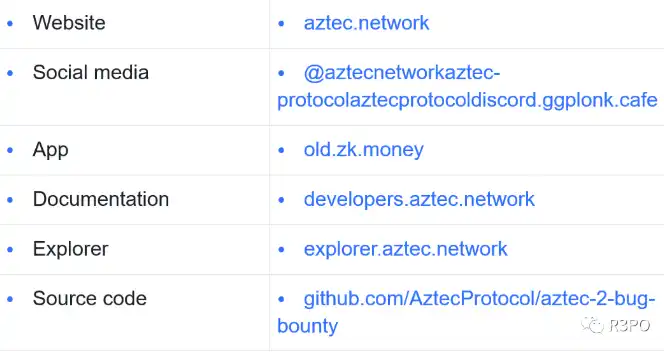

Team Background:
CEO Zac Williamson, a PhD in particle physics from Oxford University and one of the inventors of PLONK, has worked as a physicist at CERN (European Organization for Nuclear Research) and T2K (a particle physics experiment in Japan).
CPO Product Director Joe Andrews, Bachelor of Materials Science and Engineering from Imperial College London, previously served as CTO at Radish, a catering startup in Silicon Valley.
Chief Scientist Ariel Gabizon, a computer PhD from the Weizmann Institute in Israel, has worked as a researcher and engineer at Zcash and is also one of the inventors of PLONK.
Funding History: Completed a total of two rounds of funding, raising a total of $19.1 million. It is worth noting that there was a long gap between the two rounds of funding, but the team remained patient.
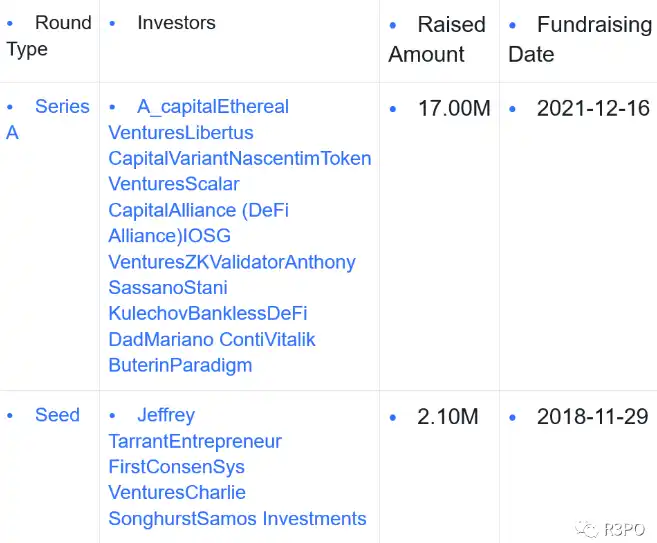
Development History:
2022-09-16 Aztec Network has completed partial integration with yield aggregator Yearn's profit-sharing agreement. Currently, users can deposit DAI and ETH into Yearn's vaults from Aztec's ZK Rollup.
As of September 9th, 2022, over 6 million DAI has been deposited into the Aztec Network, with over 1900 Rollup transactions and more than 110,000 accounts created on the network.
On August 16, 2022, the private multi-signature protocol Nucleo was launched for internal testing on the Aztec Network, a privacy and scalability solution based on ZK Rollup. Utilizing multi-signature and zero-knowledge cryptography technology, users are able to conduct private transactions, private DeFi, private fundraising, and other operations by viewing the keys, while maintaining auditability.
On July 7, 2022, Aztec Network announced the launch of Aztec Connect, a decentralized zero-knowledge network with native smart contract privacy. Aztec Connect allows anyone to add privacy to Ethereum applications through two easy-to-use tools: a bridging contract that connects Ethereum smart contracts to the Aztec Rollup interface, and an SDK, a frontend toolkit. In addition, Aztec has relaunched zk.money as a privacy DeFi aggregator, allowing anyone to use DeFi applications such as Lido, Curve, and Element. Aztec claims that this is "completely private and can save up to 100 times the cost."
In the updated SDK on March 25, 2022, the number of internal Rollup proofs has been increased, and a final submitted Rollup proof can contain 896 transactions.
2022-02-28 Aztec has proposed an integration with Compound. Aztec plans to use zkRollup to batch process user transactions and reduce Gas costs for operations such as user deposits on L1.
Product Architecture:
Aztec's product system is based on the underlying PLONK proof system, which enables anonymous transactions between accounts and facilitates privacy interactions with Defi projects through the grafting of gateway contracts.
Privacy Architecture: Use the UTXO model to ensure privacy. In Aztec's data structure, the state of all notes is stored in two Merkle Trees, one is the note tree, which stores all generated notes, and the other is the nullifier tree, which stores all destroyed notes.
Aztec aggregates transactions to L1 through "gateways". When a user wants to make a Defi transaction, Aztec will package transactions of the same type and pass them on to the Aztec Bridge Contract - a contract deployed on L1 - which aggregates funds and calls the corresponding Defi function. Finally, the funds from completed transactions are returned to the account on L2 in proportion.
Scroll: The most compatible universal L2 supported by the Ethereum Foundation
Basic Information:
1. Issuer: Scroll
2. Testnet status, no data available.
3. Technical paradigm: zkEVM, which is byte-code compatible.
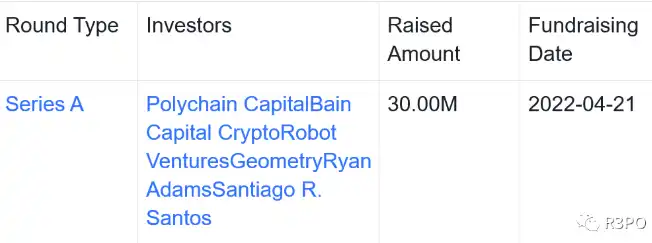
Funding situation: According to the founder, the funding was already completed by the end of 2021 and was only announced in April of this year.
Team Members:
Ye Zhang: Undergraduate degree from Peking University. Started working in the field of ZK proofs in 2018. Previously focused on researching hardware acceleration for ZK proofs and the principles of ZK cryptography algorithms. Later pursued a PhD in the ZK field, but has since quit and is now working full-time on Scroll-related projects.
Sandy Peng graduated from the University of Cambridge and previously worked in research at the Hong Kong Securities and Futures Commission. Since 2017, she has been involved in Web3 project investment. Currently, she is responsible for business development, financing, and ecosystem matters at Scroll.
Haichen Shen studied at Tsinghua University for his undergraduate degree and received his PhD from the University of Washington. His doctoral research focused on the field of low-level systems, including cross-disciplinary areas such as GPU, PL, and compiler. After graduation, he worked at Amazon on building machine learning systems and other related areas.
Product Features:
Scroll will be more similar to Ethereum's native execution method. Scroll's block-producing nodes will directly reuse the code of Ethereum's layer one nodes. Scroll's bytecode-level compatibility can fully adapt to Ethereum's various upgrades, including EIP code upgrades.
Scroll will work closely with the Ethereum Foundation because much of the code is developed jointly by us, and in the future they may directly apply this set to the Ethereum network.
Development Progress:
pre-alpha testnet already has some pre-deployed applications, such as the ability to deploy Uniswap v2 contracts to the test network, allowing users to perform functions such as transfers between L1 and L2, swaps, and other user-level interactions. However, it is currently only open to users on the whitelist.
Alpha testnet allows anyone to interact on the test network without permission. In addition, developers can also deploy contracts on the network without permission. Alpha-testnet is expected to go live soon.
The complete testnet is expected to be launched by the end of this year, which will support the generation of complete proofs for testing. The current proof part already includes most of the opcode and storage read and write access, and some remaining circuits are still being gradually improved due to engineering progress.
The main difference between the two lies in the emphasis on scalability in STARK, which is aimed at more traditional high-concurrency, low-latency scenarios. Its security is higher, such as in gaming, social, NFT and other directions. The overall development difficulty is very high.
Therefore, except for StarkWare, other L2 projects, including zkSync, Scroll, etc., are mainly adopting a more generalized SNARKs approach.
ZK-EVM: Compatible with Everything
Will another public chain replace Ethereum?
Currently, it seems that Ethereum is a unique existence without rivals. The competition among public chains, other than Bitcoin, lies in the ecosystem rather than specific technical indicators such as TPS. Although Solana's PoH (Proof of History) mechanism ensures thousands of TPS, it cannot guarantee decentralization. Frequent downtime is obviously more serious than expensive Gas Fees, as downtime is a user experience issue while high fees are a poverty mistake.
With the collapse of FTX, Solana, which was deeply tied to it, also suffered. The soBTC minted on it is essentially a promise, and it is currently unclear whether it is backed one-to-one by BTC. In other words, the Solana DeFi ecosystem is now close to extinction.
Solana was not defeated by the fellow Move-based public chain, but rather by the biggest stakeholders. In this regard, it is no different from EOS and will eventually become a thing of the past.
After this battle, all public chains must seriously consider the compatibility issue with Ethereum, whether it is Ripple's sidechain compatible EVM route or the Layer 2 ZK VM/ZK EVM competition, both of which serve as a reinforcement to Ethereum itself.
EVM and Ethereum development ecosystem are developer-friendly enough. Developers only need to develop once based on EVM, and they can rely on the security and operational efficiency of the Ethereum mainnet without worrying too much about adapting to other public chains.
Solidity is not perfect, and the EVM has room for improvement. However, as more and more public chains are compatible with the EVM, similar to the development work of iOS, with ARM chip architecture support, it can seamlessly flow on Mac, iPad, and iPhone, greatly reducing the workload of developers.
While EVM is compatible with Solidity language at the language level, developers can interact with the main network using APIs provided by Infura and use Truffle for smart contract development, testing, deployment, and more. With a complete development suite, once adapted to EVM, Dapps can run on any public chain compatible with EVM.
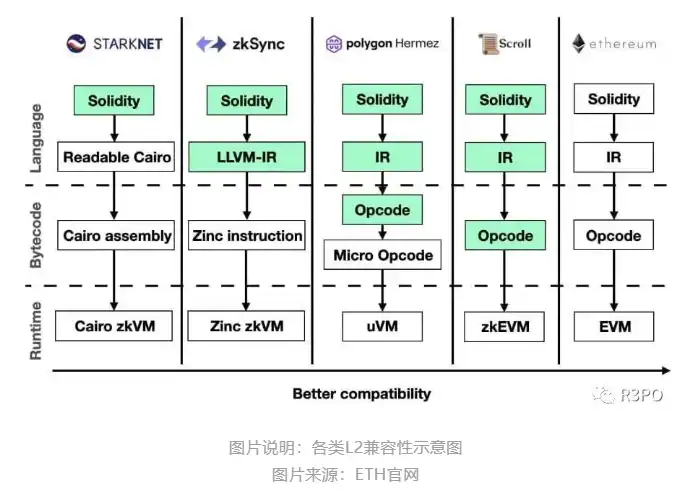
This is also the competition direction of ZK VM and ZK EVM. Vitalik has given different compatibility and performance performance relationships for EVM classification. It can be found that the lower the level of implementation, the stronger the compatibility, but the performance performance will be worse. This principle is actually very simple. By associating with the poor performance and strong security of the Ethereum main network, the mechanism can be understood.
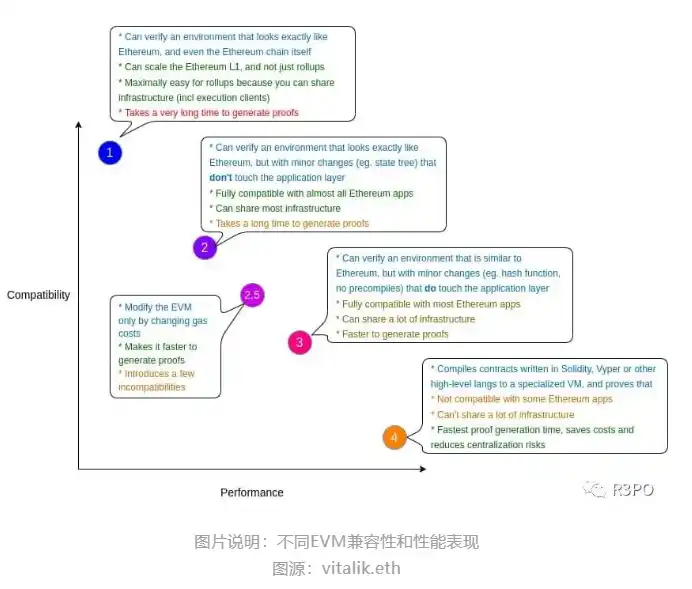
ZK EVM, which operates similarly to the native EVM, has stronger compatibility but may suffer from severe performance limitations, such as Scroll.
ZK VM has significant differences from Ethereum's native EVM, with better performance but lower compatibility, such as in the case of Polygon Hermez.
The essence of the routing dispute is that the L2 Rollup built on top of Ethereum is still too low-level, resulting in a poor user experience. In order to pursue higher performance, it has become necessary to continue building on top of it, leading to the emergence of L3. Deploying real application layers on top of L3 makes Ethereum a four-level vertically modular public chain, seeking a balance between data availability and public chain security.
Conclusion
The development path of Ethereum has come to a critical moment. Turning left will lead to a modular path of horizontal expansion, while turning right will lead to a stacked pattern of vertical layering.
Under the current competitive landscape, TPS and EVM compatibility have become two major areas of contention. The Rollup approach has proven that ZK efficiency can balance both the security of a public chain and the proof speed of L2.
However, in terms of EVM compatibility, it is a dilemma to what extent it should be compatible with Ethereum. High compatibility can lead to performance crises, but reducing compatibility can also lead to security crises. The Cario solution proposed by StarkWare is more suitable, but it also requires development capabilities far beyond the norm.
In short, Ethereum, and even the entire public chain landscape, is at a crossroads. Where it will go in the future and whether it will be the main theme of the next decade remains to be seen.
Welcome to join the official BlockBeats community:
Telegram Subscription Group: https://t.me/theblockbeats
Telegram Discussion Group: https://t.me/BlockBeats_App
Official Twitter Account: https://twitter.com/BlockBeatsAsia