What would an ideal Token distribution proposal look like?
Original title: "Token Vesting Period Proposal"
Original author: Vader Research
Original compilation: Block unicorn
Neither the VC nor the founders should receive any tokens for 7 years or more.

We would like to thank CMT Digital Contributions and feedback from Charlie Sandor. This article would not have been written without his input.
Let's imagine a case where a crypto startup raises funding from a venture capital firm for an equity entity, and It is planned to raise additional capital for this equity entity in the future. The startup also plans to launch a token in the future, and we assume that most of the overall value created by the protocol will be attributed to the token entity rather than the equity entity.
We suggest that either a) tokens should not be allocated to equity investors and teams; Equity investors and teams distribute Token, but there should be a very long lock-up period.
The Token distribution originally planned to be allocated to equity investors and teams should flow to equity entities. Equity entities should not distribute Tokens to shareholders until the underlying business reaches maturity measured by certain business indicators.
If the above-mentioned Token allocation cannot be performed due to legal reasons, the Token allocated to equity investors and teams should have a 10-year The lock-up period, and the first Token will be unlocked from the 7th year. That said, there should be predefined exceptions (eg: KPIs, acquisitions) that allow them to unlock tokens earlier.
Next we are going to discuss:
< /p>
1. Proposal for a longer Token unlocking schedule
2. Problems with the existing Token distribution plan
3. Traditional early investment
4. VC model
5. Conclusion
Proposal
Let us try to understand the above statement with an example. According to the financing plan of the start-up company, the following equity capitalization table is its situation before the Token issuance.
The basic assumption should be that 100% of the protocol value is attributed to the Token entity-> this is obviously not the case, but anything below 100 % of Token cumulative value introduces unmanageable additional complexity and weakens the proposal. Check out our article on token capitalization tables to better understand the concept of cumulative value.

< p>Assume the startup raises a total of $20 million for the equity entity over multiple rounds in exchange for 50% equity. Thus, equity investors collectively own 50% of the equity entity. The equity entity is valued at $40 million and the equity investor's stake in the equity entity is worth $20 million ($40 million * 50%).

< p>The startup also decided to allocate 50% of the Token distribution to the community and 10% to the treasury. The remaining 40% will be allocated proportionally by investors and the team. Since the equity entity has 50/50 ownership, the remaining 40% Token distribution should also have a 50/50 distribution. Therefore, the ideal token distribution is 20% equity investors and 20% team.
The agreement has an intrinsic fully diluted valuation of $100 million; that is, the $40 million equity valuation divided by 40% (team + investor Token distribution). The investor's stake in the token entity is worth $20 million (assuming the equity entity is nearly worthless).

< p>However, we suggest that the remaining 40% of Token should flow to investors and teams, not equity entities.
And why?
Questions
< /p>
So far, the biggest problem of Token entities is that the speed and quantity of Tokens issued from treasury to circulation are greater than the speed and quantity of Token demand in the market!
Token release growth <Token demand growth | Token price ↑
Token Release Growth > Token Demand Growth | Token Price ↓
< img src="https://image.blockbeats.cn/upload/2022-10-13/f1eca29c48b5cd145dbe31c876b3f8c29bda2cc7.png?x-oss-process=image/quality,q_50/format,webp">
VIS Token price and circulation supply
Although there are There are many ways to try to solve this problem, and this is the topic of another article, but a direct solution related to this article is to delay the unlocking of investor and team tokens as long as possible.
Tokens of investors and teams will be locked for a period of time. Once the token is unlocked, investors and teams usually cash out immediately - this undoubtedly puts further selling pressure on the token price as the supply of tokens released into circulation becomes larger.
The early protocols of encryption projects basically used Token incentives to guide user liquidity. By continuously issuing Tokens to users to incentivize protocol activities. As such, existing inflationary pressures to maintain and grow the ecosystem will naturally exist. Investors and teams selling their tokens before the platform matures enough will lead to further selling pressure.
Furthermore, when the founders cash out the tokens before the product launch, they will gradually lose the motivation and passion to develop the product. And using a shorter lock-up period to incentivize founders to be good salesmen - will make them focus on marketing Token by selling dreams of products that will never be released to retail investors, rather than focusing on actually building products and Understand customer pain points.
The same goes for investors; investors back the company and pay a large amount before their lock-up period ends Token. They would then sever ties to the company and stop supporting it -- because they would have little other incentive to support the company's long-term success. As long as the price of their tokens is high when they are unlocked, they will be happy. This is where the incentives of private equity investors collide with the incentives of the founders and the community.
We believe that before the specific business indicators of the platform reach the pre-set measurement standards, investors and teams will not Should be able to sell their stake. It doesn't matter whether it takes your business 5 years or 15 years to reach those standards!
Let's look at some examples of lockup periods in existing projects:
AXS (Axie Infinity)

Source: AXS White Paper
Private placement investors in AXS can invest in the Tokens are unlocked every 3 months. AXS allocates 4% of the shares to private investors, which is a significantly lower figure compared to other projects, but the existing unlock period is quite short.

< p>The picture above is the detailed lock-up period of AXS private placement investors

Token allocated to Sky Mavis (equity entity) will be unlocked within 4.5 years--at first glance, this seems to be a relatively long lock-up period, but Pay attention to details.

< p>19% Token allocated to Sky Mavis has been unlocked on the day of launch. Therefore, 4% of the total token supply is actually held by equity entities. Although we don't know if these tokens are held by Sky Mavis or distributed to team members or equity investors (who may have cashed out as well).
YGG (Yield Guild Games)
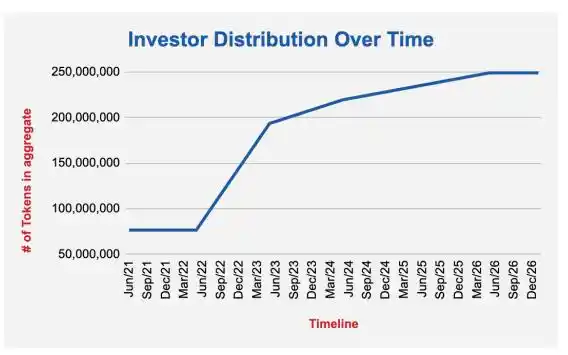
Source: YGG White Paper
25% of YGG Token is distributed to investors, and its lock-up period is 5 years in total. However, about 30% of investors’ tokens were unlocked on the token public sale date. And, that's actually 7.5% of the total supply! 2 years after the Token was launched, about 80% of the investors were also unlocked. This is certainly not a long-term lock-up period.
Traditional Early Investing
< p>By selling “dreams” or “experiences” to retail investors, crypto enables founders and investors to exit early without even selling a product. Next, let's look at how traditional early investor exits work.
VCs invest in a start-up company, only before 1) the company goes public (IPO), 2) the company is sold to exit. According to Crunchbase, the road to exits often takes 10 years.

Source: Acuris
In fact, there is a third option-a venture capital firm uses person-to-person transactions to sell Jia’s non-public equity stake was sold to another venture capital firm. These transactions, known as secondary transactions, may require approval by the startup's board of directors under a shareholder agreement. Additionally, there may not be enough buy-side VCs willing to pay the price that sell-side VCs want to execute a deal.
Because VCs have to make long-term commitments, they typically spend a lot of time on due diligence to make sure they are betting on right now. Because once they do make an investment, they have a strong incentive to add as much value as possible. Having no short-term exit options also makes VCs accountable for their investment decisions - after all, a VC investing 10 years later has a very different mindset than a trader betting 1 year later.
This also gives founders and employees the same options as VCs. It is even more difficult for them to sell illiquid, non-public stakes because of shareholder agreements and other legal reasons. As a result, they also have an incentive to make a successful exit later, and as the company performs better, they can justify paying themselves higher wages.
Thus, participants, investors and founders in the traditional early stage investment industry are motivated and want to build a long-term Viable business without any chance of early exit.
VC mode
VCs aren't managing their own capital -- they're investing other people's money in startups. The VC firm is just an agent whose fiduciary responsibility is to select the best investment opportunities for clients, execute those opportunities, and recoup the capital after 10 years.
The aforementioned "others" are called limited partners - they are wealthy individuals, sovereign wealth funds (Saudi Arabia, Norway, etc. ), pension funds (Yale, BP), endowments/foundations (Gates Foundation), and other capital allocators. These institutions do not have the talent and expertise to build the in-house teams to invest directly in these deals, so they end up investing in VC firms that specialize in specific areas and have a track record of successful investments.
Types of investors who allocate capital to VC firms
VC managers and limited A typical agreement among the partners is that the VC will not return the money for at least 10 years -- in other words, the life of the fund is 10 years. VCs invest for the first 3-4 years and spend the remaining years reaping the returns.
The conclusion drawn from the venture capital model is that venture capital is never in a hurry! Their mission is to make long-term investments, so they don't need to exit an investment in the short term, at least in 5-6 years.
Why should there be an equity entity? Why not directly formulate a longer Token lock-up period?
· Assign Tokens to equity entities, except for granting In addition to more control and legal power of shareholders, they can also unilaterally make governance decisions related to the Token agreement.
· If the agreement has a potential acquirer, it will be easier for them to get the 40% Tokens and the legitimate interests of equity entities, rather than having to collect Tokens from the public or having to negotiate bilaterally with each investor.
< p>What are the potential problems of equity entities owning a large number of Tokens?
· SEC recommends decentralization based on Token network To a certain extent, establish a regulatory framework for digital tokens. Equity entities that own 30%-40% of the Token network may not pass the SEC's minimum decentralization requirements.
· Another potential problem could be double taxation. Once the underlying business matures and decides to distribute tokens as dividends (payment in kind) or be acquired by another company - its investors may need to pay double taxation.
End
< /p>
We suggest that tokens should not be allocated to equity investors, but team tokens should be allocated to equity entities. These Tokens held by equity entities should not be unlocked and distributed to shareholders before the company achieves certain business preset metrics. Shareholders should be allowed to reward them proportionally with some or all of the tokens as business metrics are achieved. It also makes the equity entity more likely to be "acquired" by a potential acquirer.
< p>Alternatively, the Token lock-up period should be extended to more than 10 years, except for pre-set business KPI targets or potential mergers and acquisitions.
Original link
Welcome to join the official BlockBeats community:
Telegram Subscription Group: https://t.me/theblockbeats
Telegram Discussion Group: https://t.me/BlockBeats_App
Official Twitter Account: https://twitter.com/BlockBeatsAsia



 Related Articles