Token governance, optimistic governance, and security guard realize the separation of powers of DAOs governance
原文标题:《 Decentralized Governance Structures--Checks and balances for lean and trust minimized DAO governance 》
Originally written by Joey Santoro
Contributor: Dewei, Daoctor@daorayaki
Governance makes modern society possible. Governments decide where tax revenues are allocated and influence the levers that control the flow of economic value. But that was the way it was done. Blockchain technology allows these actions to take place in the open -- putting affected citizens at the forefront of decision-making.
Decentralized autonomous organizations (DAOs) are on-chain governments that control large amounts of resources. These might eliminate corruption through contractual incentives. In other words, "Don't be evil" is far more powerful than "don't be evil." Even if Google and governments around the world have no intention of doing evil, they have the capacity to do so. Only open source governance algorithms can help humans evolve to a higher level of coordination.
Many DAOs have struggled to create governance processes that balance agility and security. Developers need to build and iterate quickly, rather than having lengthy arguments first every time they release code, and communities need to be able to stop bad actors. Here is a framework model: adopt multiple governance policies to maximize development speed while ensuring protocol security.
Future DAOs will leverage three main categories of microgovernance rights:
1. Token governance -- Direct democracy with "executive branch" -like powers
2. Optimistic governance -- representative democracy with quasi-" legislative branch "powers
3, security guards - with certain conditions of the "judicial branch" of power
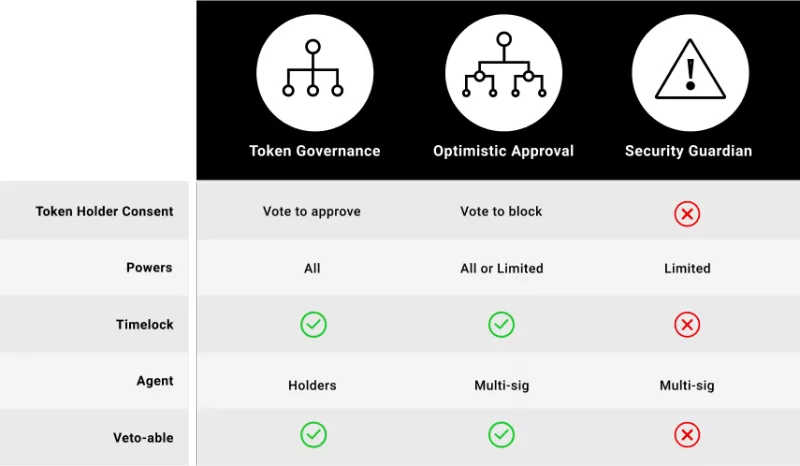
Token governance
Token governance means that all holders need to vote for change. This is "positive consent" because enough stakeholders need to actively approve the new proposal. It maintains full authority over all other components of the system as an executive branch.
Token governance can have any combination of the following attributes:
1. Quorum -- the minimum number of approvals approved
2. Delegate -- Appoint a representative to vote on your behalf
3. Time lock - A grace period after a proposal is passed until it takes effect
Ballot - To lock up votes for a period of time in order to get more votes
Token governance is cumbersome. As ill-informed Token holders are encouraged to participate in frequent and complex proposals, problems such as apathetic voters and free riders often arise. Holders can speculate on project results without participating in governance.
For the above reasons, Token governance should ideally only be used for the most important decisions, including but not limited to:
1. Casting new Tokens (dilute holders)
2. Contract upgrade
3. Change governance rules
4. Appoint/reject other layers of governance
In an ideal world, every proposal that enters Token governance would have a high level of participation because of its importance to stakeholders. In other words, low participation is a symptom of overuse of Token governance.
The best Token governance contracts available are OZ Governor, Governor Bravo and Curve Voting Escrow.
Bonus: Vitalik Buterin has a great article on beyond Token governance.
Optimistic governance
The optimistic governance model allows a core group of elected actors to formulate proposals on behalf of the community. This form of governance is seen as "negative consent" as Token holders do not interfere in the formulation of proposals in the Happy Path. So enough stakeholders need to actively block a new proposal from taking effect. The function of optimistic governance is to act as a legislative branch, with elected representatives under the supervision of Token governance and security guards drafting and promulgating proposals that benefit the community.
When challenges inevitably come, there are protections in place to protect ecosystems.
The first protection is time locking. This transparency allows users to find a solution in the event of a malicious proposal, and users can exit the ecosystem during a time-locked window.
The second safeguard is veto power controlled by other stakeholders, such as Token governance and security guards. This means that during the time lock period, when enough stakeholders vote to cancel the proposal, it will not take effect. This is the ultimate protection against bad governance.
Optimistic governance is lean and efficient, enabling key stakeholders to act in the best interest of the majority. It is ideal for almost any governance application:
1. Parameter changes
2. Contributor compensation
3. Give out rewards
4. Small upgrades/integrations
In a perfect world, optimistic governance would have high transparency and low participation. Low participation means the proposal is easy to understand and not controversial. If optimistic governance sees a high degree of participation in the proposals of elected participants, then participants are likely to propose controversial changes. For example, high transparency is important to allow other stakeholders to make informed decisions about whether to participate and try to veto.
The best optimistic governance will use OpenZeppelin TimelockController and allow key stakeholders to veto.
Security guards
When Token and optimistic governance fail, daOs need emergency shutdown mechanisms for critical functionality. Performing this operation is the job of the security guard. An effectively designed security guard can help prevent vulnerabilities. This helps prevent vulnerabilities from being exploited and gives stakeholders time to develop longer-term solutions before restoring functionality. It acts as a judicial branch to ensure Token governance and optimistic governance behavior is sincere and takes into account strong security practices.
Security guards should have "conditional omnipotence", that is, immediate action, but only for pre-defined actions. These actions should include:
1. Suspension of the contract
2. Reject malicious optimism or Token governance proposals
3, forced operation, otherwise it may be invalid
The security guard should "trust minimization" because it can never actively harm a user, or at least won't be motivated to do so. Security guards shall not take any of the following actions without good cause:
1. Withdraw funds
2. Prevent users from exiting the system
3. Change key parameters
In an ideal system, the use of security guards should never occur. This means that the contract is secure and that the holder of the security guard is properly motivated rather than acting in bad faith.
The best security Defender is a Gnosis Safe, which uses OpenZeppelin Defender to store and simplify secure operation manuals.
conclusion
Daos can make decisions quickly while minimizing corruption and maximizing transparency. This is achieved by combining subtle governance powers at different levels:
1. Token governance should only be used for the most important decisions.
2. Optimistic governance should empower key stakeholders to take power with the approval of Token holders.
3. Security guards should have conditional omnipotence/authority to respond quickly to security problems.
Decentralized governance will improve existing power structures and introduce new and open ones.
Welcome to join the official BlockBeats community:
Telegram Subscription Group: https://t.me/theblockbeats
Telegram Discussion Group: https://t.me/BlockBeats_App
Official Twitter Account: https://twitter.com/BlockBeatsAsia

 Related Articles