Detailed explanation of the 3 models of NFT loan agreement: existing problems and solutions
Original title: "A&T View: Is there a better NFT lending agreement? Existing Problems and Solutions"
Original author: Liam
TL; DR:
Assets encapsulated in the form of NFT were one of the major flashpoints of the last bull market, but apart from spot transactions, the development of other NFT-Fi related projects lags behind, especially in the lending market. On the other hand, when looking at DeFi Summer, the rise of DEX and Lending Protocol is almost synchronous.
From an absolute level, the total amount of NFT loans is not high because NFT is still a long-tail asset; from a relative level, the penetration rate of NFT loans is low It is not that there is a lack of supply and demand in the market, but more that there is a lack of lending agreements that adapt to the characteristics of NFT and can efficiently match supply and demand.
The loan agreement mainly solves three problems: one is to efficiently match and bring together the supply and demand of funds; the other is to safely keep the collateral; the third is to Dispose of collateral as agreed. The existing Peer-to-Pool model and Peer-to-Peer model fail to solve the first problem. Their matching efficiency is not high, either the hidden capital cost is high, or the time cost is high.
The advantage of the Peer-to-Pool model is that the time cost is low and "Instant Borrowing" can be realized. The disadvantage is that the hidden capital cost is high and it depends on the oracle offer. The advantage of the Peer-to-Peer model is that the hidden capital cost is low and no oracle machine quotation is required, and the disadvantage is that the time cost is high.
Based on the lessons learned from the Peer-to-Pool mode and the Peer-to-Peer mode, a Peer-to-Orderbook mode that takes into account the advantages of both can be imagined. For example, it is possible to gather orders with the same collateral, loanable amount limit and term but different interest rates into one order book, allowing both borrowers and lenders to bid and match at different interest rates, thereby reducing hidden capital costs and time costs, Achieve higher matching efficiency.
Assets encapsulated in the form of NFTs were one of the breaking points of the last bull market. The total market value of NFTs was less than 70 million US dollars at the beginning of 2021. By August 2021, it has skyrocketed to US$42.7 billion, and even in the second half of 2022 when the market turns bearish, it will basically remain above US$21 billion. The popularity of NFT spot transactions has given birth to unicorns such as Opensea with a valuation of over 10 billion U.S. dollars. However, apart from spot transactions, the development of other NFT-Fi related projects lags behind, especially in the lending market. On the other hand, when looking at DeFi Summer, the rise of DEX and Lending Protocol is almost synchronous.
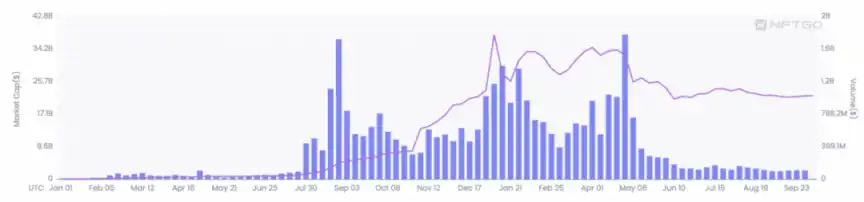
Marketcap and Trading Volume of NFT (source: nftgo.io)
So, NFT lending is not active, What exactly is the reason for the low penetration rate?
From an absolute level, the total amount of NFT loans is not high because NFT is still a long-tail asset. For a separate Collection, the total market value
From a relative level, the low penetration rate of NFT lending is not due to the lack of supply and demand in the market, more It is the lack of a lending agreement that adapts to the characteristics of NFT and can efficiently match supply and demand.
Compared with FT, the fact that NFT is still a long-tail asset is obvious. Even for the top projects, such as BAYC, its total market value is still fluctuating around 1 million ETH , only less than 1.5 billion US dollars, which is even much lower than the FDV of Ape coin.
We can’t change this fact in the short term, but as Web3 investors, we have seen the potential of NFT. In the next round of bull market, there is a high probability that there will be More types of assets are packaged in the form of NFT, and the total market value of NFT is likely to increase tenfold or even a hundredfold. Therefore, standing at the current point in time, we can dig out lending agreements with higher matching efficiency and capital utilization efficiency. Such projects will have more potential to explode in the next round of NFT bull market.
Before evaluating the model of the existing NFT lending agreement, you might as well sort out the nature of mortgage lending and the role played by the lending agreement.
The specific process of mortgage lending is that the borrower provides a package of assets as collateral, and the lender agrees with the lender on the upper limit of the loan amount, interest rate, term, and liquidation conditions and methods After reaching a consensus on the key parameters, obtain working capital from the lender and repay the principal and interest as agreed. During the continuation of the loan relationship, if the borrower defaults or triggers the liquidation conditions, the collateral will be liquidated according to the agreed method.
In the above process, The role played by the loan agreement can be considered from three angles/stages:
Before the loan relationship occurs, the agreement needs to efficiently match the supply and demand of funds, that is, to match the key parameters that can reach a consensus on collateral, loanable amount limit, interest rate, term, and liquidation conditions and methods Borrowers and lenders, helping both parties to establish a lending relationship.
During the duration of the loan relationship, the agreement needs to safely keep the collateral.
During the duration of the loan relationship, if the borrower defaults, the agreement needs to dispose of the collateral as agreed.
Clarifying the nature of mortgage lending and the core value provided by the lending agreement, we can begin to evaluate the pros and cons of the existing model.
1. Peer-to-Pool mode:
Advantages: It can realize "Instant Borrowing ", the time cost of matching is low
Disadvantages: high hidden capital cost (the capital utilization rate is not high, and there is a large interest rate difference in lending rates), relying on prophecy Machine Quote
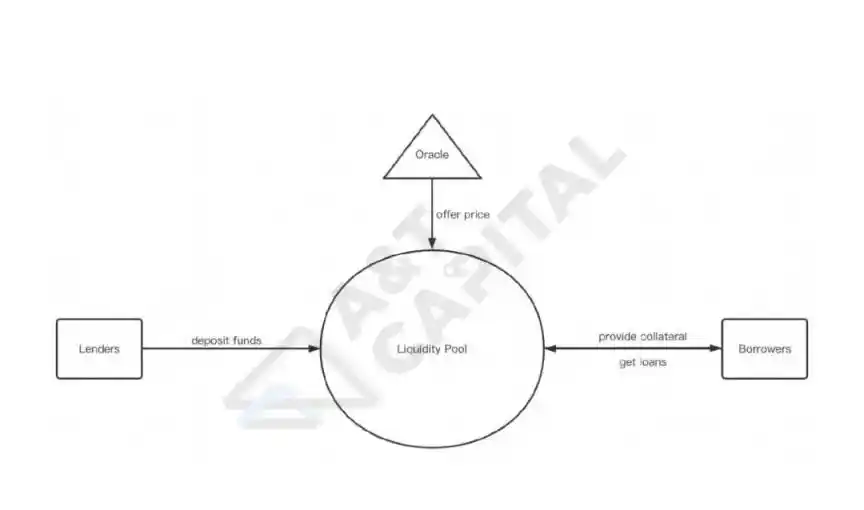
Peer-to-Pool mode
This mode is essentially an imitation of AAVE, although the AAVE mode It has been successful in the FT market, but it is not without its drawbacks. There are three main disadvantages of the AAVE model. First, the utilization rate of funds is not high;
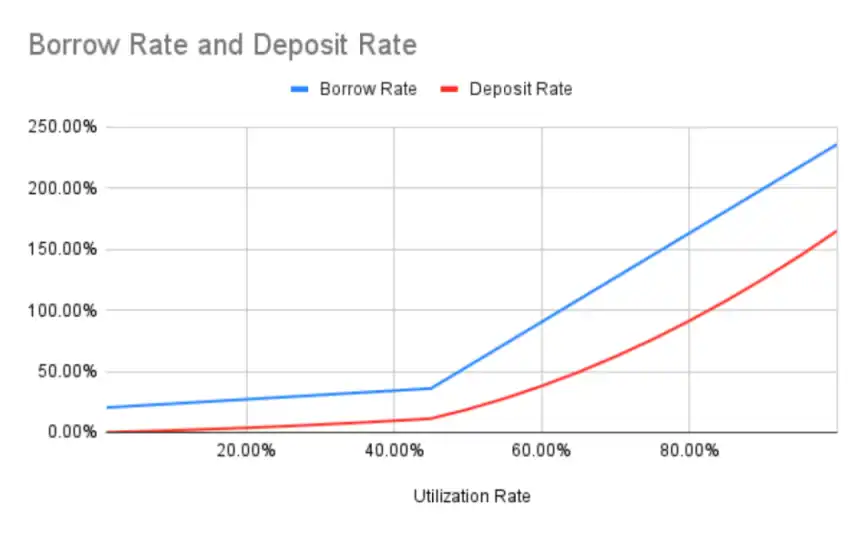
Due to the setting of the interest rate curve, the funds deposited by the lender will basically not be lent out, and the actual capital utilization rate is often lower than 50%, and this This problem has further led to a large spread in lending rates, because the interest paid by the borrower needs to be distributed to all lenders. This greatly increases the hidden funding cost of matching borrowers and lenders. For example, the lender was willing to provide liquidity of 100,000 ETH to the market, but the borrower was actually only willing to lend 50,000 (no more would be able to bear the high interest rate); the borrower was willing to pay an annual interest rate of 36%, but the lender On average, only 12% is received.
When matching the supply and demand of funds, the agreement replaces the lender Decision-making, the lender does not decide what is the collateral for the loaned funds, nor can it control the interest rate and term of the loan. Therefore, in order to control the risk of the system and protect the interests of lenders, the Peer-to-Pool model needs to introduce external oracle machine quotations to ensure that the collateral can repay the loaned funds in real time.
However, the disadvantages of relying on oracle quotes are magnified in NFT lending, as assessing fair prices for NFTs remains a major challenge. For example, the reliance on immature external oracle machines may cause the agreement to misestimate the liquidity in the market, burying the hidden danger of liquidity risk for the subsequent liquidation process.
In general, the current Peer-to-Pool model is not efficient, the matching cost of the implicit payment between the borrower and the lender is relatively high, and there is a problem of relying on the oracle Risk, not ideal model.
2. Peer-to-Peer mode:
Advantages: no oracle machine, no funds Low cost (high capital utilization rate, small loan spread)
Disadvantages: high matching time cost, high threshold for becoming a lender
p>

Peer-to-Peer mode
Essentially speaking, the reason for the various defects of the Peer-to-Pool mode is that when matching When there are both supply and demand sides of funds, the agreement makes decisions on behalf of the lender. So, if the right to determine the key parameters of the contract is returned to the lender, will these problems be solved?
Indeed, in the Peer-to-Peer model represented by NFTf, due to which NFT is accepted as collateral, the upper limit of the loan amount, the term, and the interest rate The key parameters such as the conditions and methods of liquidation are agreed by both the borrower and the lender, so the borrower can lend as much money as the lender provides; the higher the interest rate the borrower pays, the more money the lender can get. high interest rates. Moreover, as long as the borrower can repay the principal and interest before the due date, liquidation will not be triggered, and there is no need to rely on the oracle.
Although the Peer-to-Peer mode represented by NFTfi solves the problem of the Peer-to-Pool mode, this solution There are also sacrifices, and it is also not a perfect solution.
The disadvantage of the Peer-to-Peer model is that the matching process takes a long time, and it often takes several rounds of quotations to reach a consensus between the borrower and the lender; It has not yet supported a borrower to borrow from multiple lenders (Peer-to-multiPeer), which prevents potential lenders with small funds from entering the market.
3. Peer-to-Orderbook mode:
Based on Peer-to-Pool mode Based on the lessons learned from the Peer-to-Peer mode, we can imagine a Peer-to-Orderbook mode that takes into account the advantages of both.
In fact, in the Peer-to-Peer mode, standardized lending orders have been used:

If these scattered orders are centralized into an open order book, the time cost of matching can be reduced while retaining the advantages of the Peer-to-Peer model. Because, before lending, the two parties are looking for counterparties in a Pool (Orderbook), which has the advantages of the Peer-to-Pool model; Advantages of Peer mode. For example, orders with the same collateral, loanable amount limit, and term but with different interest rates can be aggregated into one order book, so that multiple lenders can provide liquidity at different interest rates, and borrowers can withdraw from the order book at any time. Withdraw the funds they are willing to accept, achieving the so-called "Instant Borrowing".
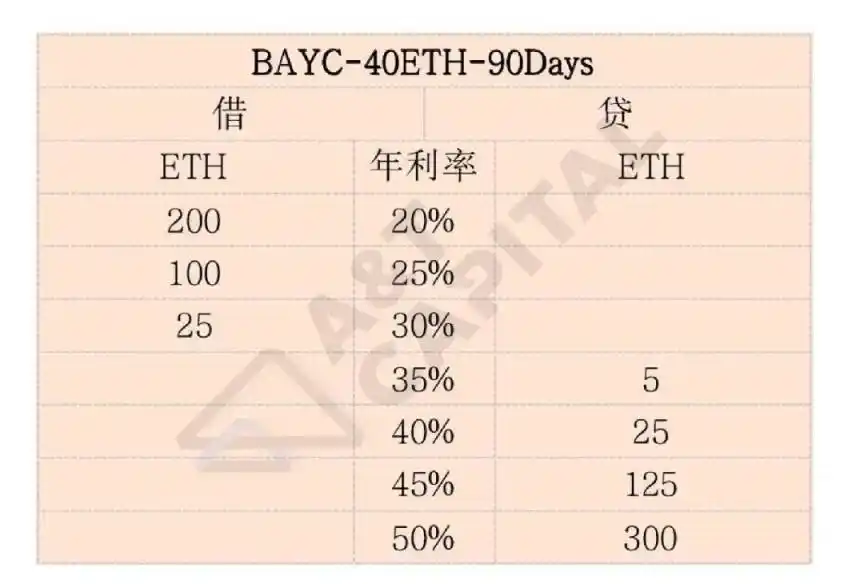
For example, the figure shows a possible order book. The header "BAYC-40ETH-90Days" means that the borrower in this order book can obtain a loan with a maximum loan amount of 40ETH and a maximum period of 90 days for each BAYC provided as collateral (the same is true for lenders). The "Borrow" column on the left represents how much unsatisfied borrowing needs are at different interest rates; the "Loan" column on the right represents how many funds have not been lent at different interest rates.
I think that the efficiency of matching will be greatly improved by allowing borrowers and lenders to bid on the open order book. Considering the matching time cost and hidden capital cost, the Peer-to-Orderbook mode will be better than the Peer-to-Pool mode and Peer-to-Peer mode.
Original link
a>
Welcome to join the official BlockBeats community:
Telegram Subscription Group: https://t.me/theblockbeats
Telegram Discussion Group: https://t.me/BlockBeats_App
Official Twitter Account: https://twitter.com/BlockBeatsAsia
 Related Articles