3 Questions to Create Web3 Brand Soul: Why?What?How?
Original title: "Three Questions about Creating the Soul of a web3 Brand-Why, What, How"
Original Author: starzq.eth
These two very appropriate news in the past two days, Starbucks announced its plan to enter Web3 and build a blockchain-based user loyalty platform; Top The blue-chip NFT project doodles announced $54 million in financing to build it into a world-class entertainment brand native to Web3. On the one hand, the top Web2 brands are transforming to Web3, and on the other hand, the growth of Web3 native brands is accelerating.We have come to the eve of the explosion of Web3 brands.
I also read a lot of articles about the Web3 brand during this time, but more on the technical level. Communicating with friends from Web2, the biggest confusion at present is actually at the level of Tao. Why do you want to do this? What exactly does Web3 branding mean, and how does it differ from Web2 branding? After figuring out these questions, traditional brands will have a more comprehensive understanding and preparation before taking the why step to explore what to do (what) and how to do it (how). Borrowing the model of "Three Questions of the Soul" in my favorite podcast "Two Blossoms of Arts and Sciences", through this article, I try to answer the three questions of the soul of building a Web3 brand-Why, What, How, from Tao to Technique
1. Why: Why is Web3 a must for brands?
2.What: What kind of category is suitable to be a Web3 brand?
3.How: How to build a Web3 brand, including mindset change/skill tree/case analysis
4. Finally, 3 very practical questions and answers are attached
1. Establishing a Web3 brand, what is the most important thing at the beginning
2. Why I strongly recommend converting membership cards to NFT< /p>
3. Final suggestions for traditional brands entering Web3
After reading this article, I hope you can gain the following
・If you are a traditional brand, I hope this article can help you (and your boss) firmly resolve to switch to Web3, and understand how to better meet the GenZ generation You can refer to the new needs of users, the cases and suggestions in the article
・If you are planning to build a Web3 native brand, I hope this article can help you better choose categories, design products, and cold start the community< /p>
・If you are a Web3 user, great~ I hope the methods in this article can help you find a better community-driven brand, go deep into the community and brand co-construction, and form a win-win situation
Why: Why is Web3 a must for brands?
Based on NFT or ERC-20 Token, let’s see what changes consumers/communities/brands will have.
Consumers
1. The demand has been upgraded from "consumption" to the trinity of "consumption + assets + digital identity"
< p>2. Consumers are upgraded to "sovereign individuals", and behind the brand are not just consumer goods. It has also become the personal assets of consumers (Token holders). Consumers will invest more emotion and energy in it to help the brand/personal assets grow; at the same time, consumers will also have more benign creative incentives, making this investment process continue3. For Z-generation consumers (GenZ), more willing to establish a unique digital identity (digital identity) to show their personality and as a passport to the metaverse, which requires a corresponding brand to meet
Community
Compared with the Web2 community like a loose interest group, Web3 consumers have more practical input and rights, and the condensed community consensus is deeper and more powerful , and the brand will gradually form an equal relationship. Water can carry a boat and overturn it. A strong community can not only accelerate brand growth, but also protect FUD (Fear, uncertainty, and doubt**,** simple understanding is to create and spread negative news) brands. The brand itself must face up to and embrace
The brand
1. Based on the above analysis, the brand must It must be able to meet the new needs of new users, otherwise it will be eliminated by the times. As the proportion of users' virtual consumption increases, traditional physical brands must plan and respond in advance, have the ability to provide virtual products in the future, or combine virtual and real products, and occupy a place in revenue. The fastest mover here is Nike, which has generated more than 185 million US dollars in revenue, ranking first in the revenue list of major brand NFT projects
2. Brands need to form a symbiotic relationship with consumers/communities to share benefits, Rather than the unilateral consumption relationship of Web2
Summary in one sentence, users have changed and their needs have changed, and there is a need for brands and (fictional or real) that can satisfy "sovereign individuals" combined) product. Web3 is essentially rebuilding the relationship between brands and consumers, and even changing the attribution of "brand sovereignty", giving consumers the right to become brand owners. The philosophy behind it is consistent with the entire Crypto, just like the confirmation of user assets. In essence, it is truly "user first".
Expand this "symbiotic relationship" again
・(Generation Z) consumers need Web3 brand to help build a digital identity, while owning brand equity, gaining more equity from the brand. From the perspective of users, they are no longer simply consumed or even materialized by the brand, but become the owner of the brand to build together and share benefits. And in this process, the community has a powerful consensus
・From the perspective of the brand, various costs have been reduced, including customer acquisition, product definition, testing and promotion costs. With the help of a community with a strong consensus, it can grow and spread faster
This symbiotic and win-win relationship will definitely breed a highly competitive Web3 native brand. Then in a highly competitive market, traditional brands will be very active in Web3 transformation. After all, if they do not revolutionize themselves, they will be replaced by others.
So here we answer the question at the beginning
Q: Why is Web3 important to brands Is it important, or is Web3ization of brands bound to happen?
A: Because only the Web3 brand can meet the trinity needs of "consumption + assets + digital identity" of "sovereign individuals". The Web3 brand is not just a change in marketing methods and revenue structure, it is essentially to meet the new needs of new users, it is a change in mindset, and the brand is built or reconstructed from the original user.
What: What kind of category is suitable to be a Web3 brand?
What kind of category is suitable to be a Web3 brand? My answer is that categories that can be driven by the community are worth a try. Users participate in product definition, production, testing and promotion, and part of the product's profits flow back to the community. In this process, users and brands achieve a win-win situation. Token supports user participation and benefit distribution in this process.
Because it is community-driven and can form a brand at the same time, the category needs to meet the following conditions
・Low production cost
・Short test cycle
・High variety of categories, easy to form a brand
Theoretically In other words, categories that require a large number of test models all meet the above three conditions. To be more specific, clothing, food (drinks), and dramas are all perfect categories. In the following example, we can also see that a large number of Web3 brand entrepreneurs have also chosen the above three categories.
How: How to build a Web3 brand?
"How to build a Web3 brand" itself is a very big topic, and there is no so-called "best practice" at present. is exploring. This section tries to answer this question in two parts, hoping to inspire and help readers.
1. The key difference between Web3 and Web2 brands, and the core skill tree that the brand needs to build
2. Through 4 case studies , a more concrete study on how to build a Web3 brand, including different categories and building methods
The key differences between Web3 and Web2 brands, and the core needs of brands Created skill tree
< /p>
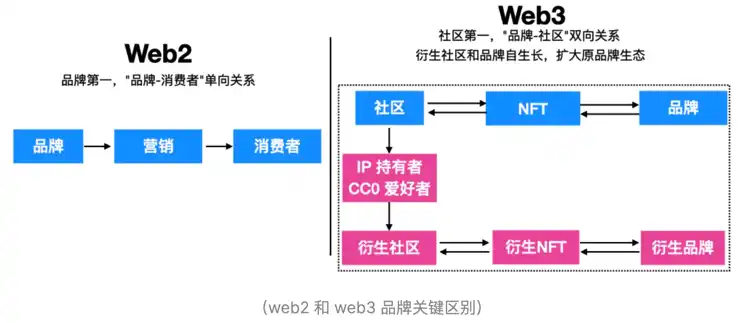
I drew a picture to more clearly describe the two key differences between Web3 and Web2 brands, which are also two win-win strategies
< /p>
Win-win strategy 1: Community first, "brand-community" two-way relationship
Compared to Web2 brand's "brand first" or "Product first" and "brand-consumer" one-way relationship; Web3 brand needs "community first" and "brand-community" has a two-way relationship. Why do you need community first?
From the chronological order, first the community and then the brand: As explained above, there is more than just consumer goods behind the brand. It has also become the personal assets of consumers (Token holders), so consumers are also investors. Even users are investors first, and then consumers, because it takes a certain amount of time (3 months to 1 year) to create consumer products, and before building, you need to have start-up funds, and you need to build a "(potential) investor community". So from the chronological order, first the community and then the brand.
From the perspective of affiliation, first the community and then the brand: because the user has the dual identity of investor/consumer at the same time, as the owner of the brand , has the right to participate in the definition and construction of the brand, so in terms of affiliation, the owner (community) comes first and then the brand
In terms of importance, the community comes first and then the brand Brand: "Brand-community" constitutes a two-way relationship. Brands not only use the community to grow and spread, but community users will also invest more emotion and energy in it to help the brand/personal assets grow. A strong community consensus was condensed in this process, and the brand vision is based on this consensus. Therefore, the order of importance is "community consensus brand". The community is the foundation of the brand, and a brand without a community is a tree without roots and water without a source
Win-win strategy 2: Derivative community and brand self-growth, expanding the original brand ecology
This is also a very different point between the Web3 brand and Web2, which is built through the power of community users A larger derivative community and brand ecology, feeding back the original brand, I marked it in pink in the above picture
Different from Web2 brands that control their own IP and profit from it , the vast majority of Web3 brands have authorized IP to NFT holders (Holder), and the CC0 brand has opened IP to everyone. Community users can use their IP or CC0 IP to start a derivatives community based on the original brand community. On the one hand, they can establish their own derivative brand business, and on the other hand, they can expand the influence and life cycle of the original brand to create a win-win situation
The above are the changes in the mindset of Web3 brand building. Next, let’s compare the differences between the core skill trees that Web2 and Web3 brands need to build. It can be clearly seen that those are the same things in terms of types, but unlike Web2 where all things are controlled internally by the brand, the foundation of all Web3 brand operations is the community. How to combine all work with "community operations" is a The biggest challenge in the actual work of the Web3 brand side. In short, building a Web3 brand is essentially building community.

< /p>
Case study 1: Web3 community incubation brand: FWB x Taika
Taika is a coffee start-up brand, and now it is going to launch a new sub-brand And category——mate tea, this time they did not choose to make it entirely by themselves, but with FWB(Friends with Benifits) Cooperative Incubation.
・FWB is recognized as the most creative DAO (Decentralized Autonomous Organization) in Web3
・FWB members have a comparative Strict joining mechanism: you need to hold a certain amount of FWB Token, then fill out the application form, and join after review. It can be considered that the joining members have certain creativity and jointly hold FWB Token assets
Cooperation method:
1. Scope of cooperation: brand investment, taste definition, testing, promotion and profit distribution, basically covering the whole link of brand building
2. Brand investment: FWB uses its own Token Invest in new yerba mate brands
3. Taste definition, testing, promotion
・FWB members You can apply to join a paid working group to define product concepts, design flavors and formula packaging, and produce design and marketing materials with Taika colleagues
・After the product is defined, Forms 2 flavors, red pot and blue pot. Based on a set of 500 NFTs issued by the FWB community, buyers can exchange for a box of drinks, and vote to decide which one to go on the market after tasting. Note that this set of NFTs is not limited to only being purchased by FWB members, and actually launched a derivative community for new brands
4. Benefit distribution: new product sales The profit will be shared by Taika and FWB, and FWB gets 18%
Currently the product is in the stage of drinking and voting which one will be launched. Let's summarize what are the benefits of this new brand driven by the FWB community
1. Based on the test NFT issued by the FWB community, it actually launched a new The brand's derivative community solves the brand's troublesome cold start problem and guarantees the quality of community members
2. Through FWB Token investment and profit sharing, FWB members actually become the owners of the new brand, Having greater agency to define, design and market helps Taika create the best product possible and sell more of it. Telling my friends that I participated in the design of this drink, does Bel have a sense of face?
In addition, some friends asked that many beverage brands (such as Yuanqi Forest) also have a lot of ab tests on flavors and packaging, and even a lot of internal employee tests, FWB How is x Taika different?
The biggest difference is that for the Web2 brand, brand designers and testers/consumers are separate one-way relationships, and the latter just passively accept the former Decision-making, making it difficult to have a strong sense of identity and agency. Even for internal employees, it is more of a task to complete (think about us helping to test the products of the next-door group in a large factory); but the real owner of the Web3 brand is the community users, and the final sense of identity and initiative is It is completely different, and this difference determines the acceleration of brand growth.
Read with me 3 times the core difference between Web3 brand and Web2: community, community, community: )
BTW, after establishing a model of cooperation with Taika, FWB has decided to cooperate with Hennessy and Reebok, successfully expanding from a start-up company to an international first- and second-tier brand.
Thanks to Chao for sharing the above case in Web101.
Case study 2: NFT holders build spin-off brand: Yuga Labs/BAYC spin-off brand
< /p>
・After purchasing BAYC, the corresponding numbered NFT IP will be automatically authorized to Holder for use, including commercial use
・CrytoPunks, the representative project of NFT, has not opened IP authorization before it was acquired. One point makes NFT controversial, what exactly did users buy?
・BAYC has created a precedent for IP commercial authorization, increasing the rights of IP empowerment for holders. What users buy is not just a small picture, but also the huge IP value behind it
Based on this, a large number of BAYC holders have developed nearly 80 derivative brands based on BAYC IP, including fashion brands, music, fashion, food, beverages, skateboards, basketball , clubs, podcasts, games, and more. On the one hand, BAYC IP and the community helped these derivative brands do a cold start. On the other hand, these derivative brands also enhanced the utility of the original IP and expanded the ecology, attracting more users to join, and finally formed a win-win situation for the original brand and derivatives .
Yuga Labs' IP Empire: Nearly 80 Brands, Creators, Projects, and Artists" provides a very comprehensive introduction to these 80 IPs. Interested friends can read them directly. repeat.

Cite first A previous article about CC0 for a quick understanding of CC0:
< br>
CC0 is the abbreviation of Creative Commons Zero copyright agreement. Adoption of this agreement means that the author declares to renounce all copyrights of the creation, and the creation enters the public domain and becomes the common intellectual property of mankind. In the vernacular, everyone can use CC0 creations, including commercial and secondary creations
・The BAYC mentioned in the previous section (non-CC0 ) Open IP Rights to the owner, Li Ning bought BAYC #4102, so Li Ning can put this monkey on posters and T-shirts (other monkeys that don’t own it can’t)
・mfers is a CC0 agreement , whether you have mfers or not, you are free to use 10,000 mfers, including personal use (printed T-shirts to wear), commercial (printed T-shirts for sale), secondary creation...
According to incomplete statistics, there are more than 50 NFTs derived from mfers, and there are countless cafes using mfers offline. Compared with the top brand BAYC, it is not inferior in terms of quantity, although the price is only 1 of BAYC. /50 less than. How was this done, and why did these spin-off brands choose to base themselves on mfers?
I have summed up 2 reasons
1. The meme of mfers "Are you winning son?" itself is well-known in European and American culture, coupled with the unique operation of the creator Sartoshi, the IP of mfers has a certain popularity and community foundation
2 .Because it is a CC0 protocol, everyone can use it at zero cost or even commercially. mfers has become the first choice for many brands to attract Web3 users or GenZ users. For example, Meta Space in Beijing, OFFF in Shanghai, and social beast in Hangzhou, these three Web3-themed cafes all used mfers as decorations, further enhancing the influence of the original IP.

Case Study 4: Co-creation of Animated Series: The Real Metaverse
The previous examples are all about physical consumer goods, and finally we will introduce another Cultural and creative categories—animated series, The Real Metaverse
< /p>

The Real Metaverse is created by the mother A co-creation animation series created by the company @InvisibleUniv . How to co-create it? If you hold their Producer Pass NFT
1. You have the opportunity to contribute to the first season (34 episodes) of animation, decide the lines and fate of the characters
p>
2. If you are the holder of 5 NFTs including BAYC, Doodles, CoolCats, Robots, and World of Women, you can apply for the PFP you hold to appear in the first season animation, wow!
3. If you don’t hold the above 5 NFTs, you can vote for your own NFT to appear in the second season animation
Isn’t it interesting ? Animated series are very suitable for community co-creation. Compared with novels, the holders themselves have emotional investment in PFP. If they can appear in the screen plot, it will greatly mobilize the enthusiasm of the holders to contribute content to the series and do more. promote. At the same time, this matter is also a win-win. Through community participation, the animation series itself has gained more attention and commercial value, driving the value-added of the corresponding Producer Pass NFT; at the same time, the holder’s PFP also increases in value through exposure. Imagine, your PFP becomes a movie star!
This is all inseparable from the participation and contribution of the community. So from the very beginning, The Real Metaverse cooperated with the above 5 communities to build its own community for cold start. This project will be mint today, wait and see~
3 other important Q&A
1 .What is the most important thing in the initial stage of establishing a Web3 brand?
Introduce the right community members, and define the correct OKR and North Star indicators.
Because the community is so important to the Web3 brand, and the initial community members will have a great impact on the consensus, so it is necessary to be very strict at the beginning of the community Member screening and setting a reasonable NFT issuance price. In the current market environment, most NFT offerings bring "traders" who focus on short-term interests; but the users that brands hope are "creators" and "consumers" who bring long-term value. But you can’t just ignore the users. This gap will make the brand focus on the wrong place, which will delay the brand building and target user acquisition, and even be kidnapped and backlashed.
As a brand, it is necessary to define the correct OKR and North Star indicators to avoid being led by vanity indicators such as transaction volume. These are the basic skills to build a brand, product or even a company. From the indicators that the brand pays attention to, we can also see its strength. For example, the most important indicators for the founders of Yuga Labs are the number of NFT holders and the number of active people in the community. He does not want NFT to be hoarded by holders for profit, but to attract more community members, so each of the founding team only holds one BAYC.
Summary in one sentence, do long-term valuable things, set and manage short-term expectations.
2. My model is a membership club, is it necessary to convert to Web3? There seems to be little difference?
Converting membership card to NFT has the following benefits, including 3 user-side and 1 brand-side benefits
User Perspective 1: Enhancing Rights
・Once a user applies for a card in a traditional membership club, they often Club interests collide. Because clubs can improve their own profits by reducing user rights and interests, and become a win-win situation
・However, as a Web3 brand, users are investors, and member clubs must guarantee high-quality rights and interests, which are consistent with the interests of users; The active participation of users is also enhancing the brand value, forming a win-win situation
User Perspective 2: Enhancing Transaction Liquidity and Value
・Traditional membership cards are difficult to trade second-hand. After becoming an NFT, it will bring a natural trading market and liquidity, thereby enhancing the asset value of the membership card itself
User perspective 3: Get personalized Identity
・Avatar a unique digital identity (digital identity) to show your personality and serve as a passport to the metaverse
・Membership cards are not necessarily static. Well-designed traits can grow with users and have special effects, increasing user stickiness
Brand Perspective: Expanding the Depth and Breadth of Users
・Based on the data and behavior on the chain, on the one hand, a more comprehensive understanding of the stock Users (A user holds 5 monkeys), on the other hand, it is easier to reach incremental users (users in a certain community are especially suitable for this brand)
Therefore, converting the membership card to NFT is not only good for users, but also good for the brand. Why not?
3. Any suggestions for traditional brands to enter Web3?
It is recommended to try light-weight at the beginning, mainly to understand user feedback, and do not post projects as soon as they come up. Li Ning bought BAYC as a good attempt, and there are also a large number of CC0 projects that can be used, such as mfers and black cats.
The beginning of the article has already analyzed that the essence of brand transfer to Web3 is to meet the new needs of new users and rebuild the relationship between the brand and users. It is clearly advised not to move. Don't think of issuing NFT projects as a low-cost marketing. Once the community is established, it needs to be operated continuously for a long time, otherwise the community may fud the brand at any time, and the gains outweigh the losses.
In addition, the entry of traditional brands into Web3 also requires the upgrading of brand mindset and organizational capabilities, refer to the third part of this article.
End & Prospect
Unknowingly put another one from a discussion with a friend Wrote a long article. As mentioned at the beginning, there are currently a large number of brands that want to enter Web3 but are unable to do so, and most of them regard the issuance of NFT as a marketing act. But as mentioned in this article, the essence of brand transfer to Web3 is to meet the new needs of new users and rebuild the relationship between the brand and users. There is a lot of room for opportunity, but it also requires an overall plan. I hope that after reading this article, the answer in my heart can be clearer.
At the same time, as a Web3 surfer, I also very much welcome Web2 brands to enter Web3 and make the NFT ecosystem bigger together. On the one hand, there needs to be more narrative and utility beyond PFP, which is the battlefield where experienced Web2 veterans can play; on the other hand, the Web3ization of traditional brands is also a process of introducing new Web3 users. In the news that Nike has generated more than 185 million US dollars in revenue, there is a very interesting data in Dune Analytics quoted. Among the mint users of these brand NFTs, an average of 40% are mint for the first time, which can be considered as NFT new user. The promotion of NFT with a volume of 100 million users cannot do without the help of a steady stream of Web2 brands. WAGMI!

Original link
Welcome to join the official BlockBeats community:
Telegram Subscription Group: https://t.me/theblockbeats
Telegram Discussion Group: https://t.me/BlockBeats_App
Official Twitter Account: https://twitter.com/BlockBeatsAsia

 Related Articles