From the perspective of U.S. regulation, why is Tornado Cash subject to sanctions and subsequent speculation

Article title: "The Huawei Issue in the Coin Circle: Why Sanctions on Tornado Cash Will Be Imposed from the Perspective of US Regulation and Subsequent Speculation"
Source: W3.Hitchhiker
Regulatory events
On August 8th,The Office of Foreign Assets Control (OFAC), an arm of the US Treasury Department, announced sanctions on Tornado Cash, an encryption mixer, said the service laundered more than $7 billion in the past three years and helped North Korea's Lazarus Group, a state-run hacking Group, evade U.S. penalties. The total money laundered included $455 million for Lazarus Group in March and $96 million for the Harmony Horizon Bridge hackers in June.
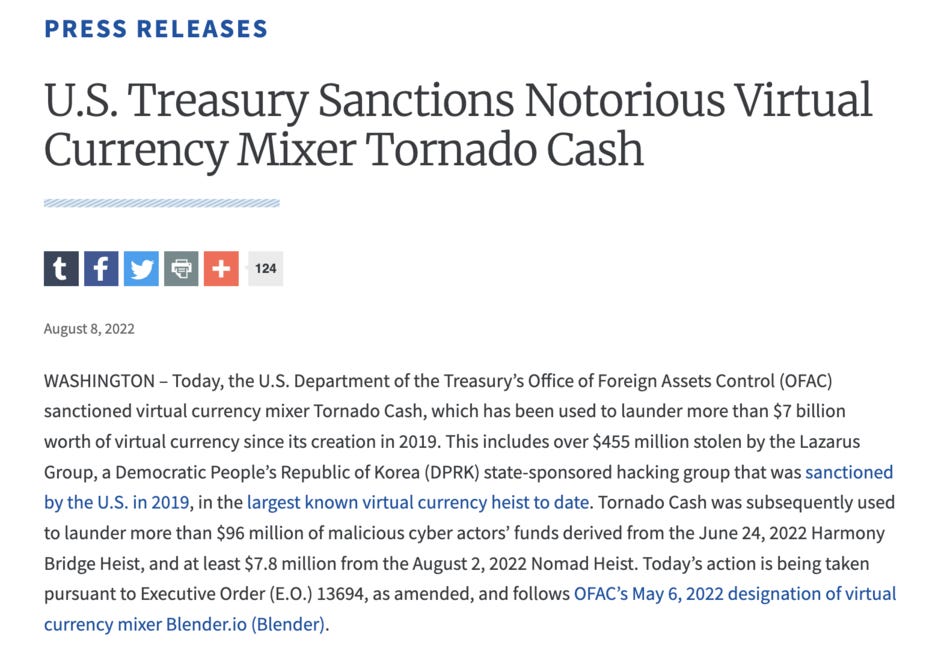
So far, the affected areas are:
1. Some Ethereum and USDC addresses and USDC assets that interact with Tornado Cash and are included in SDN
2. The Github code base and front-end official website of Tornado Cash are no longer accessible
Analysis of regulatory background
Background 1: The sanctions are more motivated by U.S. officials to ensure that financial sanctions against crypto hackers are effective
The sanctions were imposed by OFAC, an agency within the U.S. Treasury Department that enforces financial sanctions against overseas institutions and individuals. Its day-to-day work is not directly involved in the regulation of the crypto industry, but rather monitoring sensitive flows of money abroad while ensuring its sanctions are implemented. OFAC has been active in previous U.S. government sanctions against Iran, North Korea, Russia and even China's Huawei. It regularly publishes a well-known Special sanctions list (SDN) of people or organisations whose assets are frozen and with whom US citizens are often barred from dealing.
The sanctions on Tornado Cash follow OFAC's addition of Lazarus to the SDN list under the North Korea Sanctions Ordinance on April 14. North Korea's hacking program dates back to at least the mid-1990s and has grown into a 6,000-strong cyberwarfare unit, according to a 2020 U.S. government military report. Blockchain analytics firm Chainalysis said Lazarus stole nearly $400 million worth of digital assets in at least seven attacks on crypto platforms in 2021. In 2022, the group also launched an attack on Axie Infinity, capturing $625 million in assets including 173,600 Ether coins ($597 million) and $25.5 million worth of USDC. It was the largest decentralized hack to date. In the first half of this year, hackers transferred $1.14 billion in stolen assets to Tornado Cash, accounting for about 60 percent of all stolen assets in the same period, according to BEOSIN.
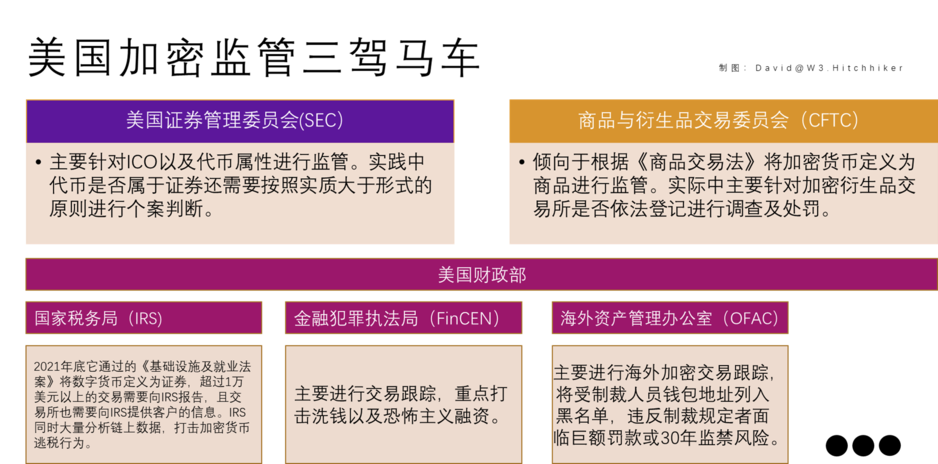
As shown below, in the "troika" of crypto regulation in the United States, the SEC and CFTC mainly determine the attributes of assets (commodities or securities?). , and conduct corresponding regulation on tokens that each considers to be securities or commodities; The Internal Revenue Service is mainly concerned with whether crypto transactions are taxable, FinCEN is mainly concerned with money laundering and anti-terrorism in the US, and OFAC is mainly responsible for implementing financial sanctions against overseas blacklisted institutions or individuals. All three require long-term tracking of on-chain transaction data, analysis and judgment, and accurate law enforcement.
Background 2: Crypto fund flow regulation and penalties are beginning to be put on an equal footing with traditional fund flow regulation
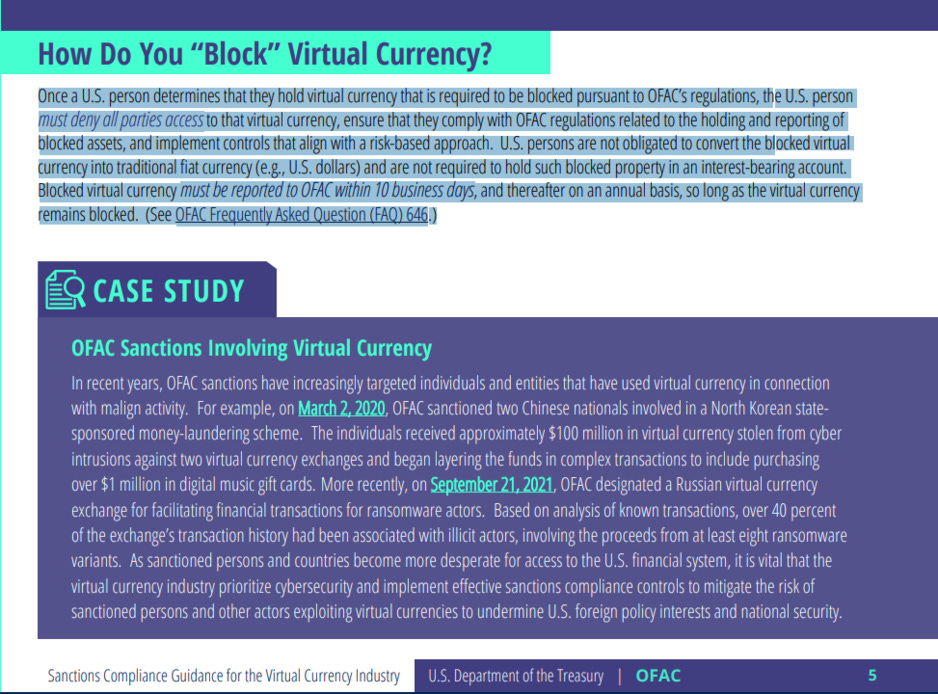
In 2021, OFAC published a book on the growing use of cryptographic protocols to move money around the worldA manual on virtual currency sanctions compliance guidelines, indicating that OFAC sanctions compliance obligations also apply to holders of virtual assets involving US citizens.
Americans must report to OFAC within 10 business days if they believe they hold sanctioned crypto assets.
Members of the crypto asset industry are responsible for ensuring that they do not directly or indirectly engage in transactions prohibited by OFAC sanctions, such as transactions with sanctioned persons or property, or engaging in prohibited trade or investment-related transactions. OFAC has the power to impose Civil Division OFAC sanctions for failure to comply.
Background 3: Penalties for privacy-enhancing technologies in crypto transactions have occurred many times before, and regulation of privacy technologies is expected to continue
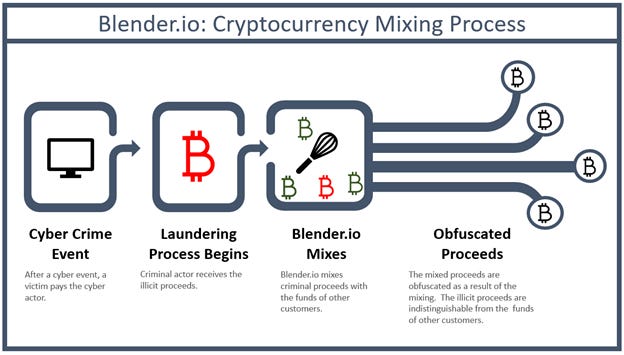
The growing trend is for criminals to use privacy-enhancing technologies, or operate on opaque blockchains. These privacy-enhancing assets or business services (mixers) help criminals hide the flow of money and where it comes from.
1. Privacy enhancing technologies pose challenges for investigators trying to track illicit gains. OFAC has pointed to the Monroe chain. USES:
2. Ring signature technology, used to hide the identity of the transaction originator;
3. Environmental protection technology is used to cover up the transaction amount;
Hidden address technology is used to mask the identity of the payee.
And the transactions were not broadcast to the Monroe blockchain, but were masked with one-time addresses.
For example,
- By the end of 2020, FinCEN will be ready to work on mixers & NBSP; Helix Larry Harmon, its founder, paid a $60 million fine for failing to legally register and helping to convert dark web drug-related funds into cryptocurrency.
- In late 2021, OFAC, working with the FBI, announced an investigation into a company called & NBSP; SUEX Said it deliberately "facilitates illegal activities" and said it would tighten regulation of mixers.
- In May, OFAC launched a new cryptocurrency hybrid service.Blender.io Imposed sanctions for helping Lazarus launder more than $20 million. An OFAC spokesman said this regulation of mixers would not be the last.
In fact, TORNADO.CASH tweeted in April that it would use Chainanalysis's predictor protocol to block OFAC-sanctioned addresses from accessing the platform. But Roman Semenov, co-founder of Tornado Cash, has said in an interview that imposing sanctions on decentralized agreements is "technically impossible" because of the way they are designed. Tornado uses smart contract deployment + zero-knowledge proof technology. Even if Github is blocked, the smart contract runs on Ethereum, and the contract code itself is publicly available on the Ethereum browser.

conclusion
Combined with the background of multi-headed regulation of the US financial system, regulators have their own roles, and the part involving the crypto industry in the process of legislation and enforcement often leads to over-interpretation of the industry.
OFAC is not unaware of the technical context in which decentralized smart contracts are at some level out of control, but given OFAC's enforcement requirements and Lazarus' current damage to the crypto ecosystem, relatively extreme measures may be necessary. The subsequent impact on the privacy track needs to be continuously observed.
The original link
Welcome to join the official BlockBeats community:
Telegram Subscription Group: https://t.me/theblockbeats
Telegram Discussion Group: https://t.me/BlockBeats_App
Official Twitter Account: https://twitter.com/BlockBeatsAsia