Interpretation of Coinbase Q2 financial report: net loss of 1.1 billion US dollars, continued huge expenditures are the main reason
Original title: "Detailed explanation of Coinbase's second quarter financial report: the number of users exceeded 100 million for the first time, with a record net loss of 1.1 billion US dollars"
Original author: Lin Qi & Gu Yu, chain catcher< /blockquote>
Coinbase announced its financial report for the second quarter of 2022 today. The net income for this quarter was approximately US$803 million, a decrease of 31% quarter-on-quarter and 63.5% year-on-year. The net loss was approximately US$1.1 billion, an increase of 250% quarter-on-quarter. After the quarter, it once again created the worst financial report record since listing.
After the news was released, the stock price of Coinbase fell 5% to $83 after hours, and it has fallen by about 25% since the high point in August. Coinbase's dilemma as a trading platform giant. So, what information does this financial report specifically reflect? How did such a huge loss come about? The chain catcher will be explained in detail below.
For a long time, trading income has been the main source of income for Coinbase, and it has long been criticized for having a single source of income, which is also the main source of the dismal quarter. According to the financial report, Coinbase’s trading revenue in the second quarter was US$650 million, a year-on-year decrease of 66%, and a quarter-on-quarter decrease of 35%. decline, especially for retail users.
In the second quarter, Coinbase's retail user trading volume fell 37.8% to $46 billion, contributing revenue to $616 million, and institutional user trading volume fell 27.2% to $171 billion, contributing to trading revenue down to $39 million. Coinbase further disclosed in the shareholder open letter that the average transaction revenue contributed by each retail user in the quarter was about $29, and the cumulative number of transaction users in the quarter reached 21.24 million.
In addition, As of the end of the second quarter, Coinbase's total verified users exceeded 100 million for the first time and reached 103 million, up 51% year-on-year, although the average monthly active users (MTU ) was 9 million, a decrease of about 200,000 from the first quarter. Average monthly active users refer to retail users who trade at least one or more products every month, including Token trading, pledged products, etc.
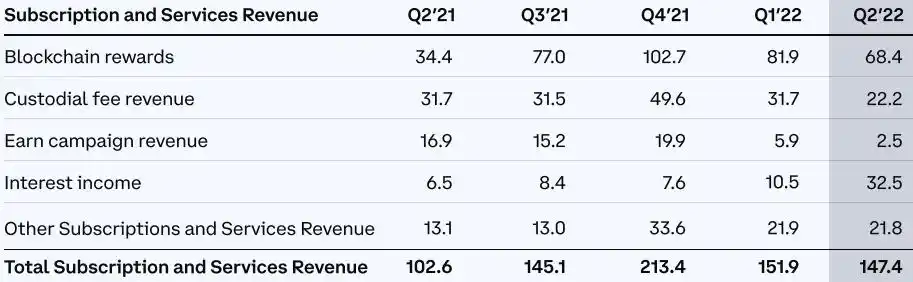
Coinbase stated that in the second quarter, monthly active users were more inclined to non-investment activities such as staking, of which 67% (about 6 million) of users participated in transactions including non-investment products. Reflected in the financial report, subscription and service revenue has become a bright spot with a small number of digits. In the second quarter, it achieved a revenue of 147 million US dollars, an increase of about 44% year-on-year, and only a decrease of 2.6% from the first quarter. It can be seen that Coinbase has diversified revenue. Some progress has been made in terms of commercialization, but the impact on overall performance is still relatively small.
Specifically, blockchain rewards (i.e. Token Pledge services) revenue was $68 million, up 98% year-on-year, but down 16% from the first quarter; custody fee revenue was $22 million, down 30% year-on-year; Earn activity revenue was about $2.5 million; down 97% year-on-year; interest Revenue was US$33 million, a year-on-year increase of 211%, mainly due to USDC-related activities and higher interest rates, which generated interest for custody funds of fiat currency customers; other subscription and service revenue was US$21.79 million, an increase of approximately 66% year-on-year. Some of that was primarily revenue from cloud services unit Coinbase Cloud.
The NFT market promoted by Coinbase in the second quarter did not contribute revenue because it did not charge users for the time being. However, according to the data of the Dune platform, the transaction volume in the past 7 days was only 200,000 US dollars, and the cumulative transaction volume was 635 Ten thousand dollars, the performance can be described as quite dismal.
High spending was one of the main drags on Coinbase's earnings. Coinbase said it took steps to streamline its operating cost structure during the second quarter, including realigning its hiring plan, optimizing vendor spend, increasing discipline in the deployment and measurement of marketing spend, and reducing short-term funding allocated to discretionary investments, However, judging from the public news, many of the initiatives took place in June and had limited impact on the overall financial situation in the second quarter.
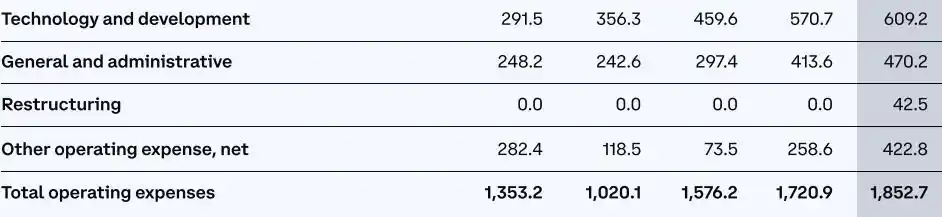
From the perspective of specific financial data, although transaction costs and marketing costs have been greatly reduced compared with the first quarter, by 40% and 30% respectively, expenditures on technology research and development, corporate management, etc. still increase to varying degrees. Overall costs rose to $1.85 billion.
Of which, technology and development expenses rose 110 percent to $609 million. Coinabse explained that part of the expense was due to a $172.4 million increase in personnel-related expenses (including $129.7 million in stock-based compensation expenses) and an $84 million increase in software and services costs.
General and administrative expenses also rose 89% year-over-year to $470 million, Coinabse explained, including a $121.5 million increase in customer support costs due to increased capacity, temporary labor to support customer experience and compliance and Increased need for managed services; personnel-related expenses, excluding customer support, increased $59.8 million; professional services expenses increased $29.9 million, primarily due to increased business process and acquisition advisory services, as well as litigation, regulatory and compliance-related expenses Increased legal costs.
Other operating expenses rose 50% to $420 million, related to total impairment charges on crypto assets held during the quarter, net of any recoveries, of $377 million.
Additionally, conference events and sponsorship expenses increased by $25.6 million during the quarter and impairment charges recognized for certain strategic equity investments increased by $69.3 million. Coinbase also stated that the platform has no significant volume exposure or counterparty exposure related to the LUNA, Three Arrows Capital, Celsius, and Voyager liquidation events.
It’s worth noting that Coinbase added a “restructuring” expense to its operating costs, accounting for $42.5 million, driven primarily by separation salaries and other post-employment benefits. Due to the rapid expansion of Coinbase's personnel in the first half of this year, in May this year, the company said for the first time that it would slow down its recruitment and reassess its talent needs based on its priority business goals. On June 14, Coinbase announced an 18% layoff. In this financial report, Coinbase disclosed that it has laid off about 1,100 people, but as of June 30, the company still had 4,977 employees.
In terms of other data, as of June 30, Coinbase held a total of $102.1 billion in liquid assets, including $95.6 billion in assets held by customers, and $5.6 billion in cash and cash equivalents. Generated cash flow of $1.5 billion. From the perspective of currency, the transaction volume of Bitcoin rose from 24% in the first quarter to 31% in the second quarter, while other assets declined to varying degrees.
Furthermore, Coinbase said it had updated its retail user agreement in June to clarify the applicability of UCC Section 8 to custodial crypto assets. According to this regulation, the financial assets held by Coinbase are not the property of Coinbase and are not subject to the claims of its general creditors. Previously, in May of this year, Coinbase stated in a document submitted to the SEC that in the event of bankruptcy, the encrypted currency assets held by the trading platform may be regarded as the property of the bankruptcy process, and customers may be regarded as general unsecured creditors. caused massive criticism from the industry.
Coinbase has also made further forecasts for this year's financial data based on July data. Since the monthly active users in July fell to around 8 million, Coinbase predicts that the monthly active users will decline further in the next quarter, and the MTU ratio of non-investing users will be higher than that of investing users, and the average retail revenue contribution revenue is expected to drop to 20. USD or less. In addition, Coinbase expects sales and marketing expenses to be about $100 million, and research, management and other expenses are expected to be about $1 billion in the third quarter, including about $400 million in stock compensation.
Coinbase aims to limit its potential adjusted EBITDA loss to around $500 million for the full year in 2022, but lost $151 million in the second quarter alone. It is clear that it is in a stressful market environment, but based on the fee management measures it took in the second quarter, Coinbase said it is still cautiously optimistic.
Previously, Binance.US announced that it would allow users to trade spot bitcoin in USD, USDT, USDC, and BUSD without paying spot transaction fees. Robinhood and FTX US are both trying to launch zero-commission trading services. From the transaction data of Coinbase retail users described above, it can be calculated that its comprehensive transaction fee rate exceeds 1%, and its attractiveness and progress to retail users are significantly weaker than competitors.
At the same time, Coinbase said it had received investigative subpoenas and requests from the U.S. Securities and Exchange Commission, suspected of allowing Americans to trade unregistered "securities," requesting documents and information about certain customer plans, including the company's listing process , the classification of certain listed assets, its pledge plan and its stable currency and income-generating products, which will also affect the pressure of Coinbase’s business operation and expansion to a certain extent.
In general, due to the "multiple-pronged" pressure from Terra and Three Arrows Capital in the second quarter, retail users and institutional users suffered substantial asset losses and a decline in transaction willingness, and the aggressive market expansion plan was unable to quickly " Braking”, leading to further expansion of the negative state in the second quarter.
Coinbase stated that since the second quarter, the platform has been focusing on five areas of development, Coinbase Retail App, Coinbase Prime, staking functions, developer solutions (products) and Web3. Coinbase believes the current cycle is unique and may not be over yet, but believes it has the key attributes to win in these market conditions and become a leader in Web3.
In the end, though, it's all about the data. The following third quarter is a critical period to reflect the effect of Coinbase's response strategy.
Original text link
Welcome to join the official BlockBeats community:
Telegram Subscription Group: https://t.me/theblockbeats
Telegram Discussion Group: https://t.me/BlockBeats_App
Official Twitter Account: https://twitter.com/BlockBeatsAsia



 Related Articles