Messari: PoPW has the potential to ignite the next bull run

Original title: "Using Crypto to Build Real-World Infrastructure"
Original author: Sami Kassab, Messari
Original translation: Cookie, Chain Catcher
Summary
Proof of Physical Work (PoPW) is a novel Token distribution mechanism that rewards participants for completing verifiable physical work in the real world.
Many protocols are using the proof of physical work framework to incentivize supply-side participation in building hardware networks. These include wireless, mobile, ambient, computing, and storage networks.
Cryptoeconomic protocols are very powerful in incentivizing and coordinating human activities, making them very useful for developing real-world decentralized infrastructure and hardware networks.
Using a physical proof-of-work framework, protocols can incentivize participants to build their networks in a way that users find attractive.
Amid the market decline, cryptocurrency critics have become active, attacking whether the industry has any real use cases. Beyond innovation in capital formation and use cases for non-sovereign currencies, removing middlemen, and breaking up monopolies, their arguments seem to make sense. But in reality, crypto protocols have been so successful in coordinating activities in the digital realm that projects have begun using crypto for real-world infrastructure.
Cryptoeconomic protocols can incentivize the development of real-world infrastructure and hardware networks through the coordination power of blockchain technology. Rather than relying solely on a single centralized entity, millions of individuals can band together to deploy and operate infrastructure in a trustless, permissionless, and programmatic manner.
Multicoin Capital calls this mechanism Proof of Physical Work (PoPW). PoPW rewards users for performing verifiable physical work, such as deploying 5G hotspots. The protocol algorithm verifies the state of the device and rewards the owner according to a set of predetermined rules. Many PoPW protocols are already coordinating hundreds of thousands of participants around the world, covering wireless networks, mobility, environment, computing and storage.
Physical Proof of Work
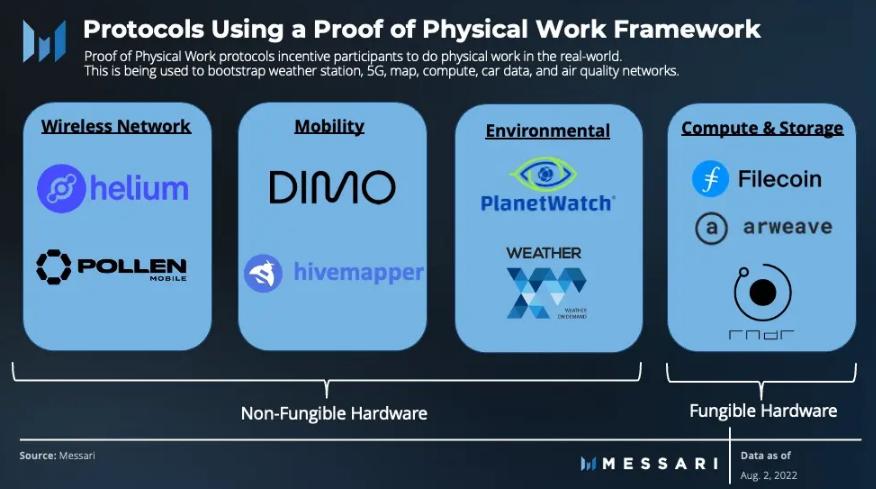
There are two main types of infrastructure networks: fungible and non-fungible. Fungible infrastructure networks use hardware devices that are location agnostic. Compute and storage protocols fall into this category because their services do not depend on where the server/node is hosted. 1 TB of storage in Hong Kong is exactly the same as 1 TB of storage in Singapore. The location of wireless hotspots is important, which defines it as a non-fungible infrastructure network.
Many communities are building in the PoPW space, many of which are still in the early stages. Most of these protocols build applications on top of existing L1. So far, applications in the PoPW track can be divided into the following categories:
Wireless Networks
Logistics Networks
Natural Environments
Computing and Storage
Wireless Networks
Helium and Pollen Mobile are two well-known protocols operating in the decentralized wireless (DeWi) space. Helium currently consists of IoT and 5G networks, and Pollen Mobile focuses on 5G. These protocols incentivize supply-side participants (hotspot operators) to provide network coverage in exchange for Token rewards. In addition, participants also earn fees for routing data through their hotspot services.
Logistics Networks
Logistics networks refer to the industry of transporting people and goods, and two emerging networks in them are Hivemapper and DIMO. Hivemapper is a decentralized map built by participants using dashcams. The protocol rewards supply-side participants (map miners) for driving or using dashcams to move around and contribute to the network map.
DIMO allows users to own their mobility data to provide services in areas such as car finance, insurance, maintenance, etc. Supply-side participants (data miners) are rewarded by connecting hardware devices to their cars and contributing that data to the network.
Natural Environment
WeatherXM is a decentralized weather network powered by a distributed network of hardware devices. It allows supply-side participants (weather station operators) to earn rewards by deploying small weather stations and providing accurate weather services. PlanetWatch is a decentralized global air quality sensor network. The protocol rewards supply-side participants (sensor operators) for streaming real-time air quality data back to the network.
Compute and Storage
The Compute and Storage category includes the most mature protocols in the PoPW space in terms of network usage and revenue. Filecoin and Arweave are storage networks with different models. Filecoin uses a contract-based storage model, while Arweave uses a permanent storage model. Both protocols incentivize supply-side participants (storage providers) to dedicate physical storage drives to store data in exchange for Token rewards. Render Network is a distributed GPU rendering platform. Its Token economics is designed to reward supply-side participants (node operators) for dedicating GPU hardware to the network and completing rendering work.
Why use blockchain?
Because large physical networks require large capital injections and complex guarantee systems, they usually require large companies to build. This usually results in a small number of companies controlling the pricing structure and conditions for users, making it impossible to form a free market.
Cryptoeconomic protocols solve this problem completely, allowing globally distributed individuals to collectively bootstrap a network in a permissionless and trustless manner. This is a more cost-effective solution by collectively building and maintaining the network and distributing the benefits entirely to supply-side participants.
The decentralized storage platform Filecoin is an example of the benefits of using a decentralized blockchain approach. Storage providers on Filecoin are rewarded with tokens for providing storage capacity to the network, as opposed to centralized infrastructure approaches such as Amazon S3, and the network has grown to over 17 EiB in two years. Additionally, Filecoin does not charge a high fixed rate, but allows market participants to set the price of storage.
In an article by Evan Conrad, he highlights how if Filecoin were a centralized entity, it would be inclined to take a share of the network's revenue. As the network becomes more popular, Filecoin's network effect continues to grow. In the case of Filecoin right now, all value is attributed to the protocol, making it "the cheapest commodity market, where no middleman gets a cut of the pie."
Benefits of using crypto for infrastructure
As Tushar Jain, managing partner at Multicoin Capital, describes it, there are two benefits to using cryptoeconomic protocols for infrastructure networks: the ability to scale the network quickly around the world, and a system that is owned by all participants, rather than a small group of shareholders.
Cryptoeconomic protocols allow users around the world to build permissionless networks in parallel. Participants can also focus on deploying infrastructure that meets local market needs. In exchange for building the supply side of the network, participants receive an ownership stake in the network, which incentivizes them to grow the network.
While the above protocols allow individuals to contribute to the network and earn passive income, they also open the door to franchise-like businesses. Mike Zajko, co-founder of Lattice Capital, describes the entrepreneurial opportunity:
Participating in these networks looks a lot like opening a franchise, with the franchise being a significant portion (more than 10%) of the larger economy. You need some startup capital, physical real estate, some operational know-how, and then the community and protocol help take care of the rest.
Hexagon Wireless is one such franchise operating in the DeWi space. The company is currently using their technical expertise and proprietary relationships to deploy hardware for the Helium and Pollen mobile networks, accelerating the growth of DeWi.
Economic Model
Token incentives play a very important role in building real-world infrastructure and solving coordination problems. Helium has proven this theory over the past year or so. It has expanded the IoT network from 30,000 to more than 900,000 physical hotspots in 170 countries by providing rewards to hotspot deployers.
To start the economic model, the project first needs to provide users with rewards for completing verifiable physical activities in the real world:
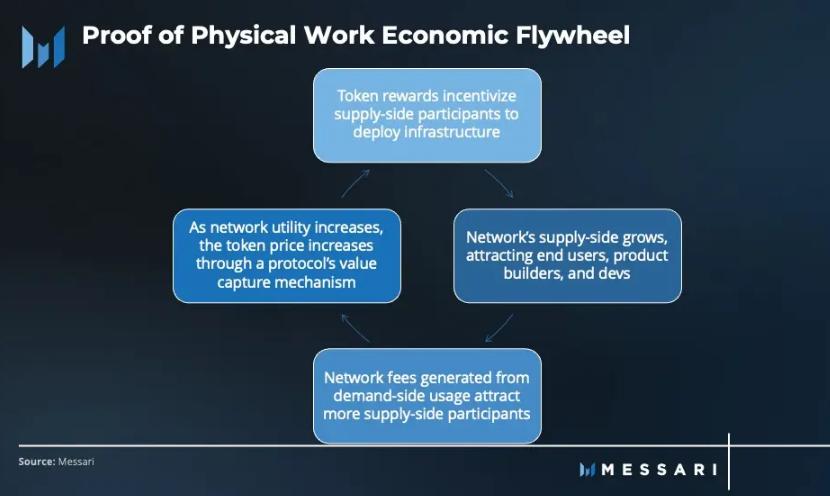
Supply-side participants are incentivized by inflationary Tokens, with the goal of developing specific activities required for the network. These rewards serve as subsidies to supply-side participants. Rewards often support participants building the network until the network begins to generate sustainable fees from demand-side usage.
As the network grows, developers and product builders are attracted to the network. Additionally, the protocol’s subsidies to its supply-side participants allow them to offer cheaper services, helping to attract more users.
End users begin paying for network services, which can increase revenue for both supply-side participants and the protocol. This creates a positive feedback loop that can attract more supply-side participants and investors.
Value is typically captured through a (burn-mint) supply equalization (BME) model or a work token model. As network utility increases, supply is either burned through a BME model or staked by service providers through a work token model, and the reduction in circulation drives up token prices. Rising token prices re-attract more supply-side participants, creating a virtuous cycle.
PoPW’s economic model fundamentally solves the chicken-and-egg dilemma. Using token rewards, protocols can incentivize participants to build the supply side of the network to a point where it is attractive to users. This is the initial impetus for crypto protocols to compete with Web2 companies.
Final Thoughts
Physical Proof of Work represents a novel token distribution mechanism. Tushar Jain believes that a new Token distribution mechanism could trigger the next bull run.
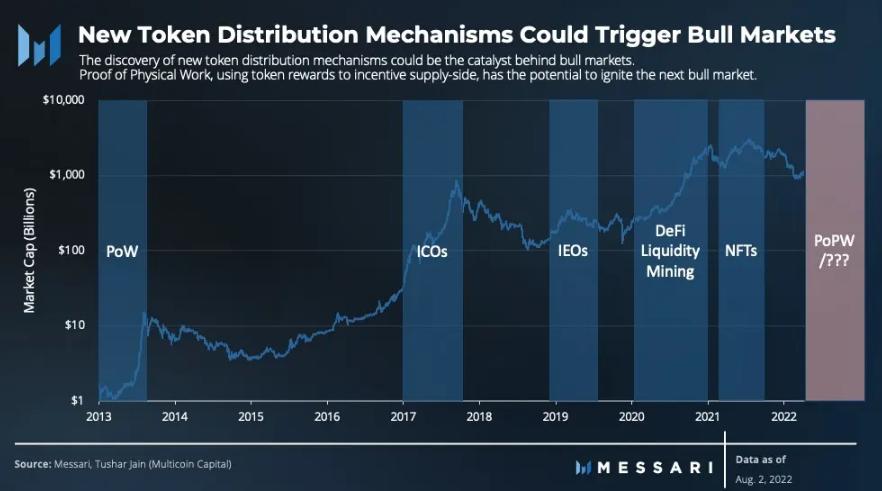
According to statistics, the time points of changes in the Token distribution mechanism include: PoW Token in 2013, ICO in 2017, IEO in 2019, DeFi liquidity mining in 2020, and NFT in 2021. Each new Token distribution mechanism coincides with a bull run. If the argument is correct, the next successful Token distribution mechanism could bring about a bull run. Given the success of Proof of Physical Work in various fields and its ability to provide value by building global infrastructure, PoPW is likely to ignite the next bull run.
Original link
Welcome to join the official BlockBeats community:
Telegram Subscription Group: https://t.me/theblockbeats
Telegram Discussion Group: https://t.me/BlockBeats_App
Official Twitter Account: https://twitter.com/BlockBeatsAsia