Continuous collapse of Ponzi schemes: Reflections on the CeFi crypto lending market model

Original title: "Continuous Collapse of Ponzi Schemes: Reflections on the CEFI Crypto Lending Market Model"
Original author: David, W3.Hitchhiker
Note: Recently, crypto lending platforms have suspended redemptions one after another, causing panic among crypto market participants and a sharp drop in the crypto market. This article explains the inevitability of such platform collapses, how to avoid such Ponzi schemes in the future, and the possible direction of DeFi in the future by sorting out the core models and actual operation of centralized crypto lending platforms.
I. What is Crypto Lending
Crypto lending is a novel financial instrument that can quickly obtain liquidity and allows cryptocurrencies to be pledged to obtain loans. Crypto lending platforms generally also provide deposit services. Depositors can earn interest income by depositing cryptocurrencies into deposit accounts. The platforms also attract crypto deposits by offering deposit yields higher than market interest rates (generally 4-12% annualized interest rates).
Crypto lending platforms generally provide loans to institutions or individuals in the form of over-collateralization on the platform. They also provide over-collateralized loans to institutions involved in crypto trading such as trading platforms, market makers or hedge funds in the OTC market that require immediate financing (leverage trading or short selling, etc.).
Crypto lending does not require a credit investigation of the borrower (but may involve varying degrees of identity verification and source of funds review), but the borrower needs to pledge the cryptocurrency to the lender, who generally deposits the collateral into an escrow account after receiving it. This is different from P2P lending, which is generally a credit loan for a certain project and generally does not involve collateral.
2. Overview of the centralized crypto lending market
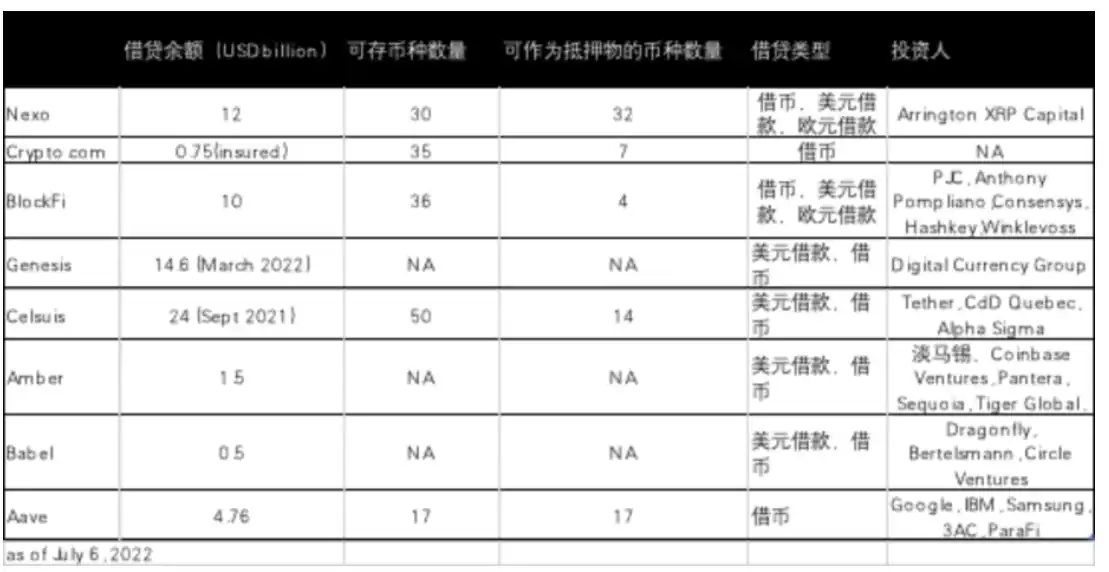
In 2020 alone, the assets under management of the three major CeFi lending platforms increased by 734%. Celsius and BlockFi each hold more than $4 billion in assets, and Nexo has about $2 billion in assets under management. The three major CeFi platforms have a total of nearly $7 billion in assets locked on their platforms.
3. The role of crypto lending
Promoting market arbitrage behavior:
Cryptocurrency is still an emerging asset class with low market liquidity, which leads to high volatility in cryptocurrency prices. Lack of liquidity often creates arbitrage opportunities, for example, if different cryptocurrency trading platforms have different liquidity levels, there are different trading prices at the same time.
Crypto lending provides liquidity to institutional investors such as hedge funds, crypto trading platforms or market makers, allowing them to take advantage of these arbitrage opportunities to earn the difference. The more market participants participate in arbitrage transactions, the smaller these arbitrage opportunities will be, and the more efficient and stable the entire crypto market will become.
Providing liquidity to crypto institutions:
Due to the relatively lagging supervision, institutions involved in crypto activities such as miners or crypto investment institutions find it difficult to obtain liquidity through the traditional financial system. Many cannot even open bank accounts and can generally only obtain liquidity through crypto lending.
As cryptocurrencies are gradually recognized by regulators and their value is determined at the legal level, the application scenarios of crypto lending will inevitably expand. In 2022, more and more CEFIs or traditional financial institutions began to accept margin loans with BTC as collateral, such as the $250 million loan from Silvergate Bank to MicroStrategy. But overall, the window for crypto institutions to obtain US dollar liquidity is still narrow.
Improved the efficiency and inclusiveness of financial resources:
Due to the technological attributes of crypto lending itself and the digital attributes of collateral, multiple transactions and businesses can be quickly processed in a short period of time, which has huge efficiency advantages compared to traditional financial institution lending. At the same time, on-chain crypto lending eliminates the need for credit assessment of borrowers, recognizes coins instead of people, and improves the inclusiveness of financial services.
Four, general terms of crypto lending and the current situation of CEFI
By combing through the general terms and conditions of crypto lending on platforms such as NEXO and BlockFi, the following characteristics can be found:
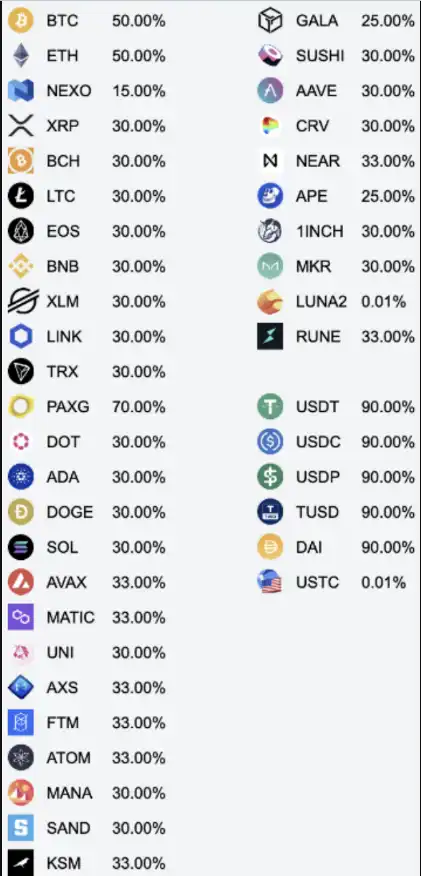
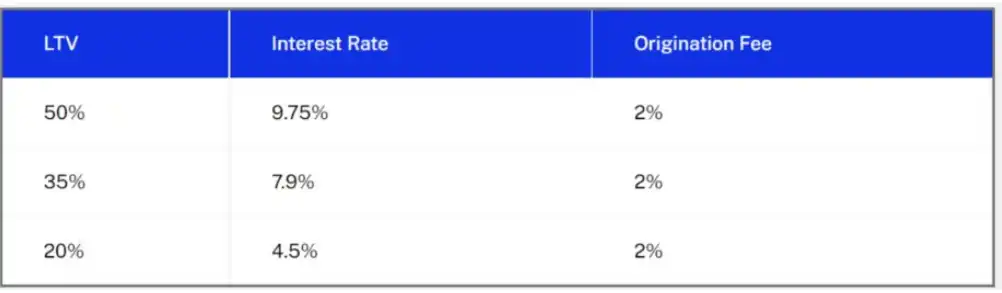
1. The value of the loan is determined by the LTV (Loan-to-Value) given on the platform. The value of the collateral is calculated by the platform based on market prices and relevant policies.
2. The platform owns the ownership and all joint and several interests of the collateral during the outstanding period of the relevant loan, and can dispose of the collateral in any way at its own discretion. This is controversial because in the general rights and obligations of mortgage loans, the lender only obtains the security right rather than the ownership of the collateral, and the security right is generally subordinate to the creditor's right.
3. If the LTV increases to exceed the maximum allowed value, the platform should liquidate the necessary amount of collateral to return the LTV to a normal level after notifying the customer as far in advance as possible. Due to the volatility of the digital asset market, customers need to understand that it may not be technically possible to notify in advance before the relevant liquidation, and customers are solely responsible for monitoring the current market conditions at any given time and maintaining the collateral ratio at a normal level in full accordance with these general terms.
4. Regarding the determination of LTV, the current (Monday, July 4, 2022) NEXO and BlockFi web pages show the following:
5. The calculation method of crypto loans is based on compound interest.
According to the US SEC's investigation of BlockFi in February 2022, since the launch of BlockFi's certificate of deposit service BIA on March 4, 2019, BlockFi stated on its website and multiple promotional materials that its institutional loans are "usually" overcollateralized and the LTV is less than 50%.
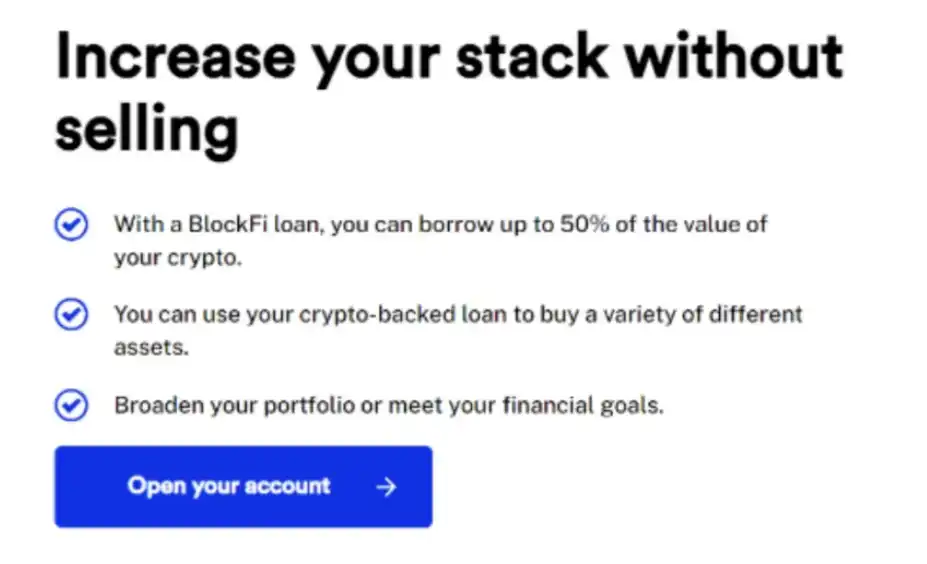
In fact, the LTV used in most institutional loans is higher than this number, because institutional investors are usually unwilling to provide over-collateralization, and the lending market is highly competitive, and platforms usually have to relax collateral requirements to obtain business. According to SEC survey data, about 24% of institutional crypto asset loans were over-collateralized in 2019; only about 16% were over-collateralized in 2020; and about 17% were over-collateralized in the first half of 2021.
In practice, the collateral ratio is much higher than the requirement, which makes the core risk control measures become a decoration, and the risk level of the entire lending asset is greatly increased: a slight fluctuation in the price of the collateral will cause the entire asset to face liquidity risk. This arrangement also makes individual investors actually bear more risks.
五、通用条款 of Crypto Deposits and Current CEFI Situation
By combing through the deposit terms of relevant platforms, the following features can be found:
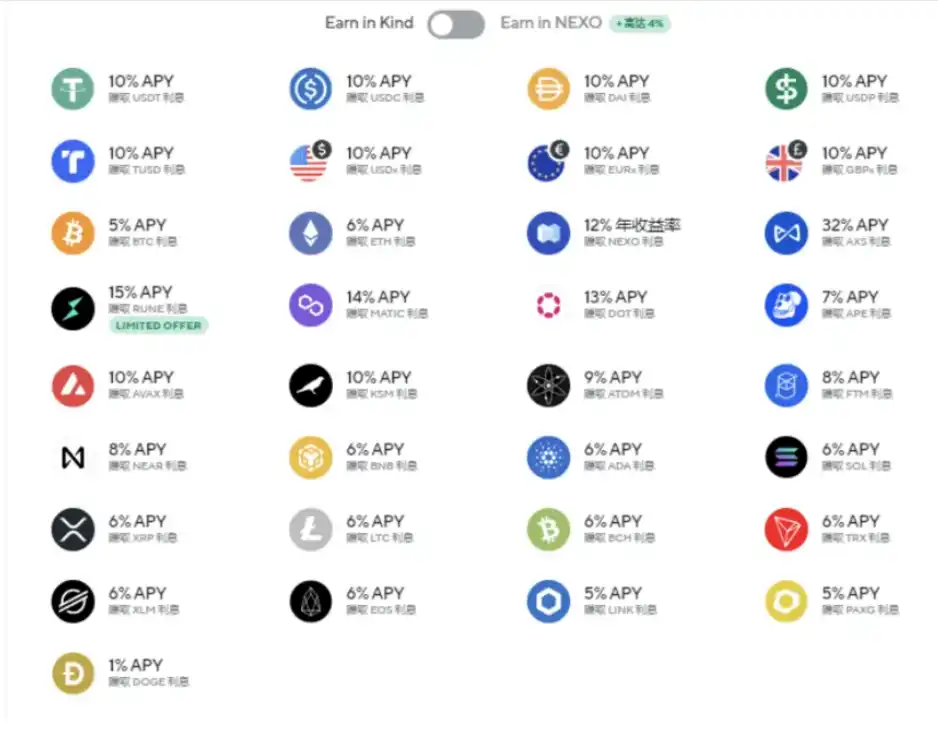
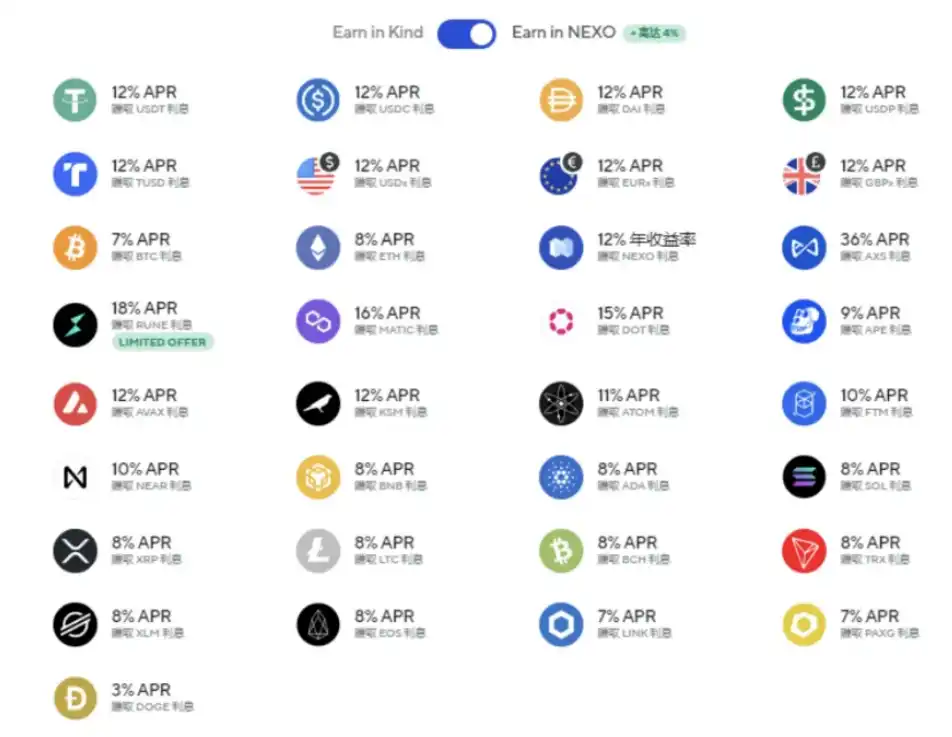
1. Users can choose fixed deposits or demand deposits. Fixed deposits can be used as additional collateral when LTV is insufficient. Interest can be paid in the deposit currency (compound interest) or in the platform token (simple interest), and the two can be switched at will (taking NEXO as an example). If the user chooses to use the platform Token as interest income, the platform will provide additional interest income as an incentive. Users can deposit or redeem products at any time. Generally speaking, similar platforms will attract customers through high yields (as shown below). This picture was captured on July 4, 2022. Although many platforms have collapsed, NEXO still puts this high-yield gimmick on its official website.
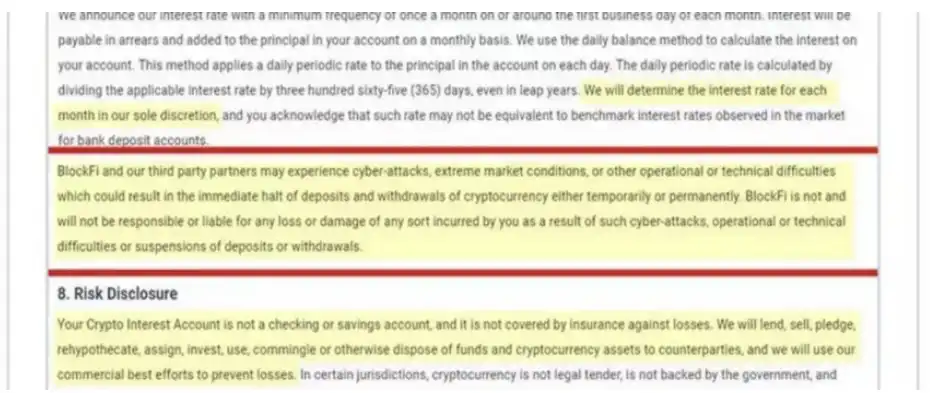
2. BlockFi also clearly states in the terms of its deposit account that it is not responsible for any financial losses caused by cyber attacks or technical problems. For a company that operates technology (at least that's what they claim), such a disclaimer is a bit strange.
3. Based on the characteristics of the deposit certificate itself, that is, an investment contract sold to the public that can bring expected monetary returns, the US SEC sent a regulatory letter to BlockFi on February 14, 2022, stating that its deposit certificate is essentially a security. BLOCKFI currently states in the notes section on its website that BIA is not a bank or securities account and therefore will not be protected by regulation.
4. From March 4, 2019 to the present, BlockFi has offered and sold BlockFi accounts BIA to investors, through which investors lend crypto assets to BlockFi in exchange for the interest income it promised. According to the SEC, BlockFi "tout" in its advertisements that BIA balances of up to 25 bitcoins or 500 ethers (equivalent to approximately $100,000 and $70,000, respectively, at the time) would earn an annualized return of 6.2%, and all balances exceeding this limit would earn a tiered interest rate of 2.0% annualized return. However, the SEC found that as of November 1, 2021, the interest rate actually paid by BlockFi to investors ranged from 0.1% to 9.5%, depending on the type of crypto assets and the size of the investment. The benefit to depositors is that they can redeem the deposit at any time.
Six, Ponzi scheme operation?
The current CEFI model can be simply compared to a fund pool/fund pool business. The fund pool is a long-standing non-compliant financial business familiar to domestic investors. It is an illegal act of absorbing funds by means of high interest deposits on the fund raising side. The asset side takes advantage of the opaque nature of the asset pool itself to move assets within the pool and artificially match risks and returns, causing huge systemic financial risks.
According to domestic financial institution regulatory documents, the wealth management pool can be defined as "an irregular fund pool business refers to multiple wealth management products of different types and different maturities corresponding to multiple assets at the same time, and it is impossible to achieve separate accounting and standardized management of each wealth management product."
This type of fund pool business generally continues to raise funds by rolling out multiple wealth management products of different maturities to maintain a balance between the source of funds and the use of funds. The funds are invested in a variety of assets including bonds, bills, trust plans, etc. Fund pool financial products usually have the characteristics of "continuous issuance, collective operation, maturity mismatch, and separate pricing". At the same time, in order to ensure smooth fundraising, the fund pool usually also has the characteristics of high-interest deposit collection.
**Continuous issuance and high-interest deposit collection:**Continuous issuance refers to the continuous issuance of financial products for fund raising. Judging from the deposit terms of most CEFI platforms at present, users can deposit or redeem Token at any time, and some can even change the interest calculation method at any time. At the same time, as mentioned above, most platforms have the situation of attracting investors with high yields.
**Collective operation:**Collective operation refers to the collection and management of raised funds, which are uniformly applied to collective asset packages composed of various target assets that meet the investment scope of this type of asset pool. The operating income of this asset package is used as a unified source to determine the income of each product. According to the SEC's investigation, BlockFi opens BIA accounts to investors in exchange for capital investment in the form of crypto assets. BlockFi pools the crypto assets of BIA investors and uses them for lending and investment, with investment income and interest income shared by BlockFi and BIA investors. According to the Texas Securities Association, Celsius also "uses the cryptocurrencies deposited by investors in interest-bearing accounts for free, mixes coins from various sources, invests in traditional financial assets and crypto assets, lends to institutional and corporate borrowers, and engages in any other activities determined by Celsius at its discretion." The biggest problem with collective operations is the opacity of operations, which provides a stage for high-risk operations and profit transfer.
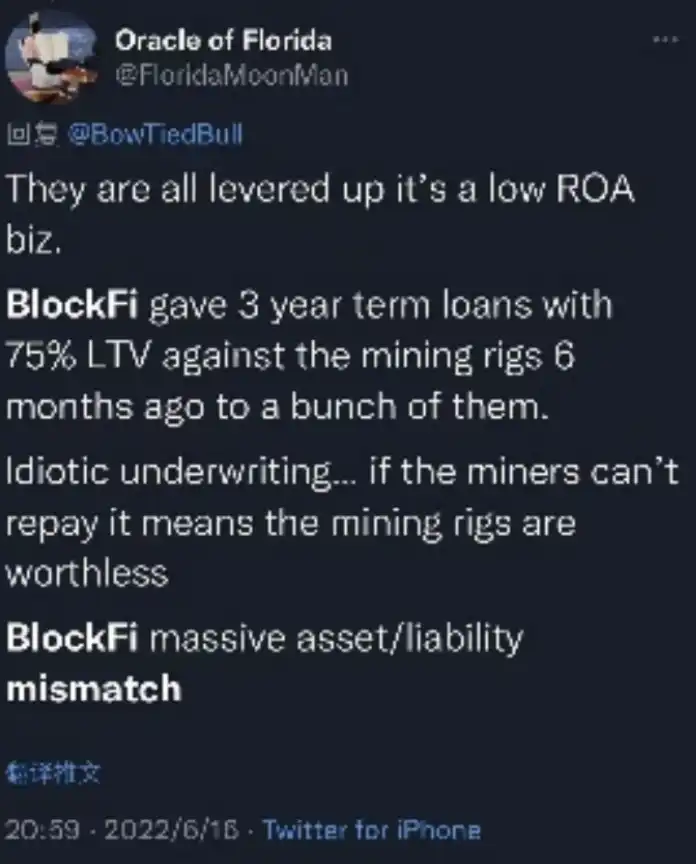
**Maturity mismatch:**Maturity mismatch refers to the term of the source of funds in the asset pool, which is not exactly the same as the term of the fund user (collective asset package). Maturity mismatch, especially the long-term nature of the asset side, coupled with the short-term nature of the liability side, makes it easy for institutions to stampede, which in turn causes market panic, and the platform can only announce the freezing of withdrawals/withdrawals. The figure below shows that market rumors say that BlockFi has engaged in long-term (3-year) borrowing at a very high LTV.
Celsius's investment in stETH and WBTC, Three Arrows Capital's investment in Grayscale Trust shares, and the investment of such asset pools in the primary market are typical liquidity crises caused by maturity mismatch. Most of the funds raised by the CEFI platform are current accounts and can be redeemed at any time, but its investment is a long-term investment.
**Separate pricing: **Separate pricing refers to the income level of various wealth management products issued by the same asset pool. Generally, it is not directly linked to the actual income of the collective asset package during the survival period of the wealth management product, but is separated and priced according to the expected maturity yield of the collective asset package. This pricing method will cause a mismatch between the actual risks and returns of customers and BlockFi. The figure below is an example of Bitconnect. The more funds a user puts in, the higher the "guaranteed" interest rate and the shorter the payback period. Its interest rate is not linked to the actual income of the underlying assets.
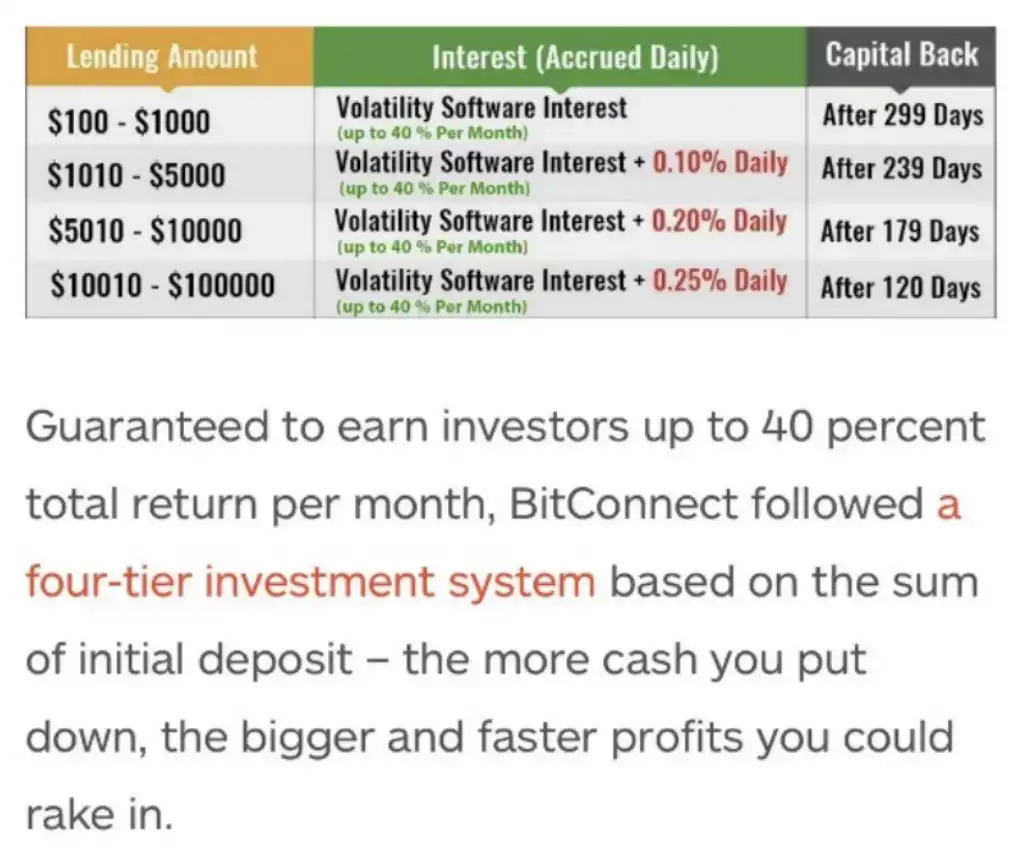
Separate pricing also leads to inadequate risk pricing, forming a so-called "death spiral" in a down market. Institutions have to invest in investments with higher returns because they promise high returns. Similar to the collapse of luna, market sentiment towards these high-risk crypto projects has cooled sharply, and Celsius has faced redemption pressure. As of May 17, the value of assets locked on the Celsius platform has shrunk sharply from more than $28 billion at the end of December to less than $12 billion. In the case of an overall decline in DeFi yields, Celsius had to take some high-risk operations in order to meet the 17% yield promised to customers.
As a result, Celsius has used its customers’ Tokens to participate in some high-risk projects that have suffered from collapse one after another:
It lost $120 million in the BadgerDAO hack in December last year;
In the Luna incident in May, the company withdrew $500 million in UST on Anchor (avoiding losses);
The tilt of the stETH/ETH pool may cause the company to face liquidity risks.
Especially when the overall crypto market fell and customers rushed to exchange BTC or ETH, they found that the company had suspended the withdrawal and transfer functions, which exacerbated the panic.
It can be seen that the crypto lending platform that is currently in trouble has the above four characteristics at the same time, and is a typical Ponzi scheme.
At present, it seems that without effective supervision, the operation of CEFI has inherited the Ponzi scheme model in traditional finance, becoming a hotbed for non-compliant financial operations, posing a major threat to the further development of the crypto ecosystem.
So will the situation improve when DeFi deals with these problems? The answer is yes. In the actual execution process, DeFi's smart contracts solve the problems of opacity on the asset side and counterparty risk (trustlessness), and effectively slow down the accumulation of financial risks.
However, as to whether the collective operation of funds will eventually be formed and effective risk pricing will be formed, no project has yet formed a solution to this problem.
Eight, is the thunderbolt over now?
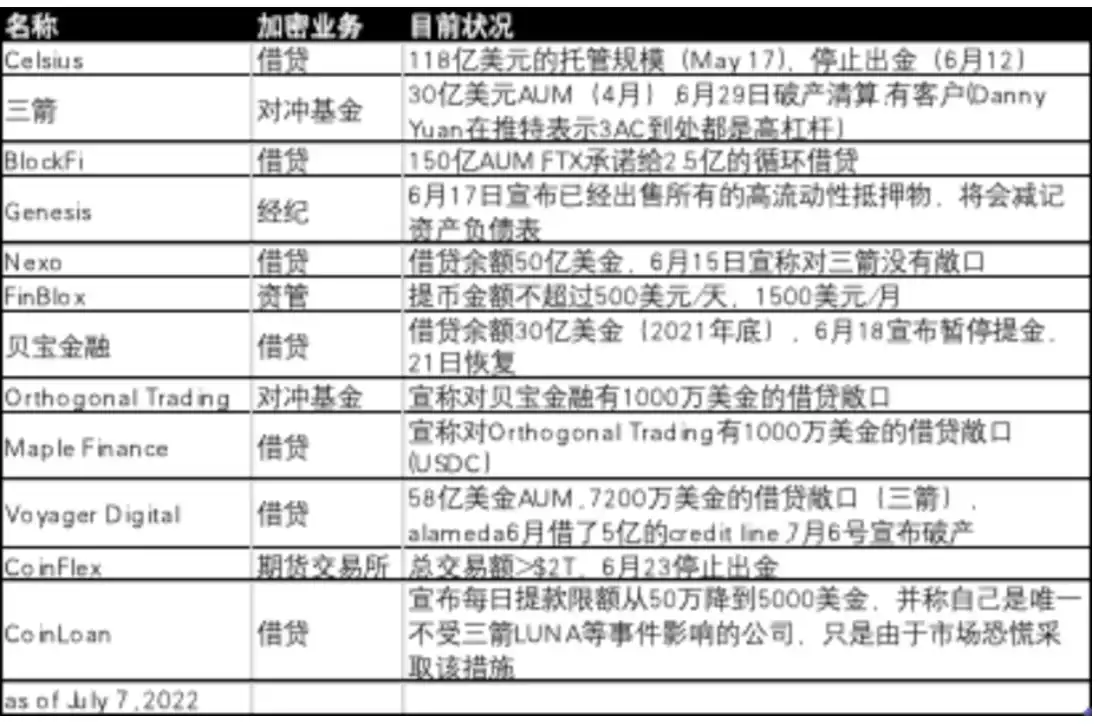
On June 29, Three Arrows Capital announced bankruptcy and liquidation. Three Arrows Capital is currently one of the largest lenders and customers in the global crypto lending market. Almost all the institutions in the figure have business dealings with Three Arrows (except NEXO and CoinLoan have claimed that they have no exposure to Three Arrows). The bankruptcy and liquidation of Three Arrows will have a chain reaction on the market. A large number of institutions will be forced to bear losses, write down their balance sheets, or even file for bankruptcy directly.
On July 6, Voyager Digital, which has 3.5 million users, declared bankruptcy. The company managed $5.8 billion in assets. It is highly likely that there will be further liquidation actions in the crypto market in the future.
Original link
Welcome to join the official BlockBeats community:
Telegram Subscription Group: https://t.me/theblockbeats
Telegram Discussion Group: https://t.me/BlockBeats_App
Official Twitter Account: https://twitter.com/BlockBeatsAsia